The concept of the “great actor” functions as a type of myth. Great actors are like Greek gods. They have human desires and flaws, but they remain above us, always, visitors from some wondrous realm.
Perhaps it’s an accurate description of certain gifted individuals, like Bernhardt. Or perhaps it’s suggestive of the role these individuals fill in popular culture. (It’s curious that we’re only allowed one or two great actors per generation. Too many gods is equivalent to having no gods. The currency must not be debased.)
Susie Lindeman’s Sarah Quand Même presents Bernhardt’s life. Bernhardt recalls to her granddaughter key events. Lindeman performs both roles, and if you were to cast someone as a great actor, she’s your choice. Lindeman’s vocal performance and physicality are superb.
Lindeman has also written the piece (for the anniversary of Bernhardt’s death). She tells a fascinating tale of Bernhardt’s glorious resilience. Quand Même means “despite all” or “no matter what”. Bernhardt was a superstar, and like anyone who mounts the monster of fame, the ride has its moments.
In a particularly poignant choice, Lindeman uses as a motif Bernhardt’s description of the audience as “the monster”. If you have gods, there will be monsters; and perhaps it’s only the gods who can tame them. I would’ve loved to have seen more of Bernhardt the actor, the god who tamed the monster, perhaps a speech or two from the great classics, a sample of her extraordinary ability. Lindeman could do it. Instead, we must be satisfied with review quotes that expound Bernhardt’s talent, and we all know what the opinion of reviewers is worth.
What would you call this? A reportage play? A recent history play? Whatever you call it, it’s a happening genre. Recent events, covered by the media, become a work of theatre.
The reasoning is simple: what the media provides is problematic. The media throws information at us helter skelter, bit by bit, hour by hour, and then moves on. The media isn’t trying to help us make sense of the world; it’s simply trying to get our attention. It treats us like children; it shakes a rattle, it plays peek a boo. For those of us who have achieved object permanence, this can feel a little dissatisfying. I’m informed that such and such happened, but I often don’t know what happened before such and such, and I rarely find out what happens after. A lack of understanding of how motivations, actions and consequences interconnect is a recipe for disempowerment. The media purports to offer information, but often is only selling passivity and impotence.
Dramatists, and writers of other forms, have realised there’s a place for an extended narrative that makes sense of the helter skelter of the media, joining the before and after of an event into a coherent whole.
In 2017, Luke Harding wrote A Very Expensive Poison: The Definitive Story of the Murder of Litvinenko and Russia’s War with the West. In 2019, dramatist Lucy Prebble adapted it, presenting the story of Alexander Litvinenko, poisoned by Russian agents in London in 2006.
Of course, the challenge of this type of writing for theatre is that some of it will naturally be invention. Did Putin really say that? Fiction can be taken as fact. Prebble guards against this through the use of a playful meta-theatricality, reminding us to remain alert, that the passivity endemic to television viewing is no option.
The point of all this – apart from entertainment, and this play and this production are hugely entertaining – is to impart political insight. Sure, some of these insights may appear too obvious to earn that title. That expediency often trumps justice, that determination is necessary if justice is to be ultimately achieved, are assertions unlikely to enlighten anyone – but in any seriously engaged political life they bear repetition.
Other insights offered are more drama-ish. (Yes, a made up word.) By it I mean the insights that drama is particularly suited to give. These are often of the giving-voice-to-the-devil type. Several men whose ethics we might find reprehensible are given voice in this piece. One tells of Russia’s history of suffering, suggesting that our moral objections might, from another perspective, seem merely irrelevant self-indulgent scruples. Not for a moment does Prebble suggest that Litvinenko deserved to be murdered; her intention is clearly to indict a Russian regime capable of such an atrocity, and to critique Britain’s reluctance to seek justice. But it remains a valid point, that despite our deepest wishes, moral systems are not universal. To successfully live with others (other countries, other individuals) and to retain the hope that we might nudge the world a little closer to the ideal we desire, we need to know this.
Have I made all this seem rather heavy? It’s not. Prebble’s script is brilliant, and director Margaret Thanos’ production allows it to shine. With movement director Diana Paola Alvarado, Thanos gives a show brimming with pace, energy and pizazz.
Performances are excellent. Richard Cox as Alexander Litvinenko gives a moving portrait of the relationship between moral exertion and woe. Chloe Schwank as Marina Litvinenko beautifully portrays a journey from fear and frustration to strength and resoluteness. Tasha O’Brien as Putin is absolutely marvellous; she gloriously embraces the comic possibilities of the role while simultaneously presenting a character whose personal awkwardness and deep mistrust make a truly dangerous enemy.
Written by Irish playwright Mark O’Rowe, and first produced in 2018, The Approach is about relationships. This might seem an absurdly naïve thing to say; after all, isn’t that what all drama is about, it being the artform best suited to exploring how we relate to each other?
But this work is fascinating in its seeming simplicity and focus. Through only a series of tete-a-tete conversations between friends, it forefronts our desire for human connections, despite the pathetic inadequacy of so many of these connections. It’s La Rochefoucauld, without the exuberance he derived from cynicism. The relationships portrayed in The Approach are filled with grievances, resentments, dishonesties and envies, and are maintained by characters who struggle for self-awareness, and who would probably choose to live without these relationships if they could.
Some people might suggest this is simple Truth; theatre at its most beautifully realistic. Perhaps. I’m not sure calling it Truth isn’t merely the romanticisation of garden variety misery. But, if it is, who am I to complain about how others cope?
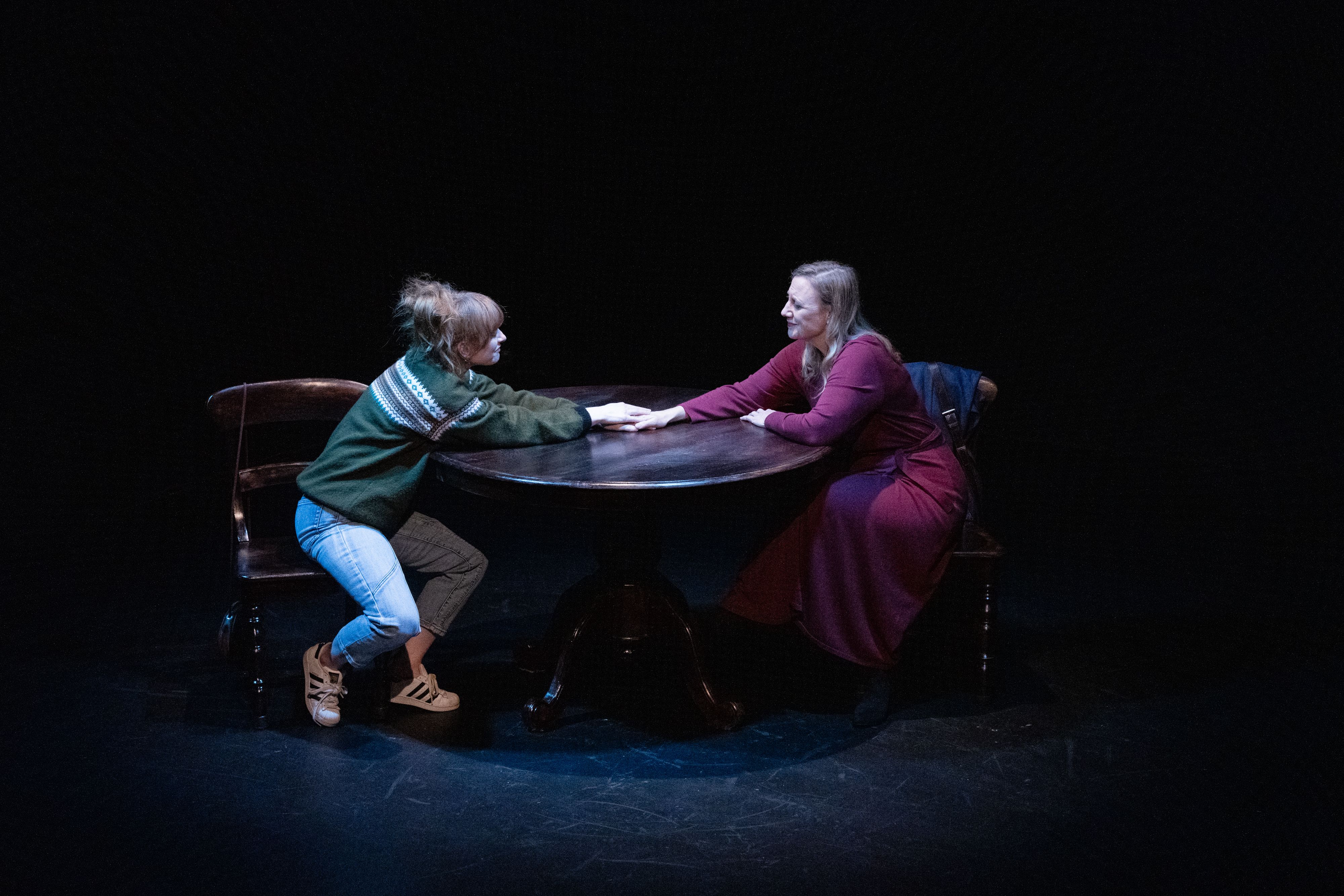
It’s a finely wrought play, eighty minutes of tight, engaging writing. Director Deborah Jones keeps the production splendidly sparse, allowing her excellent cast to shine. It’s a joy to witness Linda Nicholls-Gidley, Lindsey Chapman and Sarah Jane Starr present these characters, like watching sunlight glimmer through the discarded pieces of a broken stained glass window. I use this ostentatious simile deliberately: the play presents a world in which individuals have seemingly lost the ability to look up. There’s one particularly poignant motif: a fourth character, who we never meet, who climbed a nearby mountain and lit a fire. In rich ambiguity, this serves as both a powerful image of troubled flight, and of the desperate need to go beyond.


 Theatre Red