Archive | April, 2024

The Front Page

28 Apr

This is fast-talking, wise-cracking American comedy, of the style brought to a world audience during the Golden Age of Hollywood.

First produced in 1928, The Front Page by Ben Hecht and Charles Macarthur is the play that became the film His Girl Friday, starring Rosalind Russell and Cary Grant.

Set in a Chicago courthouse newsroom at the eve of an execution, it’s satire of cynical journalists, police officers and politicians is nothing new now (though still it rings true.)

This production, directed and adapted by Nicholas Papademetriou, has a beautiful bouncy, brassy spirit. Except for the opening scene, which on the night I attended lost necessary pace because of line stumbles and awkward props, the show honours the grand comic tradition of which it is part.

Papademetriou follows the lead of the writers of His Girl Friday and makes the play’s protagonist a woman. Hildy has worked for The Examiner for years, and though it’s a man’s world, she is clearly their ace reporter.  However, with the offer of marriage to a respectable man, she’s tempted by the quiet of domesticity.

Can she leave the game behind? Her boss, Walter, wants her to stay, for more reasons than one.

Rose Treloar as Hildy is extraordinary. Rosalind Russell would be proud. From the moment she enters, Treloar’s energy is stellar, and she drives the production with a gloriously assured exuberance.

Andrew Waldin as Walter is brisk and nimble, and achieves that most difficult of comic tasks: the portrayal of a charming con-man.

The large supporting cast generally does good work. Let me cherry pick just a few favourite performances. Diego Retamales as the man on death row is superb, his physical comedy top class.  Callum Stephen slips into the shoes of the ex-gangster with such laughter-inducing ease that we readily believe the character has helped many a chump slip on shoes of the concrete variety. Braydon May, as a messenger in the Governor’s employ, works the classic trope of the pedant in a world of action with hilarious effect. Georgia Nicholas as the only other female reporter in the newsroom has a wonderful stage presence, positioned perfectly in regard to Hildy’s energy, and establishing with tight rope precision the competing needs created by a patriarchal environment, the requirement for both female feistiness and sisterly support.      

Brash, buoyant, confident, this is comic theatre with old school swagger.

Paul Gilchrist

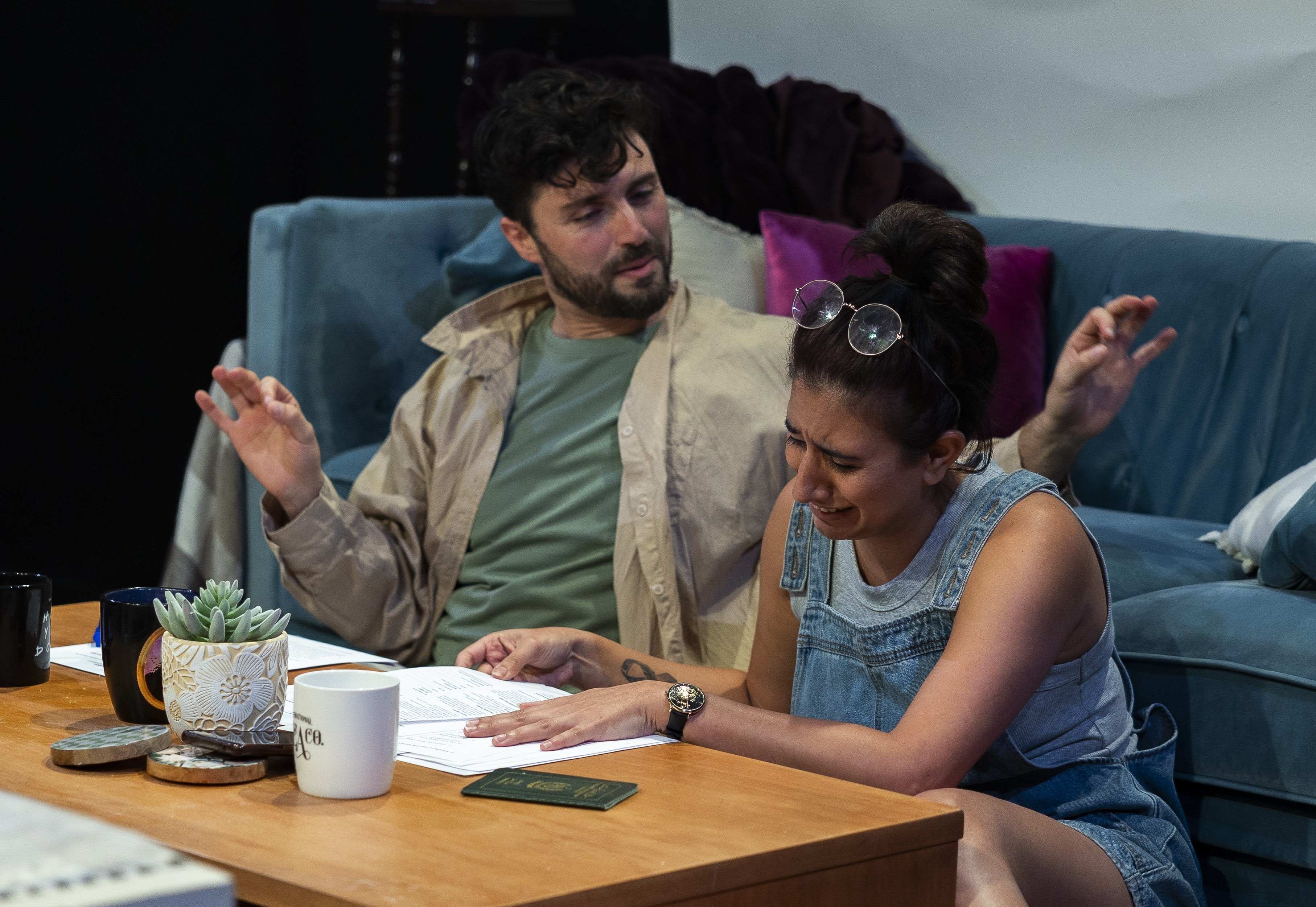
The Front Page by Ben Hecht and Charles Macarthur (adapted by Nicholas Papademetriou)

at New Theatre until 18 May

newtheatre.org.au/

Image by Chris Lundie

Do You Mind?

26 Apr

Wittgenstein suggested a work of philosophy could consist entirely of jokes.

Can a piece of theatre consist entirely of questions?

Written and performed by Shay Debney, Do You Mind? is such an attempt.

The script is beautifully whimsical and very funny. It allows Debney to showcase his extraordinary linguistic and vocal skills and his delightful physical comedy.

Recently I wrote, that to be left with questions is exactly what I want from a piece of theatre … so how can I not be satisfied with this?

Some of the questions Debney poses to the audience are simply about our personal tastes or experiences. Other questions are the equivalent of a Zen koan, joyful little puzzles that tease us out of complacency. (They’re of the family of – but not including – What is the sound of one hand clapping?)

We live in the Age of Assertion and Grand Theory. Everyone seems to know the answer to everything. Certainty is now equated with commitment.  A piece of theatre that reminds us of the value of the question is a rejuvenating antidote to this dullness of mind.

Questions help us dig deeper, to see that things may not be as simple and flat as we’d lazily like them to be. We reanimate our world through questions. Questions are how we unwrap the gift that is Life.

Not that Debney’s questions are what most people would call political: they’re impishly playful.

Since we’re on the topic of questions, you might ask this question: Can a show like this – one that doesn’t construct a traditional character and which eschews a traditional narrative arc – is this a show capable of retaining my attention? At just under an hour, the experiment is exactly the right length. Director Julia Robertson masterfully creates changes of pace and pleasing variations of texture. And, anyway, Debney has such a warm, vibrant stage presence that we’re keen to stay for the ride.

(I’ve got to note that it’s refreshing to see a one-person show that’s not autobiographical. In shows in which an actor talks about themselves, I often have to fight the temptation to suggest that the size of the cast directly correlates with the level of interest the play is capable of generating.)

For theatre nerds, Do You Mind? also poses intriguing questions about form.

Peppered with questions delivered in direct address, the audience of which I was a part seemed uncertain when (or whether) they were expected to provide answers. (In conventional question/answer format: Q. Is there audience participation? A. Only if you want there to be.)

But what this mischievous little show does is illuminate the strange miracle that is art. Every single piece of theatre ever made is created by both the artist and the audience. However, we tend to privilege the first of these two. If you think my choice of the word privilege is perverse, just try putting on a show in your room by yourself and see if you don’t come to feel that the audience is every bit as important as you. A show like this spotlights the agency of those who attend.

By focussing on the magic of the question – questions of all types – this little show is a glorious gift, a reminder of the childlike wonder to be found in the choice to be forever unwrapping.

Paul Gilchrist

Do You Mind? by Shay Debney

at the Old Fitz, as a late show, until April 27

www.oldfitztheatre.com.au/

Image by Julia Robertson

Uncle Vanya

25 Apr

I’ve always loved the play and, directed by Charlotte De Wit, this production is utterly mesmerising.

It’s simple and extraordinarily beautiful. Chekhov and Stanislavski (who directed the first production in 1899) were part of the great reaction against the hyperbole of 19th century melodrama. They valued truthfulness above all things.

And this production is gloriously faithful to that vision.

The cast inhabit their roles with a naturalness that’s a joy to witness and which, even now, remains a challenge to complacent assumptions about what it is to act.

Mike Booth is magnificent as Vanya. It’s a performance I’d happily see again and again. Vanya feels he has swallowed a lie and wasted his life, and Booth’s portrayal is so deeply moving because he makes it appear so honest.

Similarly, Marigold Pazar is brilliant as Yelena. The young wife of an aged academic, Yelena finds her life boring, and Pazar presents the role perfectly because she does not push. Indolence infuses both her voice and her movements, and so her character does not so much claim boredom, as embody it – ironically making Pazar’s performance absolutely scintillating.

Mikhail is in love with the married Yelena. Tristan Mckinnon plays beautifully the tension between desire and despair. The triumph of Chekhov, and of this production and this particular performance, is that we can judge the characters if we wish, but the invitation is simply to observe.   

Sonya is in love with Mikhail. Her love both enriches her and pains her. (Chekhov looks at life unflinchingly.) Maike Strichow’s portrait wonderfully captures both Sonya’s joy and her suffering.

Chekhov called his plays comedies, and without straining for laughs, this production is very funny. It’s the humour of recognition.

Annie Baker’s adaptation of the original wisely retains the traditional setting but allows the characters to speak in a modern vernacular, making that recognition inescapable.

I’ve yet to discuss the meaning of the play (unusual for an armchair philosopher like myself.) This reticence is partly because the method (yes, that method) employed to convey the play’s meaning is so persuasive that it becomes the meaning. Of course, the play is a meditation on being “infected by uselessness”. Chekhov’s comedy follows the traditional trope of an ordered world disrupted by interlopers, but he turns this trope on its head by having the newcomers represent not action and vibrancy but rather inaction and indolence. Our heroes and heroines must strive to cure themselves of this infection.

But it’s the sheer truthfulness of the portrayal that makes this such a rich, intensely humane piece of the theatre.

Paul Gilchrist

Uncle Vanya by Anton Chekhov, adapted by Annie Baker

produced by HER Productions

at Flow Studios until April 27

www.herproductions.com.au

Toy Symphony

22 Apr

The Loading Dock Theatre is a brilliant addition to the Sydney scene.

I was privileged to see the first show produced there, Michael Gow’s Toy Symphony, presented by Ad Astra.

The play was first produced in 2007 at Belvoir. It tells the story of Roland, a famous playwright suffering writer’s block (though don’t you dare use that phrase in front of him.)

There are three curious aspects to the play.

The first is that it’s almost theatre in the first person. I’m not suggesting it’s autobiographical (who knows?) but it’s fascinating that the focus is so firmly on one central character. And this is highlighted by the fact that good chunks of the play appear to be this protagonist’s personal memories. Furthermore, the protagonist’s problem is quite particular: can he continue to write theatre? (Admittedly, anything of concern to any individual should be of interest to a truly cosmopolitan person. That Gow assumes his audience consists of such broadminded people is a beautifully generous-hearted vision.)

Another curious aspect of the play is its structure. This production was two and a half hours (including intermission) and there are scenes which left me wondering why they were there. They’re interesting in themselves, but I was uncertain of their purpose or value in the play as a whole. Why do we get a scene explaining copyright law? Why are the childhood memories of Como Primary School so thorough? Why do we get a lengthy monologue in which Roland tells an unseen character what he said at his mother’s funeral? These vignettes further suggest the play’s affinity with autobiography, a form which acknowledges that the entire truth of a life can never be told, but that certain select moments will be its best intimation. The truth is clearly outside the text, not inside. This is probably true of all theatre, but to vastly varying degrees. Some plays seem to deliberately ask us to judge whether they’re a fair representation of reality (or, increasingly, they simply assert they are.) Other plays focus instead on drawing us into their world, inviting us to go for the ride. Toy Symphony is the first type, because the vignette form means the world of the play is inherently fractured and incomplete, but the challenge for us is that the truth being represented seems so especially precise, and potentially personal, that it’s difficult for us to judge the representation’s success.

The final intriguing aspect of the play is a recurring conceit. As a child, Roland can conjure people. He thinks of them, and they appear – but not to his mind’s eye alone, to everyone else as well. On one level, this is a literalisation of what playwrights do when they create characters … but the conceit resists such easy interpretation. If it’s meant to suggest the potential creative power of playwrights, you might respond that surely the play itself is an attempt to display this power, and so the conceit begs the fundamental question of realist theatre. (It’s as though a carpenter made a table out of little tables in order to clarify what she can do.) As a result, the play feels like a shot fired in a very Australian culture war, part of that battle in which artists desperately feel they must justify their own existence.

Clearly, this play sent me off into the night with a bundle of questions – exactly what I want from theatre.

Director Michelle Carey deals with this provocative play by presenting it with boundless energy.  Gregory J Wilken as Roland gives a performance that’s vibrant and always engaging; juxtaposing the wide-eyed child with the jaded artist. The supporting cast matches his energy, bouncing between realistic portrayals of adult professionals to theatrically enthusiastic children. Let me cherry pick some favourites. Wendi Lanham is eminently watchable as Roland’s therapist. Felix Jarvis as Daniel, an actor in training, gives a wonderful portrait of that youthful mix of confidence and insecurity. Bernadette Pryde is mesmerising in her evocation of the gentle, good humoured primary school teacher. Sam Webb as the school yard bully is suitably both intense and dense, and John Michael Narres’ school principal is deliciously meanspirited.

It was a pleasure to see this piece in an exciting new venue.

Paul Gilchrist

Toy Symphony by Michael Gow

at the Loading Dock Theatre, Qtopia, until 27 April

qtopiasydney.com.au/performances/  

Image by Bojan Bozic 

Sotoba Komachi 

13 Apr

This is a beautiful play, wonderfully presented.

Despite being only 45 mins in length, it’s fantastically rich.

Written in the early 1950’s by Yukio Mishima, and inspired by traditional Japanese Noh theatre, it’s a meditation on time, ageing and beauty.

A young poet meets a 99 year old woman in a park, late at night. The opening sequence, which juxtaposes the ancient woman collecting cigarette butts with young lovers seeking the ephemeral pleasures of sexuality, brilliantly introduces the play’s concerns.

Though sourced from the Japanese, the play reminds me of Thomas Browne’s Urn Burial, and all those artists of the European late medieval and renaissance eras who knew that Death underpins Life, that Change grants meaning to Constancy. Think those shadowy still life paintings juxtaposing flowers and skulls. It’s not morbidity, but honesty … and the Truth will set us free. It’s a privilege to see a piece like this in our anglophile Australian theatre, to be shown how another culture has discovered similar treasures.

Susan Ling Young is magnificent, in one instant an aged woman, in another the young woman of eighty years earlier.

Wern Mak is utterly compelling, delicately balancing the cynicism of the disappointed young man with the wonder of the poet learning to see unexpected beauty.

Director Jeremi Campese pitches the piece perfectly between humour and suspense, and aided by choreographer Artemis Alfonzetti, complements the simple lucid language with heartbreakingly graceful movement. The scene in which the entire cast dance – at a ball eighty years gone but eternally present – is theatrical gold.

Paul Gilchrist

Sotoba Komachi by Yukio Mishima

at Old Fitz, as a late night show, until 13 April

www.oldfitztheatre.com.au

Image by Karl Elbourne

For The Love of Paper

12 Apr

Some plays have as their central action an epoch changing battle, or perhaps the execution of an unjustly accused heroine, or even a torrid, illicit love affair. For one dreadful moment, I thought this play was going to be about the filling in of a form.

Kaveh is an Afghani-Australian. He is gay, but his family back in Afghanistan are arranging a marriage for him with a woman. His flatmate in Sydney, Amaliah, is Pakistani and she’s keen for Australian citizenship.  

You can probably guess the rest.

Antony Makhlouf and Almitra Mavalvala are entrancing as Kaveh and Amaliah.

Written by Mavalvala, the play has elements of rom-com – though not a lot of the “rom”, nor an unwavering dedication to the “com”.

It shares with romantic comedy a lightness of touch and a focus on a single central relationship. Mavalvala allows the friends to remain platonic. And, though she toys with comic set-ups (Joseph Raboy does an amusing turn as multiple characters), she chooses never to flesh out these set-ups fully, and with an easy-to-watch, languid style of direction, the production rests in a type of realism-lite.

Though we do see the friends fill in a form, it’s fundamentally a play about homelands.

Director Kersherka Sivakumaran began the opening night performance with a lengthy and heartfelt acknowledgement of country. (I’ve been criticised previously for mentioning these acknowledgements, as though we should be embarrassed about them, as though they were some sort of personal ablution – necessary but best kept private.) This particular acknowledgement used the phrase “stolen land” and it reminded me, as I watched a play about who is granted the right to remain in this country, that all relationships we have with the land are also relationships between human beings. The manner in which our connection with any land is exercised is necessarily predicated on the acknowledgement of this connection by other individuals. Drama can attempt to portray our relationship with land, but as an artform it will inevitably emphasise relationships between specific people. This is not a fatal inadequacy of the artform. Whether Amaliah can stay in Australia is dependent upon individuals from the immigration department, and on Kaveh.

And previous homelands? The relationships the characters have with Afghanistan and Pakistan? These are represented by phone calls and letters from loved ones faraway. All are presented as voice overs, and this poignantly catches a sense of distance, of absence.  

The older generations banished from the stage, we’re left with an image of children alone and lost in a strange land, and in that there’s a terrible pathos, a plea for openheartedness that must be acknowledged.   

Paul Gilchrist

For The Love of Paper by Almitra Mavalvala

at KXT Broadway until 20 April

kingsxtheatre.com

Image by LSH Media

Australia Felix

7 Apr

Written and directed by Geoffrey Sykes, this is the story of convict George Clarke.

There are three intriguing creative choices being made.

One is to include original musical numbers. The songs, written by Steve Wood, are engaging. Kate Stewart, Tisha Kelemen and Freya Moore give particularly pleasing vocal performances, but it’d be terrific to hear these songs performed with more texture than voice, guitar and found percussion allow.

The second intriguing creative choice is to have Clarke’s story told by an old fashioned travelling theatre troupe. We’re being told a historical story through another historical story. I’m not sure of the value of this. As the different characters in the troupe aren’t meaningfully distinguished, the effect is to slow down the story we’re actually being asked to care about. The choice also facilitates the use of direct narration, disappointing to an audience perhaps desirous of drama rather than documentary.

The third intriguing choice is perhaps not as intriguing as the others, simply because it reflects the zeitgeist. Clarke is obviously valued as a character because of the genuine links he made with indigenous people; he spent at least five years living with peoples beyond the colonial frontier and is said to have taken an indigenous wife. However, the production presents none of this experience; it’s recalled, briefly, in conversations between colonisers. I can’t blame Sykes for this reticence – it’d be a foolhardy artist who would now appropriate the stories of the marginalised – but it’s a choice that can’t help but weaken this particular story.  

And that’s a pity, because the piece clearly brims with an open-hearted awareness of injustice, to both the original inhabitants of this land and to those who’ve sought a happier resolution to colonial contact than we’re yet to achieve.    

Paul Gilchrist

Australia Felix by Geoffrey Sykes

at Richard Wherrett Studio, Roslyn Packer Theatre until April 6

www.playscript.net.au