Archive | August, 2024

Love and Faith (and something unholy)

31 Aug

There’s some thrilling creative decisions being made here.

Director and adaptor Lucy Boon abbreviates two Elizabethan texts, and then both juxtaposes and links them.

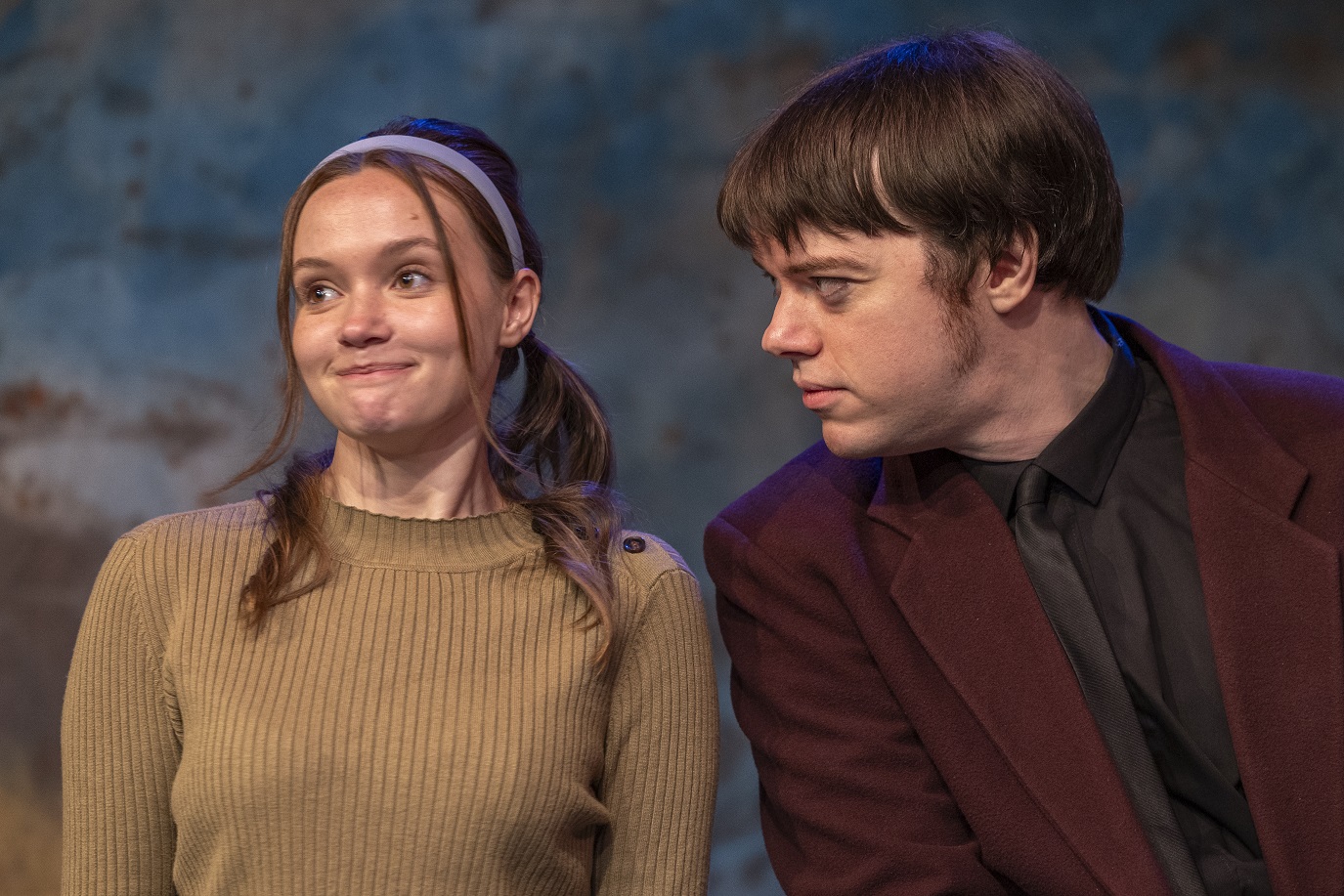
John Lyly’s Galatea tells of two maidens who escape into the forest dressed as men, hoping to avoid becoming sacrificial tributes to the god of the sea, Neptune. While disguised they meet, and the attraction is instant – and bewildering, and exhilarating. Meanwhile, in the same forest, is the god of chastity, Diana. When her entourage is surprised by Cupid, mayhem ensures. The adaptation is taut and terrific.

Shakespeare’s Measure for Measure tells of Isabella, tasked with saving her sibling from execution. The twist is that Lord Angelo has condemned the supposed criminal for fornication, the very act he now demands of Isabella if her sibling is to escape death. It’s a classic exploration of hypocrisy and, once again, the adaptation is excellent. The beautiful sting in the tale is that Boon cleverly alters Shakespeare’s overly neat and problematic denouement to express the pathos-inducing injustice of silenced voices, both female and lesbian.

The performance style is what I’ve previously termed the Theatre of Audacity. By this, I mean it appears that the audience is being invited to respond with a loud I can’t believe you’re actually doing that in front of me! Performances are fun and high energy. With the support of movement director Miriam Slater, the physical comedy is especially good, with highlights being Clay Crighton as Cupid, Jemima Hartley as the mischievous godling’s victim, and Cara Whitehouse as Venus and the Duke of Vienna. At times, the cast are challenged by Lyly’s language (though that probably helps explain why we still valorise Shakespeare but have pretty much forgotten the earlier playwright. Of course, Lyly’s interest in classical gods rather than real people might play a part in that, too.)

One aspect of the Theatre of Audacity that’s particularly fascinating is that it doesn’t demand perfection. (In fact, if you are flawless, your performance wouldn’t actually be audacious.) This aesthetic is reflected in the decision to have the cast both dance and lip-sync to recorded pop songs. (Drag in general shares this approach, declaring that Who I am is derived from already existing tropes, but I’m claiming it, and so, by sheer exuberance, it boldly stakes out an individual identity, but one still secure within a community.)

Theatre of Audacity’s seeming opposite is Theatre of Authenticity, but they’re not mutually exclusive. Isabella, played with both charisma and vulnerability by Aisling Delahunt, must navigate her conflicting loyalties – but she also radically seeks her own fulfillment. And, by ultimately connecting the two Elizabethan works, this piece offers a stunning resolution, one that’s a clear assertion of the authenticity of identities and of desires that transcend any stifling, small, supposed normalcy.

Paul Gilchrist

Love and Faith (and something unholy) adapted by Lucy Boon from Lyly and Shakespeare

presented by Acoustic Theatre Troupe

at the Substation (Qtopia) until Aug 31

qtopiasydney.com.au

The Department of Family Values

26 Aug

Written by Jon Glass and directed by Garreth Cruikshank, this is an enjoyable social satire.

Set in contemporary Australia, it interrogates the relationships within a privileged family.

Rebecca (Alexandra O’Brien) is a corporate lawyer and her husband Oliver (Barret Griffin) is a writer who suffers from the luxury of writer’s block. Their daughter Chloe (Rhiannon Jean) has won a place at Oxford, studying Comparative Literature.

Of these familial relationships, only that between father and daughter appears amiable.

Several factors add to the tension. Chloe has hooked up with a new guy, Josh (Angus Farrand) and as boyfriends go, it would probably be better if he did. Simultaneously supporting the family and having their own expectations are longtime friends Mark (Cruikshank) and his terminally ill partner Anne (Sally Williams).

For the most part, the characters are selfish and/or stupid, and so are alternatively amusing or pathos-inducing. There are some terrific one liners, but I was uncertain whether I was watching a comedy or a drama – a result of both the writing and the performance choices. At times too slow for comedy and at others too hyperbolic for drama, the work exists in a disturbing liminal space, one wonderfully appropriate for eliciting discomfort in an audience whose world is possibly not too dissimilar from that of the characters. (Adherence to the conventions of genre is one way we guide our audience through a production, but a single-minded insistence on these conventions is also how we attempt to tame the revitalising wildness of the theatrical experience.)

The final scene tries to do too much: too quickly solving dilemmas which were, admittedly, never sufficiently fleshed out. However, in its emphasis on reconciliation, the piece takes part in the grand tradition of comedy, while also challenging us to find room in our reality for this golden but oft forgotten value.  

Paul Gilchrist

The Department of Family Values by Jon Glass

The Greek Theatre

21st to 24 Aug (This run has been completed)

Image by Garreth Cruikshank

The Curious Incident of the Dog in the Night-Time

25 Aug

This is a big, bold adventure in theatre making.

Several years ago, when I heard that the novel had been turned into a play, my first response was How? (Though that was very closely followed by a Why?)

The most distinctive feature of the famous novel by Mark Haddon is that it’s narrated by a neurodivergent teenager.

Apart from one-character shows, drama really doesn’t do the whole first-person thing. Its glory is that it’s multi-voiced.

Simon Stephens’ stage adaptation tries to keep central Christopher’s voice, but not surprisingly, a play that’s 2 hours 40 minutes long (including interval) looks for ways to create texture.

One way is by giving some of Christopher’s narration to his mentor Siobhan, who reads from his notebooks. In fact, Siobhan (played by Brigid Zengeni with a stage presence that is noble, authoritative and warm) becomes almost a semi-divine figure, a type of guardian angel, making us feel no real harm can come to our hero. These decisions downplay Christopher’s isolation, but deliberately make the piece safe and inviting (which, perhaps, only devotees of the Theatre of Cruelty will regret.)

Another way of texturing a predominantly first-person narration is to privilege the dialogue from the novel at the expense of its more discursive elements. However, one of the charms of the book is that Christopher often records other character’s words without understanding their subtext. The reader gets what his father means, but Christopher does not. Of course, you can do this in drama, but, ironically, it ceases to be dramatic irony; it becomes just misunderstanding. Perhaps this creative decision is a more humane, egalitarian-spirited response to Christopher’s situation, but it does mean the dialogue functions differently than it does in the novel, and that it does not especially underline Christopher’s isolation, or what might be distinctive about his experience as a neurodivergent individual.

(Should it? I suspect this play, this production, will be valued as a representation of a marginalised group – or dissed as an inaccurate one. It’s odd how we’ve come to read fiction in this way. If you wanted to tell the truth about an entire demographic group, why would you choose a form that by its very nature focuses on the individual, the particular, the specific? Invariably, you’ll elicit dissatisfaction when another individual, particular, specific characteristic is not represented. Though, admittedly, most of the audience are in no position to judge the veracity of your representation anyway; they’re positioned to passively accept it.)

Another way of granting texture to a work originating in first-person is movement. On multiple occasions, the cast mirror Christopher’s movements, and this is cute, fun and well executed – though it raises the spectre of bad faith in the script. It feels as though gaps are being filled, ones that another production might have filled (possibly no more satisfyingly) with high tech.

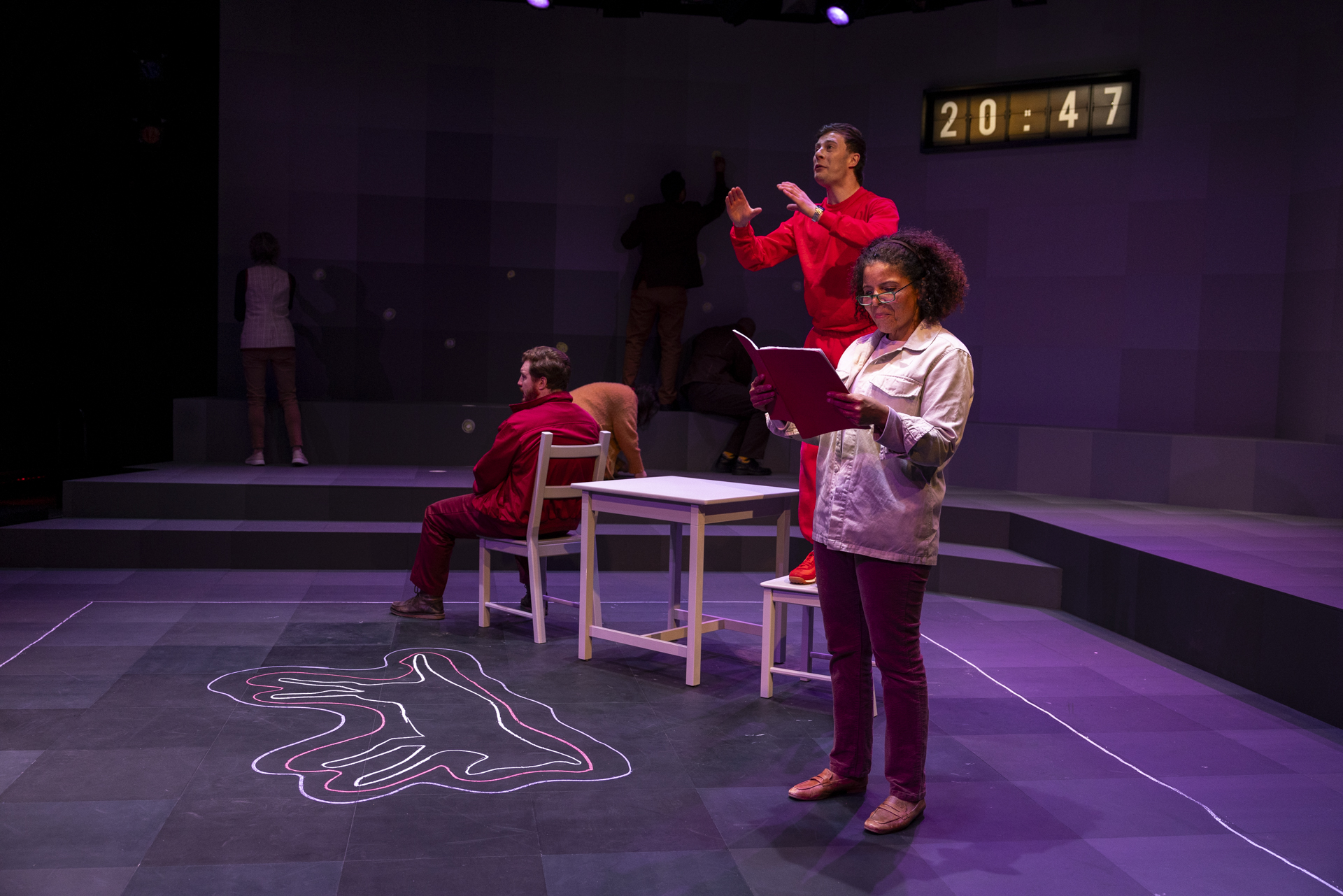
Speaking of tech, above the stage is a device which displays words, warnings, and the time. In the novel, Christopher often tells us exactly when things happen. He makes statements like At 4.02 pm father did X. But the device I’ve mentioned means Christopher doesn’t tell us the precise time, we know it – but, of course, we don’t need to know it, except in so far as this hyperbolic precision tells us something about Christopher. Similarly, the protagonist’s love of mathematics is presented as a very Belvoir dance number, a delightful high energy parody, but one perhaps hinting more at the assumptions being made about the audience than about Christopher’s passion and skill. (Though see my earlier comments about representation.)

Christopher himself expresses uncertainty whether his experience can be turned into a play. (If dramatic irony is when the audience knows more than the characters, what do you call it when characters know more than their creators?)

But does it matter if the play reflects the novel? Or if it accurately represents a lived experience?

Apart from these things, what does the play, the production, do?

Under the direction of Hannah Goodwin, we’re given some wonderful performances. Matilda Ridgway as Christopher’s late mother, a simple woman who struggles with the complexity of raising her son, beautifully balances vibrancy and vulnerability. Daniel R. Nixon as Christopher has a gargantuan role, and he presents it brilliantly, eliciting both pathos and humour, while embodying an inspiring individual dignity.

It’s a deeply human story told with fun and feeling.

Paul Gilchrist

The Curious Incident of the Dog in the Night-Time, based on the novel by Mark Haddon & adapted for the stage by Simon Stephens.

Belvoir until 22 September

belvoir.com.au

Image by Brett Boardman

Hangmen

19 Aug

I don’t believe in theatre awards. (Not that they exist, but that they have much validity.)

But Hangmen by Martin McDonagh won the 2016 Olivier Award for Best New Play, and it’s certainly an extraordinarily well-crafted comedy.

Set in 1960’s northern England, it purportedly features the last hangmen employed by the British Crown. But capital punishment has just been abolished, and at least one of these men feels that now is the time to bask in a little celebrity.

But fame is a lure that attracts some truly strange fish.

Directed by Deborah Mulhall, this is a terrific production. The entire cast do brilliant comic work. (A few highlights: Nathan Farrow as the bragging, bullying publican and ex-executioner is point perfect. Sonya Kerr, as his wife, beautifully balances the no-nonsense strength of a woman who runs a pub with the vulnerability of a mother only too aware of the dangers faced by her daughter in a brutal, male-centric world. Kim Clifton as that daughter is excellent, offering a marvellous portrait of that quintessentially teenage mix of awkwardness, defiance, naivety and wonder. Robert Snars as the stranger who appears at the pub is superbly menacing.)  

Hangmen is a black comedy, and black comedy is a very particular taste. (Not particularly mine.)

How can we laugh at violence?

There is most certainly a strand of spiky satire, a mocking of the inadequacy of those whose administer justice, and a poking at pretension, egoism and heartlessness.

But it’s the last of these – the attack on heartlessness – that undermines black comedy for me. It’s as though we’re being invited to respond to the heartlessness of violence with …. heartlessness. It can feel a little like the pot calling the kettle black (or, at least, somewhat grimy.)

And this show demands a pitiless physicality. Horrific violence reportedly happens offstage, but we must also witness horrendously violent acts onstage. Frustratingly, the spoiler rule reduces me to a nebulous imprecision – but let me say that an act is represented that more sensitive souls may not wish to see, let alone be inclined to giggle at. (But more on this latter.)

Comic violence is extraordinarily difficult: how much do we want the audience to believe it? If the representation fails to achieve verisimilitude, our attention is drawn to this seeming defect. But, if the representation does appear realistic, it’s unlikely to be funny. (Again, more on this later.)

And adding to the challenge of representing such violence on stage is the spell-breaking fear that the stunt may go dreadfully wrong. Safety procedures mean that it won’t – but, as you hastily make that assessment, you’re dragged out of the world of the play.

But back to my annoying More on this later refrain.

Despite my doubts about black comedy, I know the genre is deliberately edgy. It’s meant to make us feel uncomfortable. And discomfort can be soul-expanding, and in our lives of privileged complacency and self-righteous moral certainty, a little expansion wouldn’t do any harm.

Perhaps our laughter at black comedy is just how we hide from a horrible truth. Perhaps it’s merely our way of refusing to acknowledge seriously that a temptation to violence dwells in the human breast.

Or, perhaps our laughter at black comedy can surprise us. Perhaps it can be a delightfully disarming revelation that we too share in humanity’s darker tendencies.

And, if it helps us realise that we’re in this grand mess together, then it’s a good thing.

Paul Gilchrist

Hangmen by Martin McDonagh

until 14 Sept at New Theatre

newtheatre.org.au

Image by Bob Seary

The Cherry Orchard

15 Aug

This is not the one by Chekhov. Though it is, sort of. Gary Owen has taken the bones of the story and buried them in Thatcher’s Britain.

It’s odd (though enjoyable) that we’ll put on a century old Russian play in contemporary Sydney. And the odd (though enjoyable) dial is ramped up further when we put on a British adaptation of an old Russian play. (And even more so when you consider that this particular adaptation is actually a historical drama, set forty years earlier than the time it was written. And then add the fact that this is the second modern British play informed by Chekhov’s The Cherry Orchard presented by this particular producing company in the last two years.)

It’s mirror reflecting on mirror, endlessly fascinating.

As I suggested, the bones of the story are the same: a privileged family in the process of disintegration. With the matriarchy asleep at the wheel, will they get to keep their estate?

Owen’s version keeps the pre-story of the death of the matriarch’s son, but soaks her grief in alcohol. The result is that the play seems smaller than Chekhov’s, haunted by a dead child and highlighting substance abuse. The sense of social change enervating an entire class is weakened, though perhaps it’s my historical ignorance that makes it difficult to find connections between Thatcher’s anti-working class revolution and the malaise of the landed gentry in fin de siècle Russia.

Under the direction of Anthony Skuse, performances are marvellous. Deborah Galanos as Rainey the matriarch has a tough job – the script rarely has her without a drink in hand – but she beautifully balances bullying charisma and vulnerability. Jane Angharad as her adopted daughter, struggling to keep her home and navigating a precarious romantic relationship, is deeply moving. Charles Mayer as Rainey’s twitty brother is great fun. James Smithers as the young would-be-radical is excellent, combining a boasting bravado with the ominous sense he might sell out. He’s having a fling (or is it?) with Rainey’s daughter, played with a glorious vibrant intelligence by Amelia Parsonson, and their scenes together are electric.

Paul Gilchrist

The Cherry Orchard by Gary Owen

At the Old Fitz until Aug 24

oldfitztheatre.com.au

Image by Braiden Toko

The Arrogance

8 Aug

This is a beautiful play, wonderfully presented.

Written by Olivia Clement and directed by Lucinda Gleeson, it’s an exemplar of the grand tradition of drama.

(Perhaps there are two grand traditions. One’s the Theatre of Audacity, the type that asks to be valued because it surprises, shocks and delights. It has us say of the actors I can’t believe you stood in front of people and did that! The other grand tradition is the Theatre of Authenticity, the type that asks to be valued because of its universality, veracity and honesty. It has say of the actors You made me believe it was true.)

The Arrogance is of the second of these traditions. On the simplest level, it presents the relationship between parents and children; a relationship as close to universal as you’ll get. Amber (Whitney Richard) reflects on her relationship with her father (Alan Glover), a man she’s beginning to acknowledge verbally and physically abused her when she was little. She’s also making friends with her new neighbour (Linden Wilkinson) and learns that she too has had a problematic relationship with her child. But, true to the Janus-like visage of the human condition, as we look into the past, we must still look to the future. Amber is pregnant. That most fundamental, most fractious, of relationships is about to begin once again.

When I praise the Theatre of Authenticity, and this most marvellous example of it, what most impresses me is its unflinching gaze. It refuses to polish to unrecognizability the crooked timber of humanity: it records what’s messed up, what’s contradictory, what’s irresolvable. Philip Larkin famously wrote “They fuck you up, your mum and dad.” Adrian Mitchell replied with his playful parody “They tuck you up.” Drama of authenticity shows how both experiences can happen simultaneously.

And there’s another tension portrayed brilliantly in this piece. It’s about the contingency of judgement. We’ve all been told you shouldn’t judge people. And we’ve all been told there are times you most definitely should. Amber has to make such a judgement, but once she’s begun she has difficulty knowing when to stop. She falls into the error of lumping people together (an error endemic to our sociologically obsessed age.) There are few cries more tragic, more wrong-headed and more wrong-hearted, than You are all the same!

To suit the play’s commitment to both truth and its complexity, designer Soham Apte gives us a simple playing area, one evoking a garden, but soaked in dark hues, a place symbolic of the contradictory connotations of digging – it’s both a place to plant, and a place to bury.

Gleeson draws from her cast performances of glorious, unadorned honesty. At a mere 70 minutes, nothing is hurried, nothing forced – and truth is laid bare.

Paul Gilchrist

The Arrogance by Olivia Clement

At KXT on Broadway until 10 Aug

kingsxcrosstheatre.com

Image by Georgia Brogan

Occasional Combustible Disaster

5 Aug

This is great fun and seriously thought-provoking.

It’s also incredibly difficult to write about without breaking the spoiler rule.

Freddy is finishing his HSC and is about to turn eighteen. Liv, his sibling, has come home from overseas to help him celebrate. But his parents, Beth and Jim, are worried about Freddy’s behaviour – though it’s not like they have everything worked out themselves.

None of that is spoiler material, but the very kernel of the piece is dependent on the withholding of information. The nature of Freddy’s problem is only fully clarified at the play’s resolution. Stories that withhold information have dangers: some audience members clock what’s going on immediately and lose interest, others only understand in the final moments and so become frustrated long before that.

Written by Daniel Cottier and directed by Benjamin Brockman, this piece avoids these pitfalls by its humour, deeply humane vision and wonderful performances.

Nicholas Cradock’s Freddy is a moving portrait of a troubled soul. Nyx Calder as Liv delivers sharp one liners marvellously, but also gives a rich characterisation of caring sibling and angry child. Hester van der Vyver as Beth and Richard Hillair as Jim are hilarious as they work the satire of early middle-aged myopia, but when things get genuinely confronting, they subtlety move to truthful performances of perplexed but heartfelt concern. When the full extent of Freddy’s pain is revealed, van der Vyver’s reaction of bewildered vulnerability is absolutely magnificent  

I don’t think I’m giving away too much to say Freddy has mental health issues.

Voice over is used to suggest Freddy suffers from intrusive thoughts. It’s a bold decision. Drama always struggles to present the inner experience of its characters. We guess at a character’s inner world from their words and actions, but as in Life, we can’t really get inside. The Elizabethans invented the soliloquy to try to solve the problem – but it’s only a partial solution, privileging a character’s deliberate, articulated thoughts rather than the ever-changing whirlwind of interiority. The VO powerfully underlines that Freddy is a victim of thoughts he can’t control, but each time it’s used it threatens to pull us out of the world of the play. Why can we hear his voices while his Mum, Dad and sibling can’t? (Yes, I know, the characters don’t hear the soundscape either – but then none of them do.) This VO technique has been used in other productions to create humour – it sets up that expectation – but I was glad it wasn’t employed that way here. What Cottier is exploring is too important for that.

Freddy can’t control his thoughts – and control is a theme that weaves through the piece.

Consider his parents. Mum wants to control Freddy’s study habits and places unneeded pressure on him by repeatedly asserting he will be school dux. Dad wants Freddy to leave his room, to get out and do stereotypical-straight-male-teenager-sort-of-things. Like Mum’s demands, it’s good-natured, but it highlights that teenagers must perpetually navigate parental expectations.

And the younger generation don’t get off unscathed. There’s a poke at their desire to control in the quip They care about everything, that’s why they’re all so depressed.

Chilled Liv seems able to transcend the temptation of control, but even they, in the inevitable argument with Mum about personal pronouns, falls back on But I want you to call me that!

So, what about the focus of the piece? Freddy’s condition? Is this also ultimately about seeking control? His cure obviously is; he needs to get back control of his own thoughts.

But what about the condition itself? Is there an element of control-seeking in his behaviour? On the simplest level, I don’t think this play says so; it’s too beautifully empathetic. But its presentation of poor teenage Freddy’s suffering is so powerful that it becomes apparent that his desire to keep it all to himself is part of what prevents him finding relief.

The piece is a gorgeously gentle, generous-spirited reminder to talk about it, to seek help.

Paul Gilchrist

Occasional Combustible Disaster by Daniel Cottier

At the Loading Dock, Qtopia, until 10 Aug.

qtopiasydney.com.au

Image by Phil Erbacher

Uncle Vanya

1 Aug

This is a classic play; it’s very funny and deeply humane.

Directed by Mark Kilmurry, this is the second production of the play I’ve seen this year. I’d happily see it again.

Chekhov follows the usual comic trope of outsiders disrupting the stable world of convention. (Think Benedict and Don John arriving in Messina in Much Ado.) Chekhov’s twist is that the interlopers don’t energise the original inhabitants, they enervate them.

Professor Serebryakov and his young wife, Yelena, have come to live at the family estate, and they bring with them indolence. Vanya realises it’s contagious, but can’t remain immune.

Though written in late 19th century Russia, the play is provocatively relevant. It juxtaposes two questions our society continues to wrestle with: Who am I? versus What is to be done? Vanya thinks he’s a failure, that his life has been a waste. Understandably, he’d like to blame others. But is this really the way forward?

Joanna Murray-Smith’s adaption retains the original setting (there’s a samovar, there are peasants) but the language is our modern vernacular, allowing Chekhov’s brilliance to shine.

Under Kilmurry’s direction, a terrific cast honour Chekhov’s famed honesty and truthfulness.

Out of the crooked timber of humanity, Chekhov creates a confronting beauty. Everyone is unfortunate, flawed and foolish – and still utterly lovable. (Even the pompous old professor, played wonderfully by David Lynch; his awkward, explanation-requiring, Gogol joke is comic gold.) Everyone’s in love with the wrong person. No one’s advice is quite right for anyone else. I don’t think this is a spoiler, but proceed with this paragraph at your own risk. Sonya’s beautiful final speech might be right for her, but can it really mean that much for her Uncle Vanya? But he accepts it, in silence; it’s what his niece can bring to the table, and if he has grown at all through the events of the play, he’s learnt to listen without criticism.  

Yalin Ozucelik as Vanya offers an irresistible figure of both hilarity and pathos. Chantelle Jamieson as Yelena initially plays indolence in the key of annoyance, a surprising choice, but one which pays off magnificently, delivering a second act of intensely moving vulnerability. Tim Walter, the visiting doctor who sets the women’s hearts afire, beautifully balances charm and dissolution. Abbey Morgan as Sonya offers a performance that is gloriously natural, an encapsulation of the Chekhovian genius; humanity in its unadorned simplicity, in its labyrinthine complexity, in its troubled passage through the sea of time, guided by hope and threatened by despair.

Paul Gilchrist

Uncle Vanya by Anton Chekhov, adapted by Joanna Murray-Smith

at Ensemble until 31 August

ensemble.com.au

Image by Prudence Upton