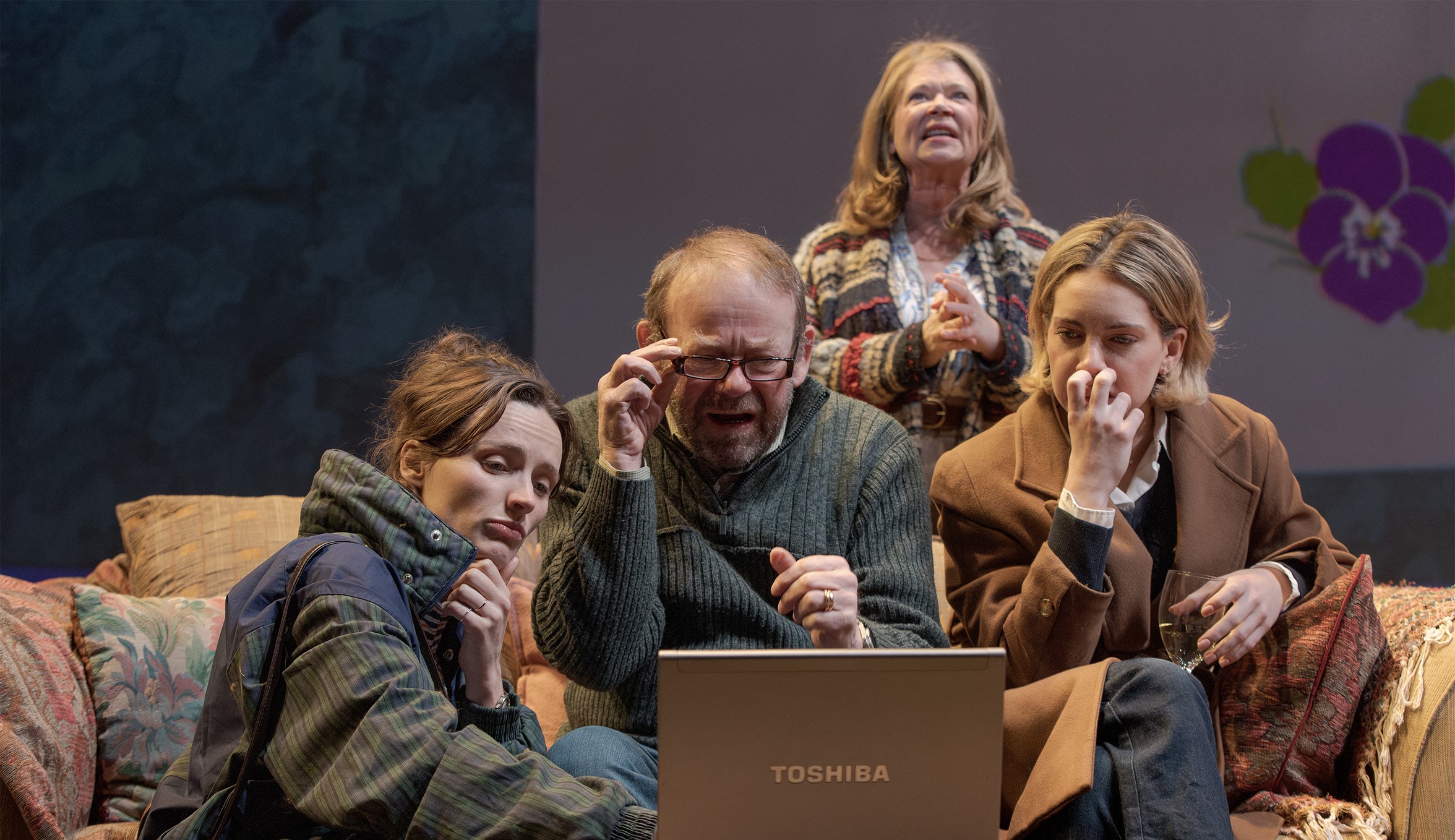
Go gentle into that good night….(with apologies to Dylan Thomas.)
In Laura Wade’s play, Myra is dying of cancer. She has six months to live.
Her husband and two adult daughters struggle to deal with this. (Myra seemingly less so.)
Told with gentle humour, it’s an unusual story to put on stage – because it’s so very, very common an experience. That almost seems the point of the piece, the mundanity of it all.
Apart from being kept busy dying, Myra seems most interested in where she will be buried and what will be painted on her coffin. I’m not sure why. Perhaps it’s a coping mechanism, but the script offers so little about Myra that it’s difficult to tell. This British play is definitely set in a post-Christian world: there’s no judgement or evaluation of what Myra’s life has been worth, and no thought of an afterlife. Her death, like her life, is part of no grand soul-lifting (or even crushing) narrative.
In some ways, Colder than Here reminds me of Margaret Edson’s W;t, but without that play’s references to John Donne’s religious poetry which make apparent the relative spiritual poverty of modern secular materialism. Perhaps in this play, in which a richer worldview is never even alluded to, the pathos is more powerful.
Or perhaps we’re being offered comfort. Perhaps we’re being reminded, that after all, none of it matters that much. Perhaps it’s the equivalent of standing in a century old graveyard and finding peace in the knowledge that in an hundred years’ time no one will mourn you, that you will be forgotten, as all are forgotten.
Not that Myra’s family isn’t troubled by her impending death. In fact, the play’s focus does seem mostly on the family members who will survive her – on her Death as against her Dying. (Dying being what the sick person does, it’s only those who remain who experience Death.)
But the family are a rather hapless bunch; they clearly love Myra, but their responses are a mixture of bewilderment, confusion and self-concern. Before the giant Death, they are little people. The confrontation forces them to grow, but not very much. Nor is there a Life-affirming defiance in the face of the Great Inevitability, there’s no sense that though “we cannot make our sun stand still, yet we will make him run” (with no apologies to Andrew Marvell.) If Death can’t provoke from us Poetry, or at least Rhetoric, you got to wonder what Death is for.
Director Janine Watson elicits fine performances from the cast, each actor successfully finding the balance between humour and fragility. Hannah Waterman as Myra begins with an almost cheeky sense of fun, that might be part acceptance part denial, but gradually textures this with the increasing irritability of a person in genuine pain. Huw Higginson as her husband perfectly delivers the one-liner-wit that is clearly key to the couple’s ongoing attraction, but also movingly presents a man emotionally frozen, overwhelmed by the demands of the moment – a deepening cold that holds no promise of future warmth. Charlotte Friels as Myra’s eldest daughter offers a poignant portrait of a woman responsible and mature, but one imperceptibly and frighteningly losing her sense of centre. As younger sister Jenna, Airlie Dodds gives us perhaps the most fascinating journey of the characters, unexpectedly charming in her initial clumsy self-centredness before growing to a greater awareness of others, but one still subtly tinged with the personal absorption which is the hallmark of current perceptions of what it is to be human.
This is a simple piece, a small piece, but in these qualities an honest one, both a powerful encouragement to acceptance and a surreptitious challenge to the pettiness of our vision of Life.
Paul Gilchrist
Colder Than Here by Laura Wade
At Ensemble until 12 Oct
www.ensemble.com.au/shows/colder-than-here/
Image by Phil Erbacher
 Theatre Red
Leave a comment