Tag Archives: 107 Projects

I Worked with Heath Ledger Once…

28 Sep

It would be natural to assume, that as a theatre critic, I would relate to a story of a failed artist.

Jarred Keane plays Jeremy, an actor who’s made a pact with himself that he’ll quit if he hasn’t “made it” by 35.

Trouble is, 35 is hurtling towards Jeremy with the velocity of a dinosaur-ending rock.

Written and directed by Keane, this piece asks questions every performer should ask themselves:

Am I doing this for fame?

If so, WHY?

And how, EXACTLY, do I define success?

And is success really a HELPFUL concept?

Let me lay my cards on the table: I think the pursuit of fame is disturbing, at best symptomatic of a deep insecurity or at worst indicative of a myopic self-obsession. Similarly, I think success is a sloppy, problematic concept. Doing something successfully is a secondary virtue. The crucial issue is what you’re trying to do, not how well you do it. Surely, it’s better to fail at something worthwhile than succeed at something worthless. For example: Who’d want to be remembered for producing a piece of art that most effectively keeps the world small and cold? Alternatively, if being a success as an actor only means being able to earn a living wage from the craft, the concept loses its magic aura, and becomes akin to the success or failure you might have as, say, an Uber Eats delivery driver.)

Jeremy’s pact implies he isn’t really interested in art. (Stanislavsky said you should “love the art in yourself, not yourself in the art”.)

But as his deadline gets closer, Jeremy’s beginning to realise his simple ultimatum might just be that – too simple.

One possible catalyst for his change might be that a young filmmaker is shooting a documentary – with Jeremy as the subject. I don’t know why. It does allow the production to be a hybrid, with most scenes being played live but with sections of the documentary shown on a screen.

There are problems with pace. Everything would benefit from being faster, from the changeovers between scenes to the delivery of many of the lines. Some of the cast would also gain from a greater focus on vocal projection.

Jade Nicholson-Lamb as Nikki, Jeremy’s ex, has a wonderful stage presence, effectively portraying a woman who’s definitely moved on from a past relationship but refuses to dismiss it as merely a step in some upward progression, something to be kicked away and forgotten when finished.

Richard Cotter is very amusing, presenting a subtly satirical portrait of the experienced actor who’s worked with everyone – and makes sure you know it.

Lisa Hanssens plays a famous, successful filmmaker, more interested in art than fame and success. Hanssens has a gentle easy-going gravitas that makes for a magnetic performance.

I Worked with Heath Ledger Once playfully pokes at some unhealthy values that permeate the artistic world, and with some further tightening, it could prove the revitalising detox we need.  

Paul Gilchrist

I Worked with Heath Ledger Once… by Jarred Keane

At 107 Projects as part of the Sydney Fringe

until 28 September

sydneyfringe.com/events/i-worked-with-heath-ledger-once/

Image by Matej Hakl

Vickie & Vinnie

18 Sep

They’re filming the pilot of the TV sitcom Vickie & Vinnie and we’re the studio audience.

I pray the show never gets the green light to be developed into a full series; it’s truly awful. And that’s one of the comic delights of Amy Lawler’s play – it delivers a terrific parody of a genre that too often deals in cliché and untruth.

In the pilot, the titular and platonic housemates are surprised by a visit from Vickie’s mum. (No-one living on the planet on which television was invented over 70 years ago would be surprised by that plotline.) Incomprehensibly, Vickie’s mum is outraged that her adult daughter is sharing a house with a man. Even more incomprehensibly, to placate her, the housemates pretend to be engaged. If you were pitching the idea to a producer, you might say it features a group of creatures who look human but who share with that species only the qualities of deceit and mean-spiritedness. These creatures spend a lot of time insulting each other – and this is the interesting bit – they do it while sitting on a couch.

Yes, television like this gets made.  

And people watch it.

(It’s probably best not to think too much about what that says about human nature.)

But Lawler digs deeper by presenting the world in which such rubbish is created. Alexis has been cast as Vickie. It’s her first big chance in the industry – but it’s not going to be easy: the director is abusive; the first AD is obsessed with an unrealistic schedule; her co-star is unsympathetic and impatient; and the actor playing her mother, a TV legend, is a total diva. Like all good satire, it feels like there’s only a sprinkle of hyperbole.

The conceit that we are the studio audience, and that we’re expected to respond to cue lights demanding Laughter and Applause is great fun, and effectively encapsulates the superficiality of sitcoms. (The conceit, however, does come with a cost: the piece is forced into a similitude of real time; location becomes frozen into a type of static realism; and, when there are conversations that would presumably be private, our presence as studio audience is conveniently forgotten.)  

Directed by Lawler, performances are wonderfully comic. Theo Rule as the TV director is gloriously shallow and inconsiderate. Linda Nicholls-Gidley as the diva is tremendous fun; imperious and hilariously self-important. Nicholas Richard as the first AD does awkward with elegant acumen. Nikita Khromykh as the actor playing Vinnie slips smoothly between the uptight smart alec of his TV character and the cynical professional whose talents are being wasted – while simultaneously offering sufficient hints that he might just be human after all. Milli Higgins as the gopher delivers some magical physical comedy. Claudia Elbourne as Alexis beautifully balances the humour of the parody and satire with a naturalism of genuine confusion and hurt that gives the piece its emotional punch.

The program suggests Alexis is neurodiverse. I wouldn’t have picked this up from the production; the character simply appears to be what used to be called a sane, good person – she just happens to be stuck in an utterly barking mad environment. Semantically, the term neurodiverse implies the existence of a common or typical experience. (Does the term imply there’s a normal? No, but I’ll get back to that weaselly little word.) Clearly, there are individuals who experience life differently than many others do, and often their experience is more challenging. And, if the writer director and some of the creative team of this piece say they’re sharing their experience then that can only be a good thing, one that shines light on some otherwise neglected aspects of what it is to be alive. However, the program note suggesting the play represents the experience of a neurodiverse individual still has me wondering if it’s one last cheeky piece of satire – not aimed at those who are neurodiverse, or even aimed at the term itself, but rather at the TV industry, where barbaric behaviour might be so common, that some might say it’s just normal, and if you can’t cope with it, then you’re the one with the problem.

Which is, of course, a most insidious way of silencing criticism.

Vickie & Vinnie by Amy Lawler

at 107 Projects until 21 Sept

as part of the Sydney Fringe

sydneyfringe.com/events/vickie-vinnie/

Image by Holly-Mae Steen Price

Bonny and Read

18 Mar

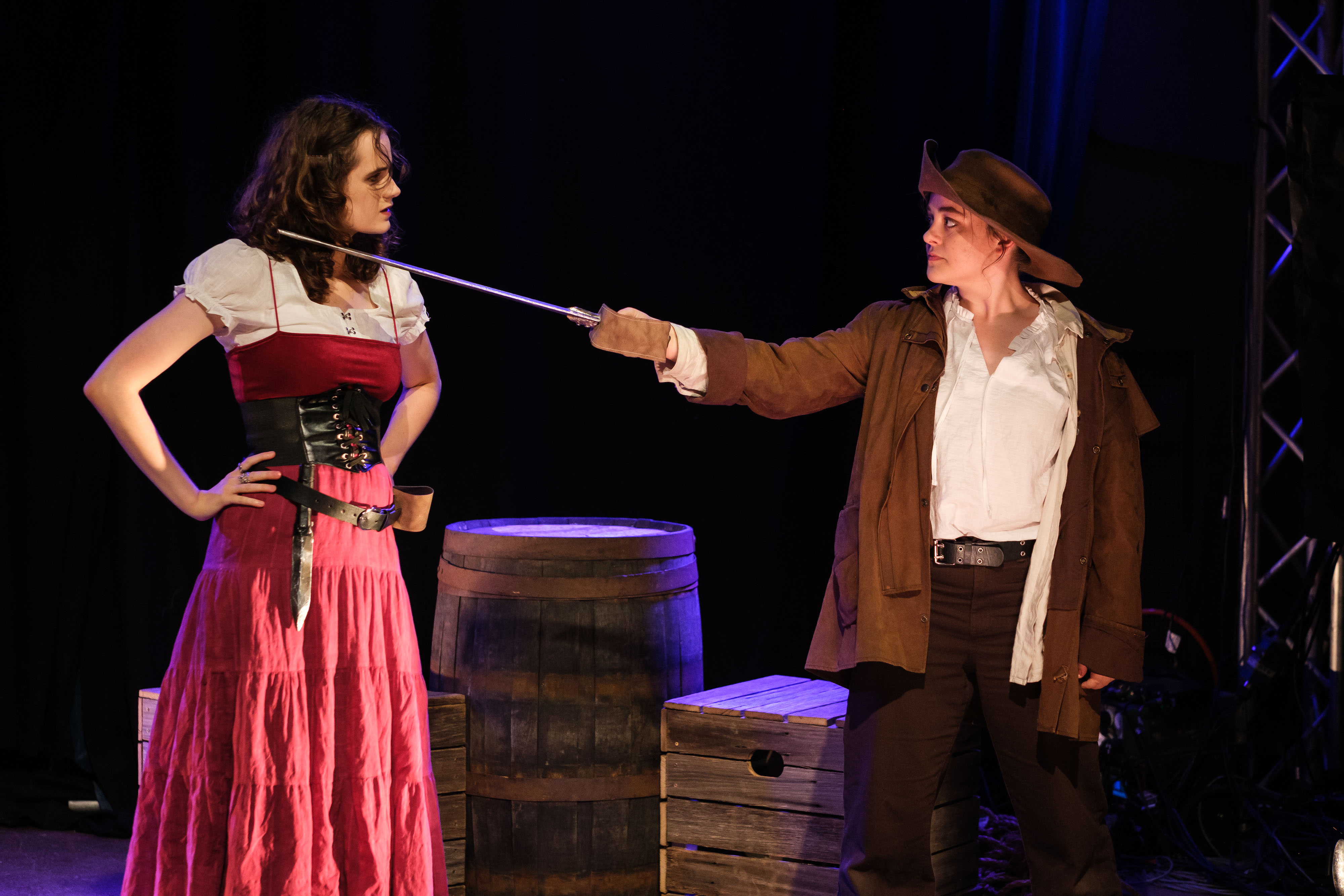
Perhaps you’ve heard of them? I hadn’t. But apparently, Anne Bonny and Mary Read were pirates who sailed the seas in the early 1700’s, an era referred to as the Golden Age of Piracy.

It wasn’t a golden age for women, regardless of occupation. In this terrific micro-musical by Emily Whiting and Aiden Smith, Bonny and Read must navigate a man’s world. Apart from physical dangers, they face heteronormative bigotry and male unwillingness to accept them as equals.

But it’s not a story of victims. It presents two extraordinary individuals who are more than equal to adversity, and to most of the men. Utterly inspiring (if you can forget the fact they were pirates.)

The songs are classy and clever. Melody, harmony and lyric meld brilliantly. And, considering it’s only an hour long, the narrative arc works well.

The songs are performed beautifully, by Anka Kosanović as Bonny, Gabi Lanham as Read, Ben James as Jack Rackham (Bonny’s love interest when the story begins) and Louis Chiu as Jack Bonny (Bonny’s love interest from way before the story begins). They’re supported wonderfully by the crew, played by Roya and Eli Reilly.

In this performance, the music was prerecorded and the vocals sung live. As a result, it was one of the more satisfying musical experience I’ve had – because I could actually hear all the lyrics. (Yes, I know there’s magic to a live band, but it seems SO hard to get the sound levels right.)

One challenge of the piece is, that for the majority of audiences, the world of the pirate is a literary world, an imagined world. Like the Wild West, we know a world something like this did have a historical reality – but in a pirate story we’ve come to expect something other than reality. Pirate stories are romances, in the old fashioned sense: there are wild adventures, larger than life characters, exotic settings, sudden discoveries and extraordinary coincidences. Think Treasure Island. Pirate stories have also become increasingly silly, filled with pantomime villains and absurd accents. Think Captain Hook from Peter Pan. Think Pirates of the Caribbean. Think International Talk Like a Pirate Day (September 19).

The attempt to tell a truthful story in pirate world can ironically (and unjustly) seem like historical naivety.

The solution? Either ground the piece in such a gritty realism that its historical credentials are unquestionable. Or begin the piece by embracing the silly and self-referential, and then transcend it – with characters we relate to and love.

Perhaps the second of these is the best option for a musical. And currently only at an hour, there’s plenty of room for this piece to grow.   

Another element of the imagined pirate world is flamboyance and vitality (think swashbuckling Errol Flynn) and this piece, in its next reincarnation, would benefit from a more confidant, bold physicality.

Regardless of my unsolicited suggestions, the production as it is now is an entertaining piece of music theatre, with serious potential.

Bonny and Read is part of ARTSLAB, a showcase of new works by Shopfront’s young resident artists.

Paul Gilchrist

Bonny and Read by Emily Whiting and Aiden Smith

at 107 Projects until March 24

shopfront.org.au/artslab-2024/

Art for the End Times

16 Mar

The website suggests it’s “A puppetry performance examining the future of AI developed art”, but I didn’t read that before the show.

I don’t read anything before a show.

I’m a theatre reviewer, which might tell you I find reading sort of hard.

During the show, it never occurred to me that it had anything to do with artificial intelligence. That might be indicative of RI (reviewer intelligence) but I’ll blame the fact I couldn’t see at a couple of brief but crucial moments. A combination of overly dim lighting and awkward sight lines meant I had difficulty following the narrative arc.  

On reflection, little puppet Rodrick was, I guess, suggestive of some sort of machine. And despite being forced to experience multiple examples of art, he struggled to create the real thing himself. So, yes, AI.

At the time, I took it all as a more generalised meditation on art. What is its value and purpose? What makes anyone an artist?

Looked at this way, it was fuel for a fiery demarcation dispute. It’s me and my reviewer friends who write about art in abstract terms. (We must be allowed some revenge on beauty.) In fact, I’ve been known to suggest that abstract ideas don’t belong in the theatre at all, that the stage is a place for the concrete, the specific, the particular.

But this is where puppets come in. Puppets are so clearly constructed, so obviously created, that they liberate us from what we call reality but is, in fact, mundanity. No one demands to know the back history of a puppet character – and so they live forward with a vitality that’s utterly refreshing.  No one complains a puppet’s performance is untruthful  – so they liberate us from that stifling euphemism that’s simply Narrowminded for If it’s beyond my experience it can’t be real.

Puppets are creative joy incarnate, and so are perfect for a playful poke at the big problems.

Tom Hetherington-Welch and Oliver Durbidge are company Highly Strung Puppets, and in creating this show, they create magic. Under their direction the ensemble present, with inspiring expertise, multiple forms of puppetry: marionettes, shadow figures and Bunraku-style puppets. Rodrick, who I mentioned earlier, is beautifully given life by operator Stella Klironomakis. The Curator, who collects art and hopes to teach Rodrick how to make it, is operated brilliantly by Jack Curry and the ensemble, and displays an electrifying range of emotions.

The show gains a thrilling texture from its use of projection. These projections, brimming with playful pop culture references, are the artworks from which Roderick must learn. The clips are created by Highly Strung Puppets and demonstrate both their extraordinary skill in puppet creation and their gleeful sense of mischief. Another stimulating use of projection occurs when Roderick creates his first story, and the ensemble bring it to life, there and then, filming the actions of tiny figurines, who then tower above us on the screen.  

Some audience members might feel the exploration of the artistic endeavour too narrow, too inhouse, too much just talking shop.  After all, we’re not all artists, or pursuing a career in the arts.  

But there’s something much more universal in this. Apart from a healthy critique of careerism (that very middle class malady in which we suffer from the delusion we are our job), there’s a glorious exhortation to live.

Perhaps the concluding scene is an allusion to Voltaire’s Candide, but it’s certainly a poignant image of the joy of openness, of artlessness.

Art for the End Times is part of ARTSLAB, a twice yearly event, where Shopfront’s resident artists showcase new works in a festival setting.  In its support of young creators, Shopfront once again proves itself an invaluable element of Sydney’s theatre scene.

Paul Gilchrist

Art for the End Times by Tom Hetherington-Welch and Oliver Durbidge

at 107 Projects until 24 March

shopfront.org.au/artslab-2024/

Image by Clare Hawley

The Woman and The Car

12 Dec

This is the first outing for indie company Ship’s Cat and they’ve chosen an intriguing piece.

Written by Mark Langham, the play presents Dorothy Levitt, a British racing car driver, and it being the early 1900’s and her being a woman, a feminist icon.

Levitt raced cars, motor boats and flew planes – all at a time when women were denied the vote, and even the right to open a bank account.  Langham doesn’t attempt a detailed history of Levitt’s extraordinary life, but focuses on a few days in 1909 in which she commits to write The Woman and the Car, a guidebook for female motorists. The book’s subtitle was A Chatty Little Hand Book for Women Who Motor or Want to Motor and this very Edwardian phrasing hints at the source of Langham’s unusual choice of tone. This is not a stuffy, pedantic bio-play but a type of drawing room farce. It’s littered with brilliant one-liners and terrific comic set ups and, under the direction of Cam Turnbull, the whole thing feels like a parody of those dreadful one room dramas of the early 20th century (which would be rightfully forgotten if they weren’t resurrected with painful regularity by amateur theatre.) The cast adopt the declarative tone and RP accent that dominate such pieces and play the humour brilliantly.

Lib Campbell is Dorothy Levitt, capturing her independent spirit, her fierce wit, and growing sense of desperation. One of the fascinations of the production is Campbell’s immensely watchable portrayal of Levitt’s character arc, from wise cracking swagger to debilitating misery.

Alexander Spinks is Selwyn Edge, Levitt’s married lover and employee of Napier, the company that provided her car. Selwyn functions in the piece as the archetypal obtuse male. He wants all he can get from Dorothy, both financially and physically, but he can’t make sense of her dissatisfaction with the patriarchy. One of my favourite lines is when Selwyn insists on telling Dorothy what it is that she is feeling: “being a woman – that seems to annoy you greatly”. His lack of understanding and empathy are painfully laughable.

Zoe Crawford is Isabel Savor, a female adventurer absolutely besotted with Dorothy. Though wanting to present as a confidant daredevil, Isabel is plagued by insecurities. She is unfulfilled by the limiting gender roles of her time, but struggles to forge a path of her own. She once proudly “shot a tiger in the face”, but her growing discomfort with hunting’s brutality indicates that her adoption of hyper-masculine behaviour was purely reactionary. A shot at genuine authenticity is possible when she admits her sexual feelings to Dorothy, but when they’re not rejected, Isabel has little idea how to act upon them. Crawford plays both the jokes and the pathos wonderfully.

Now, back to where I started: the unusual tone. Dorothy Levitt didn’t race her way joyously to old age; she’s presented as suffering a growing substance abuse problem, driven by both injuries sustained in competition and her bitter frustration at injustice. So why all the jokes? Some of them are, after all, deliberately rather silly. Don’t they just get in the way of a serious historical story?

Well, no. They capture something of the era, with its droll Edwardian humour. They capture something of Levitt’s exuberance. And, finally, they call attention to the fact that this (theatre, society) is a constructed world. (Man-made, if you like.) A story of patriarchal injustice is told in a way that highlights the artificiality of social structures, and so reminds us that what is made can be remade.

I look forward to seeing more from Ship’s Cat Theatre Co.

Paul Gilchrist

The Woman and The Car by Mark Langham

107 Projects until 18 Dec

www.shipscattheatreco.com

Image by Clare Hawley