I don’t believe in theatre awards. (Not that they exist, but that they have much validity.)
But Hangmen by Martin McDonagh won the 2016 Olivier Award for Best New Play, and it’s certainly an extraordinarily well-crafted comedy.
Set in 1960’s northern England, it purportedly features the last hangmen employed by the British Crown. But capital punishment has just been abolished, and at least one of these men feels that now is the time to bask in a little celebrity.
But fame is a lure that attracts some truly strange fish.
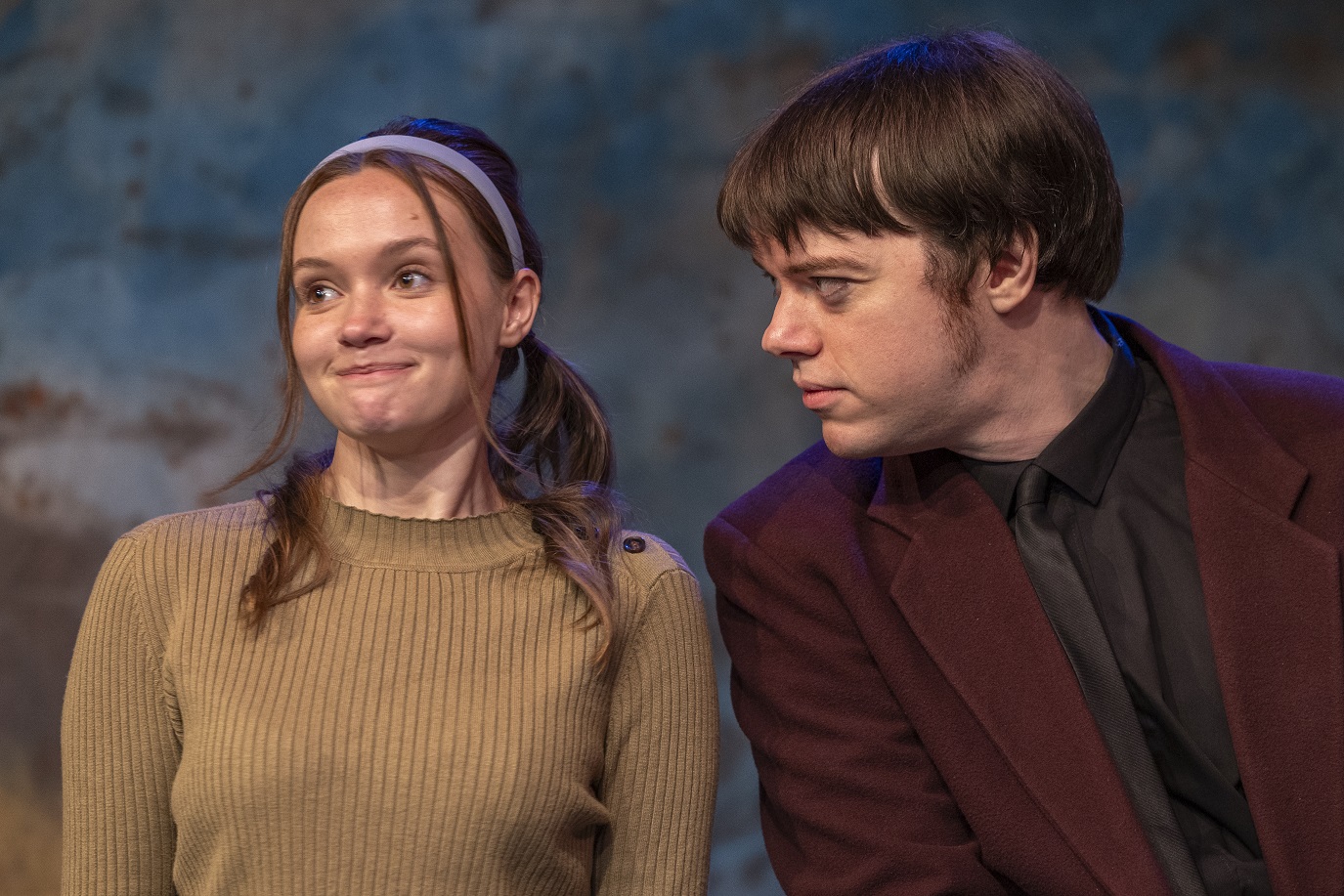
Directed by Deborah Mulhall, this is a terrific production. The entire cast do brilliant comic work. (A few highlights: Nathan Farrow as the bragging, bullying publican and ex-executioner is point perfect. Sonya Kerr, as his wife, beautifully balances the no-nonsense strength of a woman who runs a pub with the vulnerability of a mother only too aware of the dangers faced by her daughter in a brutal, male-centric world. Kim Clifton as that daughter is excellent, offering a marvellous portrait of that quintessentially teenage mix of awkwardness, defiance, naivety and wonder. Robert Snars as the stranger who appears at the pub is superbly menacing.)
Hangmen is a black comedy, and black comedy is a very particular taste. (Not particularly mine.)
How can we laugh at violence?
There is most certainly a strand of spiky satire, a mocking of the inadequacy of those whose administer justice, and a poking at pretension, egoism and heartlessness.
But it’s the last of these – the attack on heartlessness – that undermines black comedy for me. It’s as though we’re being invited to respond to the heartlessness of violence with …. heartlessness. It can feel a little like the pot calling the kettle black (or, at least, somewhat grimy.)
And this show demands a pitiless physicality. Horrific violence reportedly happens offstage, but we must also witness horrendously violent acts onstage. Frustratingly, the spoiler rule reduces me to a nebulous imprecision – but let me say that an act is represented that more sensitive souls may not wish to see, let alone be inclined to giggle at. (But more on this latter.)
Comic violence is extraordinarily difficult: how much do we want the audience to believe it? If the representation fails to achieve verisimilitude, our attention is drawn to this seeming defect. But, if the representation does appear realistic, it’s unlikely to be funny. (Again, more on this later.)
And adding to the challenge of representing such violence on stage is the spell-breaking fear that the stunt may go dreadfully wrong. Safety procedures mean that it won’t – but, as you hastily make that assessment, you’re dragged out of the world of the play.
But back to my annoying More on this later refrain.
Despite my doubts about black comedy, I know the genre is deliberately edgy. It’s meant to make us feel uncomfortable. And discomfort can be soul-expanding, and in our lives of privileged complacency and self-righteous moral certainty, a little expansion wouldn’t do any harm.
Perhaps our laughter at black comedy is just how we hide from a horrible truth. Perhaps it’s merely our way of refusing to acknowledge seriously that a temptation to violence dwells in the human breast.
Or, perhaps our laughter at black comedy can surprise us. Perhaps it can be a delightfully disarming revelation that we too share in humanity’s darker tendencies.
And, if it helps us realise that we’re in this grand mess together, then it’s a good thing.
Paul Gilchrist
Hangmen by Martin McDonagh
until 14 Sept at New Theatre
Image by Bob Seary
 Theatre Red