This is remarkably silly fun, with a truly timely message.
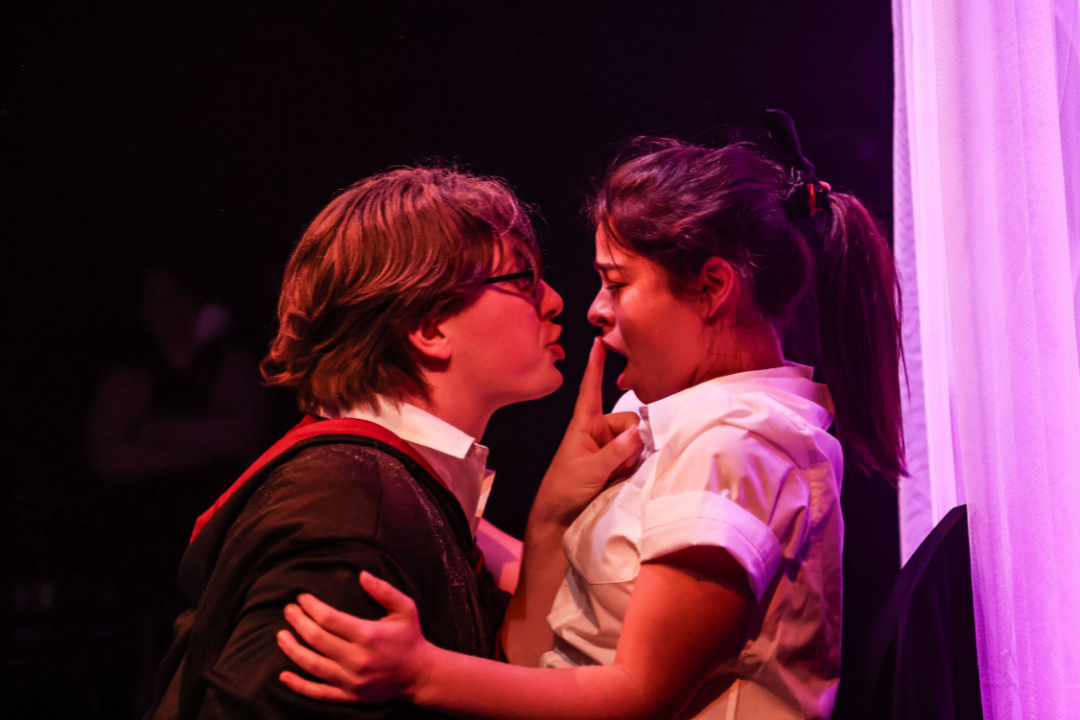
Monty (Rhiaan Marquez) is in Year 8.
This is the second KXT production in a row that’s set in a junior high school (fortunately, for me, that educational experience is still a very recent memory.)
But Monty’s school is different from most: the students and staff are mythological creatures, of the half-human half-beast variety (so maybe it’s not that different from your average high school.)
Monty’s problem is that she is all human. From her minotaur dad (Mason Phoumirath) she got the human half, and from her mermaid mum (Luisa Galloway) she got … we’ll you guessed it.
But if she remains her uncool self, and therefore an inevitable victim of bullying, how will she ever get to pash Harry the Sphinx (Lachie Pringle)?
Michael McStay’s script is delightfully funny, full of terrific one liners and outrageous puns. Director Sammy Jing elicits from his entire cast performances that are big, bold and gloriously audacious.
Except for the sexual innuendos, it’s the sort of script that could be made into a sassy TV show aimed at an audience of the same age (if not genetic makeup) as the characters.
Except for its deceptive depth.
You could read Too Human as a play about high school bullying and the need to be yourself… but that seems a little too easy.
In our age of cancel culture, the pressure to cohere to the group has a wider relevance than the horrors of high school.
And, in contrast to the mythological beasts who are intersectional exemplars (clearly half this, obviously half that), humans are described throughout the play as complex, complicated and contradictory. It’s an insight that gets less airplay than it might. In our age of incessant sociological labelling, we can forget that what’s on the label ain’t necessarily what’s in the jar. And what’s in the jar today may be very different tomorrow. Humans (all of us!) are defined by biology – but we’re also fired by possibility. We’re not so much things as happenings. (There’s something beautifully Renaissance humanist about it all.)
It’s tempting to think of fan fiction as some kooky, contemporary phenomenon.
Driven by obsessions with pop culture, celebrity and the net, we tell stories based on other people’s stories. We happily steal the universe created by some well-known story teller, people it with their characters, and then slip in some of our own – often ourselves.
It might all seem rather bizarre, but it’s actually what most of us do all the time. We make sense of our lives by viewing them through a narrative we didn’t invent. We do this whenever we call ourselves a feminist or a socialist or a Christian, or any other label that marks our participation in a grand narrative not of our own making. And we’re doing it even when we don’t label ourselves. Few moments are lived free of the phenomenon; narrative abhors a vacuum.
In [Your Name] by Kate Bubalo, three fourteen year old girls write fan fiction inspired by those famous children’s stories of a decade or two ago, the ones about the school for wizards. Being teenagers, it’s not long before these stories take on a distinctly sexual nature, and are shared with the wrong people.
Bubalo’s script is very funny. It’s constructed from the juxtaposition of two experiences: the fraught navigation of teen friendships and the wild fantasies of the fan fiction.
Director Lily Hayman understands exactly what she’s working with and pitches the production beautifully between honesty and audacity. The cast deliver wonderfully high-energy comic performances. Evelina Singh as Petra offers a marvellous portrait of a passionate, no-nonsense advocate for Truth, one who’s beginning to realise that advocacy is not as clear cut as she imagined. Georgia McGinness is terrific as Nadine, the young woman who’s already begun to wonder whether Truth is just a type of tale, and that human connections are more important. Lola Bond as Kris – brittle, fearful and full of uncertain affections – induces both laughter and deep pathos. Andrew Fraser, doubling as both the girls’ PDHPE teacher and Larry the young wizard of the fantasies, is superb. His total commitment to the physical humour is a delight. (On a dramaturgical note, some of the teacher’s decisions are ones no sensible professional would make, yet the script only glances briefly at this behaviour. Of course, this creative choice ensures the girls are the real focus, and since few groups have been more thoroughly erased in our culture than teenage girls – either entirely objectified or utterly dismissed – this is hardly a fatal flaw.)
Tyler Fitzpatrick’s design creates a stage world where magical transformations are possible.
And what transformations do we witness?
Bubalo’s joyous play illuminates one of the most important spiritual opportunities Life offers. If we live through borrowed narratives, then maturity is when we become conscious of that fact. Only then are we able to choose our tales deliberately, or dare to ask if the comfort of story can be cast aside entirely.
Reviews are utterly subjective, but I like to maintain the illusion that what I write has some value. One way I do this is by never mentioning myself. I do this in the hope that my voice – that of a specific but unexceptional human being – will be confused with some sort of disembodied, indubitable, God-like authority. Most people seem willing to go along with the charade. After all, they suspend disbelief while in the theatre; how hard can it be to continue that childlike habit when reading the reviews afterwards?
But in this review (or, at least, before this review) I will write about myself.
In this production, dog by Shayne, two characters struggle with mental health issues. One suffers from alcoholism. The other suffers from Obsessive Compulsive Disorder.
I have suffered from OCD for forty years. One might expect my personal response to dog to be one of two types: frustration that the condition I struggle with is not represented in the way I’ve experienced it OR relief that the condition is being represented at all.
But my response is neither. I’m not especially interested in the idea that art is valuable because it represents aspects of the human condition. Those aspects of Life exist regardless of whether we represent them. The need to have them represented seems oddly secondary to the business of living.
Many people will disagree with me. Some of those people will be artists – because we’ve come to see the justification for creating art as the giving of voice to marginalised peoples and their experiences. Other people who disagree with me will assert that art, like abstract thinking, is how we make sense of Life, how we hold it apart from ourselves, at arm’s length, to turn it around in the light, to have a good look at it.
But we also represent aspects of Life in an attempt to control them. And, having suffered OCD for 40 years, I know a little about the temptation to control. (I can’t emphasise enough that I’m making absolutely no comment about what may have motivated the writer of this piece of theatre.)
And here ends talk of me.
Now my review – sorry, the review – of dog by Shayne.
The script is beautifully spare; honest, brave and true.
Kim Hardwick’s direction gives space. Nothing is hurried. The world spins faster than it does in reality (it always does in drama) but here the pace is such that nothing feels artificially concentrated.
The performances are excellent. Jack Patten’s laconic working class Aussie male is pitch perfect, and the slow soak of his alcoholism is both frightening and mesmerising. Laneikka Denne’s victim of OCD has no such gradualism: their performance begins with a representation of the condition that is powerfully pathos inducing, and is then beautifully balanced with scenes in which the character’s deep and full humanity is allowed to gloriously shine.
The titular character is less convincing. But … that’s not necessarily a bad thing. Representations can fail in their portrayal of reality but succeed in something more important: the invitation, the reminder, to exercise imagination and agency.
Some plays have as their central action an epoch changing battle, or perhaps the execution of an unjustly accused heroine, or even a torrid, illicit love affair. For one dreadful moment, I thought this play was going to be about the filling in of a form.
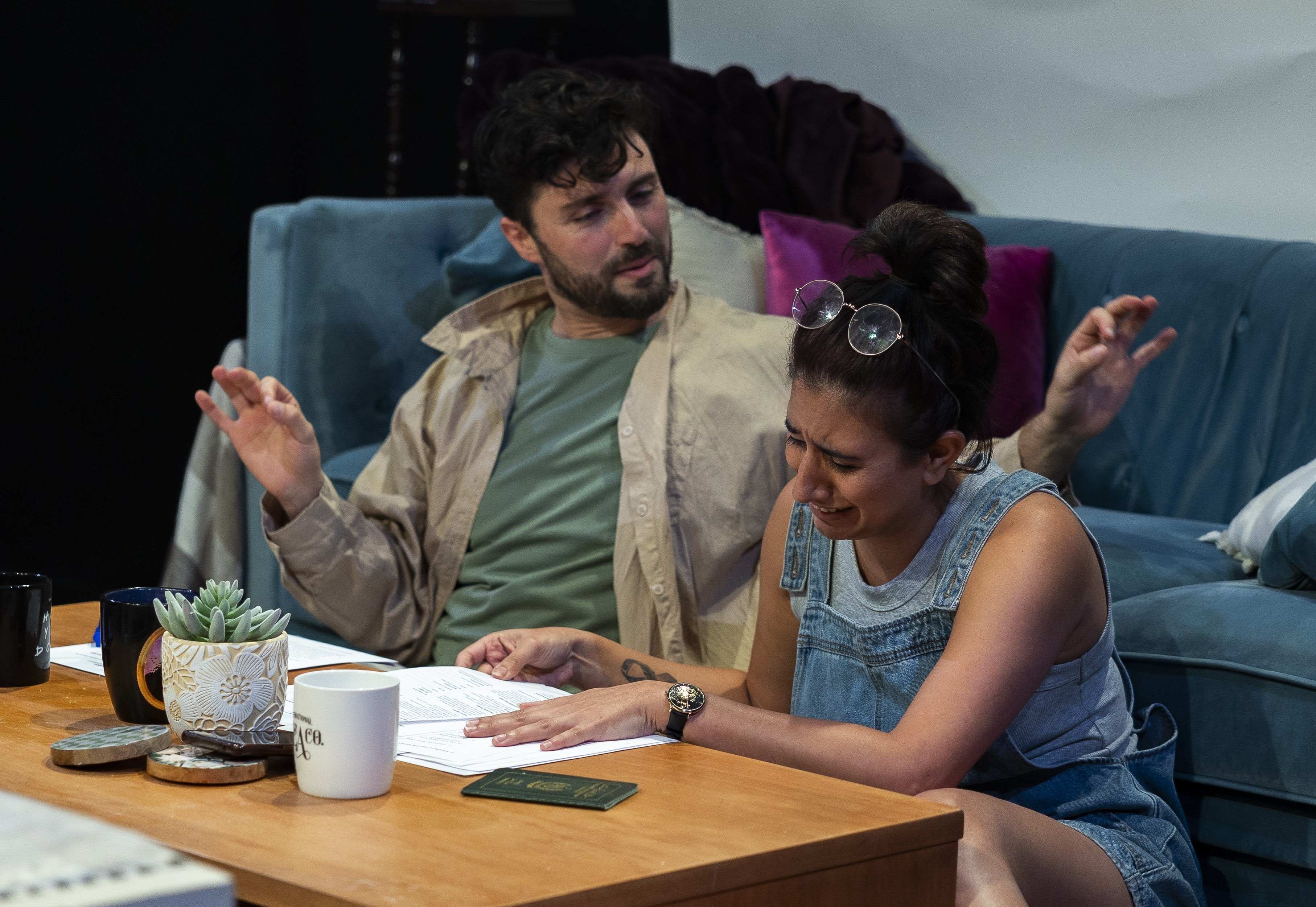
Kaveh is an Afghani-Australian. He is gay, but his family back in Afghanistan are arranging a marriage for him with a woman. His flatmate in Sydney, Amaliah, is Pakistani and she’s keen for Australian citizenship.
You can probably guess the rest.
Antony Makhlouf and Almitra Mavalvala are entrancing as Kaveh and Amaliah.
Written by Mavalvala, the play has elements of rom-com – though not a lot of the “rom”, nor an unwavering dedication to the “com”.
It shares with romantic comedy a lightness of touch and a focus on a single central relationship. Mavalvala allows the friends to remain platonic. And, though she toys with comic set-ups (Joseph Raboy does an amusing turn as multiple characters), she chooses never to flesh out these set-ups fully, and with an easy-to-watch, languid style of direction, the production rests in a type of realism-lite.
Though we do see the friends fill in a form, it’s fundamentally a play about homelands.
Director Kersherka Sivakumaran began the opening night performance with a lengthy and heartfelt acknowledgement of country. (I’ve been criticised previously for mentioning these acknowledgements, as though we should be embarrassed about them, as though they were some sort of personal ablution – necessary but best kept private.) This particular acknowledgement used the phrase “stolen land” and it reminded me, as I watched a play about who is granted the right to remain in this country, that all relationships we have with the land are also relationships between human beings. The manner in which our connection with any land is exercised is necessarily predicated on the acknowledgement of this connection by other individuals. Drama can attempt to portray our relationship with land, but as an artform it will inevitably emphasise relationships between specific people. This is not a fatal inadequacy of the artform. Whether Amaliah can stay in Australia is dependent upon individuals from the immigration department, and on Kaveh.
And previous homelands? The relationships the characters have with Afghanistan and Pakistan? These are represented by phone calls and letters from loved ones faraway. All are presented as voice overs, and this poignantly catches a sense of distance, of absence.
The older generations banished from the stage, we’re left with an image of children alone and lost in a strange land, and in that there’s a terrible pathos, a plea for openheartedness that must be acknowledged.
This is big, bold, beautiful storytelling. And that it’s new Australian work is utterly exhilarating. Thank you Snatched Collective, White Box and KXT.
Mercury Poisoning by Madeleine Stedman is set in the early 1960’s and focuses on the space race between the USA and the USSR. It bounces intoxicatingly between three separate plotlines: the female cosmonaut program in Russia; the female astronaut program in America; and also in America, an African-American actor working on a TV series that is set (you guessed it) in space.
These plots don’t connect, except thematically, and that makes for an enormously rich dramatic experience.
It’s a colossal project and director Kim Hardwick presents it brilliantly. On a fundamentally empty stage, scenes and settings flow smoothly and quickly, one into another, positioning us to delight in discovering the many connections.
I say an empty stage, but that’s not quite accurate. In Meg Anderson’s design, above floats a sky of blue fabric, as thin as silk, ethereal, dreamlike, evoking the mystery, the danger, of space.
Hardwick’s use of movement to suggest space flight is a visual treat.
Costumes by Anderson are also wonderful, successfully transporting us to the multiple worlds of the play.
And an extra joy of a piece like this, part of its thrilling theatricality, is as actors double, they switch accents, a feat the performers navigate splendidly, thanks to accent and dialect coach Linda Nicholls-Gidley.
The entire ensemble is superb. I’ll describe some, but not all, of the magic.
Violette Ayad excels as Valeria the cosmonaut, achieving an absolutely mesmerising balance between vulnerability and courage.
Her counterpoint in the States, Molly, is played by Teodora Matović and her portrayal of determination and confidence is inspiring.
Shawnee Jones as a black actor in a white industry is magnificent, offering a portrait that perfectly blends exuberance and anger, and informs both with a searing intelligence.
Playing a musician, Tinashe Mangwana glows with an almost childlike vitality, and this is beautifully counterpointed with his later turn as sombre House Committee chairperson.
Jack Richardson as cosmonaut Yuri and as the lead actor in what feels like a Star Trek parody is terrific, finding in both roles the discomforting complexity within those we glibly label heroes.
Similarly, Shaw Cameron as the idolised astronaut John Glenn powerfully depicts the patriarchal menace lurking behind male charisma. When compared to his Russian cosmonaut and lover, it’s an especially fine polyphonous performance.
Brendan Miles skilfully presents authority figures in all three worlds of the play, effectively suggesting the multifarious ways power is exercised.
As a senator’s wife and would be astronaut, Sarah Jane Starr flawlessly captures class, privilege and that disarming charm of the American creed of positivity.
Melissa Jones stuns with a portrait of a famous American pilot who threatens to kick the ladder away from the women who seek to follow and transcend her.
Back to the script. On its most obvious level, we’re presented inspiring stories of marginalised people seeking equality. But what makes Stedman’s play extraordinary is the depth of the treatment of what has become so often in our theatre a narrative cliché.
I’ll explore this depth in terms of the choice of setting. By juxtaposing women seeking equality in different societies, we’re invited to see both the universality of the phenomena and the multiple ways it’s manifest. There’s a refreshing brashness to the American women, an energetic individualism, but this comes into collision with the House Committee’s simple question Does our society need you in space? In Soviet Russia, individualism is discouraged, and the women must speak perpetually, and perhaps sometimes genuinely, of serving the state.
Further contrasts are developed, digging deeper into the relationship of the individual with the community. The Russians posit We must follow the rules so the next generation can break them. The Americans ask Can you be it, if you don’t see it?
It’s all powerfully suggestive of the tension at the heart of modern Life: we feel we personally deserve equality, but the granting of that equality is at the whim of others.
And that’s where the time period in which this play is set is so provocative. The 1960’s were different. Think the speeches of Kennedy and of Luther King. Sixty years on, the zeitgeist has changed. The 1960’s dreamt of equality. We demand it. They said We could make this happen. We say Why hasn’t it happened yet? Our attitude is completely understandable, but I suspect much can be learnt from theirs. If your equality is at the whim of others, then you have to get the others onboard. Inviting them to share a dream might do this more effectively than telling them they are evil. Visions unite, guilt divides.
But, you could respond, it didn’t work in the 60’s.
Perhaps. But to appropriate Chesterton, the hippy ideal was not tried and found wanting; it was found difficult, and left untried.
Can it be tried now? Obama, in his campaigns, peddled hope with success.
I’m not suggesting Stedman’s play necessarily asserts all this, but through her radical choice of setting, the debate on strategy – how we are to make a better world – is gloriously refreshed.
Similarly, by her juxtaposition of a TV series set in space with the actual space race, the issue of the pursuit of equality is given true range. Equality might be spoken of from the mountain top, but it only has meaning when it comes to the people of the plain. In a brilliant final scene, performed by Mangwana and Jones, they argue the value of her silly TV job, and we’re asked to consider whether you need to go to the moon to change the world.
This is a fantastic production of a tremendous play, and one of the most stimulating pieces of theatre I’ve seen for a long while.
Sacrifice is no longer fashionable. Our post-Christian society rejects it. To us, it has the whiff of exploitation, the distasteful scent of individuality burnt as an offering to duty, a duty perceived as limiting, dehumanising, imposed.
But sacrifice has been valorised by cultures long before the Christian behemoth.
Rob Drummond’s superb play Grain in the Blood explores the concept of sacrifice. Initially, it does this via a modern farming family’s connection with the tradition of the Grain Mother. This ancient pastoral deity requires a sacrifice to ensure the wellbeing of the community. Weave a Grain Dolly, fill its stomach with blood, leave it in the fields. The Mother is appeased …. and so all remains right with the world. (Jam can substitute for blood, if you’re a squeamish modern snowflake.)
The family continues the tradition in the way you might leave out a carrot for Santa’s reindeer; enjoying the ritual, but never believing in it. Or, at least, that’s what they thought they were doing, until one terrible night twelve years ago….
This tight 80 minute play creates suspense by making us wait for answers. What happened on that fateful night?And what exactly is wrong now with twelve year old Autumn? And how is it that her recently returned father has the potential to save her?
This saving has to do with (you guessed it) sacrifice, but not the magical kind exemplified by the Grain Doll ritual. Instead it’s sacrifice as our small, disenchanted world envisions it: a utilitarian* ethic that posits pointy questions, ones like Would you sacrifice one bad man to save one good one? What if it were ten bad men? Would you sacrifice one stranger to save one person you love? These questions are hypothetical, of course. Until they’re not.
Despite its conceit of withholding information, the play is predominantly presented in a naturalistic style. I say despite, because by making us wait for answers, we’re constantly pulled out of the immediacy of the moment, constantly invited to ask things like Why did she say that? What dark event is she referring to? It’s not an uncommon trick in modern theatre, though it’s a difficult one to pull off, and one that puts pressure on the actors to play the moment while trusting the whole.
Drummond’s rich and clever script most definitely pulls it off, and guided by director Victor Kalka, the cast rise to the challenge. Siobhan Lawless powerfully plays the matriarch driven by a steely determination. Ciarán O’Riordan as the returning father offers a poignant portrait of a man buckling under the weight of his past. Genevieve Muratore as Violet delivers a fascinating balance between the warmth of flirtation and the chill of vengeance. Nick Curnow as Bert, an outsider to this clan, an official on business, movingly portrays the dislocation experienced when procedure offers no guide to the wilderness that is reality. And Kim Clifton gives a wonderful performance as twelve year old Autumn, infusing the play’s few moments of theatrical monologue with a marvellous transcendence, only to return to the naturalistic scenes an angry teenager, bewildered by pain and breaking out, because she can, because it’s time to do so, because it can’t matter anymore. Her swearing is hilarious, but in her profanity is also deep pathos.
This brilliant production asks us to think about sacrifice, its nature, its value. And in a most aesthetically provocative manner, it does this through sacrifice – the ancient type. By initially sacrificing full disclosure, by asking us to go without answers, magic happens on stage.
*I acknowledge that my use of this adjective is not technically correct. I’m simply using it to denote any system that reduces ethics to a tallying of figures.
This is such a good production that I was bitterly disappointed when I finally realised it wasn’t new work. (Before I go to a show I don’t read the press release or indeed any of the marketing; I simply check the date on the invitation, and if I can go, I go.)
Clare McIntyre’s Low Level Panic premiered at the Royal Court Theatre in 1988, but coming out of KXT on Sunday evening I didn’t know that. What I did know was that I’d just seen an extraordinary piece of theatre.
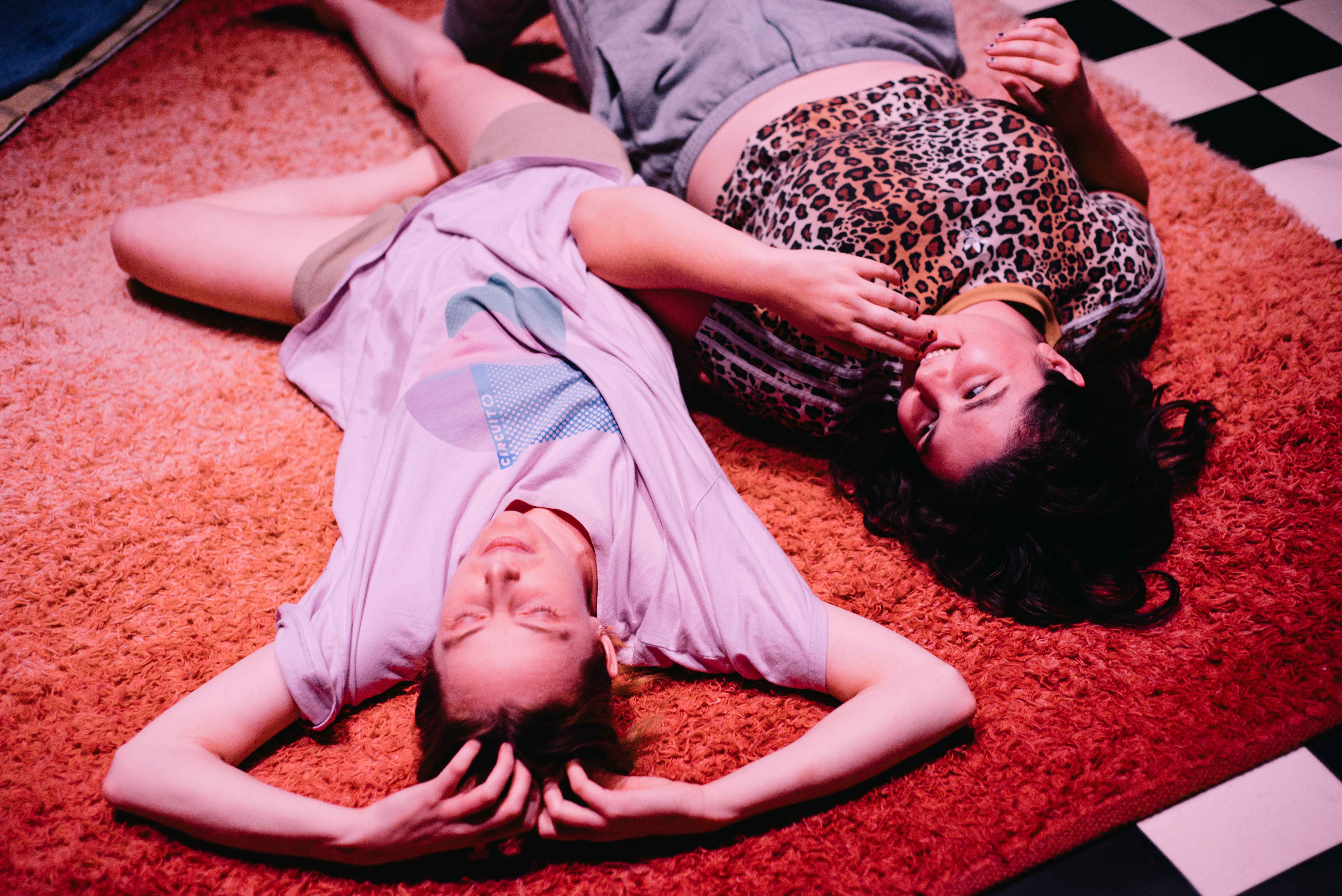
Set in the bathroom of a share house, it presents three women in their early twenties. Suiting the setting, the focus is on body image and sexuality. But most excitingly, it’s about thoughts and their awkward relation to reality.
The play is so powerful, so poignant, because it captures perfectly the way young adults have to navigate, for the first time, the tension between their rich, burgeoning inner-lives and the frustrating, frightening outside world.
Sometimes this tension is expressed in the frustration that reality doesn’t match our sexual fantasies. But as Jo says, played with gleeful and totally relatable honesty by Charlotte De Wit, thank God no one knows your thoughts.
Sometimes this tension is expressed in the terrifying awareness that you have no influence over other people’s thoughts, and that it’s not only your thoughts but theirs that create the world in which you must live. This is explored brilliantly by Marigold Pazar in the role of Mary.
Sometimes this tension is expressed in the desire to control, and Megan Kennedy gives a hilarious performance as uptight Celia.
Director Maike Strichow achieves a wonderfully thrilling texture through the juxtaposition of performance styles, giving Kennedy permission to create a gloriously larger-than-life Celia and allowing Pazar and De Wit to present a simple, raw truthfulness.
I recognise these women. Considering the age of the play, you could say I grew up with them. But the fact that HER Productions has been drawn back to this play highlights its enormous and ongoing relevance.
McIntyre writes absolutely superb dialogue. And one of its splendours is that its fad-free. Too often contemporary plays about these type of issues slip into theoretical language, and I’ll be direct: I don’t think that sort of language belongs in theatre. Don’t just throw around theoretical terms like the male gaze or the patriarchy. Show me how they operate. Leave lazy abstract words to reviewers, and do what the artform does best: show Life as it’s actually lived. Show me the women who suffer, and show me their extraordinary vitality, for in these beating hearts, strong and true, we’re offered a vision of a better world and how it will come.
And that’s what this magnificent production of this beautiful play does.
(In which my desire to appear erudite is apparent in the pretentious surfeit of quotes from other texts.)
Kenneth Grahame’s novel was published in 1908; it’s a perfect piece of Edwardian charm.
This is the literary world in which Rupert Brooke could dream of death on the Western Front in these words:
“If I should die, think only this of me:
That there’s some corner of a foreign field
that is for ever England.”
Brooke also imagined that, in the afterlife, his soul would give back to the Divine
“the thoughts by England given;
Her sights and sounds; dreams happy as her day;
And laughter, learnt of friends; and gentleness,
In hearts at peace, under an English heaven.”
In this gush of misty positivity, Brooke omits any description of his mangled, war-broken corpse.
(In all fairness, this oddly parochial era did also produce Conrad’s Heart of Darkness.)
Alan Bennett’s very clever theatrical adaptation of The Wind in the Willows was first performed in 1990 at the National Theatre. Bennett sticks to the key elements of the story, but he loses Grahame’s absolutely delightful narrative voice. Here’s a sample of how such prose might leave an honest dramatist to weep in envy:
“He (the Mole) thought his happiness was complete when, as he meandered aimlessly along, suddenly he stood by the edge of a full-fed river. Never in his life had he seen a river before—this sleek, sinuous, full-bodied animal, chasing and chuckling, gripping things with a gurgle and leaving them with a laugh, to fling itself on fresh playmates that shook themselves free, and were caught and held again. All was a-shake and a-shiver—glints and gleams and sparkles, rustle and swirl, chatter and bubble. The Mole was bewitched, entranced, fascinated. By the side of the river he trotted as one trots, when very small, by the side of a man who holds one spell-bound by exciting stories; and when tired at last, he sat on the bank, while the river still chattered on to him, a babbling procession of the best stories in the world, sent from the heart of the earth to be told at last to the insatiable sea.”
But Bennett’s dramatic treatment does allow him to add even more jokes, and the postcolonial context encourages him to makes more explicit the very English nature of the tale, and to gently mock it.
Bennett also gives a clearer narrative arc. The original novel is episodic, but Bennett introduces the villains (the weasels, stoats, foxes and ferrets) early on, in preparation for the final showdown with the heroes (a mole, a water rat, a badger and a toad.)
To any audience, familiar with the book or not, this anthropomorphism is its most distinctive feature. The characters are animals of the English countryside, but they speak (English, obviously) and live very English middleclass lives – ones filled with picnics, motoring and recreational boating. Is the suggestion that there’s something unquestionably natural about this way of life?
Grahame’s idyll was certainly a curious tale to tell at a time when England’s empire covered more than half the planet. Perhaps it was an elegy for lost innocence. Perhaps it was a smoke screen. (Though Tolkien’s diminutive hobbits – with their burrows, their penchant for comfort, their unexpected resilience, their fierce loyalty – are surely direct descendants of Grahame’s heroes. And despite Tolkien’s proclaimed dislike of allegory, this English myth of the courage of the little people came into its own in 1940.)
Whatever the case, Grahame’s story has undeniable charm, and has long been a favourite of children’s literature, a tale that speaks to both little ones and their elders.
Directed by James Raggatt, this production brims with magic. A bare stage is filled with exuberant performances. Michael Doris is terrific as Toad, presenting a character who is gloriously self-centred, eyes ever open to a world of adventure, and heart closed to anyone but himself. Lachlan Stevenson as the serious and sensible Badger has a commanding stage presence and offers a splendidly rich vocal performance. Miranda Daughtry as the weasel gives a perfectly hilarious portrait of the small time crime boss. Ross Walker plays Albert the horse wonderfully, poignantly expressing the patient resentment domesticated animals surely must feel towards their supposed owners. (The role is a superb invention of Bennett’s. He gives the horse a name and voice, and by giving him a burgeoning political consciousness, mischievously prompts us – as we watch a play soaked in anthropomorphism – to closely consider the nature of our relationship with our animal cousins.)
The use of the space is magnificent, especially as the cast, hooded like puppeteers, effectively create cars, trains and boats, all from very simple props.
Occasionally the pace falters. Perhaps a more vigorous soundscape might have helped (and that’s from someone who usually finds them superfluous at best, and cheating at worst.)
And in case you’re uncertain about spending an(other) evening with a pack of adults in animal onesies, rest assured the costuming by Isabella Holder is beautifully simple and gently evocative.
A playful paean to friendship and pleasure, this is a fun show.
Paul Gilchrist
The Wind in the Willows by Kenneth Grahame (adapted for the stage by Alan Bennett)
The future is our home country; we’ll do things differently there. (Apologies to LP Hartley*, but more so to my readers who might have to wade through the entirety of this review in order to make sense of what I’m getting at.)
One of the greatest cultural revolutions of the last millennium was that lead by Freud. Because of he and his followers, we look to our personal past to explain our present. I am like this because I was treated like that. Maybe it’s true. Whatever the case, it’s a perspective that greatly impacts the modern world, even trivialities like theatre.
It’s extremely common for modern plays to look backwards. The heroine eventually realises (or remembers!) something about her past (that is before the events depicted in the play) and this motivates her to either accept that something or to transcend it. If you want a point of difference, consider Shakespeare. Macbeth and Lady Macbeth have pasts (who doesn’t?) but the Bard doesn’t dwell on their back history to explain their actions. These are explained, in so far as they’re explained at all, by current desires and influences. (I’ve deliberately chosen the Macbeths as my example because modern directors love to read Lady Macbeth’s line “I have given suck and know how tender tis to love the babe that milks me” as an explanation for her extraordinary behaviour. Lady Macbeth has obviously lost a child and that has driven her to this – which might make sense if it wasn’t for the fact that the premodern infant mortality rate was so high that virtually every woman had lost a child, and yet only a small percentage of women went on to become regicides.)
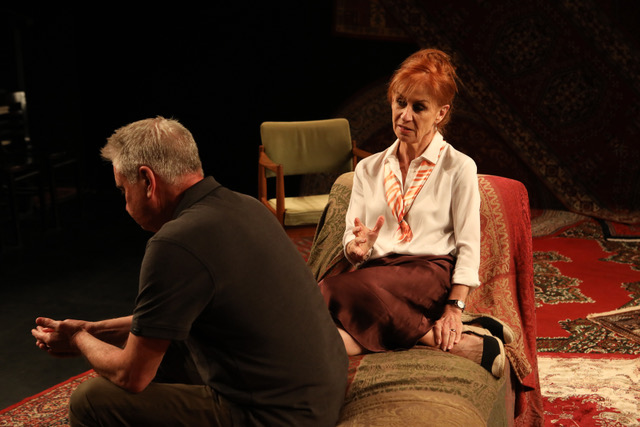
Stephen Sewell’s The Lives of Eve is a fully conscious exploration of the tradition of the unconscious (or at least our focus on our personal histories.) His protagonist, Eve, is a Lacanian analyst. We are shown her sessions with patient, Sylvia. There’s even a couch. Sylvia suffers from sexual disfunction. (I’m prevaricating: She can’t come.) It’s a brave male dramatist who writes about the female orgasm. (No doubt, if I was to do so, some wag would gleefully quip that not only had I never had one, I have probably never been in the room when one was happening.) In addition to the challenges of Sylvia, Eve has trouble at home; she and husband Paul are drifting apart, driven by unequal sexual desires. Fortunately, Eve gets support from her dead mother. Yes, the past, again. There’s a lot of talk about the past.
Directed by Kim Hardwick, the cast are eminently watchable. Helen O’Connor as Eve offers a powerful portrait of strength seeking depth. Louisa Panucci effectively presents Sylvia as the swirling whirlpool that is the growing soul: attraction competes with repulsion, inhibition with bluntness, doubt with certainty. Noel Hodda as Paul superbly depicts affability and affection in their oh so painful collision with a hostility that’s incomprehensible. Annie Byron as Eve’s departed mother, Madeline, is charmingly nonchalant and ethereal.
Sewell’s characters are extremely erudite. They quote or reference Lacan, Freud, Augustine, Plato, Aristotle, Sappho, Donne, Shakespeare, Einstein, Badiou and Grieg (though, admittedly, the composer just happens to share his name with one of Eve’s friends.) I think it’s absolutely wonderful when dramatists present Australians as educated and intelligent. (It’s like watching a Marvel movie: sure, the suit couldn’t actually help Iron Man to fly, but it’s a fun fact to forget.)
A lot of top shelf ideas are shared. Marvel fans might suggest it’s merely psycho-babble vs socio-babble. (Lacan on language vs gender generalisations.) If it takes a brave male playwright to write about the female orgasm, you’d have to be a superhero to take on philosophy in Australian theatre.
But Sewell knows what he’s doing: it’s rich and provocative, and I’ll enjoy thinking about this work for some time to come.
I want to mention two moments that stood out for me. At one stage Eve suggests (something like) we are both mysteries and disappointments to ourselves – and to other people. It’s a beautiful, deeply humane encapsulation of what it is to be alive. Similarly, in argument with Sylvia, Eve asserts that some problems might simply not have solutions; our politics can take us only so far; being conflicted and confused is the human condition.
So, despite being a play interested in how our personal past informs our present, Eve becomes a model for maturity, for both acceptance and transcendence. The future is our home country, because our dearest dream is that we’ll do things differently there.
But, in 2014, it was a Lindt Café, and the scene of a siege in which three people, including the gunman, died.
This is the background action to Katie Pollock’s Human Activity. Somewhere off stage, this horror has happened, or is happening.
The stories we follow, the ones in the foreground, are also about male violence. A woman seeks an abortion but must do it secretly due to her controlling husband. Another now lives on the street because of abuse from her man. Another woman is fired when she complains about sexual harassment. An elderly couple trace the route taken by their niece on her final day; her partner’s malicious behaviour has driven her to take her own life. Linking all this with the Lindt siege, an act of terrorism, is deliberately and powerfully thought-provoking.
Lest this seem all too dire, there’s much humour and gloriously understated poetry. There’s a group of teenagers whose dialogue is pitch perfect. On occasion, this group morph into a flock of birds. Theatrical playfulness in combination with concerns of vital importance is what makes this a thrilling example of new Australian work.
Director Suzanne Millar wisely mines all the diverse elements of this rich script, and offers us a cast that reflects the diversity of this rich city of ours.
And there’s a further motif: loss. Belongings are lost, as is a sense of belonging. Species are lost. Innocence is lost. It’s a deeply humane vision and a courageous one: the acknowledgement that the world flows in one way, and that way is often not the way we’re looking. It’s a vision beautifully encapsulated in the most surprising of closing monologues.






 Theatre Red