Tag Archives: KXT

Party Girl

26 May

“I don’t believe in anything,” says a woman dressed as a fairy.

It’s a provocative line, in several ways.

It encapsulates the key tension driving this very funny piece: an earthy, jaded, sharp-mouthed protagonist pretends to be a magical, fantastical being. It’s how you add some glitter to children’s parties. It’s also how you pay for your next bottle of vodka.

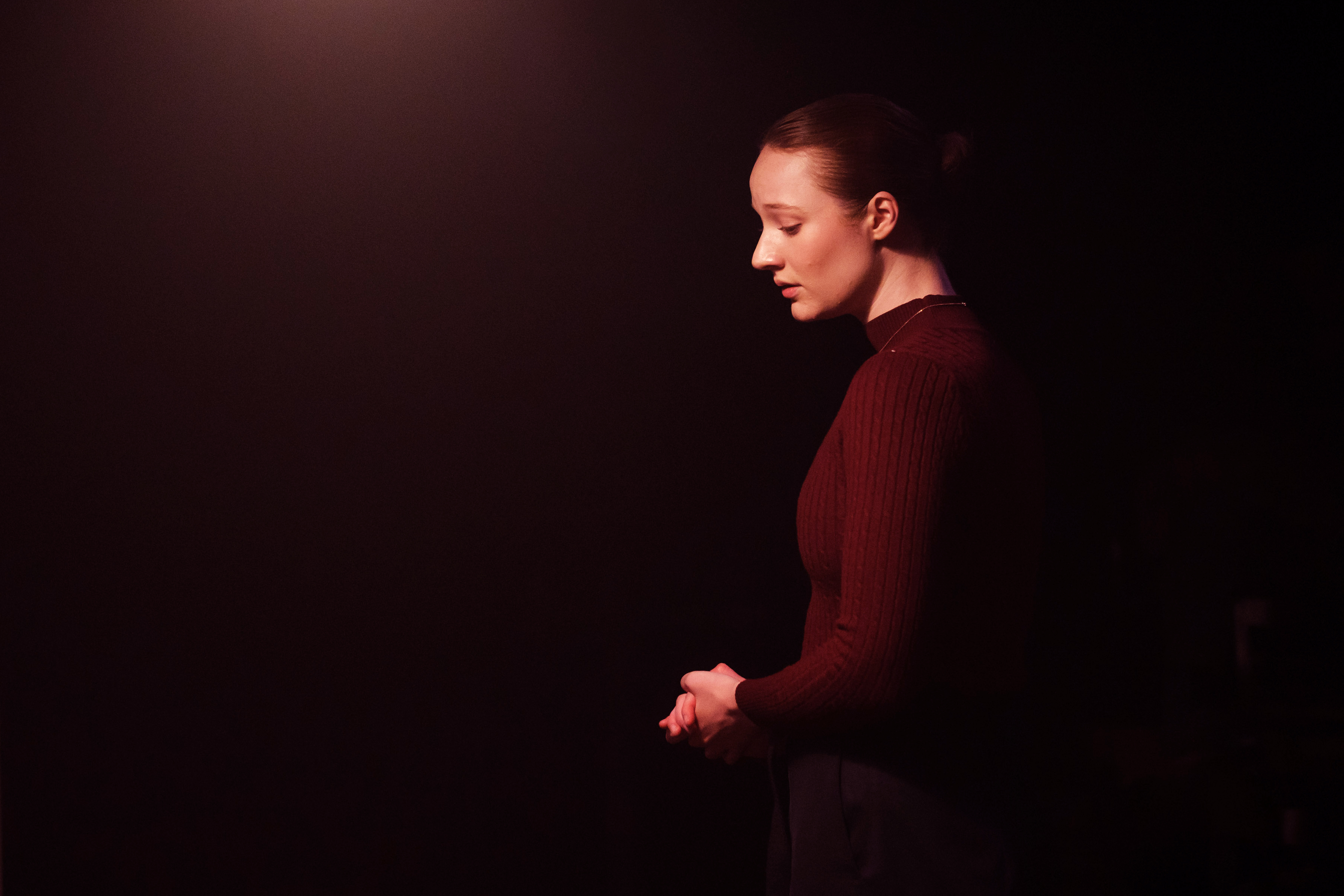
Lucy Heffernan, who wrote and performs Party Girl, is extraordinary. Her magnificent stage presence, her marvellous voice, her mean electric guitar all result in this under-an-hour show being a theatrical joy.

Fairy Sparkles tells of a day performing at kid’s parties. Linking her tale together are references to the rules of being a fairy. They are nothing but practical: Arrive in costume. Don’t be late. Don’t park too close to the birthday girl’s house. Don’t smoke.

But it’s not just the contrast between fictional fantasy and cynical pragmatism that fuels the show. At home, Mum is falling apart, a victim of mental illness. Where’s the magic in a world where this can happen? It’s hard to be ethereal when shit’s so real.

Director Lily Hayman uses the KXT traverse stage beautifully. A blank space, it slowly fills with detritus. It’s lit evocatively by Tyler Fitzpatrick, her design suggesting both rock performance with haze and the confusion of conflicting visions of life.

Linked to the whole pub rock vibe is the show’s awareness of class inequality, reinvigorating in a theatre scene currently focussing on alternative theories of privilege.   

Which oddly enough, brings me to the other way in which “I don’t believe in anything” is a provocative statement.

It’s a line that draws attention to the glorious ambiguity of that word believe. Believe to be true or believe to be of value? A thing can be true but not important (or helpful.) Can things be not true but important (or helpful)?

Yes, that’s what magic is. Not the magic that happens to you; I mean the type you cast yourself.  The world we experience is the spell we cast….up to a point. Where exactly that point is, the point where our personal magic ceases and the brute force of reality takes over – and it will – is a thing to argue. And a thing to test.

Paul Gilchrist

Party Girl by Lucy Heffernan

at KXT until May 28, as part of the TAPE OVER Festival

www.kingsxtheatre.com

Image by Clare Hawley

Mortel

27 Apr

As a writer, one might assume I have a deep love for language (though, being a theatre reviewer, one might expect that love to be expressed in the form of a disturbing fetish for cliché, banality and formulaic structure.)

But it’s not all about language. One of the glories of theatre is that it combines language with physicality. There aren’t just words, there are bodies saying those words. And what those bodies do as they say the words, and what they do when they’re not saying the words, produces a splendid complexity. (I love that in theatre a character can say how much she adores her husband at the very moment she is seen making love to someone else.)

What happens when language is taken out of theatre? (It’s worth noting, that in the rehearsal room of new work, the most common alteration to the text is the cut: I don’t need those words, says an actor, to present that emotion.) What happens in a performance when movement is privileged? What happens is a beautiful reminder of physicality: its richness, its expressiveness, its significance.

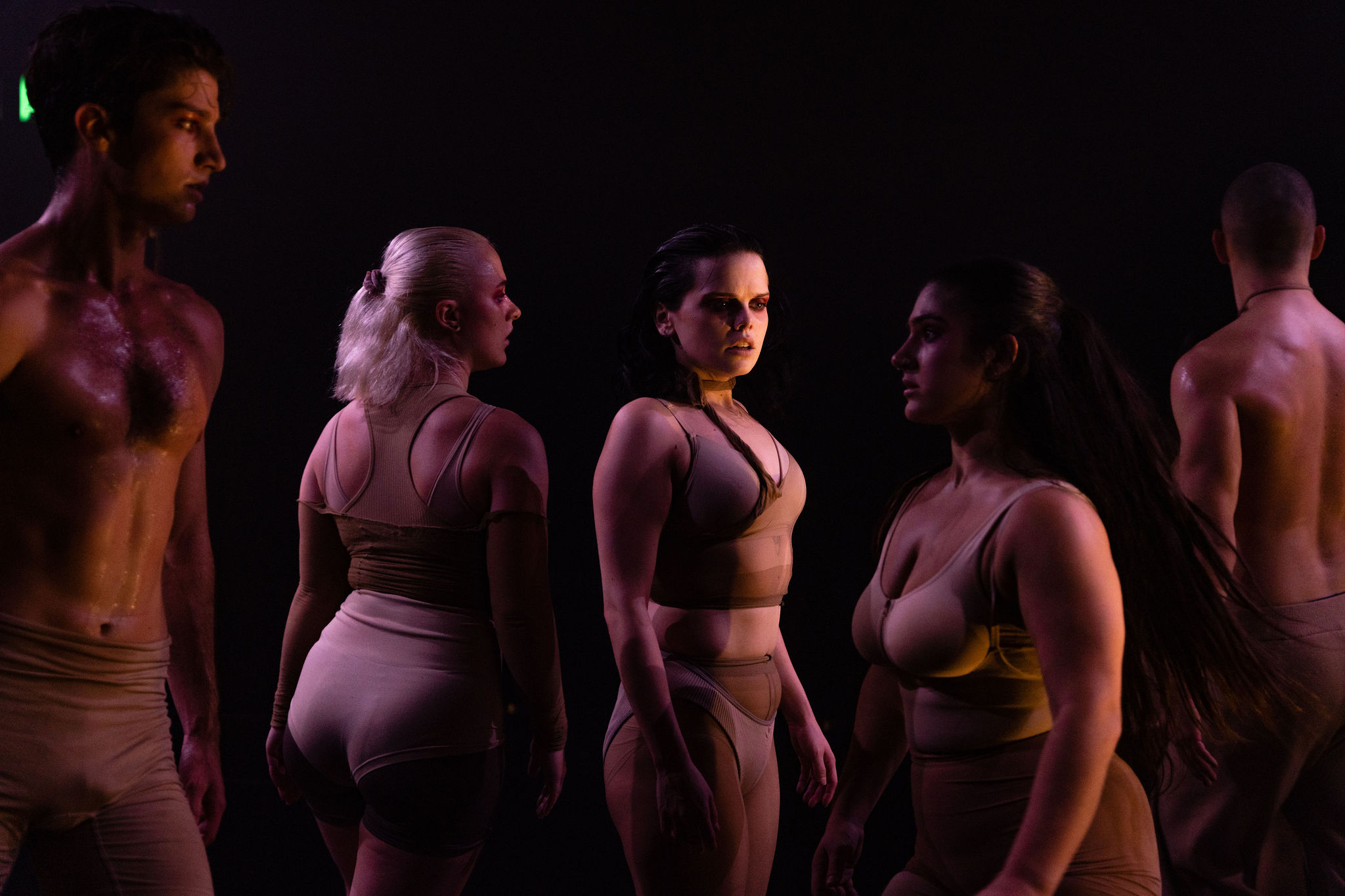
That’s what Mortel is. This 60 minute piece of physical theatre is a paean to the body; its energy, its strength, its beauty.

Directed magnificently by Steven Ljubović and performed by a gifted cast (Phoebe Atkinson, Gemma Burwell, Abbey Dimech, Giani Leon, Meg Hyeronimus, Levi Kenway, Aiden Morris, Bella Ridgway, and Shannon Thomas) Mortel highlights the experience of embodiment, of what it is to be a body. This might seem a strange thing for me to assert, but as Wittgenstein suggested “The human body is the best picture of the human soul”. Witnessing the extraordinary things the body can do is a reminder of possibility, of potential, of the flame that burns within us (which I think is a pretty passable definition of the ineffable entity that is the soul.)

It’s probably not accurate to call Mortel a dance work, but the cast interact beautifully with Kieran Camejo’s evocative and ingeniously varied soundscape. And with the space lit magically by Clare Sheridan, Ljubović creates powerful images, ones of passionate interactions and of poignant isolation. Both the initial and concluding tableaux are deeply moving expressions of the essence of individuality, that blessing and burden shared by us all.

Paul Gilchrist

Mortel directed by Steven Ljubović

Presented by Merak in association with bAKEHOUSE Theatre

At KXT on Broadway until April 29

kingsxtheatre.com

Image by Abraham de Souza

Cherry Smoke

2 Apr

Theatre is a weird art form. (Though, they all are, if you think about it.) What’s odd about theatre is the predominance of interpretive artists. Compare it to visual arts and literature, which are filled with creative artists.

Let me explain. If you buy a play from overseas, or dip back into the canon, no-one in your team is doing the original creative work. Everyone is interpreting what already exists. And, in theatre, this is par for the course. (It could be argued it’s what actors and directors always do, no matter from where the play is sourced.)

In theatre, no-one blinks an eye when you choose to produce, say, Hamlet … again. What is important is your take on the play. On opening night your hope is not that someone will say something like “Where’s the playwright? I got to meet the guy who absolutely nailed the debilitating chasm between the brutal simplicity of action and the rich ambiguity of thought.” No, you hope the buzz is more: “Swahili speaking puppets? What a brilliant choice!”

As result, we get what I call “cover theatre” – in the way a band is said to do a “cover” when they play a song they didn’t write. Those sort of musicians are usually relegated to RSL clubs, but fortunately, in theatre, there’s no such privileging of originality. (And, please, read to the conclusion of my review before concluding my attitude to this phenomena.)


Consider Crisscross’ production of James McManus’ Cherry Smoke. The play is American and has been kicking around for a decade or so. But, here and now, director Charlie Vaux’s production is an invitation to an intriguingly foreign world. It’s brutal; these characters are from the south of the US, and they’re seriously down and out. Cherry (Meg Hyeronimus) is homeless, effectively abandoned by her deeply damaged, and damaging, family. She looks for more in Fish (Tom Dawson), her “angel”, but he was forced into the boxing ring as a child, and so violence, and the incarceration that often follows, is his existence. He knows there’s something wrong with the “wires” in his head. Duffy (Fraser Crane) tries to guide Fish, but it’s a challenging task, especially when his garage barely breaks even and his own relationship with Bug (Alice Birbara) is troubled. She desperately wants a baby, and her childminding and occasional midwifery is, in Fish’s words, like being an alcho working in a bar. She “hates God” because He won’t give her what she feels she needs.

How do you find hope in such a world? Well, Cherry espouses a sort of soft-metal romanticism. It’s tough, sensual and hyperbolic. She calls Fish “Baby” a lot, and can’t eat, or breathe (she says) without him. She claims Jesus once lit her cigarette, with His finger. The smoke was cherry coloured. She offered Him one, but apparently He’s trying to quit. Her conclusion: He’s broken – just as they all are. There’s little more religion than that in the play, but the sequence evokes perfectly the pathos of weaving meaning from scraps.

We do cover theatre like this because it reminds us of basics. The world of the characters is one in which a “meanness” swirls endlessly, and lands randomly, refusing to be shaken off. In this world, posited by McManus and brought back to life here by Vaux and his committed cast, we meet again those age old problems of suffering and evil.

And so, in KXT’s cool new space in Broadway, we’re invited to a foreign place, to be reminded of our common humanity.   

Paul Gilchrist

Cherry Smoke by James McManus

presented by Crisscross Productions in association with Bakehouse Theatre

until April 8 at KXT Broadway

www.kingsxtheatre.com/cherry-smoke

Image by Abraham de Souza