Tag Archives: Mark Rogers

AUTO-TUNE

5 Sep

This is a brilliantly inventive, totally engaging piece of theatre, written by Mark Rogers and directed by Solomon Thomas.

It’s a rock opera. Sort of. Unlike most operas, the fourth wall has fallen. But it does have surtitles – with some terrifically funny graphics.

Ostensibly, it’s the story of a love triangle between young friends Michael (Rogers), Brooke (Ashley Bundang) and Andy (Liam ‘Snowy’ Halliwell), and the consequences when Michael makes a dreadful mistake.

It’s about the desire to correct errors, to smooth the rough. Hence the title.

Michael has a portal. He uses it to go back a moment or two in time to fix things. I don’t think we’re being asked to take this idea seriously.  (Though the song that introduces the conceit is absolute gold.) The portal operates as metaphor for our wish to perfect our lives.

We’re told that “In opera, it’s easy to get lost in the story.”

Which I doubt.

What’s being flagged is that the piece itself is about storytelling.

Michael tells a story about several performances he’s given. A story about stories, if you will. (Perhaps it’s also an exploration of narrative therapy, of how we’ll tell ourselves a story  …. about ourselves …. in order to lull pain, to quiet conscience, to silence Truth.)

And the chosen form draws further attention to storytelling. Songs – very cool and lyrically exciting ones – are performed with tremendous energy and exuberance by Rogers, Bundang and Halliwell. Yes, performed. What I mean is that the usual conceit of operas and musicals (that people just sing) is abandoned. The conceit is it’s a concert, and we are the audience. (Yes, I know we’re always the audience, but there are audiences and there are audiences.)

Also pulling us out of any representational realism is nostalgia. By reminding us of the blind obsessions and ferocious loyalties of pop culture, we’re invited to gently laugh at our youthful selves. Similarly, the love triangle narrative is set in regional NSW. The Wagga Wave might only come through at 5, but it will come through at 5 forever.

Though gloriously intellectually playful, the piece has also got real emotional impact. It’s like being invited to a crack-fuelled dinner party with Socrates, but with the chance of being speared in the stomach by a Spartan hoplite (which is a pull-out quote I expect to see splattered all over social media, and on the side of buses when the show gets the international tour it deserves.) 

I admit, the piece makes no actual reference to ancient Greek philosophy. Instead it spends stage time on more topical issues, like the value of hip-hop (a riff which includes one of the funniest lines I’ve heard in contemporary Aus theatre.)

I could finish with Plato. Auto-tune, our desire to tame wildness, does evoke the Cave and the shadows we watch, while all reality lies behind us, unruly but unnoticed. (Yes, I know, I’ve flipped Plato; he seems to have thought we really should be paying attention to the auto-tune.)

So I’ll finish with Mark Rogers. Performer, composer, writer – it’s an absolutely extraordinary achievement.

Paul Gilchrist

AUTO-TUNE by Mark Rogers

currently playing at the Sydney Opera House until 7 September 2024, as part of UnWrapped

www.sydneyoperahouse.com/theatre/unwrapped-auto-tune

Image by Ravyna Jassani
POV

3 Jun

This is an intriguing one.

It has layer upon layer, making it a very rich theatrical experience.

Let me try to explain the basic set-up.

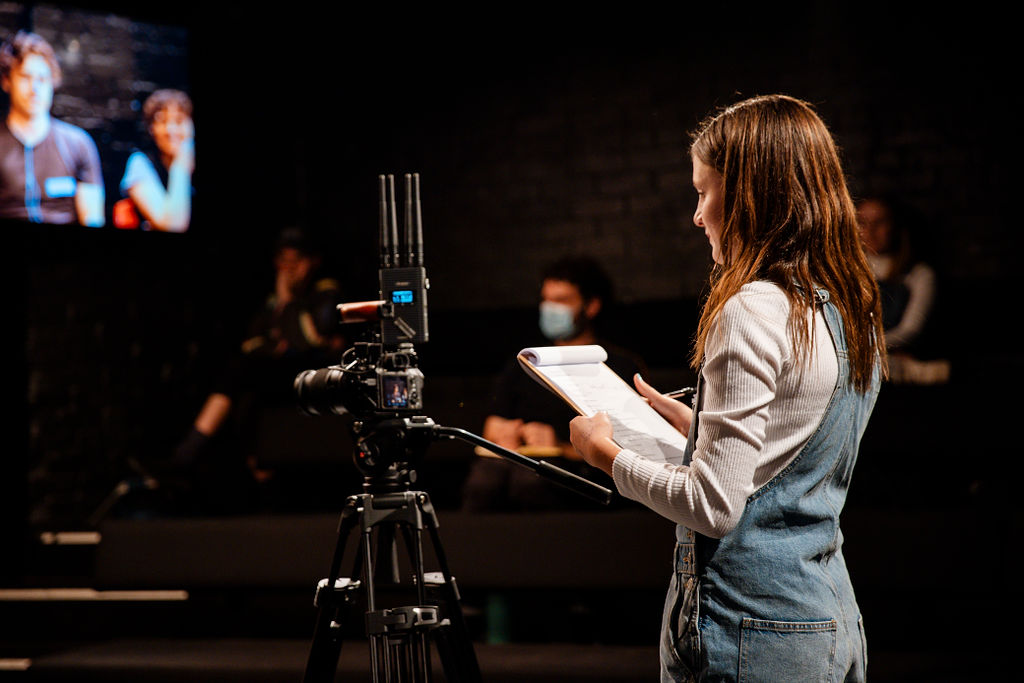
Each night of the production a different pair of actors play the mother and father of an 11 year old child. The child actor, either Edith Whitehead or Mabelle Rose, is prepared. The adult actors are not.

The child actor helps the adult actors through the performance, telling them where to stand, helping them understand their roles, ensuring they’re reading their lines from the right source (printed script or electronic screen.) The child’s director-like role is facilitated by the fact that the story being told is one in which the child, Bub, is making a documentary film about her parents. The complication is that mum is suffering a mental illness, and dad is uncertain how to help his daughter navigate this. (Bub writes to the legendary documentary film maker Werner Herzog for advice, and receives responses.)

What’s the impact of all this? I’ll break it into four points. (And I choose the noun consciously, points being sharp, and this piece written by Mark Rogers and directed by Solomon Thomas is whip smart.)

Firstly, and most obviously, the piece is a poignant reminder of what mental illness can do to its sufferers and to those they love. However, the emotional impact is tempered by the set-up; we’re never really encouraged to forget these are actors playing roles. And Bub’s additional role of ring master means any confusion or fear this child character might experience is diluted. But representational realism, a request to believe in the veracity of imagined characters and the world they inhabit, is clearly not the aim.

Secondly, the set-up highlights the wondrous skill of the actors. On the night I saw the show, Yael Stone and Benedict Hardie played the parents. To see gifted actors adapt to the tricky conditions and explore roles they knew nothing about only minutes before is a true delight, a testimony to the mastery of these performers. And 13 year old Edith Whitehead is utterly brilliant, confident and composed. Rogers’ script has much fun playing with stereotypes of the precocious child – and Whitehead lands each joke like a pilot with a life-time of experience. This second point, about the performances, develops the first: we’re being asked to pay attention to the art more than the reality it could represent.

And the third point makes sense of why we’re being asked to focus on the art. The improvisational form of the piece operates as a metaphor for how we actually deal with challenges like mental illness: we make it up as we go, trying to make the best of what is thrown at us. Despite endless media articles bearing absurd titles like “What not to say to someone who is depressed” or “How to talk to your child about bi-polar” there never will be a definitive correct response to Life’s wildness. (In the performance I saw, Stone twice ad-libbed lines. On one of those occasions, the piece invited her to do so, asking her to share how she might explain mental illness to a child. Her answer was beautiful – humble and wise. On the other occasion, she simply broke character and said “I didn’t think it would be this hard.” This stepping out of the art form and reflecting on the process was the most moving moment of the show. To find this to be the case is quite a provocation, and links with my final point.)  

Which is…. the filming of the documentary also operates as metaphor. A cynic might suggest that the whole film motif simply allows the theatre makers to play with technology. But creating a documentary (as the term suggests) is an attempt to document the Truth. And that’s what we so desperately try do when confronted with wildness – we try to control it, we try to make sense of it, we even try to find the mysterious alchemy that might transform our pain and bewilderment into beauty. With Herzog always hovering just out of sight, the piece can hint that making art is akin to dealing with Life’s bigger challenges. “Every man should pull a boat over a mountain once in his life,” says Herzog. And once again, this is an exciting provocation. The statement is normative. Should? Many of us don’t have much choice.

POV is an extraordinarily inventive piece, one sure to send audiences out into the night with minds burning with questions about the theatrical form, and with hearts relit with compassion for those who suffer.  

Paul Gilchrist

POV

Text by Mark Rogers

At Belvoir as part of 25a until June 16

belvoir.com.au