The concept of the “great actor” functions as a type of myth. Great actors are like Greek gods. They have human desires and flaws, but they remain above us, always, visitors from some wondrous realm.
Perhaps it’s an accurate description of certain gifted individuals, like Bernhardt. Or perhaps it’s suggestive of the role these individuals fill in popular culture. (It’s curious that we’re only allowed one or two great actors per generation. Too many gods is equivalent to having no gods. The currency must not be debased.)
Susie Lindeman’s Sarah Quand Même presents Bernhardt’s life. Bernhardt recalls to her granddaughter key events. Lindeman performs both roles, and if you were to cast someone as a great actor, she’s your choice. Lindeman’s vocal performance and physicality are superb.
Lindeman has also written the piece (for the anniversary of Bernhardt’s death). She tells a fascinating tale of Bernhardt’s glorious resilience. Quand Même means “despite all” or “no matter what”. Bernhardt was a superstar, and like anyone who mounts the monster of fame, the ride has its moments.
In a particularly poignant choice, Lindeman uses as a motif Bernhardt’s description of the audience as “the monster”. If you have gods, there will be monsters; and perhaps it’s only the gods who can tame them. I would’ve loved to have seen more of Bernhardt the actor, the god who tamed the monster, perhaps a speech or two from the great classics, a sample of her extraordinary ability. Lindeman could do it. Instead, we must be satisfied with review quotes that expound Bernhardt’s talent, and we all know what the opinion of reviewers is worth.
Fun and endlessly fascinating, this play deliberately resists easy interpretation.
A descendant of the absurdist comedies of Beckett, Philip Ridley’s Pitchfork Disney takes a simple scenario and posits it as a symbol of the human condition.
Presley and Haley, brother and sister, live alone. Perhaps they’ve been abandoned by their parents? They’re fearful of the outside world and their diet consists exclusively of chocolate. But Presley and Haley are not children; they’re adults, reduced to a childlike state by the absence of an authoritative world view. In a pathetic attempt to establish some sort of meaningful vision of Life, they tell each other their nightmares, retell outlandish stories, and recall a past when Mum and Dad provided a secure centre to their existence. Ridley’s genius is the conscious use of cliché and allusions to consumer pop culture to evoke the malaise of modern meaninglessness.
Into this closed world comes Cosmo Disney, a two bit entertainer who makes a living by supplying his audience with a “daily dose of disgust.” In a world devoid of higher purpose, at least fear and repulsion are constant.
Director Victor Kalka does wonderful work with this classic of modern theatre, creating a space in which imminent threat and comic exuberance play chicken.
The cast is exceptionally strong. Jane Angharad as Haley is magnificently vulnerable, her childlike physicality and her delivery of Ridley’s evocative monologues a delight. James Smithers as Presley, onstage through virtually the entire production, gives a virtuoso performance; doubt, bravado, terror, reluctance, desire, wonder, all brilliantly brought to life. Harry Winsome’s Cosmo is a beautifully disturbing portrait of self-serving confidence, operating both as a foil to the two adult children he impinges upon, and granting insight into the unexpected ways in which moral emptiness manifests itself. James Hartley provides a terrific cameo – of which the spoiler rule reduces me to silence – except to say it’s both powerful and hilarious.
(not that anyone would care, but I think) What makes theatre an extraordinary artform is that it can do two extraordinary things.
The first of those extraordinary things is that theatre embodies thoughts and feelings. Ideas that are rich, complex and subtle, and feelings that are intense, ephemeral and ineffable, are embodied by an actor: through their voice, through their movement, and through their spatial relationship with their material environment and the people who inhabit it. If theatre can be said to fairly represent reality, it does so because of this sense of the concrete. As in the mysterious miracle that is Life, certain things just are.
The second of the extraordinary things theatre does is that it allows different voices. Characters have their own distinct perspective. This doesn’t only facilitate conflict; it also manifests multiplicity. If theatre can be said to fairly represent reality, it does so because of this sense of the unresolved. As in the mysterious miracle that is Life, nothing is neat.
What makes Short Blanket by Matt Bostock a terrific piece of theatre is that it embraces both of theatre’s extraordinary attributes. (New Australian work, especially in the indie scene, is prone to attempt only the first of them.)
Short Blanket is one of the most exciting new shows I’ve seen for quite a while; it’s whip-smart, with a beating heart.
It’s the story of writing a play, or more specifically the story of development hell. (I suspect writers only endure the development process – The I-don’t-think-my-character-would-say-that sort of torment – because at some time something like it will have to be lived through if the two special attributes of theatre are to be achieved.)
In Short Blanket, Lainey’s play is being workshopped. She wants to represent the challenges Asian Australians experience, or perhaps more broadly, the pain of the global majority in a world yet to fully divest itself of colonialism. But not everyone wants it presented her way. Actor Dominique wants it angrier. Actor Joey wants it more forgiving. Company artistic director Gloria wants it more saleable. I’m simplifying (as the mono-voice of a review will do) but I’m hoping to capture Short Blanket’s sense that not everything is obvious or inarguable (despite certainty being a rather fashionable fallacy at the moment.) A play that uses the dramatic form so well is fully conscious that not every aspect of reality can be easily represented in that dramatic form. As Gloria says to Lainey, (I paraphrase) You don’t have a story, you have a feeling.
How do you represent injustice in an artform that requires an audience to sit through it and to pay for the privilege? Why use the dramatic form for this purpose at all? Every tool is not for every job. (A personal digression: it is odd that we modern theatre makers see ourselves as a sort of priestly class, responsible for the ethical education of others.) The script is very aware of the tricky question of what value we are to put on theatre. One character suggests, that if your audience is predominantly white, it won’t matter if your show is crap, because they’ll still say it was a privilege to have seen it.
Tiffany Wong’s cast do wonderful work. Andrea Magpulong’s Lainey captures the tension between the desire to make a show happen and the desperate need to bear witness. Dominique Purdue brilliantly presents the actor’s journey from initial excitement to bitter disillusionment as her hopes for the project flounder. Joseph Tanti as Joey embodies both the brutal arrogance of the privileged characters he performs in the workshopped play and the difficulties of telling a story that isn’t his. Monica Russell as the artistic director of the company effectively marries both the cold rationality required for financial realities and the resentment of a pioneer who feels her long efforts are being ignored. Sayuri Narroway as the director of the workshop presents a calmness that cleverly hides a different agenda.
Wong uses the intimate Meraki space marvellously, effectively presenting both the world in which the artist characters perform and the world in which these artists reflect on that performance.
The last image of Short Blanket is especially powerful. The spoiler rule means I shouldn’t really describe it. But I can say it functions gloriously as both an indictment of injustice, and as an invitation to ponder from where our motivation for theatre-making should come.
The more discerning theatre-goer might surmise from the title that this is a comedy.
The fourth wall is firmly down as three actors share their attempt to present all 36 of Shakespeare’s plays.
Having said that, only Romeo and Juliet, Macbeth and Hamlet are presented in any meaningful way (providing that wacky parody fits your definition of ‘meaningful’.) Most of the other plays are merely namedropped. Considering the alternative, this is in no way a criticism.
As an abridgement of Shakespeare’s plays, The Complete Works is equivalent to summarising Moby Dick with the word ‘whale’.
Written by Adam Long, Daniel Singer, and Jess Winfield, it’s been kicking around since the 1980’s. Ironically, for a piece that responds to our obsession with the Bard, I’ve seen it more times than I’ve seen most of his plays.
There’s some theatre in-jokes, but no need for any knowledge of the canon. The whole thing operates simply as an opportunity for some seriously crazy comedy. It’s audacious, exuberant and effervescent. Under the skilful direction of Madeleine Withington, the brilliant cast (Alexander Spinks, Lib Campbell and Tel Benjamin) gives this madness the high energy performances it deserves.
Once or twice the poetic (though not the dramatic) genius of Shakespeare is allowed to shine through, creating a poignant contrast that only enhances our enjoyment of the zaniness.
The original play is designed to facilitate improv and extra dialogue, and this team add some contemporary sparkle. (Though I’m not sure the references to the venue, both its history and nature, are conducive to the openhearted relaxed mood required to appreciate this sort of playful froth.)
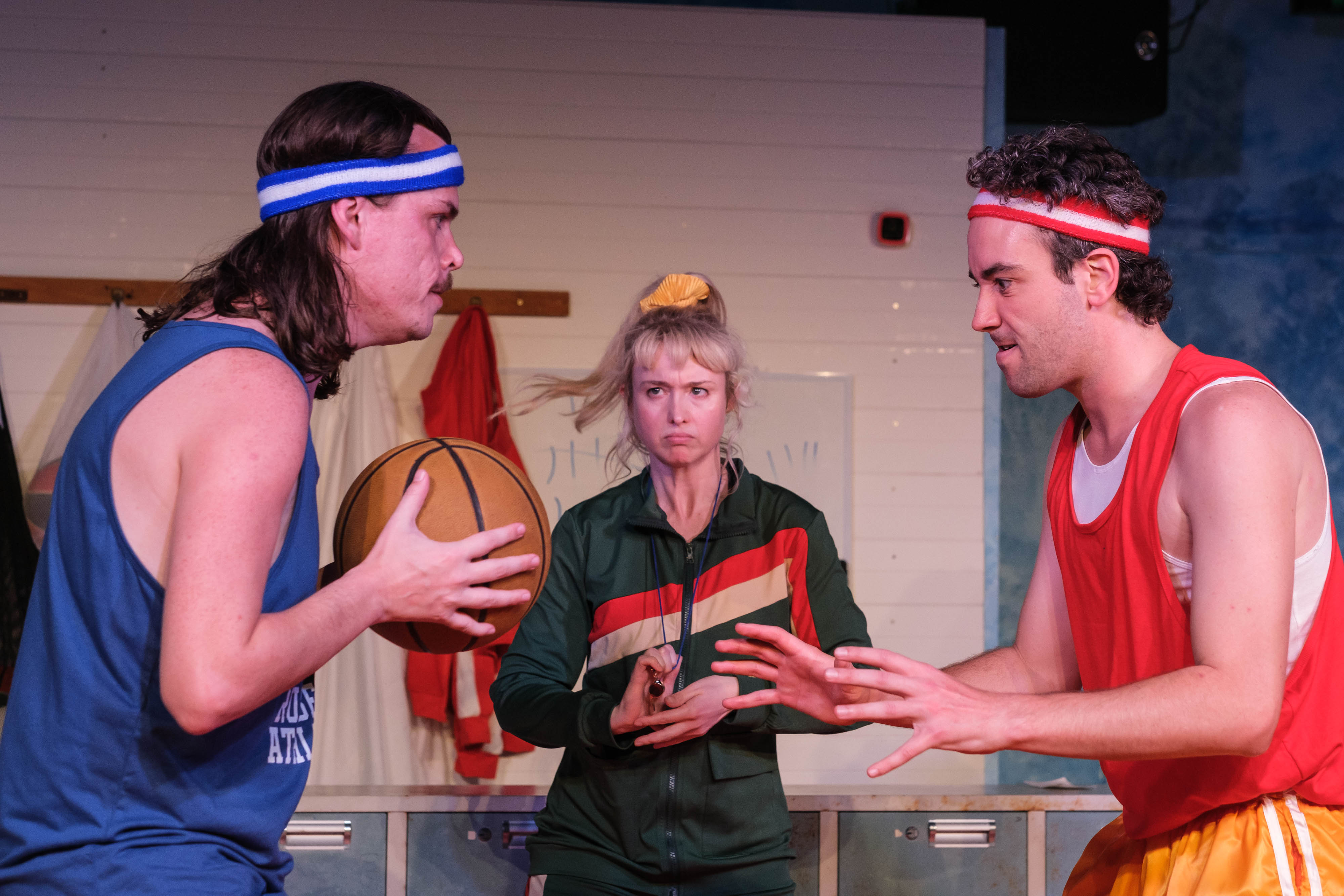
Rachel Scane’s design is magnificent. Part locker room, part synthetic playing court, and peopled with characters in daggy sportswear, it’s a world where the trivial competes with the impossible, as weirdly captivating as the silliest of Guinness Book of Record feats.
80 minutes of energising entertainment; Shakespeare would have loved it.
Paul Gilchrist
The Complete Works of William Shakespeare (Abridged) by Adam Long, Daniel Singer, and Jess Winfield
There’s a long tradition of the subversive puppet. Think Punch and Judy, Lamb Chop, Basil Brush, Agro. These puppet’s cheekiness and exuberance challenge adult norms. They’re like a personification of the Medieval Carnival; they turn the world upside with their irrepressible glee. Brash and insensitive, they topple convention with their childlike mischievous simplicity. It’s as if, when all the hobgoblins perished in the searing sun of the Enlightenment, they reincarnated as puppets.
I’ve often wanted to write puppet reviews, to respond to shows with a refreshingly impertinent naïve directness. My puppet personality would write that Waiting for Godot is “repetitive rubbish”, that Hamlet is “indulgent slop”, that this show is “puerile nihilism”.
But I’m not a puppet, and my response to theatre is more adult. (‘Adult’ as in considered and staid, rather than ‘adult’ as in naughtily scatological and profanely sex aware, which is the way the word is used when a show like this is described as an ‘adult’ puppet show. )
Richard Hilliar’s Apocka-Wocka-Lockalypse is a heap of crazy fun. It’s post-apocalypse, a disaster brought on by human greed. Melissa has found haven in a bunker, which she shares with four furry little monsters. She is part nurturing house mother, part controlling authority figure. She and her monster ‘friends’ play out a children’s TV show. There’s no audience; it’s as though by continuing familiar routines they can assure themselves all is right with the world. They sing songs, play games, read children’s books and Melissa is Miss Melissa, the kind and caring adult who gently guides her little monster friends. Well, at least that’s how it begins.
The puppets, initially, have had much of their subversive element drained out of them. They behave as grateful but cowed children. Brilliantly crafted by Ash Bell, they’re gloriously brought to life by the cast – Matt Abotomey, Lib Campbell, Zoe Crawford and Nathan Porteous. There’s a wonderful magic in being able to see both puppet and operator, a mesmerising echo between the puppet’s reactions and that of the performers. Nicole Wineberg’s Miss Melissa is comic genius, a terrific parody of the children’s TV presenter with a magnificent black comedy shadow.
Hilliar’s script is very funny, capturing both the absurdity of the situation and its growing darkness.
There’s a couple of absolute stand out moments. Crawford’s performance of Alexander Lee-Rekers’ very clever song “Maybe a Baby” is both hilarious and heartbreaking. Wineberg’s reading of a children’s book that is surprisingly and delightfully petty-minded is a riot.
Bell’s set beautifully mimics that of children’s TV set, with its bright, bold colours and its symbols of hope.
But what happens in this space belies the brightness.
Asking if saccharine positivity is really the cure for our current crises or merely a façade for malignant, manipulative forces, Apocka-Wocka-Lockalypse is a deliciously dark comedy.
They are in an Officeworks store. They’re trying out the different office wheely chairs, determining which is the most comfortable, which rotates the best, and which moves around the space most effectively. They’re not looking to purchase. They’re reliving a game they used to play with their much loved little sister.
Comfort, Spin, Travel (written by Lu Bradshaw and directed by Emma Burns) presents as a generous-spirited sharing of what it is to live as a trans person. Its focus is relationships – not romantic ones – but rather those had with strangers and acquaintances, friends and family. Clearly, all is not plain sailing. There are issues regarding the nature of allyship and solidarity, the use of pronouns and personal terms of address, the pressure to advocate, the right to body modification, the importance of safe spaces … and of basic acceptance.
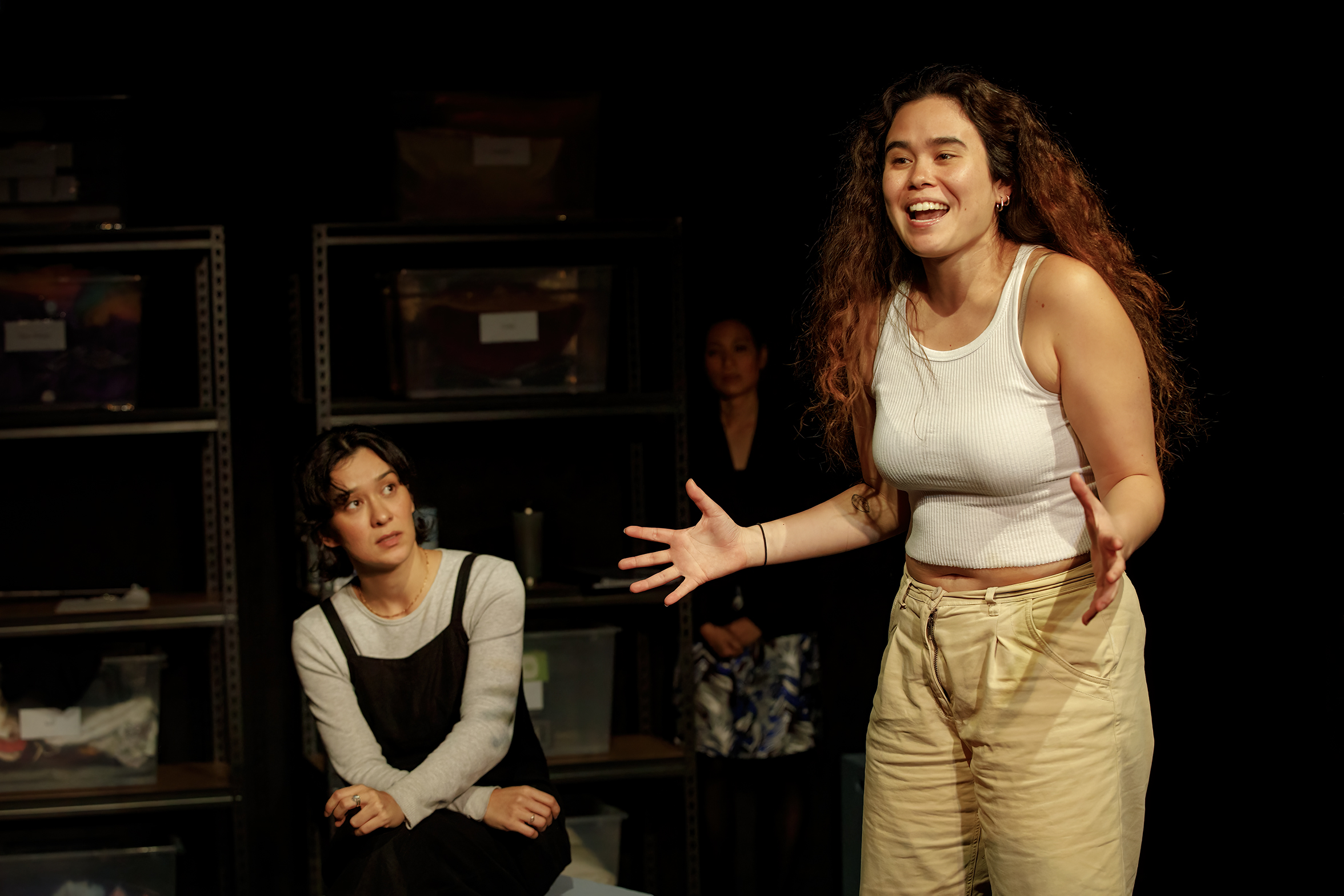
Performer Hadrian Conyngham has an extraordinarily engaging stage presence. The moment of coming out (“I no longer identify as a girl”) is presented with an everyday gentleness, a domestic ordinariness, that underlines its poignancy. The tale of dealing with cisgendered female friends who feel they can crash Queer Night is both an amusing self-deprecating anecdote and a moving expression of anger.
Setting the story in a late night visit to a stationery store allows for some delightful cameos from the supposed staff. Rachel Seeto, on stage throughout, creates a deliciously comic character, capturing both the lethargic alienation of the young student forced to work in retail and the vibrant human soul beneath.
This piece makes some fascinating dramatic choices. I suggested it presented as a ‘sharing’, and the honest expression of the difficulties experienced by a trans person suggests it is non-fiction, but the Officeworks scenario and the repeated reminders that the narrator might be unreliable evoke the opposite. (The press release tells me the piece is a semi-autobiographical creation of the writer.)
Another intriguing choice is the playful conceit of the trying of the different chairs, a conceit which invites comparison with the serious story, the one about identity. Is it a trivialisation? No, it’s a theatrical artifice that forefronts the tension between choosing and being. From the outside, the chair a person ultimately chooses appears subjective; from the inside, it is an expression of the individual’s objective reality.
Which leads me to the other musing this piece launched me on. I’m not really riffing on the LGBTQIA+ moniker, but it is true that we are often tempted to view our identity as though it were like a letter in an alphabet. Who we are, is who we are. ‘B’ is not defined by ‘A’, or ‘C’, or ‘D’. They are just other letters, separate and distinct. But the phenomena of identity is perhaps more like numbers. The number ‘2’ is defined by the number ‘1’. The number ‘15’ is in a fundamental relationship with ‘14’. (For fun, or something approximating it, Google the meaning of ‘15’. Go on.) Despite the desperate weirdness of my analogy, I think it encapsulates the situation. Our identity is a deeply personal, existential thing, but it is – at least partly – dependent on society. We can identify any way we want, but if this identity is not accepted by others, we are troubled, or tortured or erased… Even the concept of pride is reactionary: an assertion that I am valuable despite any negativity from you. That the experience of identity is both personal and social is one of the great unresolvable tensions in the human condition. I imagine no-one would endure this tension if they could transcend it (but that might be more indicative of the limits of my imagination than the actual variety of lived lives.)
My self-indulgent philosophical ramblings aside, Comfort, Spin, Travel is a beautiful, vital little piece of theatre.
This is an intriguing piece of theatre; 100 minutes of fascinating language play that doesn’t want to let you go.
Richard Greenberg’s play was written in 2002, but is set in 1940’s New York. It feels earlier, as though the past were something to not let go.
A play about recluses, about hoarders; the whole thing’s about not letting go.
Langley (Alec Ebert) is the more obviously neurotic of two brothers. He was once a performing pianist, but his playing has slowed down, because he hangs on to every note. Nor does he want to let go of all the stuff he has brought into the house. And change, of any sort, is a problem. When Milly, a wealthy heiress, shows an interest, he longs to be “Adam before the inconvenience of Eve”.
Homer (Steve Corner), the primary carer for Langley, explains his situation as “I am my brother’s…accountant”. Considering the tensions between the siblings, it’s a suitable allusion to Cain and Abel.
It some ways, it feels a little like Henry James on speed; we remain in the drawing room of the brothers’ house and 140 tonnes* of words, fast, loud and fun, bounce off the walls, and fall in bewildering, ever-growing piles around us.
Director Jane Angharad’s cast, despite the contained nature of the play’s world (or maybe because of it) deliver high-energy vocal performances: tight, intense and inspiringly focused.
Meg Hyeronimus as Milly presents an especially engaging character arc, moving adroitly from a glib flirtatiousness to a deep vulnerability tempered by dignity.
Homer makes sense of the title for us; he’s conscious of a “dazzling” array of neurotics who command the world with their imperatives: I cannot throw out a single piece of paper; I cannot listen to poorly performed music; I cannot let things go. The list of imperatives is mine, but I believe they are true to the spirit of the human experience explored – the temptation to control.
(From personal experience) I term it a temptation, and that is, of course, a harsh way to describe what might be called a mental illness, but theatre – and theatre like this especially – dissolves all disputes regarding nomenclature, being like that long warm soak in sparkling suds that loosens all labels.




 Theatre Red