
This is a piece of dramatic bliss.
It presents as sitcom spiced with satire, but appearances are deceiving. (Or should that be illusory?)
Multinational company Jojomon makes yoga clothes – and an extraordinary amount of money. But there’s a scandal, and now they have an authenticity problem. Profits are diving.
How can they fake authenticity?
Clearly, companies that make serious cash out of any spiritual tradition are perfect for a poke, as is anyone more interested in sculpting their body than nurturing their soul. The West’s appropriation of the Eastern practice of yoga is an exemplar of how capitalism can so impoverish the invaluable that it becomes obscenely valuable.
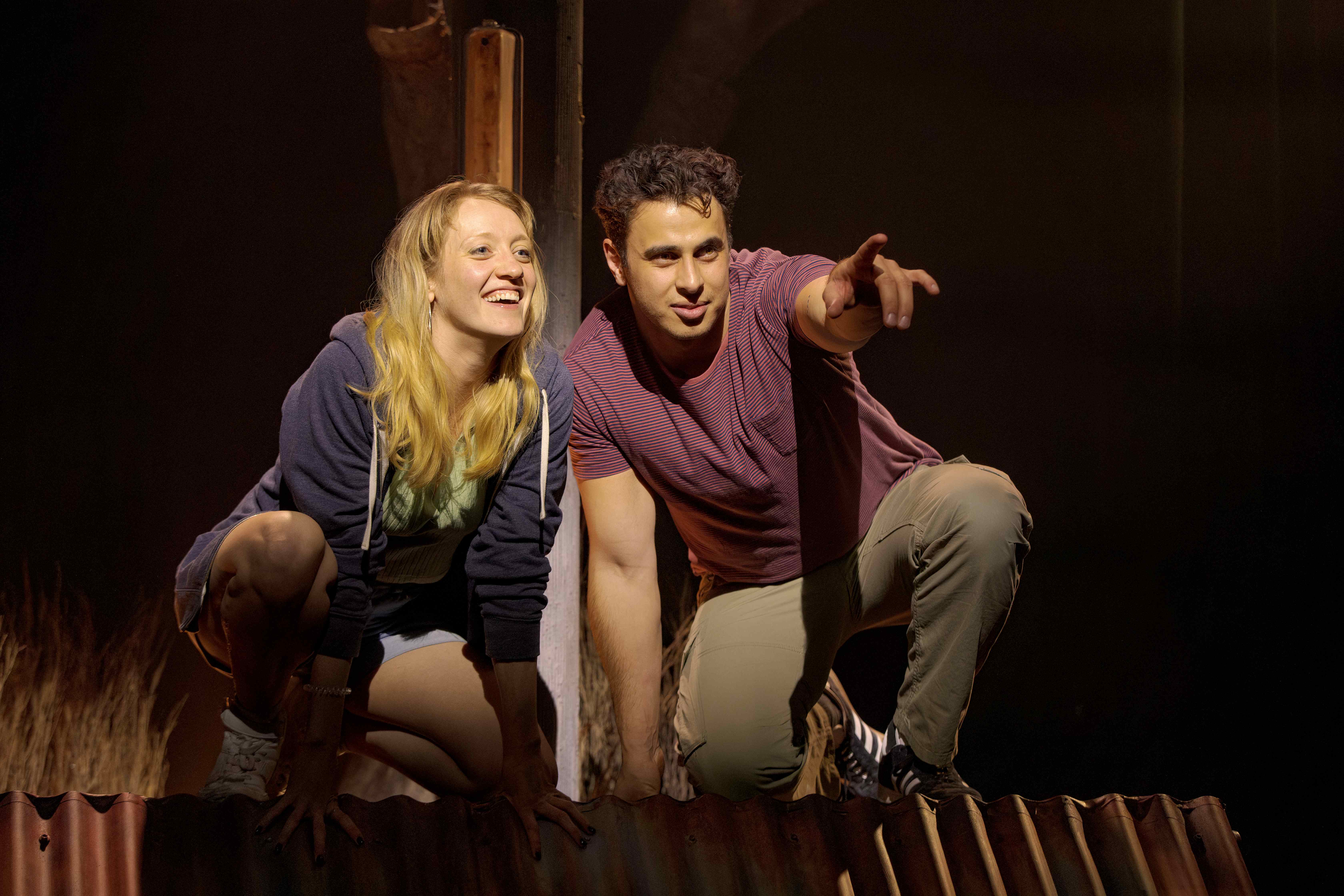
Playwright Dipika Guha creates terrific comic characters and director Mina Morita has a brilliant cast that pitch them perfectly. Joan the CEO is fully cognisant of the discord between corporate culture and new age platitudes, and Andrea Moor superbly portrays the tensions between patience, puzzlement and pressure. Thomas Larkin is magnificent as the company owner who refers to customers as family, and then treats them with the appropriate disdain. (And there’s some beautiful and unexpected doubling here). Nat Jobe and Jemwel Danao are a sensationally funny duo, playing employees who speak the new age language fluently, and almost believe it. Camila Ponte Alvarez as the LA yoga instructor who’s all gratitude, bliss and namaste – until you cross her – is absolutely hilarious.
It’s a wonderfully fun night of theatre. But I said it was dramatic bliss – because there’s more.
In addition to sitcom and social satire, there’s surprising depth. Gently and playfully, the piece explores two of the most crucial issues facing our society.
The first is sociological and centres on assumptions about identity. By creating characters of multiple ethnicities who are exploiting the practice of yoga, Guha puts cultural appropriation firmly on the table. We talk a lot about cultural appropriation these days, but at the heart of the concept are some rather odd assumptions. I’m not denying the concept has validity; I’m just suggesting we’d all gain from the sort of interrogation this very clever play provokes.
On a cultural level, what does my biological heritage entitle me to? What do I actually mean when I refer to my culture? Do I own it?
What, exactly, does culture include? (Culture is one of the most nebulous words in my language that I don’t own.) When is something a cultural tradition and when is it just a fashion? How fixed is culture? And is it possible to have tensions within a culture? If someone of, say, Indian biological heritage holds a particular value, does that value then automatically become Indian culture? Or are a certain number of Indians required to hold that value for it to pass muster? How many?
And what does my culture demand of me? If I reject elements of my culture, does that mean I’m a bad custodian? Or does it mean I’m a mature self-actualised individual?
And if elements of my culture enhance joy, why would I prevent others from sharing in it? (Unless, of course, the joy I’m talking about is defined solely as a financial gain that would be lessened if the market was saturated. And if that’s our default way of looking at cultural appropriation, it only goes to show how capitalist materialism has been appropriated by everyone.)
The second crucial issue the play addresses is psychological, and also centres on identity. Drawing on traditional Hindu beliefs (ones shared with many mystic traditions) the play asks several of its characters to consider the nature of the Self. In our globalised world, we’re perpetually bombarded by loud, outside voices. For safety’s sake, we’ve come to define ourselves quite narrowly. Or, perhaps more accurately, we’ve come to define ourselves quite emphatically. But every definition is predicated on exclusion. In asserting I am this, I’m asserting I’m not something else. What are we losing by our adherence to this safety strategy of the Self? What would happen if we didn’t define ourselves at all? If we let go of our insistence on borders, on divisions?
The play deals with all this in a gorgeously light way, and is as joyful as an invitation to the eternal cosmic dance.
Paul Gilchrist
Yoga Play by Dipika Guha
Presented by National Theatre of Parramatta & La Boite Theatre
At Riverside until 26 October
Image by Phil Erbacher
 Theatre Red