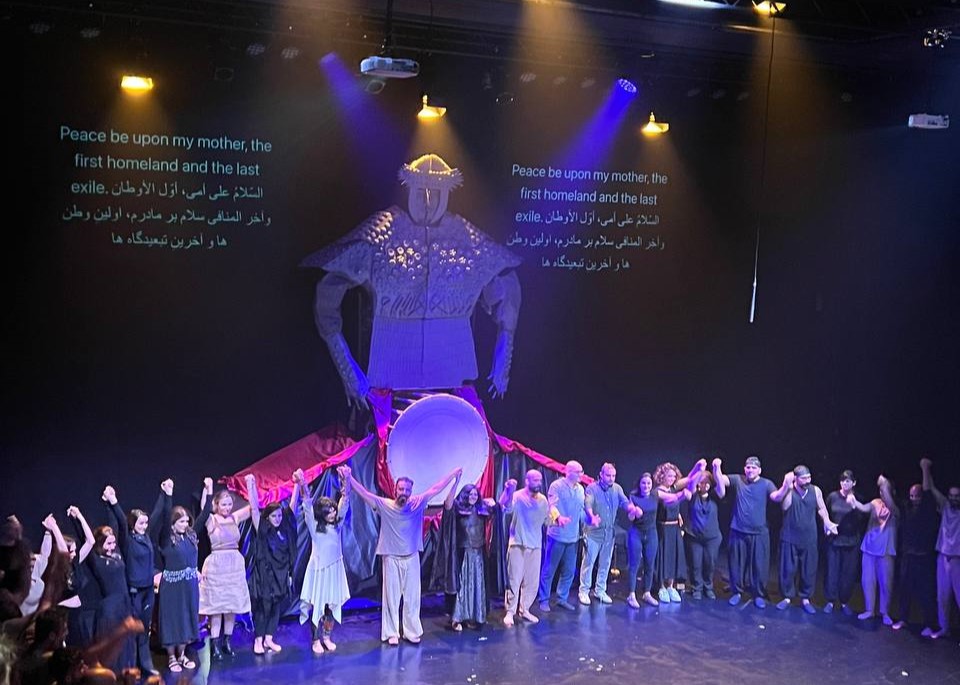
This is an absolutely terrific play. Written in 1982 by Iranian playwright Bahram Beyzai, it’s grand storytelling at its best.
It’s thrilling to see such a work on the Australian stage. It’s also a delight to have it performed entirely in the original Farsi, with English surtitles. Director Hamed Janali deserves hearty congratulations.
Set in ancient Iran, Kalat Claimed presents the rivalry between two great warriors, Tuqai Khan and Tuy Khan.
In the initial moments, each of the warriors assert that they alone have slain the dead man who now lies between them. The play’s uncompromising interrogation of martial values is perfectly introduced by this argument over a corpse.
Later, to lay claim to the city of Kalat, Tuqai Khan betrays the Machiavellian Tuy Khan in the most Machiavellian of ways. Then, before he is to be executed, Tuy Khan is dressed as a whore and paraded through the city. The male characters tell us that this is perhaps the greatest of disgraces.
But Beyzai has more to say about this myopic misogyny. In magnificent counterpoint to the warrior rivals is Ay Banu, wife of Tuy Khan, but seemingly desired by all. In order to build a force to reclaim Kalat, she exploits her sexual appeal. Her behaviour borrows from the whore’s repertoire. Is this, for her, a disgrace?
But still that’s not the end of Beyzai’s interrogation. Tuqai Khan struggles to defend the city because he’s a warrior of the desert. The symbolism is clear: the world he represents is not the civilized one. Though Ay Banu leads an army, she doesn’t glory in violence. And, in her final action of the drama, she imposes on her enemies not women’s dress, but what these warriors now perceive as truly the greatest of all disgraces.
Can you guess what that supposed disgrace is?
Even though this play is a classic of Iranian theatre, I feel the spoiler rule prevents me from saying more. But what Ay Banu imposes, or I should say, what she offers, is the most beautiful, most potent subversion of violent selfish egoism.
Janali’s cast do good work. Afshin Safari as Tuy Khan, Ghazal Ghazanfari as Ay Banu, and Janali himself as Tuqai Khan are especially engaging. Equally captivating is Mohamad Janfada. As Dinkiz, his persistent and fearless questioning of his warrior leader positions us to realise that though a better world will entail the rejection of certain values that are stereotypically masculine, individual men are more than capable of the moral maturity required.
The production is visually spectacular, thanks to a wonderful set and lighting design by Janali, and by his clever use of movement pieces to evoke both the fascination and terror of violence. Costume design by Atefeh Saniee, Vida Afshari, Mitra Amiri and Ghazanfari is excellent, suggesting an ancient world but with touches of modernity that keep in mind the play’s ongoing relevance.
And finally, the sound. At the theatre entrance, we were issued foam earplugs. Though fear inducing, the plugs proved unnecessary. Musicians Reza Jafari and Shervin Mirzeinali create an emotionally moving soundtrack. Drummers Sohrab Kolahdooz, Sara Panahi and Amirsalar Makhzani, onstage at all times, effectively build and maintain tension. It’s all a fitting addition to a production that uses multiple theatrical elements to powerfully present a brilliant play.
Paul Gilchrist
Kalat Claimed by Bahram Beyzai
at Playhouse Theatre NIDA
until 25 Feb
 Theatre Red