This is a big, bold adventure in theatre making.
Several years ago, when I heard that the novel had been turned into a play, my first response was How? (Though that was very closely followed by a Why?)
The most distinctive feature of the famous novel by Mark Haddon is that it’s narrated by a neurodivergent teenager.
Apart from one-character shows, drama really doesn’t do the whole first-person thing. Its glory is that it’s multi-voiced.
Simon Stephens’ stage adaptation tries to keep central Christopher’s voice, but not surprisingly, a play that’s 2 hours 40 minutes long (including interval) looks for ways to create texture.
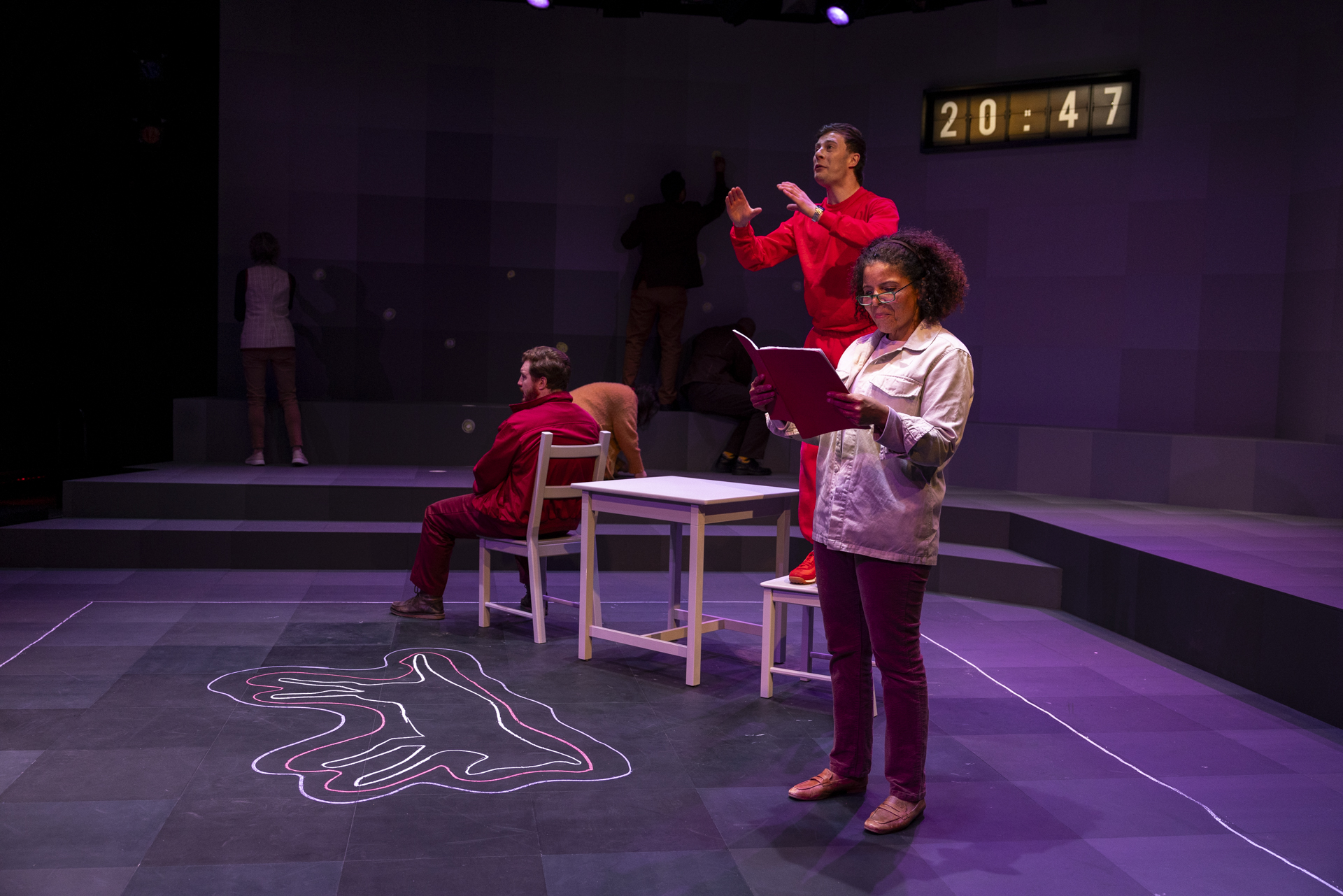
One way is by giving some of Christopher’s narration to his mentor Siobhan, who reads from his notebooks. In fact, Siobhan (played by Brigid Zengeni with a stage presence that is noble, authoritative and warm) becomes almost a semi-divine figure, a type of guardian angel, making us feel no real harm can come to our hero. These decisions downplay Christopher’s isolation, but deliberately make the piece safe and inviting (which, perhaps, only devotees of the Theatre of Cruelty will regret.)
Another way of texturing a predominantly first-person narration is to privilege the dialogue from the novel at the expense of its more discursive elements. However, one of the charms of the book is that Christopher often records other character’s words without understanding their subtext. The reader gets what his father means, but Christopher does not. Of course, you can do this in drama, but, ironically, it ceases to be dramatic irony; it becomes just misunderstanding. Perhaps this creative decision is a more humane, egalitarian-spirited response to Christopher’s situation, but it does mean the dialogue functions differently than it does in the novel, and that it does not especially underline Christopher’s isolation, or what might be distinctive about his experience as a neurodivergent individual.
(Should it? I suspect this play, this production, will be valued as a representation of a marginalised group – or dissed as an inaccurate one. It’s odd how we’ve come to read fiction in this way. If you wanted to tell the truth about an entire demographic group, why would you choose a form that by its very nature focuses on the individual, the particular, the specific? Invariably, you’ll elicit dissatisfaction when another individual, particular, specific characteristic is not represented. Though, admittedly, most of the audience are in no position to judge the veracity of your representation anyway; they’re positioned to passively accept it.)
Another way of granting texture to a work originating in first-person is movement. On multiple occasions, the cast mirror Christopher’s movements, and this is cute, fun and well executed – though it raises the spectre of bad faith in the script. It feels as though gaps are being filled, ones that another production might have filled (possibly no more satisfyingly) with high tech.
Speaking of tech, above the stage is a device which displays words, warnings, and the time. In the novel, Christopher often tells us exactly when things happen. He makes statements like At 4.02 pm father did X. But the device I’ve mentioned means Christopher doesn’t tell us the precise time, we know it – but, of course, we don’t need to know it, except in so far as this hyperbolic precision tells us something about Christopher. Similarly, the protagonist’s love of mathematics is presented as a very Belvoir dance number, a delightful high energy parody, but one perhaps hinting more at the assumptions being made about the audience than about Christopher’s passion and skill. (Though see my earlier comments about representation.)
Christopher himself expresses uncertainty whether his experience can be turned into a play. (If dramatic irony is when the audience knows more than the characters, what do you call it when characters know more than their creators?)
But does it matter if the play reflects the novel? Or if it accurately represents a lived experience?
Apart from these things, what does the play, the production, do?
Under the direction of Hannah Goodwin, we’re given some wonderful performances. Matilda Ridgway as Christopher’s late mother, a simple woman who struggles with the complexity of raising her son, beautifully balances vibrancy and vulnerability. Daniel R. Nixon as Christopher has a gargantuan role, and he presents it brilliantly, eliciting both pathos and humour, while embodying an inspiring individual dignity.
It’s a deeply human story told with fun and feeling.
Paul Gilchrist
The Curious Incident of the Dog in the Night-Time, based on the novel by Mark Haddon & adapted for the stage by Simon Stephens.
Belvoir until 22 September
Image by Brett Boardman
 Theatre Red