The future is our home country; we’ll do things differently there. (Apologies to LP Hartley*, but more so to my readers who might have to wade through the entirety of this review in order to make sense of what I’m getting at.)
One of the greatest cultural revolutions of the last millennium was that lead by Freud. Because of he and his followers, we look to our personal past to explain our present. I am like this because I was treated like that. Maybe it’s true. Whatever the case, it’s a perspective that greatly impacts the modern world, even trivialities like theatre.
It’s extremely common for modern plays to look backwards. The heroine eventually realises (or remembers!) something about her past (that is before the events depicted in the play) and this motivates her to either accept that something or to transcend it. If you want a point of difference, consider Shakespeare. Macbeth and Lady Macbeth have pasts (who doesn’t?) but the Bard doesn’t dwell on their back history to explain their actions. These are explained, in so far as they’re explained at all, by current desires and influences. (I’ve deliberately chosen the Macbeths as my example because modern directors love to read Lady Macbeth’s line “I have given suck and know how tender tis to love the babe that milks me” as an explanation for her extraordinary behaviour. Lady Macbeth has obviously lost a child and that has driven her to this – which might make sense if it wasn’t for the fact that the premodern infant mortality rate was so high that virtually every woman had lost a child, and yet only a small percentage of women went on to become regicides.)
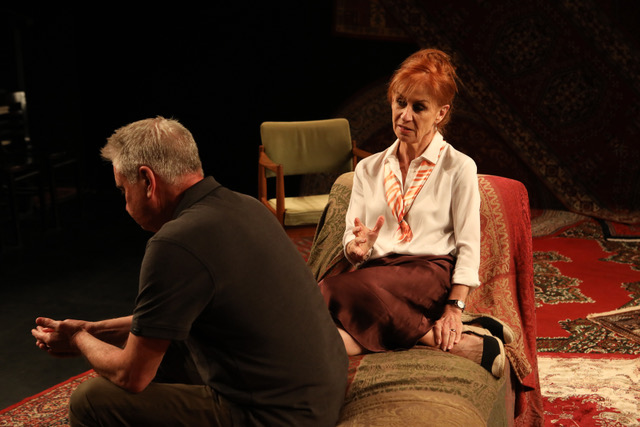
Stephen Sewell’s The Lives of Eve is a fully conscious exploration of the tradition of the unconscious (or at least our focus on our personal histories.) His protagonist, Eve, is a Lacanian analyst. We are shown her sessions with patient, Sylvia. There’s even a couch. Sylvia suffers from sexual disfunction. (I’m prevaricating: She can’t come.) It’s a brave male dramatist who writes about the female orgasm. (No doubt, if I was to do so, some wag would gleefully quip that not only had I never had one, I have probably never been in the room when one was happening.) In addition to the challenges of Sylvia, Eve has trouble at home; she and husband Paul are drifting apart, driven by unequal sexual desires. Fortunately, Eve gets support from her dead mother. Yes, the past, again. There’s a lot of talk about the past.
Directed by Kim Hardwick, the cast are eminently watchable. Helen O’Connor as Eve offers a powerful portrait of strength seeking depth. Louisa Panucci effectively presents Sylvia as the swirling whirlpool that is the growing soul: attraction competes with repulsion, inhibition with bluntness, doubt with certainty. Noel Hodda as Paul superbly depicts affability and affection in their oh so painful collision with a hostility that’s incomprehensible. Annie Byron as Eve’s departed mother, Madeline, is charmingly nonchalant and ethereal.
Sewell’s characters are extremely erudite. They quote or reference Lacan, Freud, Augustine, Plato, Aristotle, Sappho, Donne, Shakespeare, Einstein, Badiou and Grieg (though, admittedly, the composer just happens to share his name with one of Eve’s friends.) I think it’s absolutely wonderful when dramatists present Australians as educated and intelligent. (It’s like watching a Marvel movie: sure, the suit couldn’t actually help Iron Man to fly, but it’s a fun fact to forget.)
A lot of top shelf ideas are shared. Marvel fans might suggest it’s merely psycho-babble vs socio-babble. (Lacan on language vs gender generalisations.) If it takes a brave male playwright to write about the female orgasm, you’d have to be a superhero to take on philosophy in Australian theatre.
But Sewell knows what he’s doing: it’s rich and provocative, and I’ll enjoy thinking about this work for some time to come.
I want to mention two moments that stood out for me. At one stage Eve suggests (something like) we are both mysteries and disappointments to ourselves – and to other people. It’s a beautiful, deeply humane encapsulation of what it is to be alive. Similarly, in argument with Sylvia, Eve asserts that some problems might simply not have solutions; our politics can take us only so far; being conflicted and confused is the human condition.
So, despite being a play interested in how our personal past informs our present, Eve becomes a model for maturity, for both acceptance and transcendence. The future is our home country, because our dearest dream is that we’ll do things differently there.
Paul Gilchrist
The Lives of Eve by Stephen Sewell
at KXT on Broadway until 11 Nov
Image by Danielle Lyonne
* Hartley’s original line from The Go-Between was “The past is a foreign country; they do things differently there.”
 Theatre Red