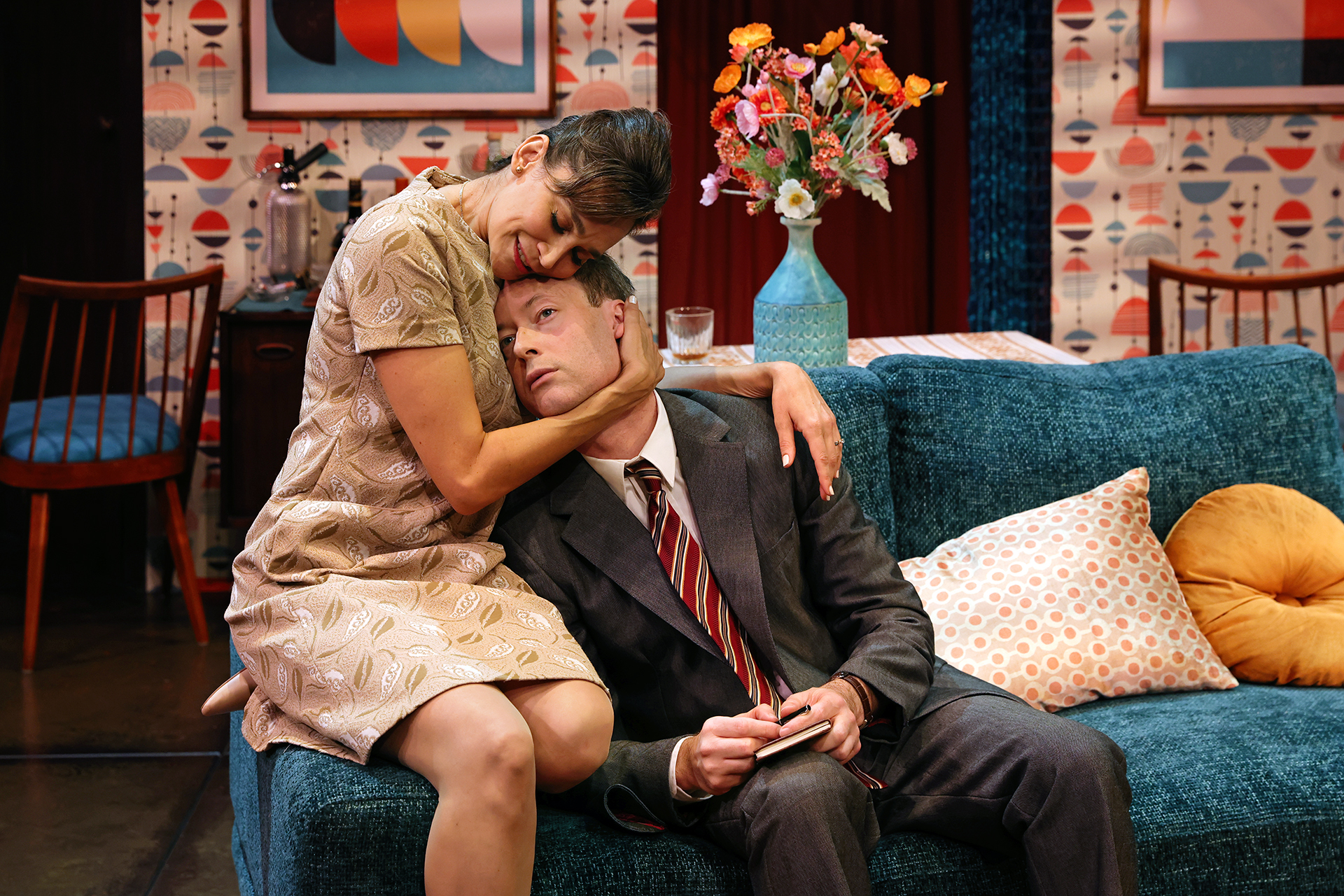
Directed by Mark Kilmurry, this is an evening of two short works by the great Harold Pinter.
Everyone’s familiar with the famous Pinter pause, that cessation of dialogue that acknowledges the world’s incomprehensibility, and seems to respond with all the world’s malevolence.
These two works employ the Pinter pause sparingly, preferring instead a related technique: the gap in exposition.
Take The Dumb Waiter. Two hit men wait in a basement room for instructions regarding their next job. We don’t know who their target will be. We don’t know why they will be targeted. We don’t know who issues the instructions. The dumb waiter installed in the room delivers food orders as though from a café above, and we don’t know why these orders make the hit men so very anxious. Only one of these uncertainties is clarified in the course of the piece, but this clarification only births further uncertainties.
Kilmurry fully embraces the comic possibilities of the scenario, and Gareth Davies and Anthony Taufa play the hitmen with terrific humour. (If Tarantino hasn’t seen a good production of The Dumb Waiter, I’d be shocked.) But Davies and Taufa also poignantly convey a rising panic, a terror in the face of power structures they know exist but don’t understand.
And that’s what the gaps in exposition do: they invite us into a similarly disorientating, dangerous world; they ask us to consider whether it reflects our experience, as individuals who are neither impotent nor omnipotent, who suffer from arbitrary power but are also complicit in its tyranny.
If The Dumb Waiter is comic, The Lover is even more so. Richard and Sarah are husband and wife, but she openly has an afternoon lover. Davies and Nicole Da Silva present this surprising couple with a delicious straight-faced matter-of-factness. Both performers glory in the particularly middle-class language Pinter gifts these characters, a dialect that’s precise yet euphemistic, fussy yet biting. Having presented an unexpected but believable relationship, Pinter proceeds, in splendid comic scenes, to reveal its complexities. But he never does so completely, once again allowing gaps in exposition to invite (or is it necessitate?) our full engagement.
Romantic love is an odd thing. We like to think that in it we can be our true selves, but simultaneously we are playing a role, that of the lover, the projection of the desires of the Other. Like Whose Afraid of Virginia Woolf? by Edward Albee, also first produced in 1962, The Lover expresses the collision of the desire for authenticity (the hallmark of the next two decades in Western culture) with the realisation that radical individuality might be a fantasy. Neither impotent nor omnipotent, we are complicit in the illusions from which we suffer – and our attempted solutions merely perpetuate those illusions.
Wonderfully performed and tremendously funny, this double bill is an excellent introduction to Pinter’s genius.
Paul Gilchrist
The Lover & The Dumb Waiter by Harold Pinter
At Ensemble until June 7
Image by Prudence Upton
 Theatre Red
Leave a comment