Presented by Stoneraven Theatre, and directed by Katherine Poulsen, this is the Australian premiere of Martin McDonagh’s 2018 play.
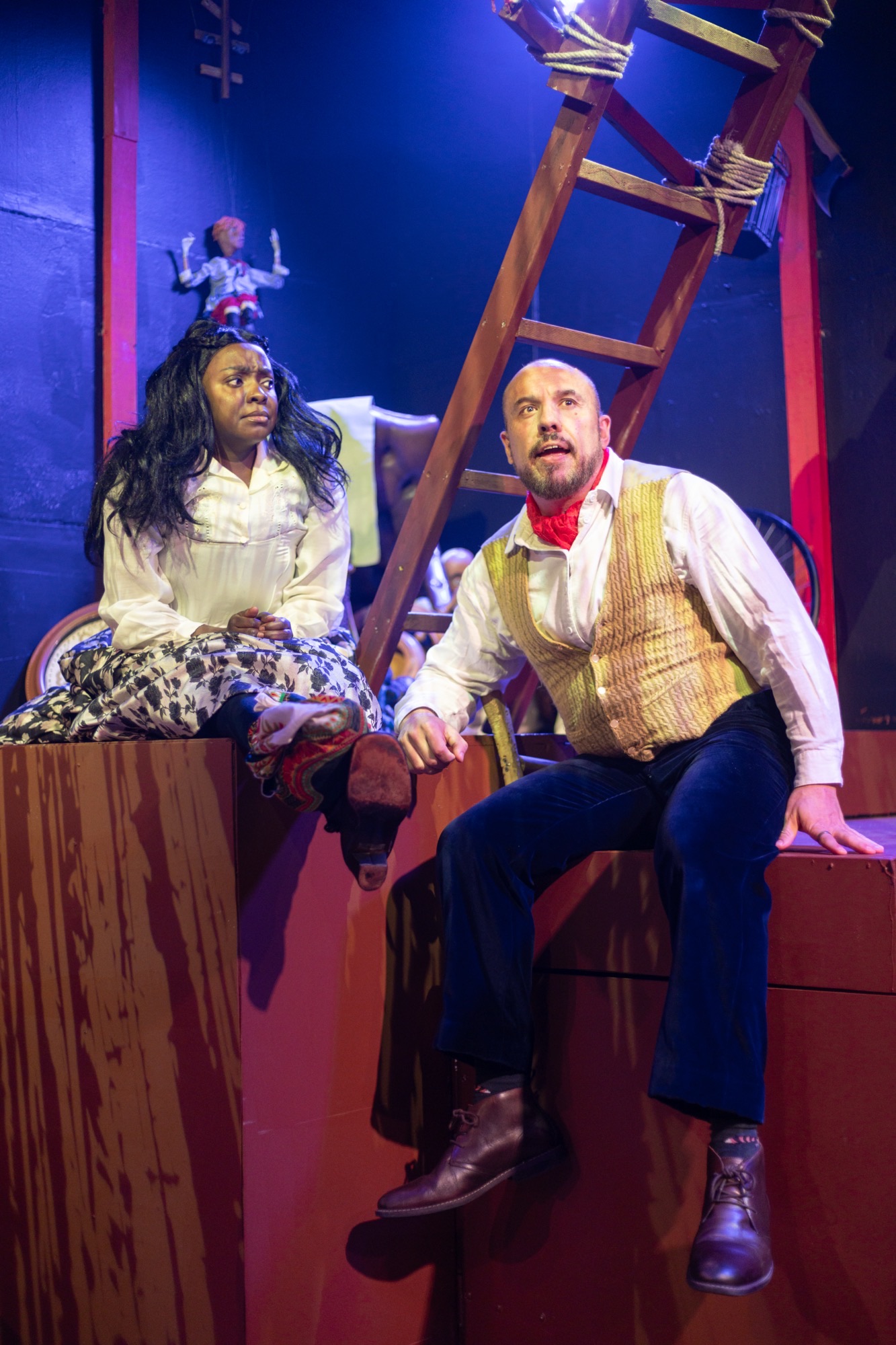
The world-famous Danish writer Hans Christian Andersen keeps a “pygmy” in a box in his attic. This imprisoned Congolese woman – who he calls “Marjory” – writes all his stories, classics such as The Little Mermaid, Thumbelina and The Little Match Girl. Meanwhile, in England, Charles Dickens keeps the sister of this Congolese woman captive – in the same manner, and for a similar purpose.
Troubling Andersen are visitations by two Belgians, men responsible for some of the soul-shattering horrors that colonialism inflicted on the Congo. These visitations are vexing because the Belgians are blood-soaked, and because their crimes weren’t committed until after Andersen was dead (The second of these reasons is only vexing because Andersen is yet to fully accept the possibility of time travel.)
More astute readers might have gathered by now that A Very, Very, Very Dark Matter is not an example of realism.
Rather, it’s a very dark comedy, spiked with absurdism. The target is exploitation, the method mad hilarity.
John Michael Narres’ portrait of Andersen, self-obsessed and pedantic, is very funny. Suzan Mutesi as “Marjory” is a wonderful foil to Andersen’s pettiness, pitching her performance in the key of bewildered dignity.
As the Belgians, Jayden Shelley and Simon Lee carry off with aplomb the tricky task of presenting war criminals as amusing goofs.
Sometimes, the production could do with a sharper pace, and the vocal work with more attention, but still this is a fascinating opportunity to enjoy a rarity from a master comic dramatist.
Written by Martin Crimp and directed by Harry Reid, this is a terrific production of a terrific play.
Performances are superb: hilarious, riveting, hair-raising.
Crimp is one of the modern masters of the dramatic form, and this is a perfect opportunity to see this mastery manifest.
To explain the skill, let me start with the purpose. Dealing with Clair is about dishonesty – in its multiple forms, and in its most devastating consequences.
Clair (Olivia Hall-Smith) is a real estate agent. She’s helping Liz (Talia Benatar) and Mike (Arkia Ashraf) sell their house. They’ve accepted an offer, but then another buyer appears. James (Daniel Fletcher) is offering more and can settle more quickly.
But don’t be deceived – this isn’t a play about the housing market. Sure, the scenario invites consideration of Crimp’s key purpose, but that’s only the beginning.
To interrogate dishonesty, Crimp employs drama’s full potential.
The script is replete with contrasting motifs that evoke the tension between the revealed and the unrevealed. Liz and Mike hide a stain on the carpet. Clair is silent when James asks personal questions. James longs for friends who would pass him on the street without acknowledging him. Anna (Jade Fuda), the nanny, has a bedroom with no windows. Anna is never fully dressed. In moments of physical intimacy, Liz and Mike ask What if Anna were to come in? only to say Let her!
And Crimp effectively employs drama’s ability to contrast action with word in real time. Several characters say they don’t smoke – while smoking. Liz expresses disapproval of Mike’s attitude – while passionately embracing him.
Then there’s the stylistic element of the dialogue of deceit. Facts that remain unsaid. Euphemisms that hide. Half sentences that never actually …..
And there’s the subject matter of this dialogue; not just the wheeling and dealing of buying and selling, but topics even less savoury. There’s a constantly hinted at sexual rivalry. And there’s a magnificent set piece in which Mike asserts what it is that goes on every time a man and women are in a room together, a sexual subtext of supposed inevitability. Mike won’t say this outright, but claims everyone knows what he’s talking about. He’s dishonest even about dishonesty. (And his wife’s response to this is shocking.)
And then there are the reported conversations. Is that what Clair said?I’m not saying they were her actual words. Something less than Truth is the lingua franca here.
And there’s the repetition of phrases that take on new meanings, or more accurately, soiled ones. What does James do? He deals in pictures. Repeated later, this now evokes something far more sinister. It’s not just that meaning changes or is fluid; it’s as though it’s going sour – until only the worst interpretations remain.
In Crimp’s world, language is inherently slippery and dangerous.
And to what does all this duplicity point?
A terrible selfishness. A shocking disregard for others.
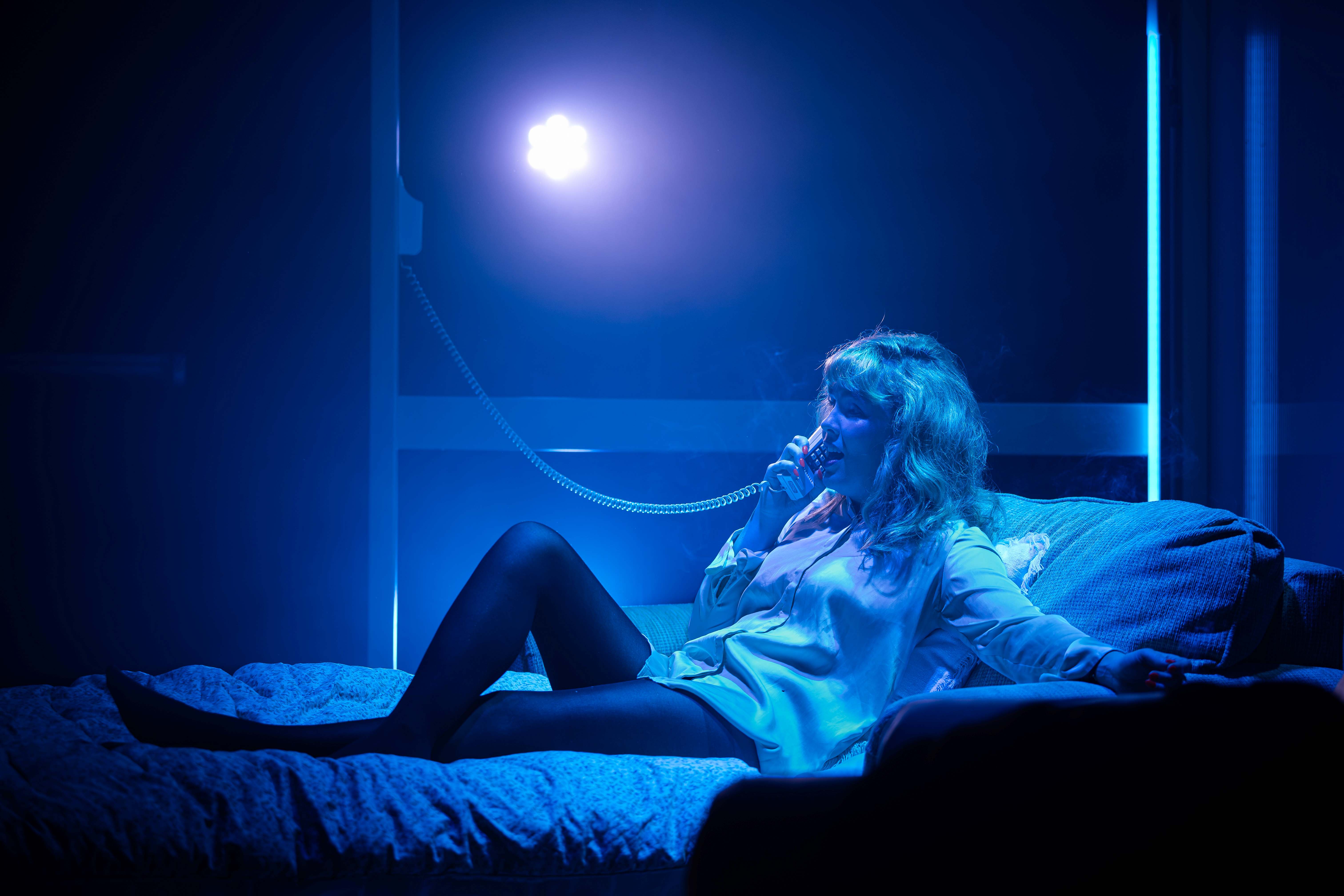
Over the phone, in a conversation that casts a frighteningly long shadow, Clair tells her mother that in her job she meets aggression, but not violence, never violence. But something very close to violence permeates much of the play: in the way Liz and Mike treat Anna, in the way they treat a tradesman (Bayley Prendergast), in the way they never connect with their baby.
And then there’s James….
In doing violence to Truth, we open a doorway to violence to people.
As I said, the script of Dealing with Clair reveals a dramatic master at work, and this production shines with a terrifying brilliance.
Paul Gilchrist
Dealing With Clair by Martin Crimp
presented by Irregular Programming & Old Fitz Theatre
Written and directed by S. Shakthidharan and Eamon Flack, The Jungle and The Sea tells of the Sri Lankan Civil War.
It’s an extraordinary piece of theatre-making.
With a simple design and an exceptional cast – Anandavalli, Prakash Belawadi, Emma Harvie, Nadie Kammallaweera, Shiv Palekar, Dushan Philips, Kalieaswari Srinivasan and Rajan Velu – The Jungle and The Sea movingly presents the impact of war on ordinary people.
The script is inspired by both eyewitness testimony and classic literature. The first of these brings an urgent truthfulness, which the second somewhat dilutes. (Allusions to The Mahabharata and Antigone risk pulling us out of what is believably wild reality into the euphemism of the constructed tale.)
A recurring motif is Fortune. And, reflecting on the events so powerfully presented in this production, ones that occurred not that far away and not that long ago, it’s difficult to see modern Australia as anything but deeply fortunate. It’s also a timely, crucial reminder to value peace and to work for its maintenance. (Hint: Seek Justice. Shun Violence. Both in equal measure.)
Another motif is the tension between Chaos and Order. There’s a provocative moment in which a defender of Order wails in frustration that Everyone can’t get what they want. Are we being invited to view this assertion as self-serving, as simply spoken by someone enjoying authority? Well, enjoying certainly seems the wrong word in this scenario – and, anyway, the painful assertion is also true. Our society’s beautiful infatuation with Justice means we desperately pursue it, without giving much consideration to what it is. Who decides the nature of Justice? Serious question. And is Justice really the paramount virtue? What of Love? One of the many glories of this piece is that it’s peopled with characters of many faiths – Hindus, Buddhists, Muslims, Christians and Atheists – and in these traditions that speak of Love there’s an awareness, that in our Fight for Justice, the Fight must not predominate.
It’s an epic piece (2 hours 50 minutes with two intervals) – and for the first two acts, the beautiful simplicity of the presentation leads us to believe we’re witnessing the dreadful Truth of civic unrest. The final act, however, feels different, as though the recording of events – and the allowing of the audience to evaluate those events – is gradually replaced by a direct evaluation by the theatre-makers themselves. Without spoilers, an example: A woman accused of treason repeatedly asserts that what she was doing was ordinary. It’s a remarkable claim, not because her actions are in any way treasonous, but because of the extreme circumstances and the life and death stakes. (In the Event of Attack: Escape, Hide, Tell.) What is perhaps understandably maddened grief is presented as a desire for justice. Like the literary allusions, this moral judgement dilutes what would be achieved by plain honesty.
Perhaps I’m being pedantic – but there’s no doubt this is a brilliant, bold piece of theatre.
Paul Gilchrist
The Jungle and The Sea by S. Shakthidharan and Eamon Flack
John Wyndham’s famous novel is not one I had imagined would readily lend itself to dramatization.
It’s in first person. It’s highly discursive. The plot is rambling. There’s no obvious climax. And its primary antagonists are seven-foot tall, walking, flesh-eating plants.
To realise this on stage, J. James-Moody has gone for full throttle theatricality – and, in this regard, it’s an extraordinary achievement.
Special praise should go to lighting designer Holly Nesbitt, sound designer Aubtin Namdar, and a plucky cast led by James Collins who navigate the orchestrated anarchy.
This stage realisation still centres Wyndham’s key concerns. Through the satellite weapons that blind billions, and the genetic meddling that results in the triffids, we’re confronted with the humbling truth that our technological development too often outstrips our moral development. And shown individuals banding together to survive in a post-apocalyptic world, we’re teased with the ethical question of how a new society might best be organised. Admittedly, this extremely theatrical presentation is more suited to the portrayal of the chaotic horror of it all, rather than the subtle provocations of political philosophy – but that’s a failure many audience members won’t regret.
However, at two hours without interval, I suspect some audience members might regret certain flashbacks and repetitions. One set of recurring motifs establishes the mid-twentieth century setting: the repetition of mock newsreel footage and of a wailing 50’s pop song. Perhaps these lighten the mood. Perhaps they evoke the nightmarish naivety of the past.
Whatever the case, it all sends us out into our contemporary darkness, to consider what horrors we ourselves have summoned.
Paul Gilchrist
The Day of the Triffids by John Wyndham, realised by J. James-Moody
It’s been a while since I’ve been invited to a Griffin show. Perhaps I’d been banned. Perhaps I’d been banned because I spoke Truth to Power. See how I’m creating a story, one in which I’m some sort of cultural hero. But that’s a story no-one needs (least of all me.)
We do need a story like the one told in Afterglow.
But need doesn’t quite express what I mean – but that’s something I’ll come back to.
Sheanna Parker Russon and Lillian M. Hearne’s Afterglow is a glorious celebration of sexual and gender diversity.
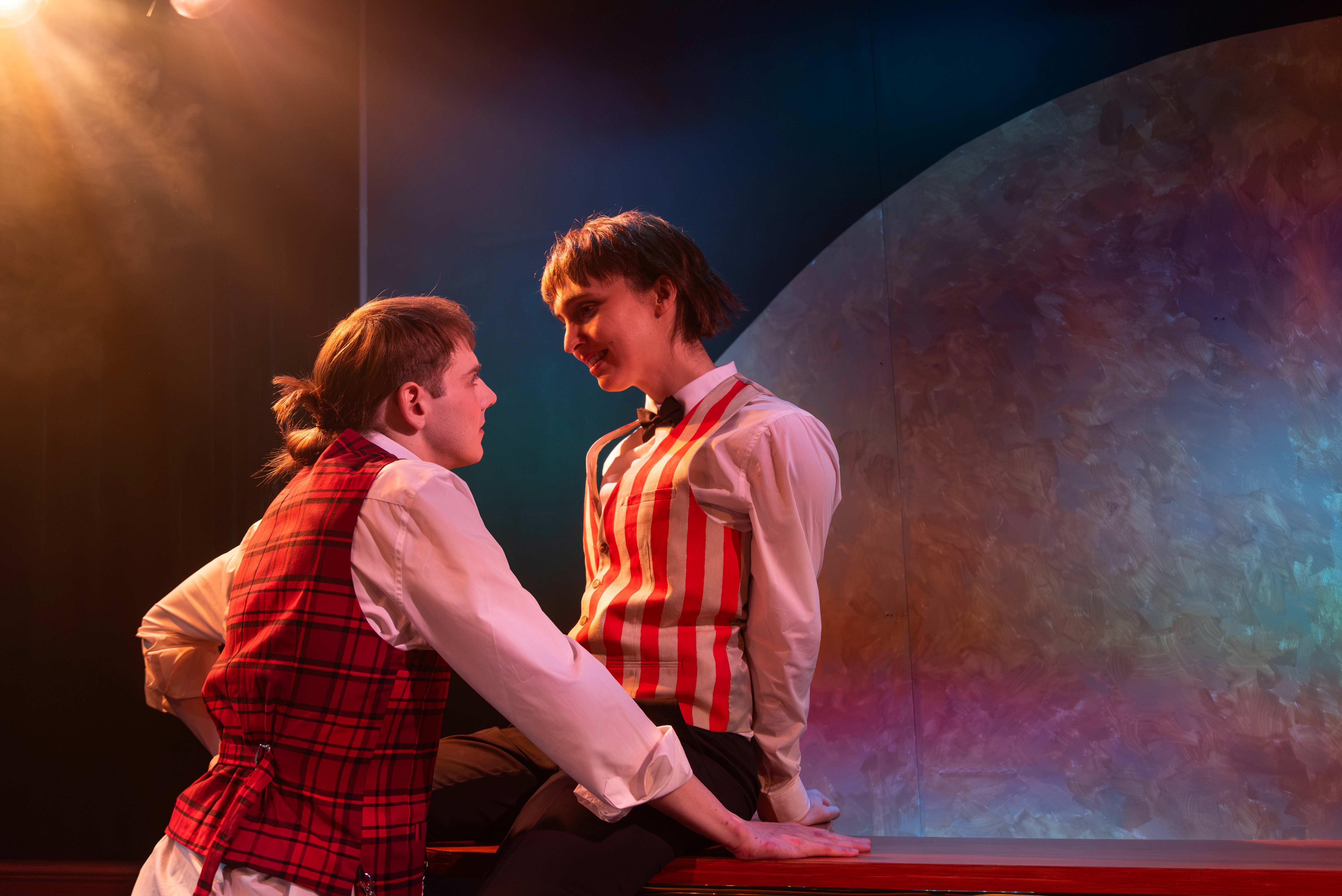
It’s a thoroughly enchanting rom-com with songs. The songs are in the style of barbershop quartet and contemporary music theatre. The barbershop is, of course, sung acapella and the contemporary is accompanied by Hearne on piano. The performance of both styles is an absolute delight.
Michael loves singing in a barbershop quartet, but he’s not quite sure who he is, and there’s good reason to believe that those who partake in the quaint artform may not be too accepting of where his journey of self-discovery may take him.
Afterglow shares with Strictly Ballroom the playful presentation of a rather antiquated artform to parody parochial insistence on conformity.
Performances are comic gold. Directors Cassie Hamilton and Lily Hayman know the sort of piece they have and make it sing. Clever lighting choices by Tyler Fitzpatrick add to the merriment.
The script hilariously targets the narrowness of some of the quartet. Playing characters who are bigoted and bumbling, Nat Jobe and Lincoln Elliott are excellent. Rarely have such bores been such fun.
The potential lovers are utter magic. Hamilton offers a superb portrait of a charming, confused vulnerability and Nic Prior gifts us a moving presentation of confidence and courage.
The script is not without provocations.
Can straight people really be reduced to middle class conventionality, to the kids, the house, the lawn? (It’s a reduction that presupposes the existence of some sort of contrasting cultural heroes. And I’ve told you already what I think about that.)
Does a cis heterosexual male really need to define his own moral growth using someone else’s language?
And there’s that word – need. As we leave behind a smaller, suffocating world, how prescriptive will we be? Can we only break old norms by introducing new ones? Or is there a wider vision of flourishing?
The absolute joy of this piece suggests the latter.
Paul Gilchrist
Afterglow by Sheanna Parker Russon & Lillian M. Hearne
presented by Griffin Theatre Company and Purple Tape Productions
According to an old wives’ tale, thirty-five is the life-expectancy of trans women. This figure is not supported by solid data; the myth gains currency from the fact that, in our small-spirited society, trans women continue to have it hard.
In one of its sharper moments, the show even suggests this life-expectancy myth is perpetuated by those who wish it true.
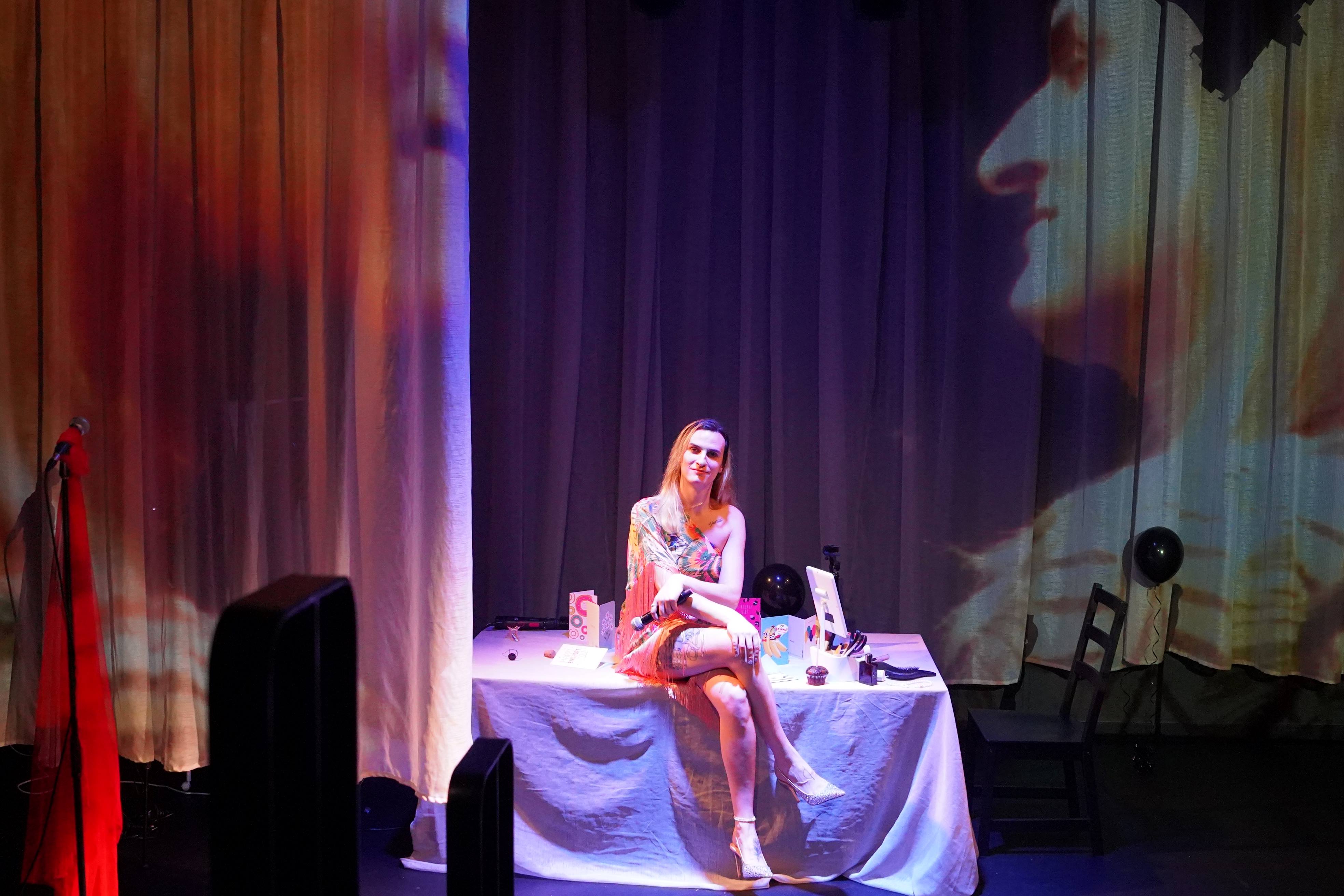
Written by Jo Clifford and Bayley Turner, and performed by Turner, Thirty-Six is life-affirming. Though bearing witness to the challenges faced by trans women, it celebrates survival and community.
Turner makes clear she’s deeply grateful for her friendship with Clifford. Having passed the thirty-five hoodoo, Clifford is valued for resilience, wisdom and hope.
Through the use of projection, voice over, amplification, music, and some poignant props, director Kitan Petkovski creates a show of theatrical richness.
Turner has a terrific stage presence and great comic timing. Her wonderfully warm delivery infuses the performance with a deeply affecting honesty.
Regardless of the veracity of the life-expectancy myth, Life’s opposite awaits us all. It’s rare for theatre to look clear-eyed in this direction. (This piece even offers an eschatology – though perhaps the offer is merely playful.)
In referring to us all, I’m not trying to so universalise Thirty-Six that it loses its vital focus on the particular: the experience of trans women. I’m simply expressing its spirit: that the Truth is for us all.
Paul Gilchrist
Thirty-Six by Jo Clifford and Bayley Turner
presented by Aperture Productions,
at The Loading Dock Theatre, QTopia, until July 18
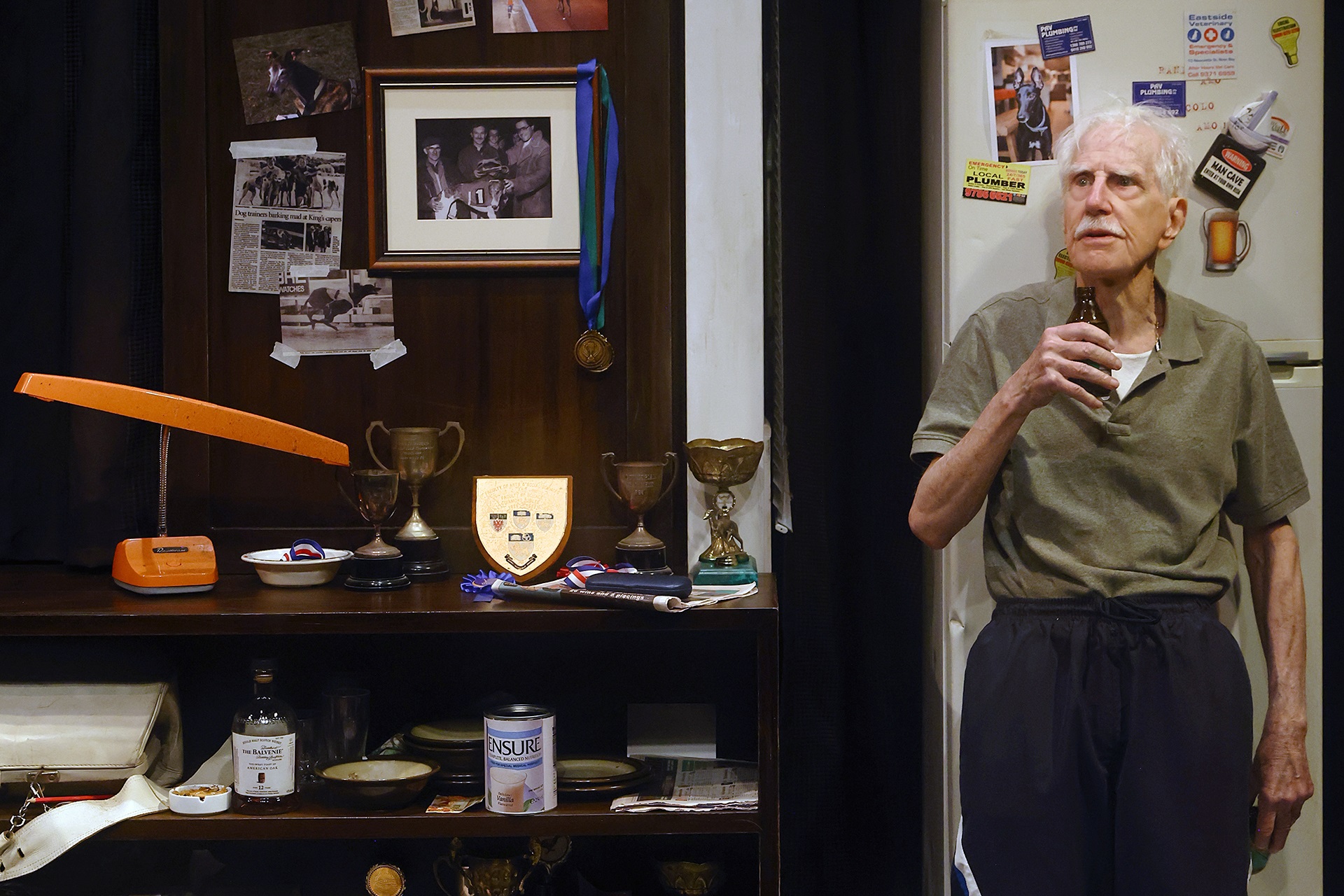
It tells the tale of a family of grifters, in love with the mad possibilities of the dog track. Playwright Mary Rachel Brown has a terrific ear for dialogue, and the script sparkles with hilarious one-liners.
Under the direction of Anna Houston, the cast present magical comic performances.
Peter Carroll is perfect as Errol, the ailing patriarch of the Sinclair family, physically suffering but still linguistically exuberant and psychologically domineering. There’s utter hilarity in his certitude, not necessarily in its falsity, but in its breathtaking smallness.
As his eldest son, Cess, Justin Rosniak radiates an extraordinary energy, creating all the more laughter – and all the more pathos.
Errol’s younger son, Jimmy, is less sure of his father’s “creative” ways, and has taken a real job; he operates the electric hare at the track. And there’s something of the bunny in his character, more gentle than his brother and woefully innocent. André de Vanny’s portrayal of Jimmy is both mirth-making and heart-breaking.
And Marco Chiappi as the track manager is superb in his shallow, glib self-importance.
Is The Dapto Chaser satire? Certainly not Juvenalian: the targets are too small. The Ensemble marketing has gone for the term black comedy, which considering one life-altering plot point it most certainly is.
But in some ways, what’s happening is that we’re being invited to share the laughter of regret. It’s an invitation made even more beguiling by the fact that, since 2011 when this historical comedy was originally produced, the Dapto Dogs track has finally closed down. The Dapto Chaser invites regret for the disappearance of this sadly parochial world, and regret that anyone ever had to experience it.
But there’s also an invitation to joy, a celebration of a wild, reckless vitality; a vitality perhaps not on the side of wisdom, but indubitably on the side of Life.
It’s intermission of Grace Malouf’s play First Do No Harm and I’m thinking I’ve just witnessed an absolutely brilliant first act.
Directed by Charley Allanah and Malouf, the performances are magnificent; nuanced and genuine. Kate Bookallil, Richard Hilliar, Josh Merten, Shan-Ree Tan and Barry French are a dream ensemble.
And the script is superb.
I’d give my right arm to have written that first act.
But that’s an old-fashioned expression.
The world moves on.
And it’s the examination of this phenomenon of change which makes Malouf’s play so exciting.
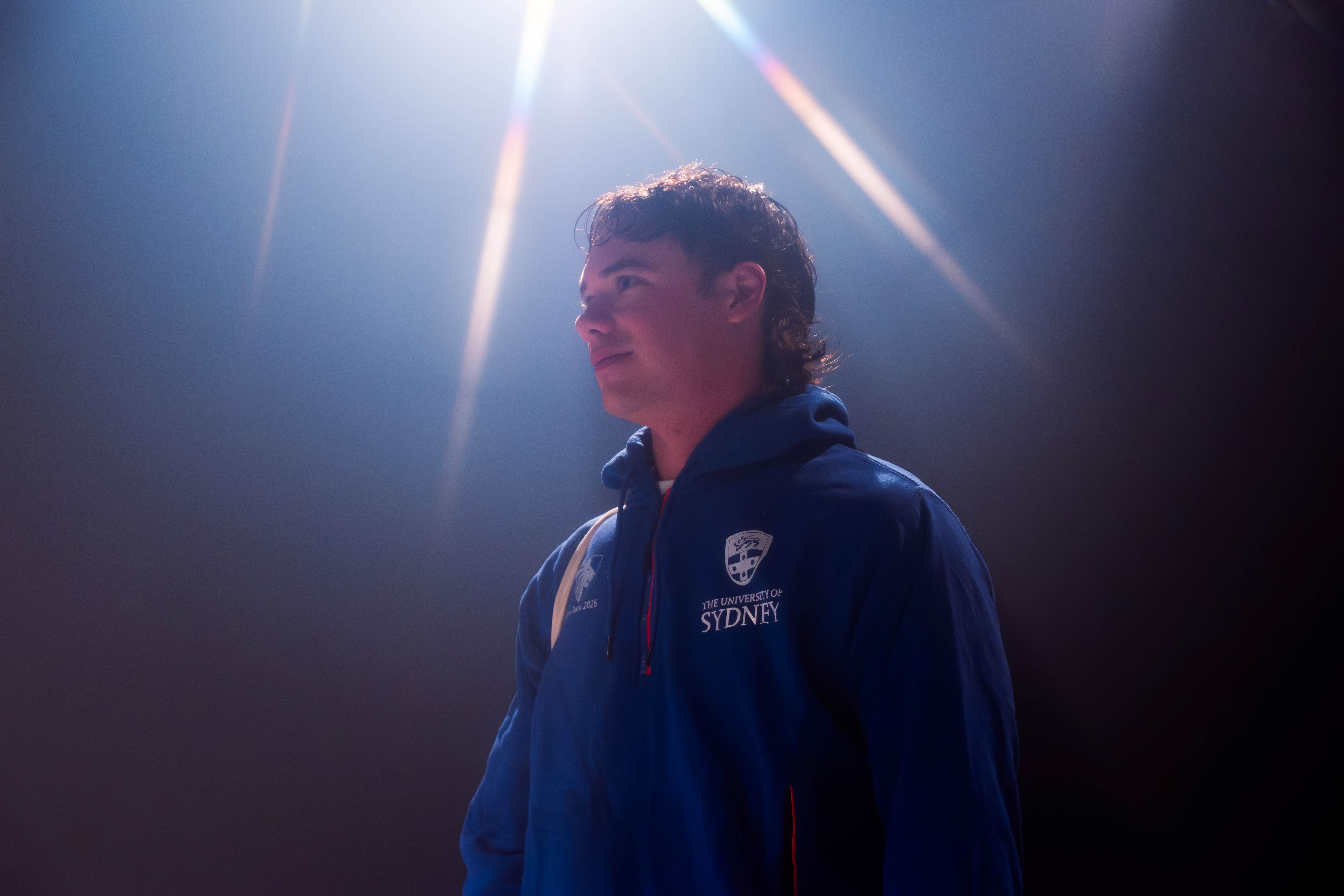
It centres on the ethics of a surgical procedure for Alexei, a young Olympic hopeful (played by Merten with utter believability.)
We witness a hilarious and provocative discussion between two medical experts (Bookallil & Tan) asking whether their profession leads ethical change or if they simply follow society?
The tacit assumption is that ethics do, indeed, develop.
It’s a phenomenon exemplified over the last 60 years, as the rights of previously marginalised groups have been increasingly acknowledged. But only Innocence will assume that change in societal values is always for the better. In the same six decades, I’ve seen the 1960’s and 70’s dream of social equality sidelined by the 80’s fixation on gaudy, material success. And more recently – and with horror – I’ve witnessed the valorisation of anger, coupled with the deeply unhelpful assertion that rage alone signifies a genuine commitment to justice.
It could all leave you with the soul-disturbing sense that our ethical values are merely arbitrary, like fashion. And, seriously, who can care that much about fashion?
Alexei succinctly expresses the issue of arbitrariness, bitterly complaining that a perception is dismissed as a delusion when held by only a few people but, when held by everyone, is readily embraced as reality.
I think it’s because the play approaches this frightening aspect of our ethical lives so entertainingly, so boldly, that I fell in love with its first act.
It’s a hard act to follow.
Perhaps a falling off is inevitable, if you value the first act as I do: as an extraordinarily powerful representation of one of the great tensions running through the human experience. We want to live for our morals – not by them, but for them – yet one of those moral values – our dedication to Truth – threatens to strip us of the certainty that helps us to live for any of them. For a serious person, that’s a frightening tension to confront. (But more on that later.)
So, the second act. It has one scene that seems unstageable. It also privileges shouting and anger. Perhaps a richer choice might have been to present a little more honest bewilderment.
Having set up the ethical issue – can Alexei have a particular body modifying surgery? – the playwright seems understandably reluctant to give a simplistic answer. Instead focus moves to other ethical decisions made by the surrounding characters. It feels somewhat diluting (akin to adding scenes to Macbeth in which Macduff and Lady Macduff argue about who has dedicated more time to the rearing of their children.)
But, I acknowledge that what I’m calling dilution (admittedly, in this case, dilution with acid) is actually the creation of multiple complex characters – and that too reflects crucial aspects of our ethical experience.
Firstly, few moral decisions are made in social isolation; our decisions impact others, and will be judged by others.
And Secondly, every individual’s moral life is of equal importance (regardless of passing fashions.)
And Thirdly, that frightening tension I refer to above can probably only be faced by embracing a compassionate humility – and, in terms of drama, that required courage and openness is perhaps best epitomised in the creation of such fully fleshed-out characters as this production offers.
First Do No Harm is thrilling, vital theatre.
Paul Gilchrist
First Do No Harmby Grace Malouf
Presented by NIDA in association with bAKEHOUSE theatre and Talia M-K
Written and performed by Tom Robins, this is a wonderful little fringe show – ambitious, evocative and magical.
The protagonist, John, tells of his maritime journey to find out what has happened to his favourite uncle, Max.
John and Max had been close, the black sheep in the family, the two individuals who didn’t fit into the small, ordered lives of the rest. Max had told John some extraordinary stories about his sea journeys. He’d asked John if he believed them – and the answer had been a resounding Yes!
Many of Max’s stories are sourced from maritime legend. In fact, Max has left, as a sort of guide, a book of such tales. In the tales told by Max to John – and by John to us – are sirens, selkies, kelpies – and the Lighthouse. Max has found the Lighthouse, and John feels he is called to follow. Like all great myths, the Lighthouse is ambiguous, inviting multiple interpretations. Is it Death? Is it the place of Enlightenment? Is it where all our many stories converge? Or is it the place from which all our stories derive?
Simply and beautifully staged, the piece is a thrilling invitation to embrace the power of story.
Its intriguing and provocative energy derives from two tensions.
Firstly, stories are everywhere. They’re the sea in which we swim; without them, we’d be as fish thrown upon the sand. Stories are this rich, life-giving medium because they forever mix, in a surging ocean of ideas. Stories inform each other. There are no entirely original tales – and that binds us all together. But – and this is the tension – each of us must find our own stories. The fish might be in the sea, it might be of the sea, but it is not the sea. To have Life is to have movement of your own, not to be at the mercy of every tide, every current. (This extended metaphor is mine, not Robins’. I hope, that by being inspired by someone else to make its own way, it exemplifies the generously wise vision his piece shares with us.)
The second tension is that between story and reality. Some people might argue that what we call reality is just one more story. But Robins’ story features a hagstone: that is, a stone with a naturally occurring hole, one which – when peered through – enables the viewer to see beyond all disguises and illusions…to reality. This tension between story and reality runs through the entire piece, just as it runs through the entirety of postmodernity. In the world in which we live, we know that any desire to reduce the human experience to mere facts is dehumanising, counter to a flourishing diversity. But at the same time, we suspect that the utter denial of facts can pave the way to atrocities, of both the figurative and literal kinds.
Robins presents John’s story in an easy, utterly watchable manner. Occasionally, I felt a clash between the character’s casual colloquialism and the grand, poetic vision of the piece – but I can’t deny that The Art of Storm-Whistling is a joyous gift.
Paul Gilchrist
The Art of Storm-Whistling by Tom Robins
Presented by Curious Roach Collective, as part of Pride Fest
The “An” in the title is misleading. There are actually three interventions in Mike Bartlett’s very funny, mischievous play.
A and B are good friends. B intervenes in A’s life regarding her drinking. A intervenes in B’s life regarding his choice of partner. And, somewhere offstage, their nation is intervening in another nation’s civil war.
It’s a brilliant device for exploring both one of our culture’s current peccadilloes, and a more universal aspect of the human condition.
Contemporary culture is very keen that we tell each other what to do. The standard you walk by is the standard you accept is a popular mantra, and one that valorises ethical imperialism. It holds that when the world behaves as you think it should, then and only then, can you be morally at ease. Of course, the intention behind such an attitude is usually/often/sometimes/occasionally/perhaps praiseworthy. (Yes, I’m offering a sort of Choose Your Own Ethical Adventure.) We say we entertain this attitude of telling other people what to do because we genuinely care, but we know it can be problematic. A accuses B’s partner of being the “joy police”, but also criticises B’s absence from a rally opposing the overseas military intervention – even though she knows it’s an action he supports.
A and B’s friendship has always been exhilaratingly combative; they like to argue for their personal vision of the Truth. We sometimes say that individuals in such a relationship like the Drama of it. But that can’t be the case if each of the friends wants to win the arguments – for Drama’s gift to humankind is its ability to resist simplicity, to embrace the expression of multiple voices. In great Drama, no single character wins, only the audience. (One of my favourite moments in this very funny play occurs in a gallery. The two friends examine an artwork. We’re told it depicts Tony Blair taking a selfie in front of a war-torn cityscape. A has wanted B to see this artwork. But B‘s response is to ask if it’s some sort of magic eye picture. He asks if he looks at it long enough, or if he squints in some weird way, will it finally reveal itself, despite all appearances, as being a work of subtlety and depth?)
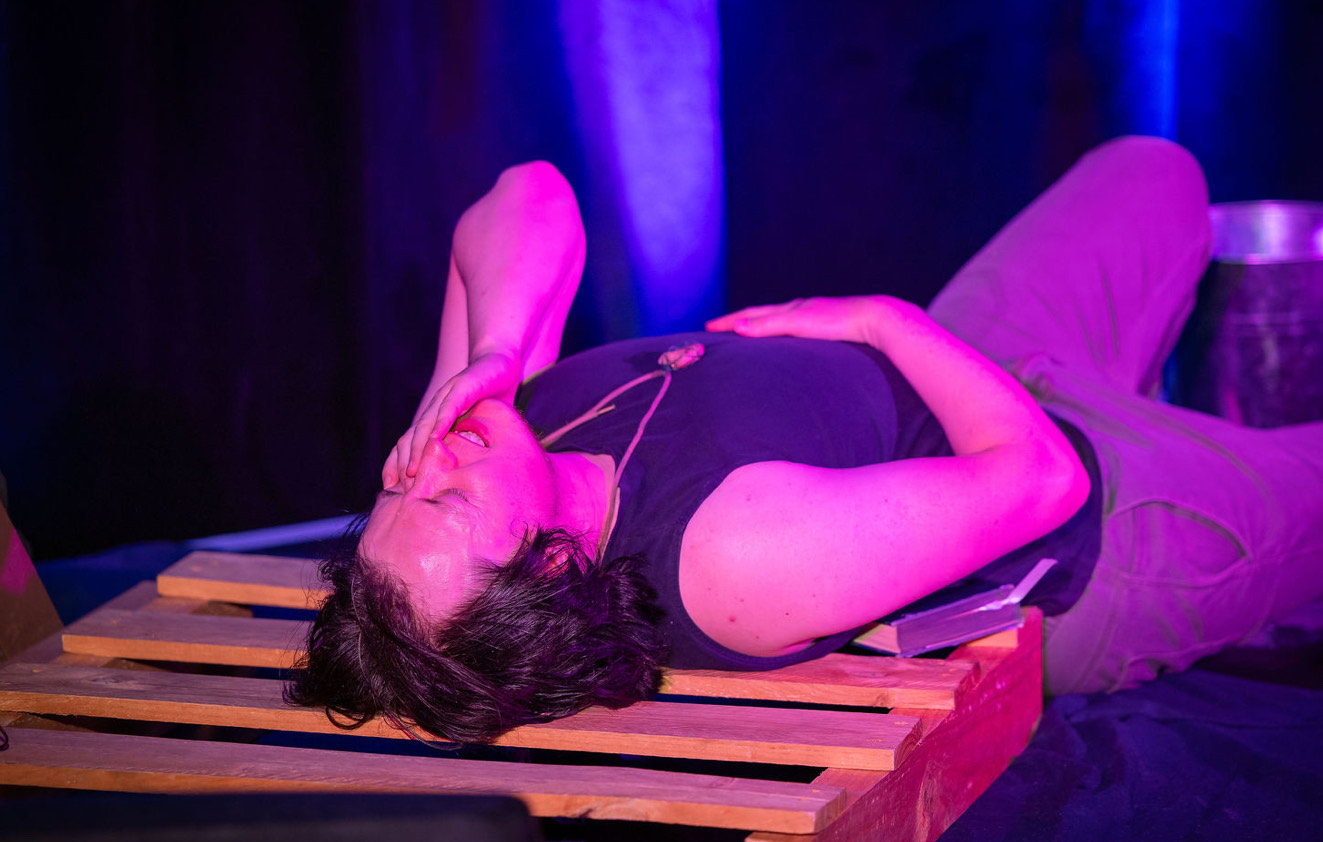
Directed by Mike Booth, this production is a comic delight and a thrilling invitation to thought. As A and B, Brea Macey and Jake Harvey are terrific, delivering Bartlett’s hilarious contemporary dialogue with aplomb. Despite being only eighty minutes in length, it’s a beautiful slow burn of a piece. It’s a joy to watch Harvey present B’s gradually growing awareness that a gladiatorial relationship might not make him happy. Similarly, Macey’s portrayal of A’s slide from sarcasm to bitterness is both pathos-inducing and utterly engaging.
I suggested earlier the play wasn’t only contemporarily relevant, but also universal.
Consider the final scene. (Don’t worry, no spoilers.) To be honest, the final scene did leave me feeling as if the play had morphed into a different genre, that we were now watching a black comedy. And the script does dictate some staging that wrenched me out of its invented world, emotionally and intellectually. But the final image, both visually and aurally, is absolute gold, an almost Beckettian encapsulation of the human condition. Other people are both the cause and cure of our Desperation.
But a Desperation shared is a Desperation halved/doubled.


 Theatre Red