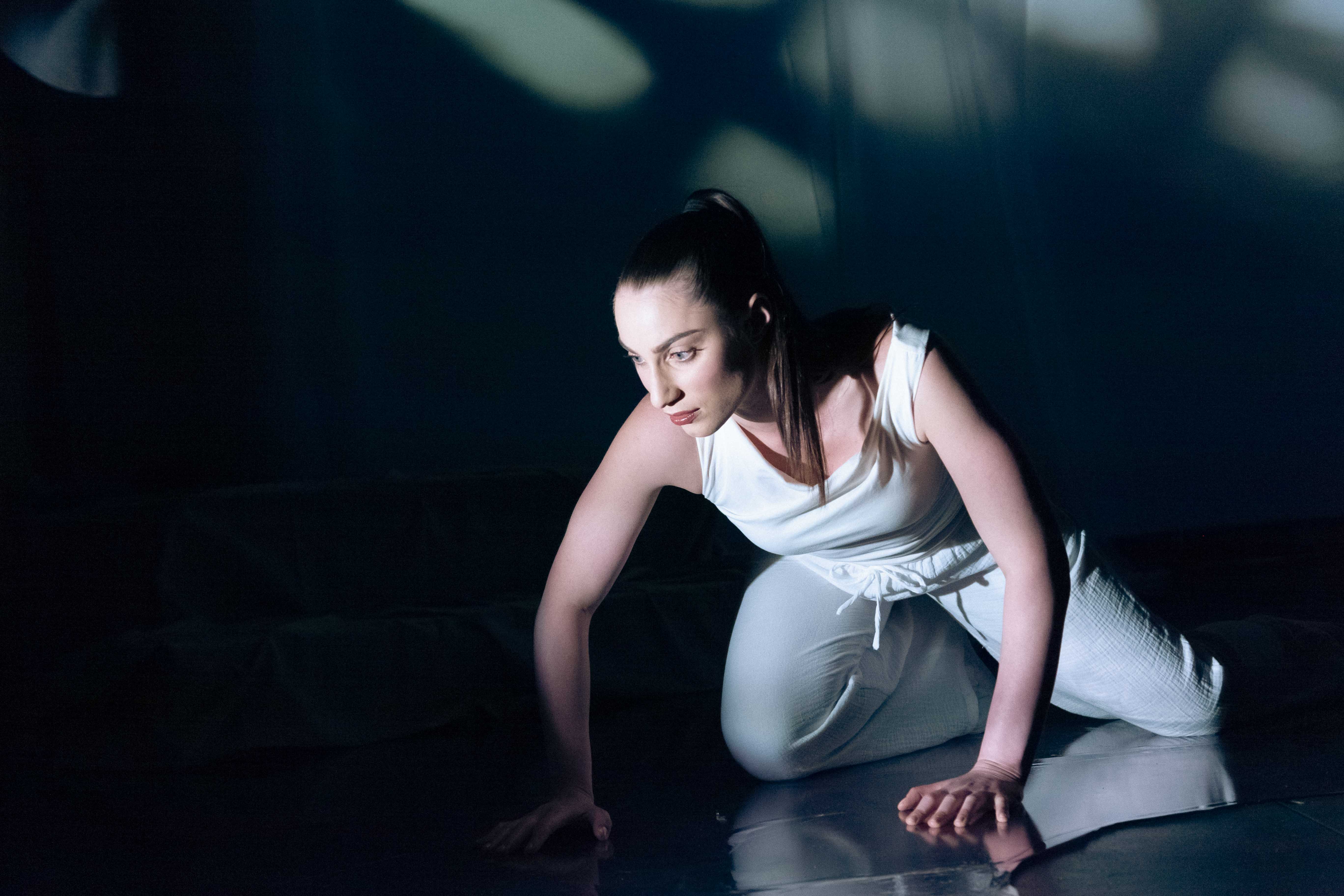
This a passionate cry against the injustice of sexual assault.
But it’s the way this cry is presented that makes The Forked Tongue such an intriguing piece of theatre.
I’d like to discuss three elements of this presentation.
The first of these relates to myth.
Written by Babette Shaw and directed by Kirsty Semaan, The Forked Tongue tells the story of Medusa, but – we’re told – not the one we know. A reasonable number of people might find this an odd claim, because I suspect a reasonable number of people don’t know any story about Medusa. After all, she is a character from Ancient Greek mythology, a cultural creation of a faraway place and a long ago time.
But if you’ve wasted vast swathes of your life and have more than a passing familiarity with the culture of the classical world, you’ll be aware that Medusa, like most Ancient Greek mythical characters, is rather nebulous. A lot of classical authors mention her, but they’re short on detail, rarely agree on her story, and seem little interested in her psychology.
But to distil: Medusa is a Gorgon, a monster, the one with snakes for hair, so hideous that she turns people into stone if they meet her eye.
It’s a myth ripe for feminist subversion – and subverted it has been. This is the second piece of theatre I’ve seen this year in Sydney that employs the Medusa motif. You might argue that observation alone counters my claim that Medusa is a relative unknown in our culture. Or you might not: you might read it as evidence that storytellers are want to emphasise stories, attributing to them far more importance than the average person does. Perhaps this is indicative of the deep insight of storytellers. Or perhaps it suggests their parochialism. All the world is a stage says the playwright; All the world smells of fish says the fisherman.
Leaving aside the value of interrogating old myths, I’ll move on to the second fascinating element of the piece: the clash that results from the modern appropriation of classical culture. When Modernity tangles with Antiquity, it really is the clash of the Titans and, in the case of The Forked Tongue, leads to some rather explosive theatre.
Let me start with a trivial example. Medusa is at work at the temple of Athena. She has rushed there this morning, fearful of being late again. It is though she works in retail and can’t afford to miss the train one more time. This is the mundane detail of the bourgeois novel – and that’s not a criticism: these modern artworks display an interest in interiority and equality which is at the very heart of the contemporary social justice project, a project unknown to a classical world in which women had virtually no power and one third of the population were slaves.
Another example (but with a different conclusion.) When Medusa is confronted by the predatory Poseidon, it’s at the end of her shift at the temple. She’s closing up. She’s alone. He asks her for a drink. She politely refuses. He violently takes what he wants. We’re asked How could the experience be consensual, considering the difference in position in pecking order of the two? Poseidon is presented as the creepy boss who abuses his power. It’s a very modern take, and one that effectively indicts such behaviour. However, if there had been any Ancient Greeks in the audience (I don’t think there were) they might have responded But Poseidon is a god! In the modern world, encounters with the Divine have become so rare we’ve forgotten that the value of such encounters is that they overturn …. pretty much everything. A terrible beauty is born. All encounters with the Divine were – and are – a type of assault. Does that justify any type of actual human assault? NO. But Poseidon’s dreadful violence reminds us of the existence of a sphere of Life beyond Project-Social-Progress, a sphere of Life where individuals are confronted with the utter capriciousness of the universe, and no well-meaning-committee-endorsed-protocols can protect them.
Modernity versus Antiquity. Time has determined the victor, but a play like this poses the question (at least for me) of what we’ve gained and what we’ve lost.
And the final creative decision making this a fascinating piece of theatre is the characterisation. It’s a one actor piece, and Emilia Kriketos is marvellous, showing enormous skill both vocally and physically. She also has the challenge of portraying three characters – Medusa, Athena, and a modern narrator – and presents these variations with aplomb.
In giving her version of Medusa’s tale, the modern narrator asserts there’s more than one side to every story. You might wonder if there’s a logical inconsistency here, or something oddly self-defeating. It’s certainly unusual for a character in drama – or, in this case, outside the drama – to make such an assertion. It’s like a used car salesman saying Trust me: at every repetition we feel a little less inclined to do so. Any commentary on the tale reminds us it’s just a tale (about a tale – which brings me back to my first question about storytellers and fishermen….)
As you can see – with its bold decisions and beating heart – this piece will spark much discussion.
Paul Gilchrist
The Forked Tongue by Babette Shaw
presented by Left Leg Productions
at the Substation, Qtopia until Dec 13
Image by Signature Photography by Kirsty Semaan
 Theatre Red
Wow, wow, wow!
The Forked Tongue was an extraordinary piece of theatre and one I won’t forget anytime soon.
The performance earned a thoroughly well-deserved standing ovation, and it was easy to see why.
Emilia Kriketos is a young, up-and-coming actress who is truly the complete package. She has a striking stage presence matched by remarkable talent, drawing the audience in from the very first moment. Watching her seamlessly embody three distinct characters was nothing short of mesmerizing — each one fully formed, authentic, and emotionally compelling.
This was a powerful, captivating performance that showcased not only skill, but confidence, depth, and heart.
An absolute joy to watch and a clear sign of a bright future ahead.