This one would be a challenge to make work: there’s only two actors, it’s 100 minutes long, there’s a huge number of short scenes, and it’s about athletics.
It does work, and gloriously so, thanks to skilful direction by Emma Whitehead and cracking dialogue by Ella Road.
Whitehead marshals a talented team to splendid effect, with projection by Aron Murray, lighting by EJ Zielinski, sound by Mitchell Brown & Osibi Akerejola, design by Kate Beere, and movement choreography by Cassidy McDermott Smith, all creating a pleasingly complete world of vitality and tension.
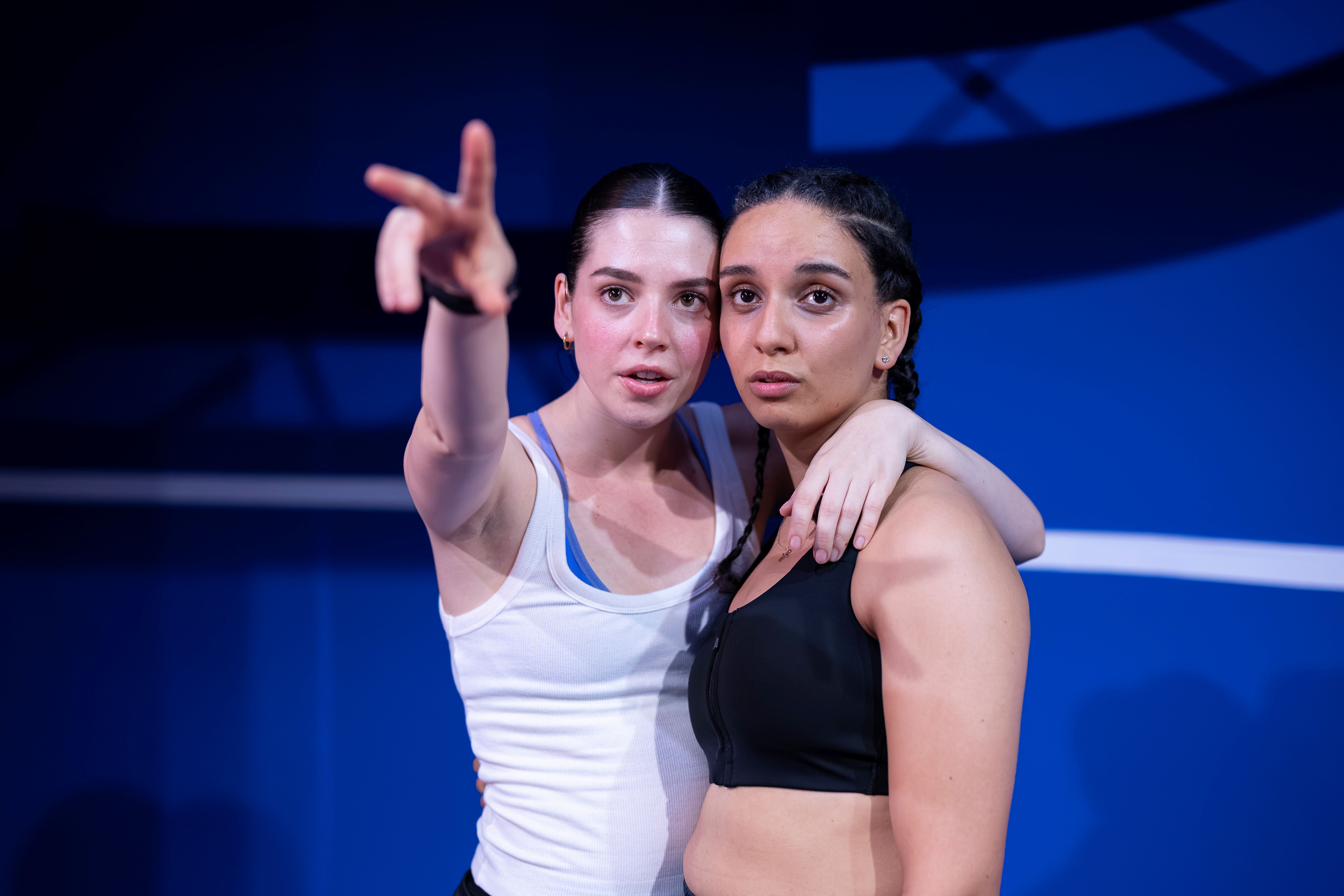
As Anne and Sophie, Rachel Crossan and Elodie Westhoff give terrific performances. There’s high-energy physicality and well-delivered humour, but also inspiring representations of strength and moving representations of vulnerability.
For most of the play it appears we’re being given a story of young female friendship, and we could do with more of these on our stages. And it passes the Bechdel test with flying colours; sure there’s talk of boys, but they’re far from the focus of these two young women’s lives – they live to run.
Or is it to compete?
That’s the twist. Competition is not inherent to friendship. There’s something frightening and threatening about competition being the backdrop to this relationship.
Until about 80 minutes into the show I was enjoying the richness of this representation of a friendship played out in an environment hostile to genuine trust and connection – and then it changed into a play about something else. Considering this change happens a long way into the action, to discuss it risks breaking the spoiler rule – but then the idea of rules and who gets to make them is one of the things the play tries to teach us, so I’m going to break it.
Read on at your own peril.
The play becomes a promotion of the argument that a neat binary concept of sex doesn’t fit reality. As one character says, the science isn’t reductive, but society is.
Does the play become didactic? We do hear from the other side. Aired is the view, that in physical competition, a clear binary division between the sexes is fairer. But the arbitrariness, and cruelty, of such a view is made apparent.
I found this change in what the play was doing frustrating, because matters of importance were being rushed. After one event, Sophie says she mistimed her race, that she’d left her run too late – and I think that’s the case here.
But that’s just a dramaturgical complaint (one I can guarantee is not shared by everyone.) There was another aspect of the play I found delightfully provocative.
The play explores the concept of justice in competition – but the two nouns in that phrase seem at odds. The first is an ethical term, and the other is, well … not. Or, at least, not obviously ethical. In fact, to some overly delicate souls, competition is downright problematic. I know we like to tell ourselves that human societies are fundamentally competitive – but are they? And should they be? Should we be encouraging competition? Is “Faster, Higher, Stronger” really a laudable goal? The fact the Olympic motto was updated in 2021 to include one more word – “Together” – highlights that there’s serious uncertainty about the valorisation of competition. Does the pursuit of justice in competition unwittingly justify a human behaviour that we’d be better off not justifying?
Or, more insidiously, does the pursuit of justice in competition contaminate the very concept of justice itself? Does it risk reducing justice to merely the right of every person to be considered better than other people?
As I said, delightfully provocative, thrillingly energetic and vitally important.
Paul Gilchrist
Fair Play by Ella Road
presented by Lost Thought
at the Old Fitz until 21 March
Image by Robert Miniter
 Theatre Red
Leave a comment