Do You Mind?

26 Apr

Wittgenstein suggested a work of philosophy could consist entirely of jokes.

Can a piece of theatre consist entirely of questions?

Written and performed by Shay Debney, Do You Mind? is such an attempt.

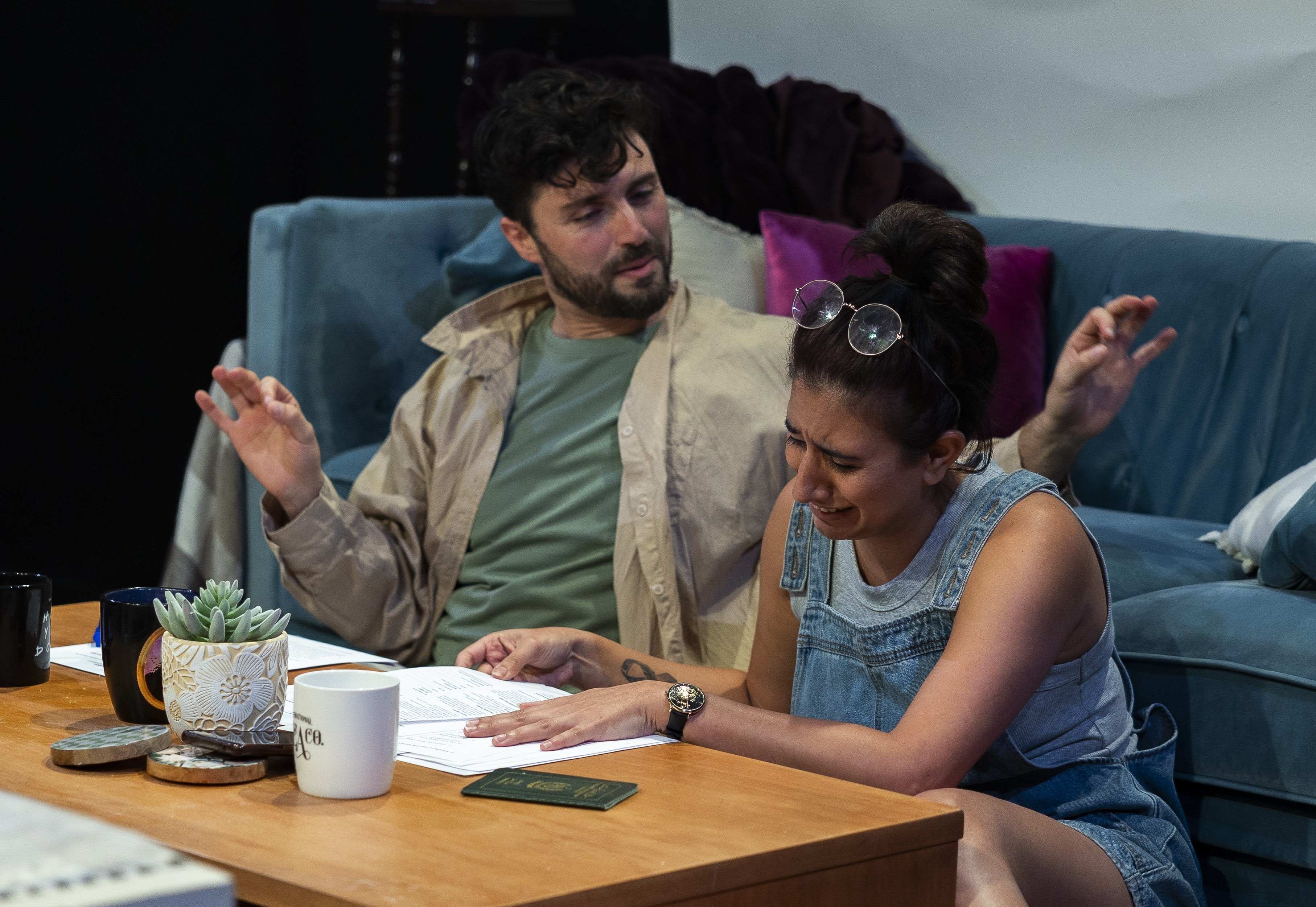
The script is beautifully whimsical and very funny. It allows Debney to showcase his extraordinary linguistic and vocal skills and his delightful physical comedy.

Recently I wrote, that to be left with questions is exactly what I want from a piece of theatre … so how can I not be satisfied with this?

Some of the questions Debney poses to the audience are simply about our personal tastes or experiences. Other questions are the equivalent of a Zen koan, joyful little puzzles that tease us out of complacency. (They’re of the family of – but not including – What is the sound of one hand clapping?)

We live in the Age of Assertion and Grand Theory. Everyone seems to know the answer to everything. Certainty is now equated with commitment.  A piece of theatre that reminds us of the value of the question is a rejuvenating antidote to this dullness of mind.

Questions help us dig deeper, to see that things may not be as simple and flat as we’d lazily like them to be. We reanimate our world through questions. Questions are how we unwrap the gift that is Life.

Not that Debney’s questions are what most people would call political: they’re impishly playful.

Since we’re on the topic of questions, you might ask this question: Can a show like this – one that doesn’t construct a traditional character and which eschews a traditional narrative arc – is this a show capable of retaining my attention? At just under an hour, the experiment is exactly the right length. Director Julia Robertson masterfully creates changes of pace and pleasing variations of texture. And, anyway, Debney has such a warm, vibrant stage presence that we’re keen to stay for the ride.

(I’ve got to note that it’s refreshing to see a one-person show that’s not autobiographical. In shows in which an actor talks about themselves, I often have to fight the temptation to suggest that the size of the cast directly correlates with the level of interest the play is capable of generating.)

For theatre nerds, Do You Mind? also poses intriguing questions about form.

Peppered with questions delivered in direct address, the audience of which I was a part seemed uncertain when (or whether) they were expected to provide answers. (In conventional question/answer format: Q. Is there audience participation? A. Only if you want there to be.)

But what this mischievous little show does is illuminate the strange miracle that is art. Every single piece of theatre ever made is created by both the artist and the audience. However, we tend to privilege the first of these two. If you think my choice of the word privilege is perverse, just try putting on a show in your room by yourself and see if you don’t come to feel that the audience is every bit as important as you. A show like this spotlights the agency of those who attend.

By focussing on the magic of the question – questions of all types – this little show is a glorious gift, a reminder of the childlike wonder to be found in the choice to be forever unwrapping.

Paul Gilchrist

Do You Mind? by Shay Debney

at the Old Fitz, as a late show, until April 27

www.oldfitztheatre.com.au/

Image by Julia Robertson

Uncle Vanya

25 Apr

I’ve always loved the play and, directed by Charlotte De Wit, this production is utterly mesmerising.

It’s simple and extraordinarily beautiful. Chekhov and Stanislavski (who directed the first production in 1899) were part of the great reaction against the hyperbole of 19th century melodrama. They valued truthfulness above all things.

And this production is gloriously faithful to that vision.

The cast inhabit their roles with a naturalness that’s a joy to witness and which, even now, remains a challenge to complacent assumptions about what it is to act.

Mike Booth is magnificent as Vanya. It’s a performance I’d happily see again and again. Vanya feels he has swallowed a lie and wasted his life, and Booth’s portrayal is so deeply moving because he makes it appear so honest.

Similarly, Marigold Pazar is brilliant as Yelena. The young wife of an aged academic, Yelena finds her life boring, and Pazar presents the role perfectly because she does not push. Indolence infuses both her voice and her movements, and so her character does not so much claim boredom, as embody it – ironically making Pazar’s performance absolutely scintillating.

Mikhail is in love with the married Yelena. Tristan Mckinnon plays beautifully the tension between desire and despair. The triumph of Chekhov, and of this production and this particular performance, is that we can judge the characters if we wish, but the invitation is simply to observe.   

Sonya is in love with Mikhail. Her love both enriches her and pains her. (Chekhov looks at life unflinchingly.) Maike Strichow’s portrait wonderfully captures both Sonya’s joy and her suffering.

Chekhov called his plays comedies, and without straining for laughs, this production is very funny. It’s the humour of recognition.

Annie Baker’s adaptation of the original wisely retains the traditional setting but allows the characters to speak in a modern vernacular, making that recognition inescapable.

I’ve yet to discuss the meaning of the play (unusual for an armchair philosopher like myself.) This reticence is partly because the method (yes, that method) employed to convey the play’s meaning is so persuasive that it becomes the meaning. Of course, the play is a meditation on being “infected by uselessness”. Chekhov’s comedy follows the traditional trope of an ordered world disrupted by interlopers, but he turns this trope on its head by having the newcomers represent not action and vibrancy but rather inaction and indolence. Our heroes and heroines must strive to cure themselves of this infection.

But it’s the sheer truthfulness of the portrayal that makes this such a rich, intensely humane piece of the theatre.

Paul Gilchrist

Uncle Vanya by Anton Chekhov, adapted by Annie Baker

produced by HER Productions

at Flow Studios until April 27

www.herproductions.com.au

Toy Symphony

22 Apr

The Loading Dock Theatre is a brilliant addition to the Sydney scene.

I was privileged to see the first show produced there, Michael Gow’s Toy Symphony, presented by Ad Astra.

The play was first produced in 2007 at Belvoir. It tells the story of Roland, a famous playwright suffering writer’s block (though don’t you dare use that phrase in front of him.)

There are three curious aspects to the play.

The first is that it’s almost theatre in the first person. I’m not suggesting it’s autobiographical (who knows?) but it’s fascinating that the focus is so firmly on one central character. And this is highlighted by the fact that good chunks of the play appear to be this protagonist’s personal memories. Furthermore, the protagonist’s problem is quite particular: can he continue to write theatre? (Admittedly, anything of concern to any individual should be of interest to a truly cosmopolitan person. That Gow assumes his audience consists of such broadminded people is a beautifully generous-hearted vision.)

Another curious aspect of the play is its structure. This production was two and a half hours (including intermission) and there are scenes which left me wondering why they were there. They’re interesting in themselves, but I was uncertain of their purpose or value in the play as a whole. Why do we get a scene explaining copyright law? Why are the childhood memories of Como Primary School so thorough? Why do we get a lengthy monologue in which Roland tells an unseen character what he said at his mother’s funeral? These vignettes further suggest the play’s affinity with autobiography, a form which acknowledges that the entire truth of a life can never be told, but that certain select moments will be its best intimation. The truth is clearly outside the text, not inside. This is probably true of all theatre, but to vastly varying degrees. Some plays seem to deliberately ask us to judge whether they’re a fair representation of reality (or, increasingly, they simply assert they are.) Other plays focus instead on drawing us into their world, inviting us to go for the ride. Toy Symphony is the first type, because the vignette form means the world of the play is inherently fractured and incomplete, but the challenge for us is that the truth being represented seems so especially precise, and potentially personal, that it’s difficult for us to judge the representation’s success.

The final intriguing aspect of the play is a recurring conceit. As a child, Roland can conjure people. He thinks of them, and they appear – but not to his mind’s eye alone, to everyone else as well. On one level, this is a literalisation of what playwrights do when they create characters … but the conceit resists such easy interpretation. If it’s meant to suggest the potential creative power of playwrights, you might respond that surely the play itself is an attempt to display this power, and so the conceit begs the fundamental question of realist theatre. (It’s as though a carpenter made a table out of little tables in order to clarify what she can do.) As a result, the play feels like a shot fired in a very Australian culture war, part of that battle in which artists desperately feel they must justify their own existence.

Clearly, this play sent me off into the night with a bundle of questions – exactly what I want from theatre.

Director Michelle Carey deals with this provocative play by presenting it with boundless energy.  Gregory J Wilken as Roland gives a performance that’s vibrant and always engaging; juxtaposing the wide-eyed child with the jaded artist. The supporting cast matches his energy, bouncing between realistic portrayals of adult professionals to theatrically enthusiastic children. Let me cherry pick some favourites. Wendi Lanham is eminently watchable as Roland’s therapist. Felix Jarvis as Daniel, an actor in training, gives a wonderful portrait of that youthful mix of confidence and insecurity. Bernadette Pryde is mesmerising in her evocation of the gentle, good humoured primary school teacher. Sam Webb as the school yard bully is suitably both intense and dense, and John Michael Narres’ school principal is deliciously meanspirited.

It was a pleasure to see this piece in an exciting new venue.

Paul Gilchrist

Toy Symphony by Michael Gow

at the Loading Dock Theatre, Qtopia, until 27 April

qtopiasydney.com.au/performances/  

Image by Bojan Bozic 

Sotoba Komachi 

13 Apr

This is a beautiful play, wonderfully presented.

Despite being only 45 mins in length, it’s fantastically rich.

Written in the early 1950’s by Yukio Mishima, and inspired by traditional Japanese Noh theatre, it’s a meditation on time, ageing and beauty.

A young poet meets a 99 year old woman in a park, late at night. The opening sequence, which juxtaposes the ancient woman collecting cigarette butts with young lovers seeking the ephemeral pleasures of sexuality, brilliantly introduces the play’s concerns.

Though sourced from the Japanese, the play reminds me of Thomas Browne’s Urn Burial, and all those artists of the European late medieval and renaissance eras who knew that Death underpins Life, that Change grants meaning to Constancy. Think those shadowy still life paintings juxtaposing flowers and skulls. It’s not morbidity, but honesty … and the Truth will set us free. It’s a privilege to see a piece like this in our anglophile Australian theatre, to be shown how another culture has discovered similar treasures.

Susan Ling Young is magnificent, in one instant an aged woman, in another the young woman of eighty years earlier.

Wern Mak is utterly compelling, delicately balancing the cynicism of the disappointed young man with the wonder of the poet learning to see unexpected beauty.

Director Jeremi Campese pitches the piece perfectly between humour and suspense, and aided by choreographer Artemis Alfonzetti, complements the simple lucid language with heartbreakingly graceful movement. The scene in which the entire cast dance – at a ball eighty years gone but eternally present – is theatrical gold.

Paul Gilchrist

Sotoba Komachi by Yukio Mishima

at Old Fitz, as a late night show, until 13 April

www.oldfitztheatre.com.au

Image by Karl Elbourne

For The Love of Paper

12 Apr

Some plays have as their central action an epoch changing battle, or perhaps the execution of an unjustly accused heroine, or even a torrid, illicit love affair. For one dreadful moment, I thought this play was going to be about the filling in of a form.

Kaveh is an Afghani-Australian. He is gay, but his family back in Afghanistan are arranging a marriage for him with a woman. His flatmate in Sydney, Amaliah, is Pakistani and she’s keen for Australian citizenship.  

You can probably guess the rest.

Antony Makhlouf and Almitra Mavalvala are entrancing as Kaveh and Amaliah.

Written by Mavalvala, the play has elements of rom-com – though not a lot of the “rom”, nor an unwavering dedication to the “com”.

It shares with romantic comedy a lightness of touch and a focus on a single central relationship. Mavalvala allows the friends to remain platonic. And, though she toys with comic set-ups (Joseph Raboy does an amusing turn as multiple characters), she chooses never to flesh out these set-ups fully, and with an easy-to-watch, languid style of direction, the production rests in a type of realism-lite.

Though we do see the friends fill in a form, it’s fundamentally a play about homelands.

Director Kersherka Sivakumaran began the opening night performance with a lengthy and heartfelt acknowledgement of country. (I’ve been criticised previously for mentioning these acknowledgements, as though we should be embarrassed about them, as though they were some sort of personal ablution – necessary but best kept private.) This particular acknowledgement used the phrase “stolen land” and it reminded me, as I watched a play about who is granted the right to remain in this country, that all relationships we have with the land are also relationships between human beings. The manner in which our connection with any land is exercised is necessarily predicated on the acknowledgement of this connection by other individuals. Drama can attempt to portray our relationship with land, but as an artform it will inevitably emphasise relationships between specific people. This is not a fatal inadequacy of the artform. Whether Amaliah can stay in Australia is dependent upon individuals from the immigration department, and on Kaveh.

And previous homelands? The relationships the characters have with Afghanistan and Pakistan? These are represented by phone calls and letters from loved ones faraway. All are presented as voice overs, and this poignantly catches a sense of distance, of absence.  

The older generations banished from the stage, we’re left with an image of children alone and lost in a strange land, and in that there’s a terrible pathos, a plea for openheartedness that must be acknowledged.   

Paul Gilchrist

For The Love of Paper by Almitra Mavalvala

at KXT Broadway until 20 April

kingsxtheatre.com

Image by LSH Media

Australia Felix

7 Apr

Written and directed by Geoffrey Sykes, this is the story of convict George Clarke.

There are three intriguing creative choices being made.

One is to include original musical numbers. The songs, written by Steve Wood, are engaging. Kate Stewart, Tisha Kelemen and Freya Moore give particularly pleasing vocal performances, but it’d be terrific to hear these songs performed with more texture than voice, guitar and found percussion allow.

The second intriguing creative choice is to have Clarke’s story told by an old fashioned travelling theatre troupe. We’re being told a historical story through another historical story. I’m not sure of the value of this. As the different characters in the troupe aren’t meaningfully distinguished, the effect is to slow down the story we’re actually being asked to care about. The choice also facilitates the use of direct narration, disappointing to an audience perhaps desirous of drama rather than documentary.

The third intriguing choice is perhaps not as intriguing as the others, simply because it reflects the zeitgeist. Clarke is obviously valued as a character because of the genuine links he made with indigenous people; he spent at least five years living with peoples beyond the colonial frontier and is said to have taken an indigenous wife. However, the production presents none of this experience; it’s recalled, briefly, in conversations between colonisers. I can’t blame Sykes for this reticence – it’d be a foolhardy artist who would now appropriate the stories of the marginalised – but it’s a choice that can’t help but weaken this particular story.  

And that’s a pity, because the piece clearly brims with an open-hearted awareness of injustice, to both the original inhabitants of this land and to those who’ve sought a happier resolution to colonial contact than we’re yet to achieve.    

Paul Gilchrist

Australia Felix by Geoffrey Sykes

at Richard Wherrett Studio, Roslyn Packer Theatre until April 6

www.playscript.net.au

Cowboy Mouth

28 Mar

Slim’s left his wife and kid for Cavale. She’s going to help him become a rock and roll god. It’s not obvious how.

First produced in 1971, Sam Shepard and Patti Smith’s Cowboy Mouth invites us into a world of dreams and desperation.

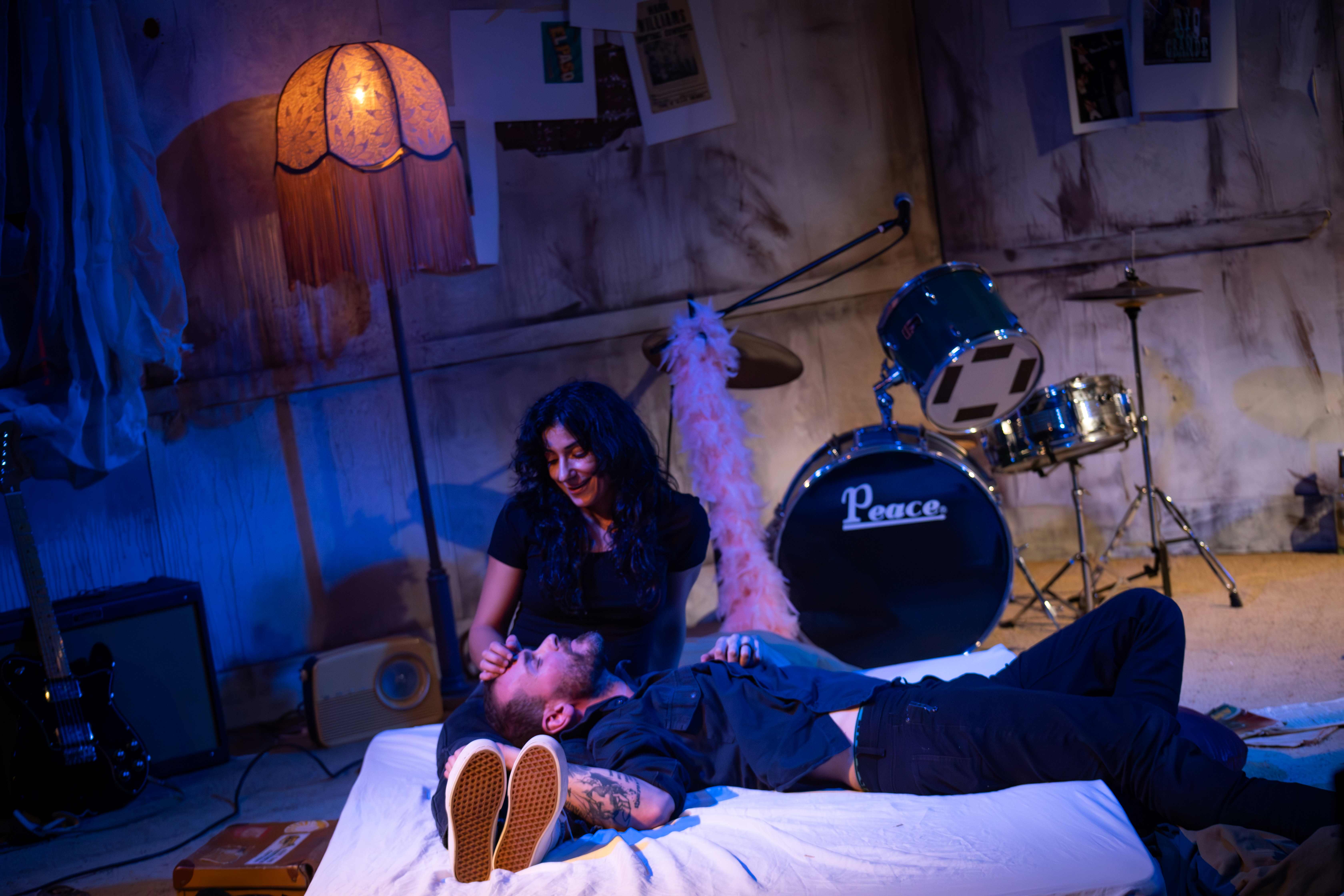
We’re somewhere in southwestern USA, in a room that’s seen better days (evocatively designed by Saz Watson.) The couple argue and make up, and argue and make up, and for a while this world seems distant, a vignette of reckless wretchedness. And then the script blossoms into beauty.

Cavale explains the need for a saviour. Not for the music industry, but for the human soul. The old religious forms no longer suffice, yet the spiritual hunger remains, deep and real. (What Australian play would say this? Has our country, insipid, sunburnt and stolen, seduced us into a pose of eyes firmly down? If so, why is it different in America?)

Saints can be found in all walks of life, Cavale says. It has to do with purity of purpose. Dylan might have been the saviour, as might Jagger, but no…. perhaps it’s Slim.

There’s a sprinkling of references to Yeats – the treading on of dreams, the beast slouching towards Bethlehem – and all this enriches a script that already bubbles hot with poetry, lava-like, frightening and fascinating.

And under Anna Houston’s direction, the cast bring it to the boil. Natassa Zoe and Austin Hayden as the couple are gloriously vibrant, but also achingly vulnerable. From their wonderfully raw physicality to their command of monologues both melancholic and mesmerising, the show is a thrilling 50 minutes of theatre.   

And there’s a cameo from Watson, which the spoiler rule probably relegates to critical silence. But let me say this: it’s a very funny, very disturbing meditation on what it might actually be to be saved.

Paul Gilchrist

Cowboy Mouth by Sam Shepard and Patti Smith

at Flight Path Theatre until 30 March

flightpaththeatre.org

Mercury Poisoning

21 Mar

This is big, bold, beautiful storytelling. And that it’s new Australian work is utterly exhilarating. Thank you Snatched Collective, White Box and KXT.

Mercury Poisoning by Madeleine Stedman is set in the early 1960’s and focuses on the space race between the USA and the USSR. It bounces intoxicatingly between three separate plotlines: the female cosmonaut program in Russia; the female astronaut program in America; and also in America, an African-American actor working on a TV series that is set (you guessed it) in space.

These plots don’t connect, except thematically, and that makes for an enormously rich dramatic experience.

It’s a colossal project and director Kim Hardwick presents it brilliantly. On a fundamentally empty stage, scenes and settings flow smoothly and quickly, one into another, positioning us to delight in discovering the many connections.

I say an empty stage, but that’s not quite accurate. In Meg Anderson’s design, above floats a sky of blue fabric, as thin as silk, ethereal, dreamlike, evoking the mystery, the danger, of space.

Hardwick’s use of movement to suggest space flight is a visual treat.

Costumes by Anderson are also wonderful, successfully transporting us to the multiple worlds of the play.

And an extra joy of a piece like this, part of its thrilling theatricality, is as actors double, they switch accents, a feat the performers navigate splendidly, thanks to accent and dialect coach Linda Nicholls-Gidley.

The entire ensemble is superb. I’ll describe some, but not all, of the magic.  

Violette Ayad excels as Valeria the cosmonaut, achieving an absolutely mesmerising balance between vulnerability and courage.

Her counterpoint in the States, Molly, is played by Teodora Matović and her portrayal of determination and confidence is inspiring.

Shawnee Jones as a black actor in a white industry is magnificent, offering a portrait that perfectly blends exuberance and anger, and informs both with a searing intelligence.

Playing a musician, Tinashe Mangwana glows with an almost childlike vitality, and this is beautifully counterpointed with his later turn as sombre House Committee chairperson.

Jack Richardson as cosmonaut Yuri and as the lead actor in what feels like a Star Trek parody is terrific, finding in both roles the discomforting complexity within those we glibly label heroes.

Similarly, Shaw Cameron as the idolised astronaut John Glenn powerfully depicts the patriarchal menace lurking behind male charisma. When compared to his Russian cosmonaut and lover, it’s an especially fine polyphonous performance.

Brendan Miles skilfully presents authority figures in all three worlds of the play, effectively suggesting the multifarious ways power is exercised.

As a senator’s wife and would be astronaut, Sarah Jane Starr flawlessly captures class, privilege and that disarming charm of the American creed of positivity.

Melissa Jones stuns with a portrait of a famous American pilot who threatens to kick the ladder away from the women who seek to follow and transcend her.

Back to the script. On its most obvious level, we’re presented inspiring stories of marginalised people seeking equality. But what makes Stedman’s play extraordinary is the depth of the treatment of what has become so often in our theatre a narrative cliché.

I’ll explore this depth in terms of the choice of setting. By juxtaposing women seeking equality in different societies, we’re invited to see both the universality of the phenomena and the multiple ways it’s manifest. There’s a refreshing brashness to the American women, an energetic individualism, but this comes into collision with the House Committee’s simple question Does our society need you in space? In Soviet Russia, individualism is discouraged, and the women must speak perpetually, and perhaps sometimes genuinely, of serving the state.

Further contrasts are developed, digging deeper into the relationship of the individual with the community. The Russians posit We must follow the rules so the next generation can break them. The Americans ask Can you be it, if you don’t see it?

It’s all powerfully suggestive of the tension at the heart of modern Life: we feel we personally deserve equality, but the granting of that equality is at the whim of others.  

And that’s where the time period in which this play is set is so provocative. The 1960’s were different. Think the speeches of Kennedy and of Luther King. Sixty years on, the zeitgeist has changed. The 1960’s dreamt of equality. We demand it. They said We could make this happen. We say Why hasn’t it happened yet? Our attitude is completely understandable, but I suspect much can be learnt from theirs. If your equality is at the whim of others, then you have to get the others onboard. Inviting them to share a dream might do this more effectively than telling them they are evil. Visions unite, guilt divides.

But, you could respond, it didn’t work in the 60’s.

Perhaps. But to appropriate Chesterton, the hippy ideal was not tried and found wanting; it was found difficult, and left untried.

Can it be tried now? Obama, in his campaigns, peddled hope with success.

I’m not suggesting Stedman’s play necessarily asserts all this, but through her radical choice of setting, the debate on strategy – how we are to make a better world  –  is gloriously refreshed.

Similarly, by her juxtaposition of a TV series set in space with the actual space race, the issue of the pursuit of equality is given true range. Equality might be spoken of from the mountain top, but it only has meaning when it comes to the people of the plain. In a brilliant final scene, performed by Mangwana and Jones, they argue the value of her silly TV job, and we’re asked to consider whether you need to go to the moon to change the world.

This is a fantastic production of a tremendous play, and one of the most stimulating pieces of theatre I’ve seen for a long while.

Paul Gilchrist

Mercury Poisoning by Madeleine Stedman

At KXT on Broadway until 30 March

www.kingsxtheatre.com/mercury-poisoning

Image by Clare Hawley

Not Now, Not Ever: A Parliament of Women

19 Mar

This is the silliest thing I’ve seen for quite a while.

It purports to be a modern adaptation of Assemblywomen by Aristophanes, but the connection with the ancient text is tenuous.

Fans of the original will be disappointed (so I suspect there won’t be much disappointment.)

The original play would be distasteful to most modern audiences. In it, the women of Athens take over the assembly, certain that they can do a better job of running the city than the men. Aristophanes is satirising the male leadership of his time, suggesting even women could do better. (It’s akin to a sporting slur like Even my grandmother could bowl faster, which is difficult to interpret as being in praise of grandmothers.)

The original play was written two and a half thousand years ago but Margaret Thanos, creator of this adaptation, has clearly not made much use of the time.

Instead of a closely worked, razor sharp script, her goal has been to create a space in which high energy comic performance can thrive, and in this she has excelled, presenting a production that is gloriously exuberant.

Thanos and the cast of co-writers leave Aristophanes behind. Despite the title, there is no parliament of women. The story revolves around two of the ancient Greek gods vying to get their chosen candidate elected to the modern Australian Parliament; we never actually see that institution. The point is that we as a nation have trouble electing women. But the gods of Olympus don’t exist as characters in the ancient text, and their addition here is more about creating opportunities for crazy mayhem, rather than sharpening any satire.   

Satire is not really the goal. Yes, the protagonist Prax pretends to be a man in order to be considered seriously as a candidate. But the implied criticism of Australian society is weakened by the fact this strategy is urged, not by a member of the Australian public, not by a cynical member of one of our established parties, but by Athena, the ancient Greek goddess of wisdom, played by a male actor in a skirt. And oddly, the election appears to be about choice of prime minister, which is not a feature of our system. Similarly loose, one of Prax’s campaign policies is Equal Pay for Women, though at no time is it suggested how the legislature might achieve this, considering it was legally established in Australia in 1972. But then, another of the policies touted is Votes for Animals.

So, no, not really satire. But wonderful fun! Much of the humour is what snobs call undergraduate (a term which has always left me wondering about the nature of post-doc humour.) But there’s a shit pile of scatological jokes, simulated masturbation and sex, including one orgasm featuring the traditional whipped cream, and not one, but two examples of that much underrated mirth maker: bestiality.

Thanos has gathered a brilliant cast and guides them all to top class comic performances. Emma O’Sullivan as Prax is a delightful mix of bewilderment and determination. Matt Abotomey as the opposing candidate is enormous fun, portraying with consummate comic skill the man who knows, that in this male world, you only have to be that least inspiring of things: a good bloke. Richard Hilliar as Athena has an absolutely divine stage presence. Hannah Raven gives a superb parody of the stereotypical vamp. Clay Crighton as Hermes gives a beautiful portrait of sanity amidst madness, the axis around which this crazy world spins.

A female PM? Not now.

Not ever?

If a more just society can come about through sheer energy, then the answer to that question is soon.

Paul Gilchrist

Not Now, Not Ever: A Parliament of Women created and directed by Margaret Thanos

Downstairs Belvoir until 31 March

belvoir.com.au

Bonny and Read

18 Mar

Perhaps you’ve heard of them? I hadn’t. But apparently, Anne Bonny and Mary Read were pirates who sailed the seas in the early 1700’s, an era referred to as the Golden Age of Piracy.

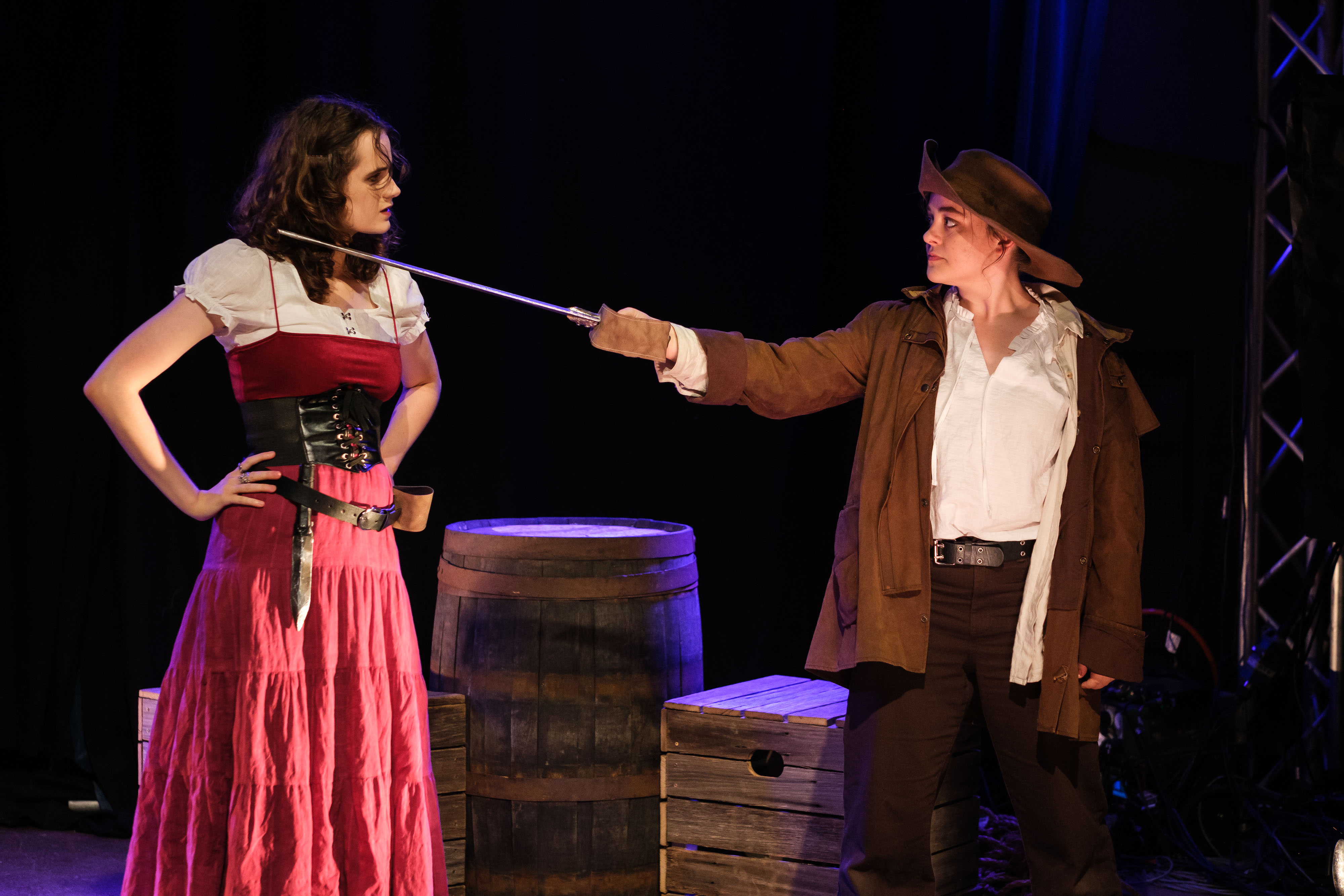
It wasn’t a golden age for women, regardless of occupation. In this terrific micro-musical by Emily Whiting and Aiden Smith, Bonny and Read must navigate a man’s world. Apart from physical dangers, they face heteronormative bigotry and male unwillingness to accept them as equals.

But it’s not a story of victims. It presents two extraordinary individuals who are more than equal to adversity, and to most of the men. Utterly inspiring (if you can forget the fact they were pirates.)

The songs are classy and clever. Melody, harmony and lyric meld brilliantly. And, considering it’s only an hour long, the narrative arc works well.

The songs are performed beautifully, by Anka Kosanović as Bonny, Gabi Lanham as Read, Ben James as Jack Rackham (Bonny’s love interest when the story begins) and Louis Chiu as Jack Bonny (Bonny’s love interest from way before the story begins). They’re supported wonderfully by the crew, played by Roya and Eli Reilly.

In this performance, the music was prerecorded and the vocals sung live. As a result, it was one of the more satisfying musical experience I’ve had – because I could actually hear all the lyrics. (Yes, I know there’s magic to a live band, but it seems SO hard to get the sound levels right.)

One challenge of the piece is, that for the majority of audiences, the world of the pirate is a literary world, an imagined world. Like the Wild West, we know a world something like this did have a historical reality – but in a pirate story we’ve come to expect something other than reality. Pirate stories are romances, in the old fashioned sense: there are wild adventures, larger than life characters, exotic settings, sudden discoveries and extraordinary coincidences. Think Treasure Island. Pirate stories have also become increasingly silly, filled with pantomime villains and absurd accents. Think Captain Hook from Peter Pan. Think Pirates of the Caribbean. Think International Talk Like a Pirate Day (September 19).

The attempt to tell a truthful story in pirate world can ironically (and unjustly) seem like historical naivety.

The solution? Either ground the piece in such a gritty realism that its historical credentials are unquestionable. Or begin the piece by embracing the silly and self-referential, and then transcend it – with characters we relate to and love.

Perhaps the second of these is the best option for a musical. And currently only at an hour, there’s plenty of room for this piece to grow.   

Another element of the imagined pirate world is flamboyance and vitality (think swashbuckling Errol Flynn) and this piece, in its next reincarnation, would benefit from a more confidant, bold physicality.

Regardless of my unsolicited suggestions, the production as it is now is an entertaining piece of music theatre, with serious potential.

Bonny and Read is part of ARTSLAB, a showcase of new works by Shopfront’s young resident artists.

Paul Gilchrist

Bonny and Read by Emily Whiting and Aiden Smith

at 107 Projects until March 24

shopfront.org.au/artslab-2024/