Not Now, Not Ever: A Parliament of Women

19 Mar

This is the silliest thing I’ve seen for quite a while.

It purports to be a modern adaptation of Assemblywomen by Aristophanes, but the connection with the ancient text is tenuous.

Fans of the original will be disappointed (so I suspect there won’t be much disappointment.)

The original play would be distasteful to most modern audiences. In it, the women of Athens take over the assembly, certain that they can do a better job of running the city than the men. Aristophanes is satirising the male leadership of his time, suggesting even women could do better. (It’s akin to a sporting slur like Even my grandmother could bowl faster, which is difficult to interpret as being in praise of grandmothers.)

The original play was written two and a half thousand years ago but Margaret Thanos, creator of this adaptation, has clearly not made much use of the time.

Instead of a closely worked, razor sharp script, her goal has been to create a space in which high energy comic performance can thrive, and in this she has excelled, presenting a production that is gloriously exuberant.

Thanos and the cast of co-writers leave Aristophanes behind. Despite the title, there is no parliament of women. The story revolves around two of the ancient Greek gods vying to get their chosen candidate elected to the modern Australian Parliament; we never actually see that institution. The point is that we as a nation have trouble electing women. But the gods of Olympus don’t exist as characters in the ancient text, and their addition here is more about creating opportunities for crazy mayhem, rather than sharpening any satire.   

Satire is not really the goal. Yes, the protagonist Prax pretends to be a man in order to be considered seriously as a candidate. But the implied criticism of Australian society is weakened by the fact this strategy is urged, not by a member of the Australian public, not by a cynical member of one of our established parties, but by Athena, the ancient Greek goddess of wisdom, played by a male actor in a skirt. And oddly, the election appears to be about choice of prime minister, which is not a feature of our system. Similarly loose, one of Prax’s campaign policies is Equal Pay for Women, though at no time is it suggested how the legislature might achieve this, considering it was legally established in Australia in 1972. But then, another of the policies touted is Votes for Animals.

So, no, not really satire. But wonderful fun! Much of the humour is what snobs call undergraduate (a term which has always left me wondering about the nature of post-doc humour.) But there’s a shit pile of scatological jokes, simulated masturbation and sex, including one orgasm featuring the traditional whipped cream, and not one, but two examples of that much underrated mirth maker: bestiality.

Thanos has gathered a brilliant cast and guides them all to top class comic performances. Emma O’Sullivan as Prax is a delightful mix of bewilderment and determination. Matt Abotomey as the opposing candidate is enormous fun, portraying with consummate comic skill the man who knows, that in this male world, you only have to be that least inspiring of things: a good bloke. Richard Hilliar as Athena has an absolutely divine stage presence. Hannah Raven gives a superb parody of the stereotypical vamp. Clay Crighton as Hermes gives a beautiful portrait of sanity amidst madness, the axis around which this crazy world spins.

A female PM? Not now.

Not ever?

If a more just society can come about through sheer energy, then the answer to that question is soon.

Paul Gilchrist

Not Now, Not Ever: A Parliament of Women created and directed by Margaret Thanos

Downstairs Belvoir until 31 March
belvoir.com.au

Bonny and Read

18 Mar

Perhaps you’ve heard of them? I hadn’t. But apparently, Anne Bonny and Mary Read were pirates who sailed the seas in the early 1700’s, an era referred to as the Golden Age of Piracy.

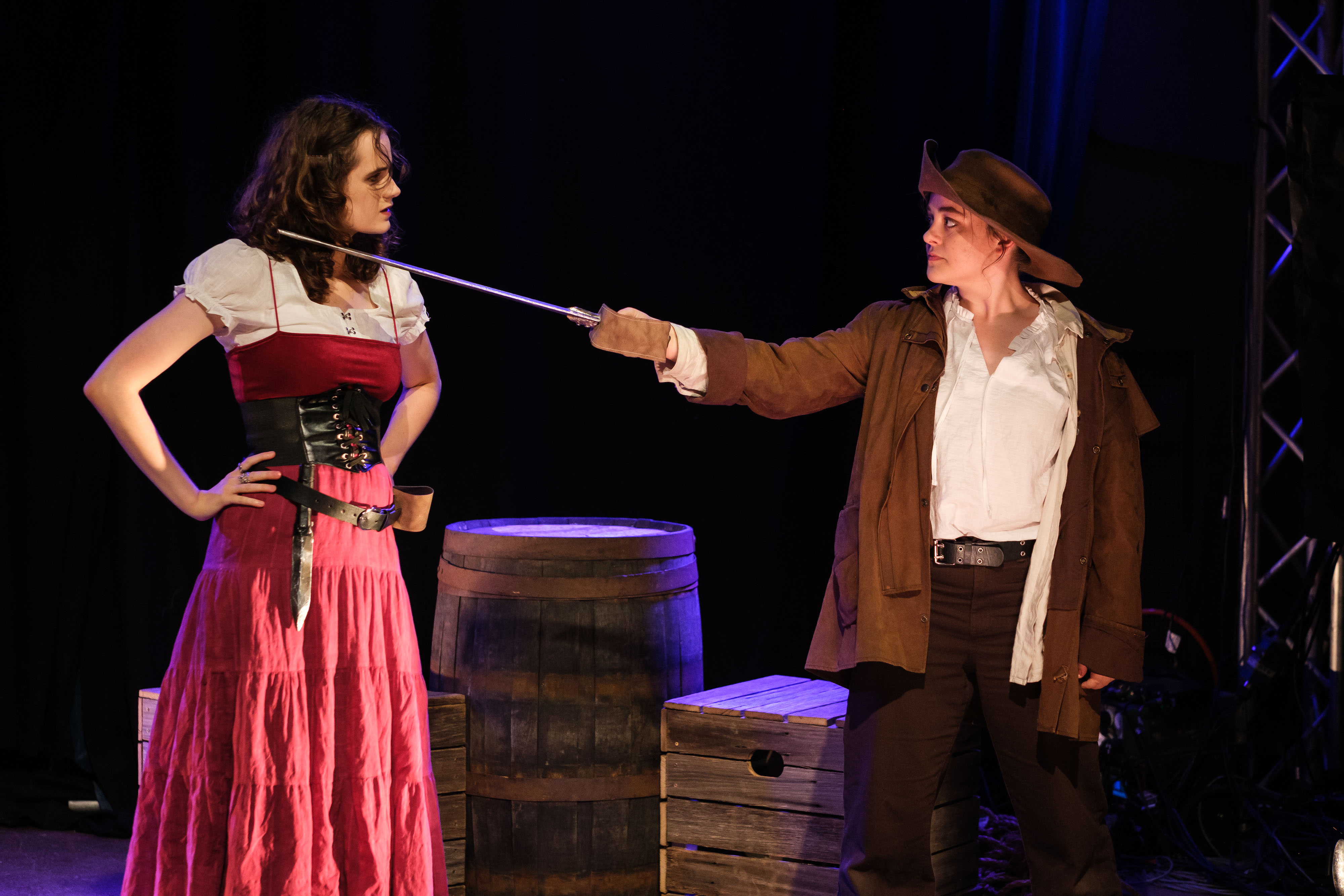
It wasn’t a golden age for women, regardless of occupation. In this terrific micro-musical by Emily Whiting and Aiden Smith, Bonny and Read must navigate a man’s world. Apart from physical dangers, they face heteronormative bigotry and male unwillingness to accept them as equals.

But it’s not a story of victims. It presents two extraordinary individuals who are more than equal to adversity, and to most of the men. Utterly inspiring (if you can forget the fact they were pirates.)

The songs are classy and clever. Melody, harmony and lyric meld brilliantly. And, considering it’s only an hour long, the narrative arc works well.

The songs are performed beautifully, by Anka Kosanović as Bonny, Gabi Lanham as Read, Ben James as Jack Rackham (Bonny’s love interest when the story begins) and Louis Chiu as Jack Bonny (Bonny’s love interest from way before the story begins). They’re supported wonderfully by the crew, played by Roya and Eli Reilly.

In this performance, the music was prerecorded and the vocals sung live. As a result, it was one of the more satisfying musical experience I’ve had – because I could actually hear all the lyrics. (Yes, I know there’s magic to a live band, but it seems SO hard to get the sound levels right.)

One challenge of the piece is, that for the majority of audiences, the world of the pirate is a literary world, an imagined world. Like the Wild West, we know a world something like this did have a historical reality – but in a pirate story we’ve come to expect something other than reality. Pirate stories are romances, in the old fashioned sense: there are wild adventures, larger than life characters, exotic settings, sudden discoveries and extraordinary coincidences. Think Treasure Island. Pirate stories have also become increasingly silly, filled with pantomime villains and absurd accents. Think Captain Hook from Peter Pan. Think Pirates of the Caribbean. Think International Talk Like a Pirate Day (September 19).

The attempt to tell a truthful story in pirate world can ironically (and unjustly) seem like historical naivety.

The solution? Either ground the piece in such a gritty realism that its historical credentials are unquestionable. Or begin the piece by embracing the silly and self-referential, and then transcend it – with characters we relate to and love.

Perhaps the second of these is the best option for a musical. And currently only at an hour, there’s plenty of room for this piece to grow.   

Another element of the imagined pirate world is flamboyance and vitality (think swashbuckling Errol Flynn) and this piece, in its next reincarnation, would benefit from a more confidant, bold physicality.

Regardless of my unsolicited suggestions, the production as it is now is an entertaining piece of music theatre, with serious potential.

Bonny and Read is part of ARTSLAB, a showcase of new works by Shopfront’s young resident artists.

Paul Gilchrist

Bonny and Read by Emily Whiting and Aiden Smith

at 107 Projects until March 24

shopfront.org.au/artslab-2024/

The Great Divide

17 Mar

Wallis Heads is a beautiful but sleepy coastal town. Multi-million dollar property developer Alex Whittle thinks it’s ripe for a make-over.

As the new playground for the rich, jobs and money will pour in. It’s entirely logical, if driven by self-interest.

And the local mayor thinks it’s a terrific idea, especially since Whittle will fund a brand new council chambers.

But where will all this leave the little people? Any chance for maintaining a pristine environment will be gone. Any possibility of social housing will disappear. Market forces will mean new jobs, but the people working them will no longer be able to pay the rent.

That’s the great divide of the title, the division of the rich from the less so.

Single mum Penny, stacking shelves at Woolies to make ends meet, has had enough. There are things you have to fight for.

In the battle for hearts and minds, one field of engagement is Rachel, Penny’s teenage daughter. To widen the cracks in an already fractious mother-daughter relationship, Whittle expresses belief in Rachel’s big dreams, aspirations her more caring mother tempers with caution.

David Williamson’s script has a majestic simplicity, an exquisite clarity. In many ways, it’s not a new story. But, in the most important ways, it’s a true story. I don’t mean it’s non-fiction; I mean it openly deals with genuine tensions in our society.

There’s gentle humour aplenty, sprinkled with silent assassin satire; it’s a warm, hearty chicken soup, laced with shards of glass.

Mark Kilmurry’s cast is magnificent. Georgie Parker as Whittle plays every note of the script with a precision and attention to detail that’s an utter comic delight.

I haven’t cried in many Williamson plays, except from laughter, but here the mother-daughter relationship is presented with an honesty and insight that had my eyes stinging with salt only a scene or two in. Emma Diaz as Penny and Caitlin Burley as Rachel are extraordinary.

Maybe the end of play has a whiff of the deus ex machina about it. (Ironic, considering what the deus is in this case…. I don’t think the spoiler rule prohibits me from mentioning the word election.) This is not a criticism of the script; the dramatic form simply has it limits. Drama confidently represents the struggles between individuals and between small groups, but it can only hint at larger movements. Its power is not to represent the masses, but to galvanise them. What we can’t see on stage, we’re encouraged to enact ourselves. Democracy is drama in the daylight. And that aphorism, like the play that inspired it, is an invitation.    

Paul Gilchrist

The Great Divide by David Williamson

at Ensemble until April 27

ensemble.com.au

Image by Brett Boardman

Art for the End Times

16 Mar

The website suggests it’s “A puppetry performance examining the future of AI developed art”, but I didn’t read that before the show.

I don’t read anything before a show.

I’m a theatre reviewer, which might tell you I find reading sort of hard.

During the show, it never occurred to me that it had anything to do with artificial intelligence. That might be indicative of RI (reviewer intelligence) but I’ll blame the fact I couldn’t see at a couple of brief but crucial moments. A combination of overly dim lighting and awkward sight lines meant I had difficulty following the narrative arc.  

On reflection, little puppet Rodrick was, I guess, suggestive of some sort of machine. And despite being forced to experience multiple examples of art, he struggled to create the real thing himself. So, yes, AI.

At the time, I took it all as a more generalised meditation on art. What is its value and purpose? What makes anyone an artist?

Looked at this way, it was fuel for a fiery demarcation dispute. It’s me and my reviewer friends who write about art in abstract terms. (We must be allowed some revenge on beauty.) In fact, I’ve been known to suggest that abstract ideas don’t belong in the theatre at all, that the stage is a place for the concrete, the specific, the particular.

But this is where puppets come in. Puppets are so clearly constructed, so obviously created, that they liberate us from what we call reality but is, in fact, mundanity. No one demands to know the back history of a puppet character – and so they live forward with a vitality that’s utterly refreshing.  No one complains a puppet’s performance is untruthful  – so they liberate us from that stifling euphemism that’s simply Narrowminded for If it’s beyond my experience it can’t be real.

Puppets are creative joy incarnate, and so are perfect for a playful poke at the big problems.

Tom Hetherington-Welch and Oliver Durbidge are company Highly Strung Puppets, and in creating this show, they create magic. Under their direction the ensemble present, with inspiring expertise, multiple forms of puppetry: marionettes, shadow figures and Bunraku-style puppets. Rodrick, who I mentioned earlier, is beautifully given life by operator Stella Klironomakis. The Curator, who collects art and hopes to teach Rodrick how to make it, is operated brilliantly by Jack Curry and the ensemble, and displays an electrifying range of emotions.

The show gains a thrilling texture from its use of projection. These projections, brimming with playful pop culture references, are the artworks from which Roderick must learn. The clips are created by Highly Strung Puppets and demonstrate both their extraordinary skill in puppet creation and their gleeful sense of mischief. Another stimulating use of projection occurs when Roderick creates his first story, and the ensemble bring it to life, there and then, filming the actions of tiny figurines, who then tower above us on the screen.  

Some audience members might feel the exploration of the artistic endeavour too narrow, too inhouse, too much just talking shop.  After all, we’re not all artists, or pursuing a career in the arts.  

But there’s something much more universal in this. Apart from a healthy critique of careerism (that very middle class malady in which we suffer from the delusion we are our job), there’s a glorious exhortation to live.

Perhaps the concluding scene is an allusion to Voltaire’s Candide, but it’s certainly a poignant image of the joy of openness, of artlessness.

Art for the End Times is part of ARTSLAB, a twice yearly event, where Shopfront’s resident artists showcase new works in a festival setting.  In its support of young creators, Shopfront once again proves itself an invaluable element of Sydney’s theatre scene.

Paul Gilchrist

Art for the End Times by Tom Hetherington-Welch and Oliver Durbidge

at 107 Projects until 24 March

shopfront.org.au/artslab-2024/

Image by Clare Hawley

Holding the Man

14 Mar

I saw this play in 2007, during its first run at Belvoir. I left the theatre deeply moved, but a friend was less so. After some grumbling, he admitted the cause of his dissatisfaction. The play had said only the obvious. His partner snapped that it wasn’t so “obvious” to a lot of people. This was before the Marriage Equality Act, and not long after homosexuality had been decriminalised.  (1997 in Tasmania.)

But my friend persisted, theatre should push the envelope. And, up to that moment, I probably would have agreed.

But the 2007 Belvoir production of Holding the Man changed me. It made me realise that we have to celebrate the values we think matter. Generosity of spirit. Openness. Kindness. Love. These are not obvious. No heaven underwrites them. Their promise lives only in our stories, their impact only in our actions.

This production by Eamon Flack is as beautiful and moving as that I saw in 2007.

It’s a love story. A true story. Tim and John meet in high school and fall in love. There’s acceptance of their love, there’s rejection, and hovering over it all – this is the 1980’s – the spectre of an enormous human tragedy. The threat of HIV/AIDS is still with us, but those who lived through its early years remember the horror of its blind, bewildering cruelty.

Danny Ball and Tom Conroy are utterly superb as the lovers, and the ensemble cast is brilliant.

The first act brims with humour. There’s a gleeful, glorious commitment to the comedy. We’re warmly invited to laugh, with both nostalgia and a more universal recognition, at the dagginess of life. The awkward enthusiasms of our teenager years. Our oh so suburban families. Our seriously naïve university activism. Even the drama school that will teach us truth by having us roll around the floor.

All this anchors the story in the everyday, and the pay off in the second act is of immense emotional impact. Playful theatricality makes way for a simple honesty that honours the human tragedy. The beautifully understated performances of the second act are grounded in the genuine.

No angry cry for justice, no burning resentment, gets in the way of Truth.

As Wilfred Owen would say, the pity is in the poetry, or in Murphy’s case, his complete command of the Australian vernacular.

I haven’t read Timothy Conigrave’s memoir, but Murphy’s adaptation is absolutely masterful, and Flack’s production is hilarious, heartbreaking, and so very vital.

Paul Gilchrist

Holding the Man by Tommy Murphy, from the book by Timothy Conigrave

at Belvoir until 14 April

belvoir.com.au

Image by Brett Boardman

The Ghost Writer

12 Mar

Directed by Jane Angharad, Ross Mueller’s The Ghost Writer is a tight, clever thriller. It’s a meditation on Truth, not so much what it is, but what we do with it.

Brihanna’s daughter has been murdered. She wants to write a book about it.

To make that happen, publisher Robert employs a ghost writer.

Whether the pun in the title is provocative or naff depends on … taste.

The danger haunting all work that borrows from the thriller genre is that their representations of the horrible can appear heartless. Are these representations there to mourn the bewildering misery of existence, or merely to sharpen the story?   

A lot of people love this type of sharpness and, with some good performances and an evocative set (by James Smithers), this story has real bite.  

But it’s not a bite to my taste.

Brihanna (Emma Dalton) claims she knows who killed her daughter. Since the murder remains unsolved, you might think this a point of interest … and Brihanna’s claim is considered, briefly, and then disappears into the background until the conclusion of the play. Stories that withhold information foster curiosity not empathy. There’s been a lot of these type of stories since the invention of crime fiction. They invite us to guess, not to grow. They humanise us as much as a crossword puzzle might. They are the sudokus of the soul.

You might counter that thrillers are not about feelings, but thought.

But thrillers have abstract ideas in the way superheroes have capes: they’re obvious, they flap around a lot, but you’re not really sure why they’re there. (Answer: They provide the illusion of flight.)

Here the abstract idea is Truth, and that cape flaps around in quite an eye-catching manner.

There’s a sexual relationship between the writer (Mel Day) and an employee of the public prosecutor (Shan-Ree Tan). Apart from being extraordinarily coincidental, the relationship is also oddly anonymous. The couple have been sharing a bed but not personal information, not even their names.

The prosecutor has eschewed truth in another way. He has knowingly charged an innocent man with murder, giving in to pressure from a government keen to assert its credentials on crime before an election. Tan gives a fine performance as the man who knows he could have done better. The scenario itself has a whiff of the American about it, where district attorneys are elected. I won’t be so naïve as to suggest that our public servants don’t cop pressure from elected representatives, but how many Australians would alter their vote according to the arrest of a single murder suspect? (In our wide, flat land, justice is a chimera, and only the hip pocket is real. Recently, 240 years of injustice towards our indigenous people failed to impact a vote. But, it could be argued, my example only further supports the premise of the scenario.)

Other characters are also presented as having scant regard for the truth. Robert the publisher is driven by sales. Mark Langham excels in the satirical portrait of the ruthless businessman, allowing it to grow subtly, until it overshadows the more gentle humour which introduced the character as a playful rogue and confused father.

And the motif of truth returns again with Brihanna’s remarkable claim that she saw Jesus take her child to the afterlife. One character asks Do you believe Brihanna saw Jesus take the child? It’s an odd way of putting it. Perhaps if it were Do you believe Jesus took the child? it might be more to the point. Or, better still, Do you believe Brihanna believes she saw Jesus take the child? None of this is unpacked, perhaps for the best. Unless you lived in Galilee in the first century of the Common Era, seeing Jesus would surely be an experience of the inner life, and the play believes in external facts. Perhaps all plays must, even when those facts are bizarre, and the last line of this play certainly is a conversation starter, or stopper, depending on…taste.

But taste is not Truth. (In every production, the least convincing performance is always the one by the critic attempting the role of Teller-of-the-Truth.)

See this taut, taunting, teasing piece for yourself.

Paul Gilchrist

The Ghost Writer by Ross Mueller

produced by Crying Chair Theatre in association with Secret House

at Flight Path Theatre until 16 March

www.flightpaththeatre.org/

Image by Braiden Toko

Grain in the Blood

29 Feb

Sacrifice is no longer fashionable. Our post-Christian society rejects it. To us, it has the whiff of exploitation, the distasteful scent of individuality burnt as an offering to duty, a duty perceived as limiting, dehumanising, imposed.

But sacrifice has been valorised by cultures long before the Christian behemoth.

Rob Drummond’s superb play Grain in the Blood explores the concept of sacrifice. Initially, it does this via a modern farming family’s connection with the tradition of the Grain Mother. This ancient pastoral deity requires a sacrifice to ensure the wellbeing of the community. Weave a Grain Dolly, fill its stomach with blood, leave it in the fields. The Mother is appeased …. and so all remains right with the world. (Jam can substitute for blood, if you’re a squeamish modern snowflake.)

The family continues the tradition in the way you might leave out a carrot for Santa’s reindeer; enjoying the ritual, but never believing in it. Or, at least, that’s what they thought they were doing, until one terrible night twelve years ago….

This tight 80 minute play creates suspense by making us wait for answers. What happened on that fateful night? And what exactly is wrong now with twelve year old Autumn? And how is it that her recently returned father has the potential to save her?

This saving has to do with (you guessed it) sacrifice, but not the magical kind exemplified by the Grain Doll ritual. Instead it’s sacrifice as our small, disenchanted world envisions it: a utilitarian* ethic that posits pointy questions, ones like Would you sacrifice one bad man to save one good one? What if it were ten bad men? Would you sacrifice one stranger to save one person you love? These questions are hypothetical, of course. Until they’re not.

Despite its conceit of withholding information, the play is predominantly presented in a naturalistic style. I say despite, because by making us wait for answers, we’re constantly pulled out of the immediacy of the moment, constantly invited to ask things like Why did she say that? What dark event is she referring to? It’s not an uncommon trick in modern theatre, though it’s a difficult one to pull off, and one that puts pressure on the actors to play the moment while trusting the whole.

Drummond’s rich and clever script most definitely pulls it off, and guided by director Victor Kalka, the cast rise to the challenge. Siobhan Lawless powerfully plays the matriarch driven by a steely determination. Ciarán O’Riordan as the returning father offers a poignant portrait of a man buckling under the weight of his past. Genevieve Muratore as Violet delivers a fascinating balance between the warmth of flirtation and the chill of vengeance. Nick Curnow as Bert, an outsider to this clan, an official on business, movingly portrays the dislocation experienced when procedure offers no guide to the wilderness that is reality. And Kim Clifton gives a wonderful performance as twelve year old Autumn, infusing the play’s few moments of theatrical monologue with a marvellous transcendence, only to return to the naturalistic scenes an angry teenager, bewildered by pain and breaking out, because she can, because it’s time to do so, because it can’t matter anymore. Her swearing is hilarious, but in her profanity is also deep pathos.

This brilliant production asks us to think about sacrifice, its nature, its value. And in a most aesthetically provocative manner, it does this through sacrifice – the ancient type. By initially sacrificing full disclosure, by asking us to go without answers, magic happens on stage.

Paul Gilchrist

Grain in the Blood by Rob Drummond

at KXT on Broadway until March 9

www.kingsxtheatre.com/

Image by Clare Hawley

*I acknowledge that my use of this adjective is not technically correct. I’m simply using it to denote any system that reduces ethics to a tallying of figures.

Everything is Sh*t

28 Feb

I have to admit, I was excited about this show because of its title. After all, who doesn’t like a guessing game?

Taking my seat in the theatre, I entertained the possibilities. Could the mystery phrase be Everything is Shut, and we were about to be treated to a story of arriving in a small country town on a Sunday afternoon?

Or perhaps the secret phrase was Everything is Shot, and in store for us tonight was a re-creation of a wrap party, that wild celebration that marks the finalisation of filming, when it’s all in the can?

Lost in anticipation as I was, you can imagine my utter shock when I learned that the missing word was Shit!

Everything is Shit!!!

Some people might be comfortable with scatological language, and perhaps even enjoy it (like pigs in shit, as the saying goes.) But even the faecally tolerant might object to the gross generalisation in the title.

After all, everything is not shit.

As an indisputable piece of evidence, I offer this show.

It’s decidedly not shit.

This rock cabaret is terrific.

Writer and performer Andy Freeborn has a glorious stage presence. Freeborn’s songs are amusing and poignant. The band is magnificent. Outrageous metaphor warning: the band is a boa constrictor – steel-tight but very much alive. It’s an absolute delight to hear Freeborn on the keyboards jam with this team, making magic before our ears. I especially enjoyed Austin Hal on drums and Alec Steedman on violin, as they respond to Freeborn’s choices with lightning speed, or when they send down a few electrifying bolts of their own. (Snakes, and now lightning; my figurative language is clearly struggling to capture the energy on stage.) Creating a wonderful texture, Ren McMeiken takes lead vocals for a few of Freeborn’s songs, and displays a voice that’s pure gold. (Reptiles, climatic events and now metallurgy.)     

So, back to that title. It refers to the trauma that Freeborn’s family suffered because of their parent’s marriage breakdown.

The show is a sharing.

I’ve mention before the preponderance of sharings currently on our stages. Perhaps this genre has always overlapped with the genre of cabaret.

I’m not a huge fan of either genre. As a lover of language, cabaret often doesn’t do it for me. Despite the potential beauty of the lyrics, they’re often so difficult to catch on first hearing. And the banter between songs leaves me cold. (If Life is a cabaret, it’s because so much of it is either incomprehensible or superficial.) And I don’t usually warm to sharings because I chose to attend a theatre not a support group.  

As a sharing, this work values honesty and openness. Freeborn appears utterly committed to honesty; for example, they admit their banter is entirely unscripted, a totally unnecessary confession. At other times they appear more reticent, leaving us to guess at their experiences. I have no problem with this; a catalogue of traumatic events is rarely entertaining. And, anyway, in the titular song, Freeborn sings Everything is Shit, but that’s Ok. They’ve found a way out of the darkness.

Freeborn calls the show a healing through song. I’m glad it is, for the artist. For us, the show’s simply an absolutely joyous paean to resilience and transformation.

Veronica Kaye

Everything is Sh*t by Andy Freeborn

At Old Fitzroy Theatre until March 1

www.oldfitztheatre.com.au/

Image by HollyMae Steane Price

Kalat Claimed

25 Feb

This is an absolutely terrific play. Written in 1982 by Iranian playwright Bahram Beyzai, it’s grand storytelling at its best.

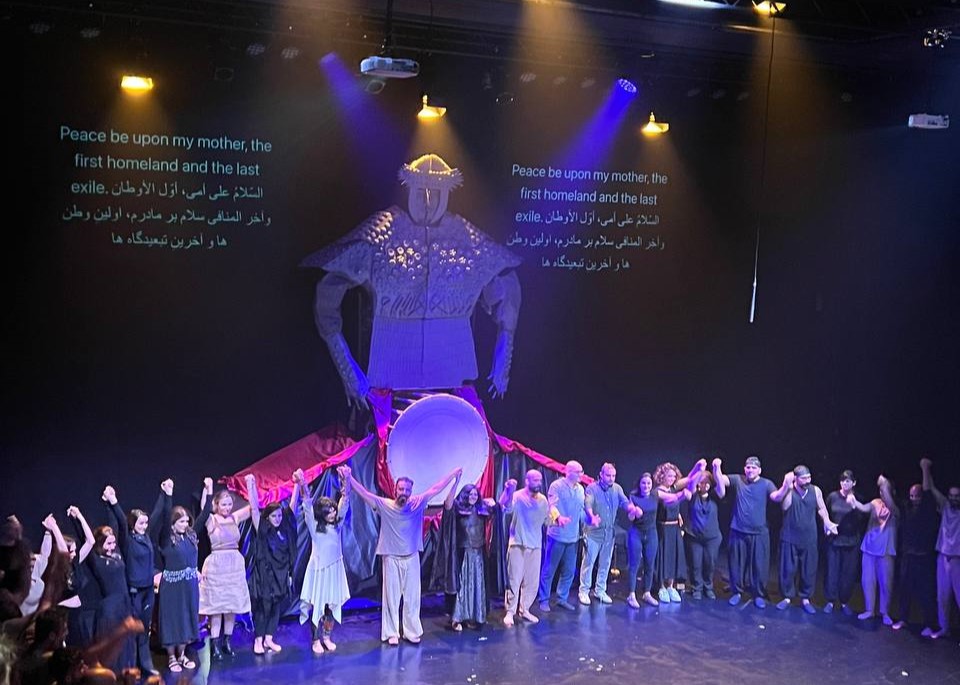
It’s thrilling to see such a work on the Australian stage. It’s also a delight to have it performed entirely in the original Farsi, with English surtitles. Director Hamed Janali deserves hearty congratulations.

Set in ancient Iran, Kalat Claimed presents the rivalry between two great warriors, Tuqai Khan and Tuy Khan.

In the initial moments, each of the warriors assert that they alone have slain the dead man who now lies between them. The play’s uncompromising interrogation of martial values is perfectly introduced by this argument over a corpse.

Later, to lay claim to the city of Kalat, Tuqai Khan betrays the Machiavellian Tuy Khan in the most Machiavellian of ways. Then, before he is to be executed, Tuy Khan is dressed as a whore and paraded through the city. The male characters tell us that this is perhaps the greatest of disgraces.

But Beyzai has more to say about this myopic misogyny. In magnificent counterpoint to the warrior rivals is Ay Banu, wife of Tuy Khan, but seemingly desired by all. In order to build a force to reclaim Kalat, she exploits her sexual appeal. Her behaviour borrows from the whore’s repertoire. Is this, for her, a disgrace?

But still that’s not the end of Beyzai’s interrogation. Tuqai Khan struggles to defend the city because he’s a warrior of the desert. The symbolism is clear: the world he represents is not the civilized one. Though Ay Banu leads an army, she doesn’t glory in violence. And, in her final action of the drama, she imposes on her enemies not women’s dress, but what these warriors now perceive as truly the greatest of all disgraces.

Can you guess what that supposed disgrace is?

Even though this play is a classic of Iranian theatre, I feel the spoiler rule prevents me from saying more. But what Ay Banu imposes, or I should say, what she offers, is the most beautiful, most potent subversion of violent selfish egoism.

Janali’s cast do good work. Afshin Safari as Tuy Khan, Ghazal Ghazanfari as Ay Banu, and Janali himself as Tuqai Khan are especially engaging. Equally captivating is Mohamad Janfada. As Dinkiz, his persistent and fearless questioning of his warrior leader positions us to realise that though a better world will entail the rejection of certain values that are stereotypically masculine, individual men are more than capable of the moral maturity required.

The production is visually spectacular, thanks to a wonderful set and lighting design by Janali, and by his clever use of movement pieces to evoke both the fascination and terror of violence. Costume design by Atefeh Saniee, Vida Afshari, Mitra Amiri and Ghazanfari is excellent, suggesting an ancient world but with touches of modernity that keep in mind the play’s ongoing relevance.

And finally, the sound. At the theatre entrance, we were issued foam earplugs. Though fear inducing, the plugs proved unnecessary. Musicians Reza Jafari and Shervin Mirzeinali create an emotionally moving soundtrack. Drummers Sohrab Kolahdooz, Sara Panahi and Amirsalar Makhzani, onstage at all times, effectively build and maintain tension.  It’s all a fitting addition to a production that uses multiple theatrical elements to powerfully present a brilliant play.

Paul Gilchrist

Kalat Claimed by Bahram Beyzai

at Playhouse Theatre NIDA

until 25 Feb

premier.ticketek.com.au/shows/show.aspx?sh=KALAT24

Low Level Panic 

13 Feb

This is such a good production that I was bitterly disappointed when I finally realised it wasn’t new work. (Before I go to a show I don’t read the press release or indeed any of the marketing; I simply check the date on the invitation, and if I can go, I go.)   

Clare McIntyre’s Low Level Panic premiered at the Royal Court Theatre in 1988, but coming out of KXT on Sunday evening I didn’t know that. What I did know was that I’d just seen an extraordinary piece of theatre.

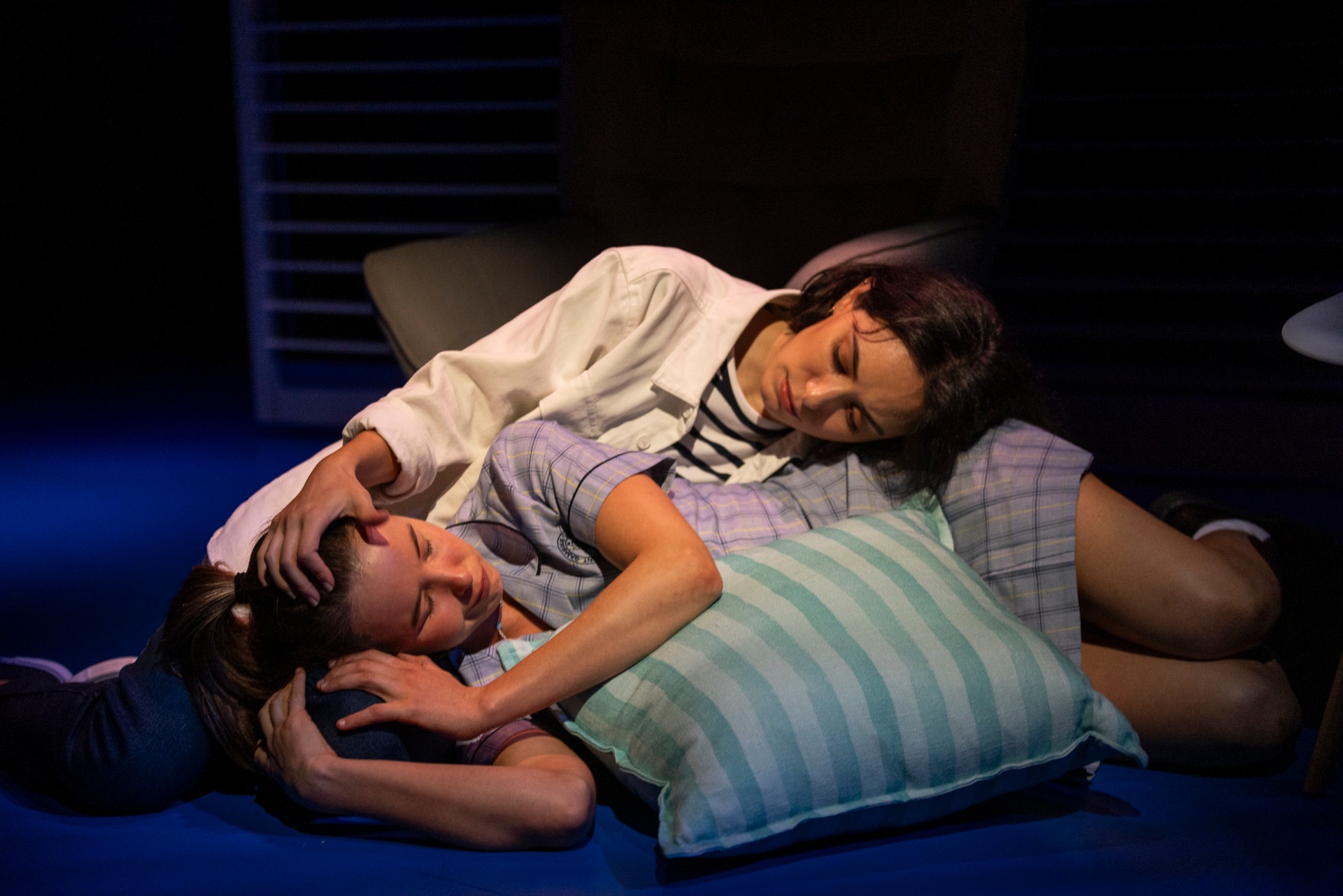
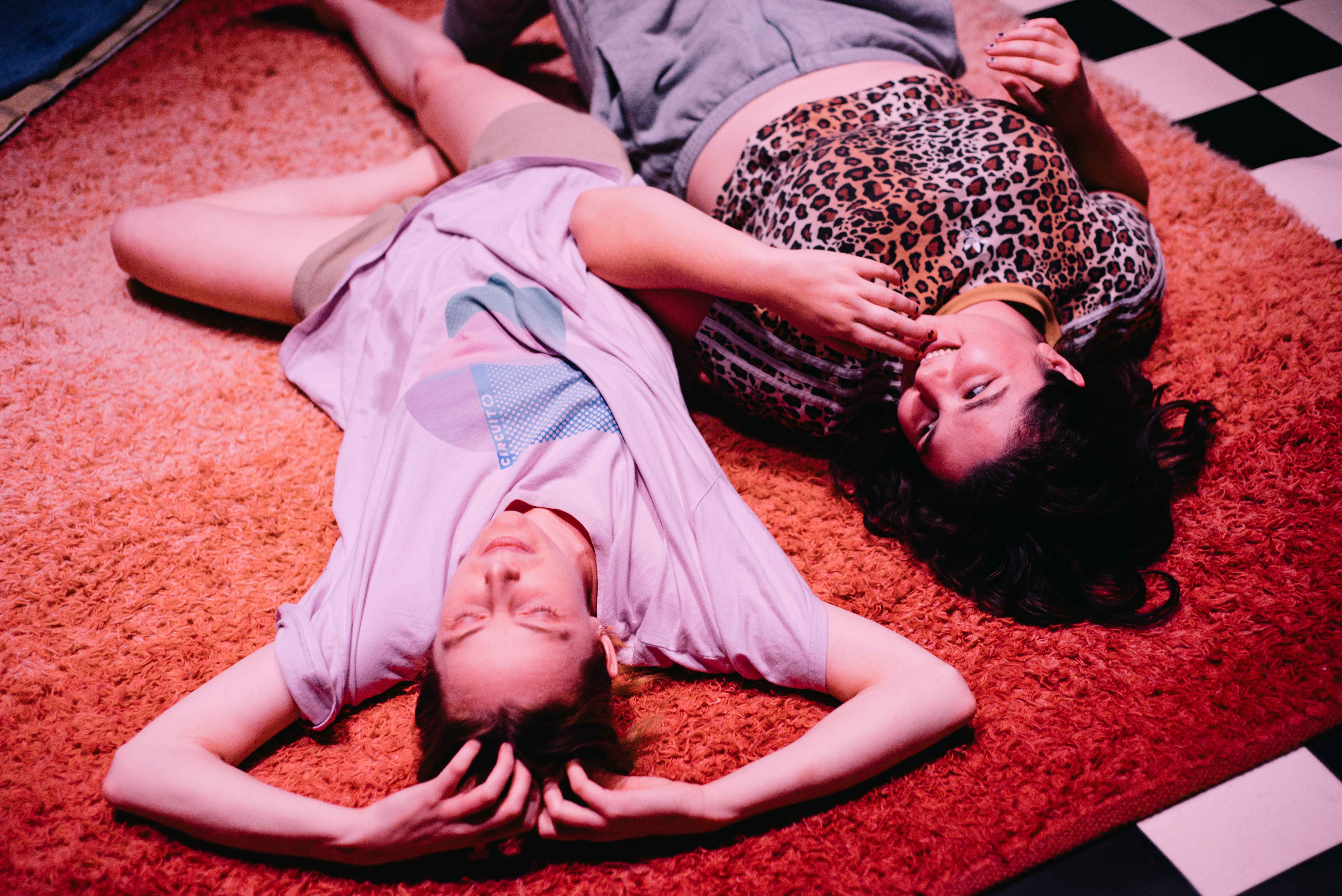
Set in the bathroom of a share house, it presents three women in their early twenties. Suiting the setting, the focus is on body image and sexuality. But most excitingly, it’s about thoughts and their awkward relation to reality.

The play is so powerful, so poignant, because it captures perfectly the way young adults have to navigate, for the first time, the tension between their rich, burgeoning inner-lives and the frustrating, frightening outside world.

Sometimes this tension is expressed in the frustration that reality doesn’t match our sexual fantasies. But as Jo says, played with gleeful and totally relatable honesty by Charlotte De Wit, thank God no one knows your thoughts.

Sometimes this tension is expressed in the terrifying awareness that you have no influence over other people’s thoughts, and that it’s not only your thoughts but theirs that create the world in which you must live. This is explored brilliantly by Marigold Pazar in the role of Mary.

Sometimes this tension is expressed in the desire to control, and Megan Kennedy gives a hilarious performance as uptight Celia.

Director Maike Strichow achieves a wonderfully thrilling texture through the juxtaposition of performance styles, giving Kennedy permission to create a gloriously larger-than-life Celia and allowing Pazar and De Wit to present a simple, raw truthfulness.

I recognise these women. Considering the age of the play, you could say I grew up with them. But the fact that HER Productions has been drawn back to this play highlights its enormous and ongoing relevance.

McIntyre writes absolutely superb dialogue. And one of its splendours is that its fad-free. Too often contemporary plays about these type of issues slip into theoretical language, and I’ll be direct: I don’t think that sort of language belongs in theatre. Don’t just throw around theoretical terms like the male gaze or the patriarchy. Show me how they operate. Leave lazy abstract words to reviewers, and do what the artform does best: show Life as it’s actually lived. Show me the women who suffer, and show me their extraordinary vitality, for in these beating hearts, strong and true, we’re offered a vision of a better world and how it will come.  

And that’s what this magnificent production of this beautiful play does.

Paul Gilchrist

Low Level Panic by Clare McIntyre

At KXT on Broadway until 17 Feb

kingsxcrosstheatre.com

Image by Georgia Jane Griffiths