Old age is not for sissies. This crack, with its whip sting, is usually attributed to Bette Davis.
Whatever the case, ageing ain’t going to be easy. And, in our secular world, ageing is an illness from which no one recovers.
Mad for You, written and directed by David Allen, presents the challenges faced by an ageing Janet (Alice Livingstone) as she loses her mental abilities. It also presents the challenges experienced by her family. Her husband, Brian (Andrew James) has promised to never put Janet in care, but her daughter (Emma Louise) sees little other option.
For the most part, Allen employs an almost TV style realism, but this realism is textured by flashbacks to better times, when Janet had all her faculties, and by brief scenes in which we witness her delusion that she’s still a working performer. Janet’s former career facilitates references to famous dramatic characters who’ve suffered madness, like Lear and Ophelia. (There’s also an odd scene in which Brian breaks the fourth wall and unfavourably compares Australia’s aged health care system to that of Holland or Denmark, I don’t remember which.)
In some ways, Allen presents us a scenario, rather than a story. Janet’s dilemma can have no satisfying solution. All roads ultimately lead to the same destination. Yes, the choice of route is debated, but the play doesn’t take us far down either dismal track.
Instead, we get a deeply moving portrait of suffering. Livingstone gives an extraordinary performance, powerfully juxtaposing the terror and bewilderment of dementia with poignant reminders of the vivacious, intelligent woman Janet once was. It’s the storm’s dark chaos, made all the more terrible by being broken by the fitful lucidity of lightning.
It’s great to see new Australian work in a wonderful little venue like this.
Claim a sportsperson has made History and you’re probably hoping to forget the horrors of which History usually consists.
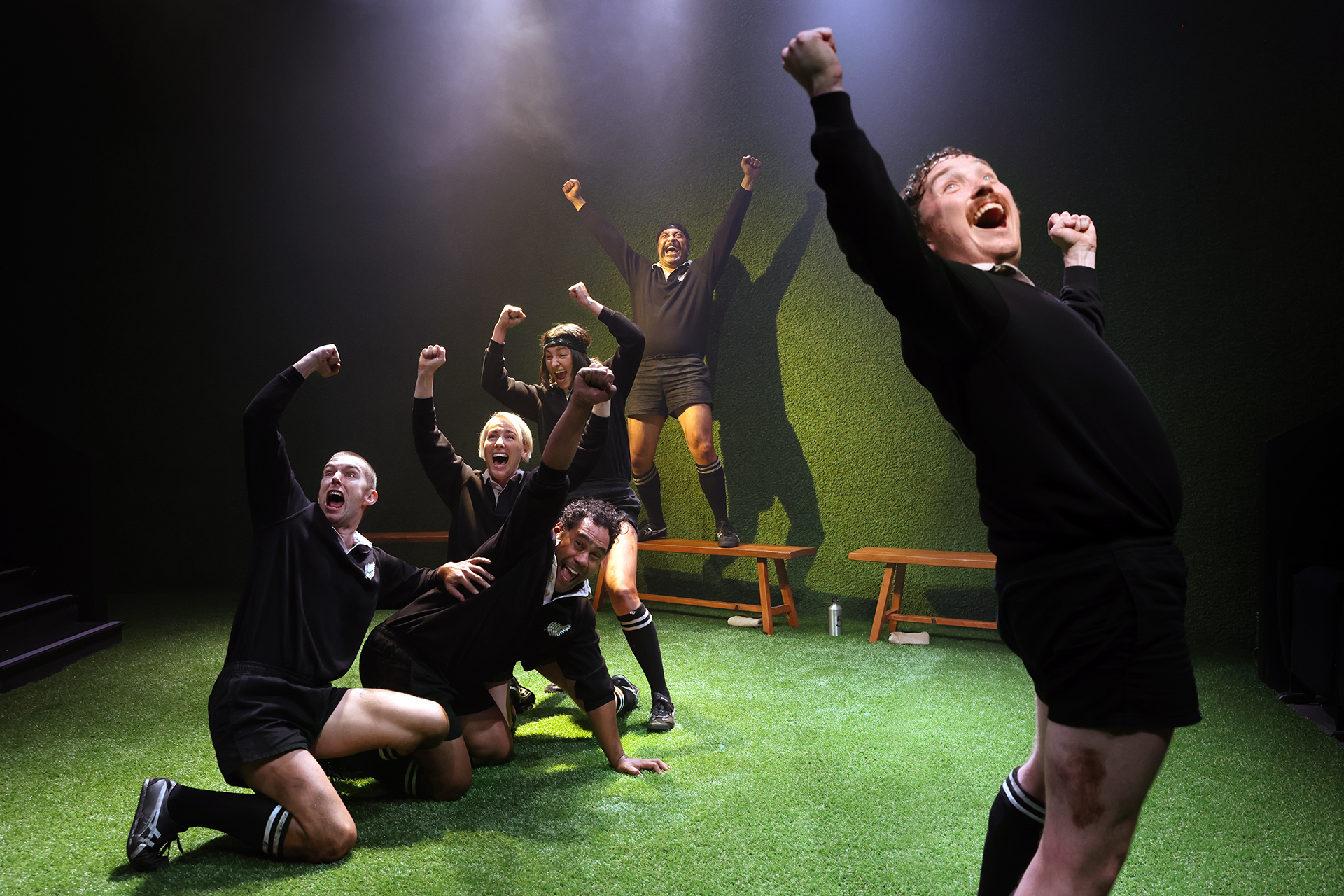
In 1978, the Irish provincial team of Munster played the touring All Blacks. For many people, it’s a game to forever remember.
For those ignorant of rugby, this might seem a little odd. But to appreciate this as a mouse-that-roared story you need to be aware, that on football pitches around the globe and for some time, little New Zealand had themselves been displaying decidedly un-rodentlike behaviour.
You might also think it sounds a little sentimental. And when one of the characters lists by name each of the Munster men who played on that famous day, I couldn’t help recollect Yeats’ roll call in “Easter, 1916” – though the events that poet memorialises are far more terrible.
Perhaps Alone it Stands is a slight story. Perhaps.
It’s certainly a terrific evening’s entertainment. Under the expert and endlessly inventive direction of Janine Watson, we’re treated to absolutely brilliant comic performances.
All six cast members play both Irish and Kiwi characters, and one of the piece’s many charms is the juxtaposition of accents. The skill with which this is presented is a tribute to dialect coach Linda Nicholls-Gidley.
The physical performances are also marvellous, and credit should go to the actors and Watson, but also to the support team of fight director Tim Dashwood and intimacy coordinator Chloë Dallimore.
The program suggests the cast play sixty roles in all. To give a taste of this amazing feast of physicality, let me pick out a few faves.
Alex King as All Black Stu Wilson magnificently embodies the extraordinary confidence and agility of a world class athlete, and she also displays true comic genius as Sinbad (and, no, Wikipedia won’t reveal who that is. Go see yourself!) Tristan Black as the Kiwi manager hilariously encapsulates the absurdly confrontational hypermasculinity of the middle-aged sporting official. Briallen Clarke is glorious in the range suggested by the portrayals of a tense expectant mother to that of perfectly assured All Black Gary Knight. Skyler Ellis presents a beautiful contrast with his suave BBC commentator and his bewildered everyman Munster fan. Anthony Taufa’s sheepish soon-to-be father, struggling to balance new responsibilities with his passion for the game, is wonderful, as is Ray Chong Nee’s young mischief-making urchin, a boy with more on his mind than football.
And these last examples hint at the glory of the piece. Yes, it’s about a football game. And, yes, a dramatist inventing the whole thing from scratch would most likely have chosen a different scoreline.
But, apart from providing an opportunity for talented comedians to show off their stuff, what playwright John Breen does so well is to create a truly Bruegelesque world.
Auden wrote in his famous commentary on Bruegel “About suffering they were never wrong, The old Masters: how well they understood Its human position: how it takes place While someone else is eating or opening a window or just walking dully along; How, when the aged are reverently, passionately waiting For the miraculous birth, there always must be Children who did not specially want it to happen, skating On a pond at the edge of the wood….”
It’s this Master status that Breen achieves, not by what he says about suffering, but by what he says about joy. It need not be grand or otherworldly. Rather it hides, amongst all the business of Life, waiting in surprise.
Not to be told what to think … how wonderfully refreshing!
It’s pure relief to see a play that doesn’t have a blatant message. It’s a burst of cool, clean air – one which the Sydney theatre scene badly needs. All too often our audiences are offered productions in which the artists have something to say, and boy are you going to hear that something good and hard.
I’m not such a nihilist that I object to a message per se. It’s just that the message is often either painfully obvious, bereft of any complexity, or simply utterly lacking originality. You don’t need to go to the theatre for this sort of thing; you could go to your local church. The performance there has every chance of being more entertaining. And, honestly, the message might be richer. And I guarantee you’ll need to throw far less into the collection plate.
Artists, if you can say it in a slogan, maybe you don’t need a story. You certainly don’t need the dramatic form, whose particular magic is multiplicity. Yes, I’m being harsh, but we really must re-explore theatre’s potential. All justice and no joy makes theatre a deathly dull and dangerous toy.
Directed by Patrick Kennedy, Richard Foreman’s Sophia = (Wisdom): The Cliffs is a wondrous gift of a piece. It playfully invites us to think: about wisdom, about theatre, about being an audience. Or perhaps it’s more tongue in cheek than that. Perhaps it’s allowing us to not think at all.
Light on both narrative and characterisation, it’s constructed from a deliciously beautiful use of space (some of the most brilliant I’ve ever seen), a glorious use of colour and costume, and an extraordinarily eclectic and evocative soundscape. All design is by Kennedy and it’s a magnificent achievement. Foreman has created a marvellously mischievous meta-theatrical template and Kennedy makes the most of its wild potential.
The cast do terrific work, inhabiting a performative world in which flat realism is almost entirely replaced by near mechanically-precise movement and vocal work. This joyfully jolts us from any risk of deadening complacency, reminding us we’re not passive witnesses and that what occurs on the far side of the fourth wall can’t (in itself alone) be Life.
And, every now and then, the lights dim and the house lights come up. We become witnesses to ourselves, and we might recall, that despite all the fabulous work on stage, it’s our response that’s crucial. We’re not mere recipients of a message. We’re co-creators of the magic.
And what magic it is!
Paul Gilchrist
Sophia = (Wisdom): The Cliffs by Richard Foreman
Produced by Patrick Kennedy Phenomenological Theatre
I have to admit, I love a historical drama. Much of the focus in contemporary theatre is on sharing our stories and giving voice to particular communities, phraseology that creates the impression that theatre is merely a type of reportage.
But historical drama is clearly not reportage: the artists creating any drama that is set in a distant historical period were simply not there! No matter how much research has been done, we know the artists are making things up, are being thrown back onto fiction, and that’s a delightful thing. Fiction can be a glorious invitation to the audience to engage, to enjoy, to flourish, rather than merely be informed. (I’m aware I’m giving little weight to the fact that theatre that shares our stories or gives voice might be offering representations of particular lives to people who have never before seen their lives represented on stage. Of course theatre can do this, and I hope it continues to do so. But it’s not all theatre does, or all it might do.)
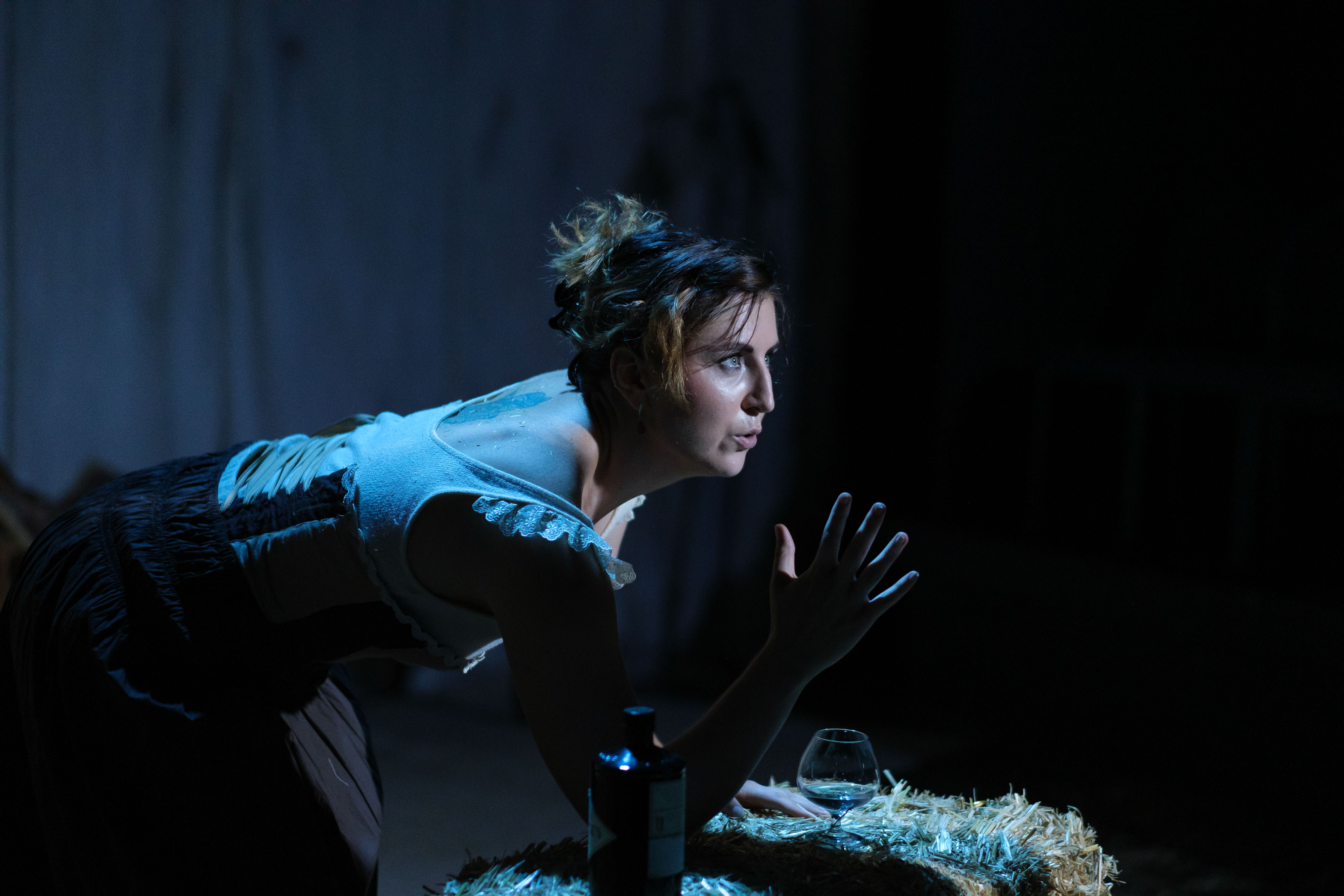
The Strong Charmion by Chloe Lethlean Higson is set in a circus in the 1920’s. Circuses traditionally present the unconventional. They are the orient of normalcy, defining what is expected, and acceptable, by displaying what is not. They operate both as freak show and as pressure valve; they offer both the titillation of the bizarre and relief from the banal. Lethlean Higson has chosen the perfect setting for her exploration of both repressive social mores and the intoxicating potential for growth. Bella Saltearn’s set and Catherine Mai’s lighting design are wonderfully evocative of the shadows and squalor from which new visions of life ultimately burst forth to find the light.
Rosalie Whitewood (Gabrielle Bowen) is The Strong Charmion, a woman of unconventional strength. She refuses to be small, she refuses to be physically vulnerable. She is one of several characters who challenge traditional visions of femininity. Her family and friends (Emily Crow, Niky Markovic and Alyssa Peters) question chastity, marriage and reductive visions of gender. Their tales are told with both humour and poignancy.
In this, its first showing, the production suffers from a few issues. On opening night, gremlins played havoc with the tech, making changeovers between scenes awkward and slow – but these demons will no doubt be exorcised as the run continues. (These tech gremlins were probably also why it took me so long to appreciate that some of the scenes were flashbacks. Or at least I’m blaming them; it might be just that I’m stupid.) The script could do with a little fleshing out; these characters are fascinating – and I’d love them to say more. I also wonder whether the piece is served by the doubling that means the male experience is not granted a fullness approximating that of the female and non-binary characters; if we better comprehend the battle, more sweetly we savour the victory.
There’s an absolutely terrific story here and I hope it gets the chance to grow further.
Lethlean Higson was the recipient of the 2023 Katie Lees Fellowship, and once again this brilliant initiative by Flight Path Theatre has added something of value to the Sydney theatre scene.
This play continues Belvoir’s magnificent commitment to indigenous theatre.
It’s an adaptation of Anita Heiss’ novel by the writer herself, directed by Nadine McDonald-Dowd and Roxanne McDonald.
Six women meet regularly as members of a book club and we witness their changing relationships as each faces their own individual problems.
This is, of course, not new territory. However, presented from an indigenous perspective, it’s fascinating.
Yes, there are several challenges involved in using this type of plot in theatre. One is that the positing of five (or is it six?) protagonists makes it difficult to give sufficient time to each individual story. Secondly, by setting many of the scenes in the actual club meetings – an exclusively female space – the main problem each woman appears to face is her relationship with other women. And to achieve dramatic tension, these women bicker and fight. In a tale which aims (I think) to ultimately valorise sisterhood, that tension is disconcerting.
But is it a truthful representation? I wouldn’t know.
And that raises the issue of theatre that purports to tell our stories. As an outsider, am I to take all this as reportage?
I suggested initially that the following of the standard tropes of a sisterhood story was made more intriguing by its indigenous perspective. How?
Firstly, all the books discussed by the club are written by indigenous writers (once again, I think). We’re spared lengthy discussions of texts we may not be familiar with, but it’s curious that what the characters often value about the chosen books is their focus on what might be called political issues. Valuing a novel for its content or theme is not what is usually done. A book about, say, native title might be well written or it might be poorly written. Consider the enormous range in quality of novels about, say, love. When an artwork is valued primarily for its content or theme it suggests either a lack of sophistication on the part of the reader, or a glorious relief that finally a deep silence is being broken. (It’s worth noting that the much esteemed Jane Austen wrote six novels about love – which is six more than she wrote about native title.)
Continuing to addressing the deep silences in our nation’s literature, the characters suggest that the great Australian novel would need to include indigenous characters and to have a “message.” The first of these requirement is obvious, but the second is highly debatable. Heiss’ Tiddas is playfully asking us to think about fiction (I’m deliberately avoiding the phrase our stories.)
In a gorgeously provocative twist, though the novels the club reads are often valued for their focus on indigenous political issues, most (though not all) of the issues Heiss’ characters face are more universal; sexual relations, procreation, and friendship. (I’ll point out a fascinating blurring of this: one character uses the word “sovereignty” to describe the experience of personal autonomy or individual independence. It will be interesting to see, over the next few years, the changing usage of this oddly legalistic word.)
If I take Tiddas as reportage, I should also point out that a fundamental aspect of the characters’ experience is an intense awareness and assertion of distinctions: Blak as against white, Aboriginal as against Torres Strait Islander, Koori as against Murri, woman as against man. Definition by opposition can feel empowering. And the characters’ emphasis on nomenclature (which word or phrase is the correct or acceptable one) expresses both a desire to be accurately represented and a desire for power. Considering this nation’s appalling colonial history, both desires are utterly understandable. (That knowledge is readily aligned with power is highlighted in a scene in which the sole white character apologises for her terrible behaviour, saying “There is so much I need to learn.” Learn? Is ignorance really her fault? Though it seems counter-intuitive, to emphasise her moral culpability would be to further underline her power. Ascribing ignorance to her weakens her, particularly when what counts as knowledge is beyond her remit.)
The cast – Louise Brehmer, Lara Croydon, Jade Lomas-Ronan, Roxanne McDonald, Anna McMahon, Perry Mooney and Sean Dow (playing all the male roles) – are very watchable, and warmly invite us to share their characters’ frustrations and joys.
I’ll finish by describing a golden moment in the performance. It’s understated and unobtrusive. The spoiler rule prevents me giving much detail, but it’s a piece of stage business involving two glasses of alcohol and which of two characters is drinking what. It’s a delightful subversion of stereotypes, and a wonderful example of the dramatic form’s ability – through its juxtaposition of voice with voice, and words with actions – to remind us that the world will refuse to fit our theories (our stories?) and will constantly challenge us to growth.
Paul Gilchrist
Tiddas by Anita Heiss
At upstairs Belvoir (as part of the Sydney Festival) until Jan 28
In every production, the least convincing performance is the one by the critic attempting the role of Teller-of-the-Truth.
But it’s nothing new to assert that evaluations of productions are subjective. (Though, in my defence, theatre is not particularly interested in novelty. It’s been quipped that Jane Austen wrote not six novels, rather the same novel six times – but the accusation that Austen endlessly returned to the same material loses any sting when compared to an artform in which practitioners routinely present plays that have been produced 100’s of times before. Theatre is an artform in love with repetition. Do that to me one more time, Once is never enough….)
But back to my earlier point: my reluctance to accept a role in which my performance (as Teller-of-the-Truth) will undoubtedly be graded somewhere on the spectrum between foolishly naïve and laughably arrogant.
Of course, I’m happy to double, briefly appearing in that small role of self-important judge. (“Small role!” I hear publicists declare imperiously, “There are no small roles, only small reviewers!”)
But I’ll double that small role of evaluator with a more important one: facilitator of what the artwork offers.
A good play is like a stone thrown into a stagnant pond. When I write about theatre, I’m not especially interested in judging how the stone was thrown; I’m hoping to perpetuate the ripples.
Paul Gilchrist
Image by aceebee from Camberley, UK, CC BY-SA 2.0 creativecommons.org/licenses/by-sa/2.0, via Wikimedia Commons
In 2016, I wrote an Open Letter to Sydney’s Theatre Critics. It was read by more people than anything else I’ve ever written for this site. (And my second highest readership ever? An article entitled Truth in the Theatre Foyer.)
In my Open Letter, I asked if it was possible, at the end of a year, to do more than simply rank the productions that had been seen.
I’ve no great issue with ranking performances – especially if anything I’ve written is on anyone’s Best of List – but I was hoping that the people who had seen so much theatre might make some further observations. I ended my Open Letter with the exhortation “Make some generalisations – you’ve earnt it!”
This year, the first full year I’ve returned to serious reviewing for quite a while, I’ve decided to take my own advice.
However, there are a couple of caveats:
Firstly, I won’t be offering my own list of the “Best of”. Quite simply, who cares about my opinion? I could, of course, entitle the list “My Favourites”. That would acknowledge the issue of the unavoidable subjectivity (but still not address the issue of relevance or value.)
Secondly, I’ve seen and written responses to only 64 shows this year. That’s a lot of theatre most normal people would say, but my reviewing colleagues and I are not of that demographic. (Some of them have seen twice as many shows as me.) And to add a little more perspective, of the 50 shows nominated for this year’s Sydney Theatre Awards, I saw only 7. I do try to get along to most things I’m invited to. However, I avoid amateur theatre – not because of the quality, but because my pretentious approach is not a good fit with their mission statements – and I’m also currently not on the publicity list of several companies (STC, Old Fitz, Hayes, and Eternity.)
So, with these two caveats in mind, here are my outrageous generalisations. I’ll start with the most trivial.
There are more reviewers than ever before. My personal publicity list currently has 37 review sites. And, every time a new show opens, I see on social media quotes from reviewers I’ve never heard of. I guess it’s a bit like those infinite number of monkeys banging away on an infinite number of typewriters: one of them will eventually write something worthwhile.
Reviews now come with stars. When I started Theatre Red in 2011, a small number of publications rated shows out of 5 stars. Now most do. (I don’t. I’m uncomfortable about the implied comparison between shows. And I’m also keen that what I write about a show isn’t entirely abbreviated to something even a monkey can read.) One site even grades productions to the first decimal point, awarding scores such as 4.9 or 4.8 stars. (I’m keen to get a copy of that marking criteria.)
Reviews are increasingly more generous-spirited. If you put on a show, someone will give it 5 stars. Perhaps this is not an ideal situation, but it’s preferable to the critical culture of several years ago, in which so many reviews were written with the subtext Who, exactly, do you think you are to write or direct or perform in a play? But, the overly effusive language of many reviews now makes it feel as though it’s marketing copy that’s being written rather than theatre criticism. (Of course, if you want exposure for your publication, if you want your site mentioned in an ad on the side of a bus, it’s good strategy to be extremely positive.)
Instagram has changed the way that shows are marketed. On Facebook, producers generally put links to the review. On Insta, using a program like Canva, anyone can now take one of their production shots, bang on it the stars they’ve been awarded and the ticket booking details, and the whole thing seems extremely professional. As a producer of theatre, I’ve done it myself. As a writer of reviews, I would really like people to actually read the reviews.
The number of independent theatre venues continues to decrease. And this is at a time when there seem to be more artists wanting to make theatre than ever. On the upside, it’s great to see little companies finding eclectic spaces to weave their magic.
There is a continuing focus in our theatre on what the Right calls identity politics. We must have diversity on our stages and in our storytelling. (And one great consequence of this trend is that over half of the shows I saw this year were new works.) But I’d like to offer an observation; consider the oft-repeated slogan Our stories must be told. It posits an interesting question: is the role of the playwright to document society? And, if so, what technical and moral attributes would be required of them to do this effectively? And what sort of awareness, both in terms of aesthetics and epistemology, would the audience of such a work need? Watching a play that purports to bear witness to the lived experience of a particular demographic group, do I say “Well, that’s the Such and Such community!” or should I count this play as merely the equivalent of a single anecdote from a single individual who undoubtedly has personal biases? (I’ve got a lot to say about this idea – but it will have to wait until a later time).
Despite the above comment aboutidentity theatre, a lot of indie work is still showcase theatre. By showcase theatre I mean indie theatre in which it appears the artists’ goal is to showcase their ability so they’ll be discovered and no longer need to do indie theatre. This is natural, and not something I can criticise – but it’s always great to see work that’s being shared primarily because of the beauty and truth it offers.
This is how I ended my Open Letter in 2016: “And what isn’t happening in the scene that you really think should? After all, a good critic recognises what’s happening, and a great critic knows what is not.” So what do I think should be happening? Who asks questions like that? If I have an answer, it’ll probably be expressed in my own own theatre, rather than in theatre criticism.
But I’m looking forward to 2024 and all the brilliant work I’m sure to see.
In the meantime, an enormous thank you to Sydney’s theatre makers!
Mark O’Rowe’s play was first produced in Dublin in 2007.
It’s a three hander, constructed from interconnected monologues.
O’Rowe tells a damn good story. Set in modern Dublin, it’s laced with sex, violence and an unconventional theology. It’s both very funny and thought provoking.
O’Rowe employs what’s been described as poetic prose. This particular jury of one is still out in regard to its effectiveness. There are certainly passages of remarkable beauty, a glorious speech in which a young woman reflects on key moments in her life being one. But the use of rhyme, so effective in creating humour, perhaps is less so in representing reality. It depends on your metaphysics, your vision of the nature of Truth, or indeed if you think Truth has any particular nature at all (and is therefore deserving of that capital ‘T’). Despite offering a portrait of a very gritty, wild, dangerous city, the tight connections between the three storylines, the presence of an eschatology (unconventional or not) and, yes, the frequent rhyme, all suggest a world in which there is most definitely an ultimate order…. and that’s a vision of life that’s increasingly less common. (I will note, however, that O’Rowe’s three storylines are hardly of the common garden variety, and so to suggest the play asserts some sort of ultimate Truth might be missing the point – and I’ve reviewed theatre long enough to know that’sa common garden variety occupational hazard.)
This production, directed by Katherine Hopwood Poulsen, is a splendid 115 minutes of theatre. Presented in the basement of the Marrickville Town Hall, the aesthetic is appropriately minimalist, allowing the script and the performances to shine. Tabrett Bethell plays a woman attempting to save another from what she believes is a forced backyard abortion. Bethell has a powerful stage presence that effectively stands in pathos-inducing contrast to the character’s deep fragility. Andrea Tan plays a woman who, in a moment of fatal danger, is aided by the most surprising of heroes. It’s in this storyline that the play is at its most fantastical, and the gorgeous strength of Tan’s performance is that we’re fascinated to see where all this unlikeliness might lead. Johnny Cordukes plays an unexpected serial killer (though I’m not sure I’ve met enough of the type to be certain about the first of those adjectives.) Cordukes nails the macabre humour and, with a mischievous twinkle in his eye, keeps us thoroughly engaged in the darkest parts of the tale.
Terminus was my final show for 2023 and, after a wonderful ride through a year of theatre, it was a terrific place for that journey to end.
(In which my desire to appear erudite is apparent in the pretentious surfeit of quotes from other texts.)
Kenneth Grahame’s novel was published in 1908; it’s a perfect piece of Edwardian charm.
This is the literary world in which Rupert Brooke could dream of death on the Western Front in these words:
“If I should die, think only this of me:
That there’s some corner of a foreign field
that is for ever England.”
Brooke also imagined that, in the afterlife, his soul would give back to the Divine
“the thoughts by England given;
Her sights and sounds; dreams happy as her day;
And laughter, learnt of friends; and gentleness,
In hearts at peace, under an English heaven.”
In this gush of misty positivity, Brooke omits any description of his mangled, war-broken corpse.
(In all fairness, this oddly parochial era did also produce Conrad’s Heart of Darkness.)
Alan Bennett’s very clever theatrical adaptation of The Wind in the Willows was first performed in 1990 at the National Theatre. Bennett sticks to the key elements of the story, but he loses Grahame’s absolutely delightful narrative voice. Here’s a sample of how such prose might leave an honest dramatist to weep in envy:
“He (the Mole) thought his happiness was complete when, as he meandered aimlessly along, suddenly he stood by the edge of a full-fed river. Never in his life had he seen a river before—this sleek, sinuous, full-bodied animal, chasing and chuckling, gripping things with a gurgle and leaving them with a laugh, to fling itself on fresh playmates that shook themselves free, and were caught and held again. All was a-shake and a-shiver—glints and gleams and sparkles, rustle and swirl, chatter and bubble. The Mole was bewitched, entranced, fascinated. By the side of the river he trotted as one trots, when very small, by the side of a man who holds one spell-bound by exciting stories; and when tired at last, he sat on the bank, while the river still chattered on to him, a babbling procession of the best stories in the world, sent from the heart of the earth to be told at last to the insatiable sea.”
But Bennett’s dramatic treatment does allow him to add even more jokes, and the postcolonial context encourages him to makes more explicit the very English nature of the tale, and to gently mock it.
Bennett also gives a clearer narrative arc. The original novel is episodic, but Bennett introduces the villains (the weasels, stoats, foxes and ferrets) early on, in preparation for the final showdown with the heroes (a mole, a water rat, a badger and a toad.)
To any audience, familiar with the book or not, this anthropomorphism is its most distinctive feature. The characters are animals of the English countryside, but they speak (English, obviously) and live very English middleclass lives – ones filled with picnics, motoring and recreational boating. Is the suggestion that there’s something unquestionably natural about this way of life?
Grahame’s idyll was certainly a curious tale to tell at a time when England’s empire covered more than half the planet. Perhaps it was an elegy for lost innocence. Perhaps it was a smoke screen. (Though Tolkien’s diminutive hobbits – with their burrows, their penchant for comfort, their unexpected resilience, their fierce loyalty – are surely direct descendants of Grahame’s heroes. And despite Tolkien’s proclaimed dislike of allegory, this English myth of the courage of the little people came into its own in 1940.)
Whatever the case, Grahame’s story has undeniable charm, and has long been a favourite of children’s literature, a tale that speaks to both little ones and their elders.
Directed by James Raggatt, this production brims with magic. A bare stage is filled with exuberant performances. Michael Doris is terrific as Toad, presenting a character who is gloriously self-centred, eyes ever open to a world of adventure, and heart closed to anyone but himself. Lachlan Stevenson as the serious and sensible Badger has a commanding stage presence and offers a splendidly rich vocal performance. Miranda Daughtry as the weasel gives a perfectly hilarious portrait of the small time crime boss. Ross Walker plays Albert the horse wonderfully, poignantly expressing the patient resentment domesticated animals surely must feel towards their supposed owners. (The role is a superb invention of Bennett’s. He gives the horse a name and voice, and by giving him a burgeoning political consciousness, mischievously prompts us – as we watch a play soaked in anthropomorphism – to closely consider the nature of our relationship with our animal cousins.)
The use of the space is magnificent, especially as the cast, hooded like puppeteers, effectively create cars, trains and boats, all from very simple props.
Occasionally the pace falters. Perhaps a more vigorous soundscape might have helped (and that’s from someone who usually finds them superfluous at best, and cheating at worst.)
And in case you’re uncertain about spending an(other) evening with a pack of adults in animal onesies, rest assured the costuming by Isabella Holder is beautifully simple and gently evocative.
A playful paean to friendship and pleasure, this is a fun show.
Paul Gilchrist
The Wind in the Willows by Kenneth Grahame (adapted for the stage by Alan Bennett)
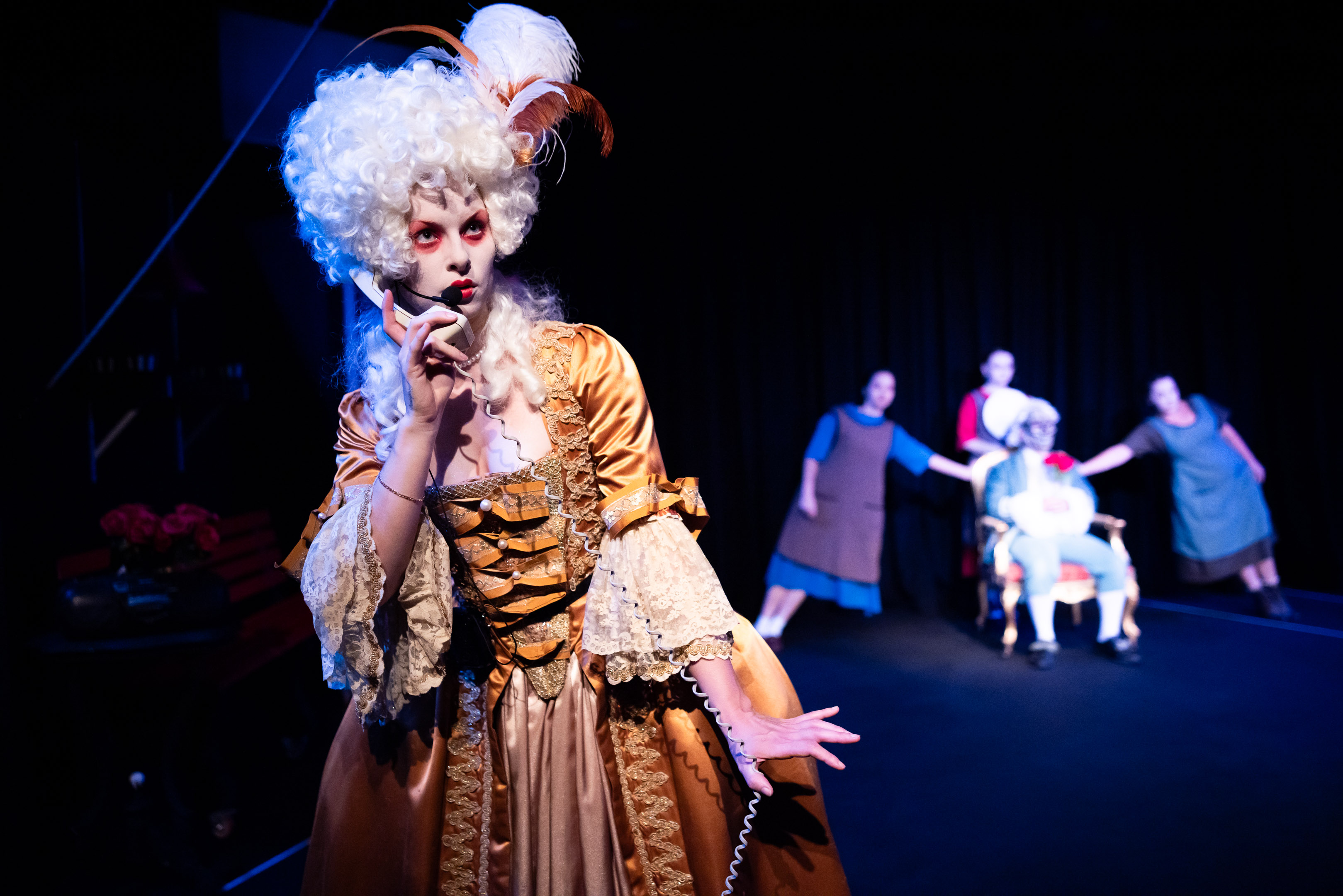
Gogol wrote the original in 1836, as a satire targeting the abuse of power. Director Alex Kendall Robson’s adaptation retains the Russian setting but updates the language. (The theme requires no updating.)
Anachronistic liberties are taken (references to Tolstoy, Chekhov, Rasputin and that quintessentially Russian pop group, Boney M) but all these add to the fun.
Gogol’s play is a classic tale of mistaken identity. The authorities in a provincial town mistake wandering scoundrel Khlestakovfor a government inspector. Knowing their conduct has been corrupt, they’re terrified, and do all they can to placate Khlestakov. There are gags galore at the expense of the greedy and the status obsessed.
Robson presents the show in the round, which puts pressure on a cast already a little challenged by the echoey acoustics of the venue, but the physical use of the space is splendid. Performances are explosively energetic, and include a fascinating range of acting choices. There’s some highly stylised movement, in set pieces by the entire cast, and in choices fundamental to the portrayal of certain characters. Raechyl French and Jade Fuda, as mother and daughter of the town mayor, move in a closely choreographed manner that might evoke a formal 19th century dance, appropriately symbolic of their fixation with class, but also hinting at the restrictions experienced by women in a patriarchy. (Incidentally, their ribald linguistic humour is suggestively naughty, but also suggestive of desire infantilised by oppression.) Jack Elliot Mitchell as the Post Master also uses hyper-realistic movement, a sort of languid slide and sensual pose, and aided by a vocal delivery that luxuriates in every syllable and so maximises the bawdy, a terrific portrait of pleasure seeking decadence is achieved. Lib Campbell as Khlestakov struts and pouts and throws herself around, wonderfully embodying a childish self-obsession.
Other actors create their characters with less fireworks, but with equal impact. Sonya Kerr lets the language do the lifting and shines in her razor sharp portrayal of the cold hearted Chairperson of the Mayoral Advisory Board on Matters of Charity, Humanity and Philanthropy. Shaw Cameron’s Mayor is also magnificent. A public man, everyman’s friend until you’re not, Cameron plays it big, garrulous and greedy, but informed by the vision of the ever practical politician, the portrait retains the truth that gives real edge to its satirical teeth. Similarly, Mitchell Frederick Stewart as the Police Commissioner is brilliant, his understated, matter-of-fact delivery perfectly encapsulating the entitlement that perpetuates systemic corruption.
Paul Gilchrist
The Government Inspector by Nikolai Gogol, adapted by Alex Kendall Robson



 Theatre Red