The Caretaker

20 Oct

This is a brilliant production of a brilliant play.

Harold Pinter’s The Caretaker is a remarkable portrait of lost souls. It features the most extraordinary dialogue, characters who speak as so many of us do:

In circumlocution.

In repetition.

In sentences that begin confidently and assured, only to ……

In awe of that single word or phrase we believe has a magical power.

In repetition.

In blustered, unearned high modality.

In low modality’s whispered reluctance.

In each utterance, each silence, language as the angel with whom we must wrestle to earn our birthright.

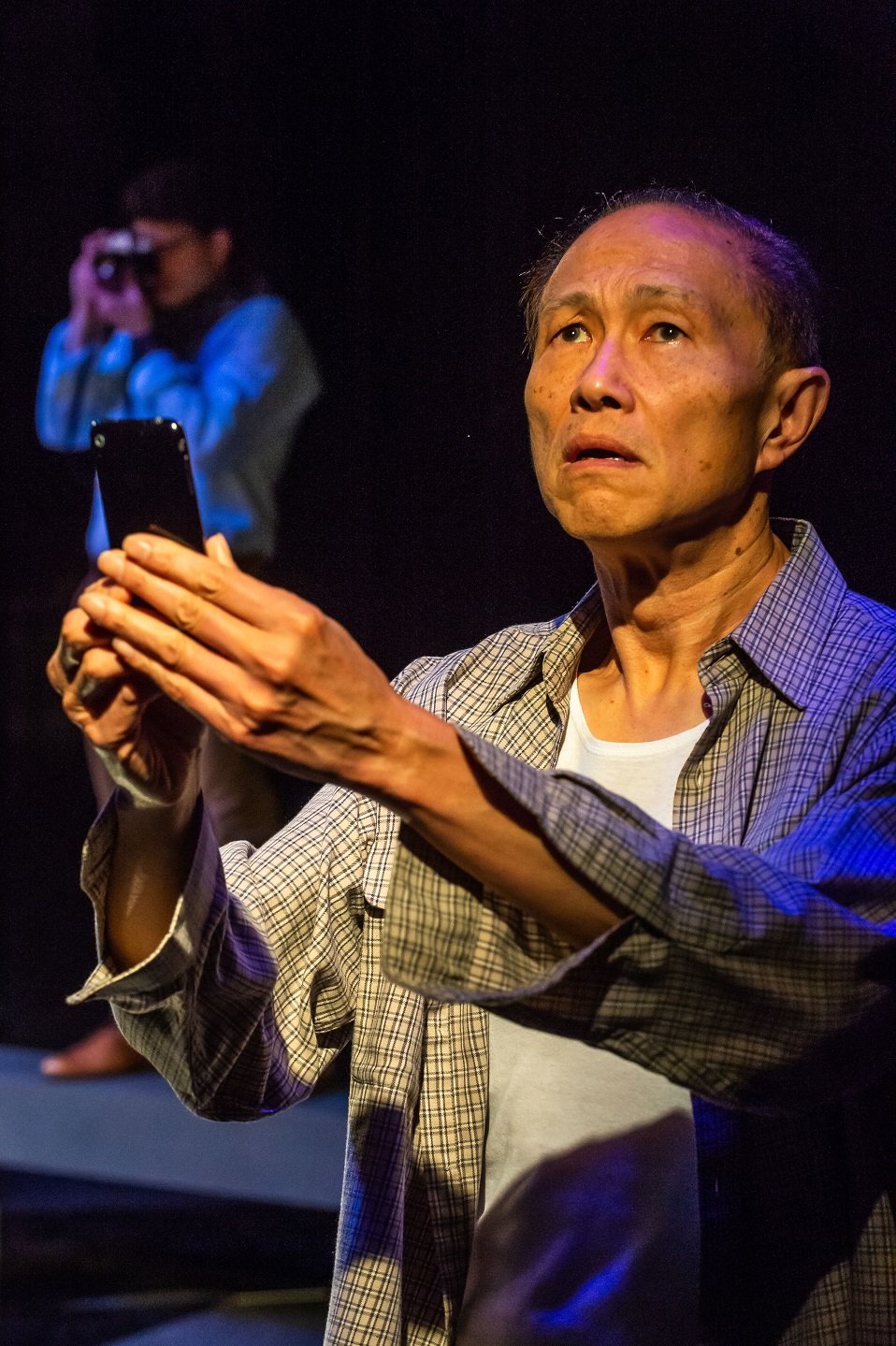
Iain Sinclair’s cast are sensational. They make us savour every syllable of Pinter’s text. And the physicality is hilarious. The sequence in which the three characters dispute ownership of a bag is magnificent. Darren Gilshenan as Davies, the man down on his luck, a stray who wags his tail now and bares his fangs then, delivers a performance of comic genius. (And I don’t mean it’s played just for laughs, but rather as a fully paid-up card-carrying member of the human comedy, as complete as it comes on that fantastical far side of the fourth wall.) Anthony Gooley as Aston, the man who offers Davies shelter, is gentle, slow, measured…. a mystery, that when revealed, is deeply affecting. Henry Nixon’s Mick is manic and volatile, the perfect foil to his brother’s quiet.

In one small, simple room these three performances reveal a world – one of damaged individuals longing to be whole. I left the theatre overwhelmed by two feelings:

wonder at what this artform can do,

and desire to cut each and every crazy broken soul just a little slack.

Paul Gilchrist

The Caretaker by Harold Pinter

Ensemble until 19 Nov

ensemble.com.au  

Image by Prudence Upton

Past The Shallows

14 Oct

Julian Larnach’s play is based on Favel Parrett’s novel of the same name.

Set in a Tasmanian coastal community, it tells the story of three brothers attempting to survive their abusive father.

Designer Keerthi Subramanyam gives the actors a simple, clear acting space that becomes, through the power of language and the evocative AV design of Nema Adel, the family home, the beach, the bush, the ocean.

Director Ben Winspear’s cast do beautiful work. The three actors – Meg Clarke, Ryan Hodson, and Griffin McLaughlin – play all the characters. Intriguingly, the roles of the three siblings – ten year old Harry, fifteen year old Miles and nineteen year old Tom – are shared, with the actors swapping from character to character, and sometimes a character’s physicality being presented by one actor and their voice by another. It’s all a tour de force of fine performance. Of course, it’s also rather confusing for someone attempting to get their head around the story. It’s a decision whose purpose appears to be thematic rather than narrative driven, an evocation of the sibling’s inviolable bond.

As a narrative there are provocative choices being made. It definitely privileges the experience of the painfully vulnerable children, characters who suffer, but whose fundamental and exemplary goodness remains untouched.  In contrast, their father’s brutality is vast and deep, a force of nature, as wild and volatile as the ocean. Yes, he’s given a back history, but it feels a little like the explanation we offer for many forces of nature. (e.g. We say the tides are caused by gravity, but what on earth is gravity?)

Mentioning back history brings bubbling to the surface the notion of repressed memories. Our psychologically aware culture has accepted the possibility of memories being repressed, and that means every narrative can, if it chooses, hide the key to the present in the past, finding that key at whatever time best delivers a dramatic punch. The way this play deals with the relationship between past, present and future invites much discussion post-show …. and into the future.

Beside the father, the other key character who gets less time on stage than he might is Tom, the eldest brother. Because he can, Tom flees the violence, leaving his siblings behind. The ethical element of this decision is acknowledged, but it is not a focus of the play. Instead, we remain with the children in their suffering, being asked for empathy we’ve already given.

But once again, post-show, we might consider that empathy for the unempowered is a quality we could all nurture a little more.

Paul Gilchrist

Past The Shallows by Julian Larnach (adapted from the novel by Favel Parrett)

The Rebel Theatre until 9 November

atyp.com.au

Image by Jesse Hunniford

For the Grace of You Go I

13 Oct

For The Grace of You Go I by Alan Harris is very funny and very clever.

On the simplest level, the play is an indictment of our treatment of the mentally ill, of how programs purportedly designed to help them are, in fact, self-seeking.

But I don’t think the play is really about mental illness, or only is in so far as many mental illnesses are suffered by almost everyone. (I don’t in any way mean the play uses mental illness or is without sympathy for those who suffer.) What I mean is that the mental illness portrayed by the protagonist is a hyperbolic example of what most people experience. (But doesn’t the hyperbole make it an illness? No, it makes it drama.)

Jim believes he is both directing a movie and is its major character. I would argue, that in modernity, this is a common human experience. We do imagine our lives as films that are watched. Life as artefact. (If not the examined life, then the viewed life.) As theatre goers, it might be difficult to see how there could be a different way of thinking about it; after all, when you watch a play, a supposed representation of life, you are seeing life from the outside. But, outside the theatre (and inside it too) you are actually just in life. The watchable parts are an extraordinarily small part of being alive. It could be put this way: there’s doing, there’s being and there is. They’re not the same, and they’re not equal. (They’re in ascending order.)

Another philosophical invitation from the play comes when Jim says he can sometimes see the little man who sits at the control board just behind his skull, directing all his movements. It’s the homunculus fallacy; the idea that to explain vision, or indeed consciousness at all, there must be a little person inside us who is watching the movie we see play on our retina, or who is directing all our movements. Like a man inside a giant puppet suit.  He directs the suit. But who directs him? Another smaller person inside him, who sees him as the giant puppet suit? And inside that person? And on, ad infinitum…..

I’m not forgetting that Jim says he can see the little person at the control board. Most of us just imagine that person exists.

None of this is to suggest that the play is heavy. It’s very funny, deeply intriguing, and eminently watchable. (I’m the one being philosophically pretentious.)

On the night I saw the show there were technical problems, but still the performances were wonderful. The cast play the humour brilliantly, and director Lucy Clements works well the script’s truly unnerving tensions. One such is the contrast between James Smithers’ Jim and Shan-Ree Tan’s Mark.  Jim’s moving dedication to truth (despite, or because of, his dissociation) smacks up against Mark’s duplicity. Mark is the type of person who says something quite threatening, only to then claim it was all a joke. Tan navigates beautifully Mark’s piteous, painful habit of backtracking. Jane Angharad plays Irina with a genuine poignancy, the character exhibiting the naivety of the I-can-help-you-and-it-will-benefit-me-too sort. As is often the case with such characters, it’s as though she is suddenly confronted with a swim across the English Channel when she thought she was to loll in a plunge pool.

Paul Gilchrist

For The Grace of You Go I by Alan Harris

KXT until 15 Oct

kingsxtheatre.com

Image by Clare Hawley

Mother May We

1 Oct

This captivating one-woman show raises a bunch of fascinating questions.

Andy Warhol said “In the future, everyone will have a 65 minute show at Griffin in which to share their trauma.” Of course, the comment is apocryphal, but it came to mind when writer performer Mel Ree suggested that Australians (or was it white people?) don’t like to hear stories of trauma. Admittedly, it is odd that we generally don’t enjoy paying to hear stories of actual suffering. (Though it is utterly, undeniably, incontrovertibly true, as Ree asserts, that the reluctance to hear such stories is part of the reason we’ve failed to achieve justice for our indigenous people.)

A show like this feels a little like a sermon. I don’t mean it’s preachy –  not at all. (Though it’s always fun to be told that I probably hold certain beliefs because of my ethnicity. Or at least as fun as the average sermon.) What I mean is that the experience somehow evokes that of going to church. I’m saying nothing new to suggest, that in our secular society, our theatres have become our cathedrals, our street performers our wayside chapels, and the kindness of strangers the visitations of angels. Ree appears to be bearing witness: this is what was done to me, this is what I have done, and this is what I have been given – each met with approving murmurs from the congregation.

In language that bubbles and bounces from the phraseology of critical theory, psychology and narratology to splendid lyric poetry, Ree shares her story. It’s about not being sufficiently loved, and the multiple disturbing ways this is manifest. 

Ree is of Papua New Guinean heritage. Her ancestors were witches. Some of her immediate family were …. troubled. Such are the gifts of diaspora and displacement. Here the deliberate obliqueness, the silences, are poignant. The rest is conscious mischievous exuberance, empowering play; we hear more about a late night booty call than about any violence.

I assume this performance is non-fiction (though obviously creative nonfiction; Ree tells us that we all build a narrative of our lives.) It’s fascinating seeing something like this in a theatre. What has become of character? Yeats suggested the performance of character is crucial to the ethical sense, because in performing someone else we establish that it’s possible to be different to who we currently are.

When our theatres no longer present characters, but rather bear witness, something else is happening…… something sadder, something smaller……. as necessary, as beautiful, as tears.  

I’ve suggested this is a story about trauma, but the conclusion is joyful. Ree tells of meeting a kind-hearted stranger. I won’t go into the details, partly because that would be a spoiler, but mainly because it’s familiar. We’re reminded of what is known by the wise of every culture: that what is taken from us we grieve, but we celebrate what we let go.

Paul Gilchrist

Mother May We by Mel Ree

SBW Stables Theatre  until Oct 8

griffintheatre.com.au

Image credit DefinitelyDefne Photography

Chain Play

23 Sep

A chain play is created by a team of writers. Each writer drafts one scene, having read only the scene that directly precedes hers. Obviously, no-one expects the resultant script to be a paragon of textual integrity. Chain plays are a type of theatre game; and therein lies the key word – game.

This Chain Play by Slanted Theatre is a riotous celebration of Asian-Australian theatrical talent. The writing is sharp and funny, and the performances are mischievously exuberant.

Chain Play actually consists of two distinct works, each written according to the chain play methodology.

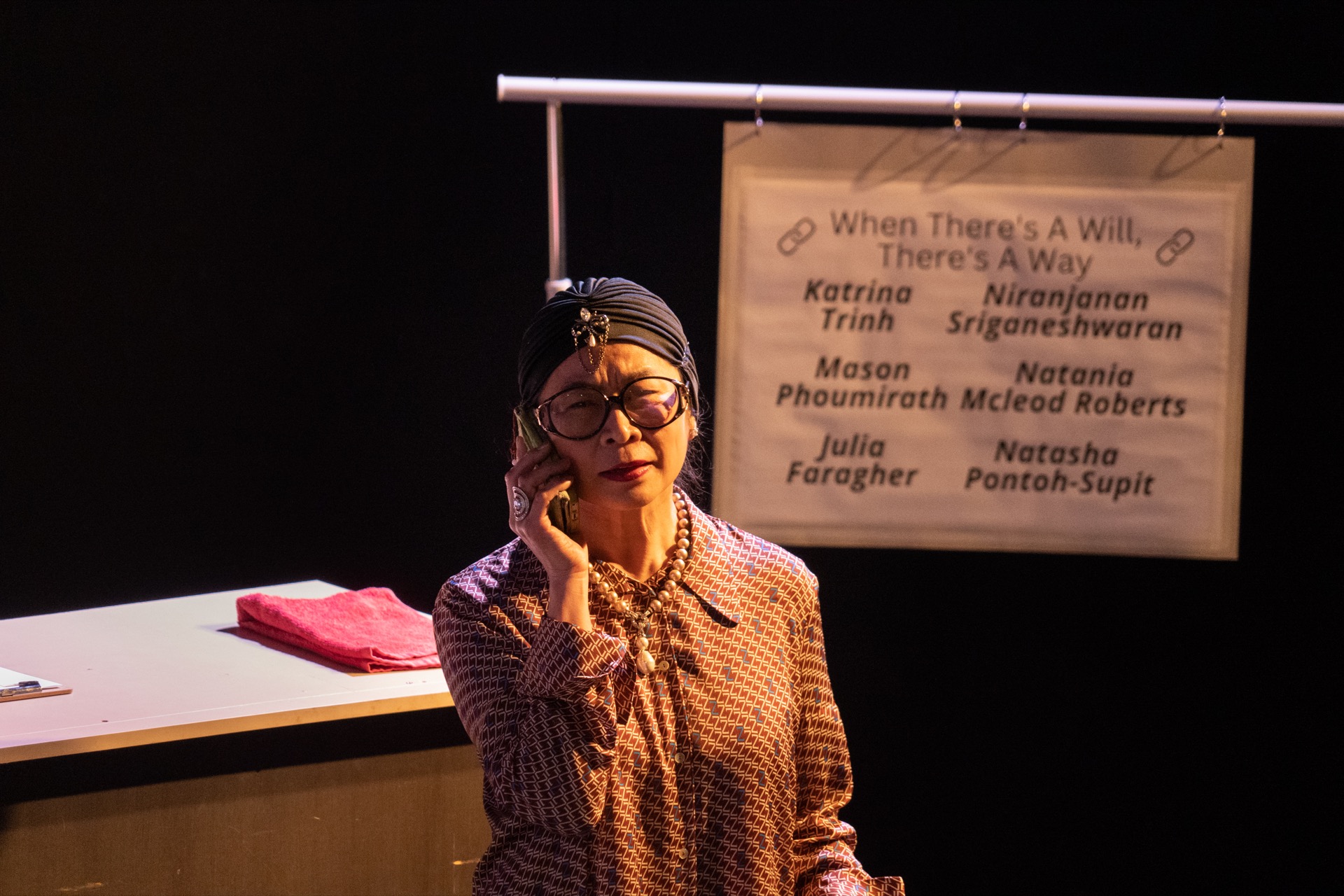
Where There’s a Will There’s a Way is written by Katrina Trinh, Mason Phoumirath, Julia Faragher, Niranjan Sriganeshwaran, Natasha Pontoh-Supit and Natania McLeod Roberts, and is directed by Katie Ord. It lands in the genre of sit-com, with plenty of great one liners and characters that are the Asian-Australian cousins of those in Commedia.

Susan Ling Young in Where There’s a Will There’s a Way

How Asian are You? written by Matt Bostock, Alan Fang, Grace Hu, Christina Kim, Eezu Tan and Simone Wang, and directed by Sammy Jing, is more conceptual.  Each scene digs into assumptions about Asian-Australian identity, and does so in ways that are both hilarious and poignant. (I’d like to see this type of digging continue in the Sydney theatre scene, digging deeper and deeper to see what we might find ……hopefully gold, and not just some gaping big hole.)

And, to conclude, a possibly utterly irrelevant philosophical digression: every play ever written is part of a chain play. We write informed by what is directly before us, sometimes only vaguely conscious of where we fit into the larger arc of history. And what we write then goes on to inform our near contemporaries, contributing to the intellectual and emotional environment to which they respond. Every playwright suffers from an inevitable myopia. Perhaps that’s no great tragedy; after all, if you can see too much further ahead than your audience, you’re not a prophet, you’re just irrelevant.

But a chain play, for all its playful nonsense, reminds us that we not only have to deal with the social environment in which we find ourselves, but we must also leave something for those who follow.   

Paul Gilchrist

Chain Play by Slanted Theatre

at Flight Path Theatre as part of the Sydney Fringe until Sept 24

https://sydneyfringe.com/events/chain-play/

Image by Aaron Cornelius

The Marriage Agency

22 Sep

The Marriage Agency by Saman Shad is joyfully funny.

Nasir believes in love, as expressed in the grand gesture. His hero is Shah Jahan, who built the Taj Mahal for his wife, Mumtaz Mahal. So that others might come to share the miracle of love, Nasir establishes a marriage agency, here in Australia. After all, marriage is the most important decision in life. Passers-by assume it’s an Indian restaurant, and are disappointed there’s no butter chicken. Nasir’s wife, Tasnim, Indian in heritage but Australian born, doesn’t relate to the grand gesture. She’s more comfortable in the greys of life. (As someone not of Indian heritage I’m uncertain how to read pieces like this. Is a comment being made about the differences between cultures? Or between genders? Or are the differences specific to these characters? Is this reportage or fiction? But I’m comfortable in the uncertainty; it’s arguably this tension, present in all good dramatic pieces, that fuels post-show discussion.)

Director Kenneth Moraleda elicits wonderful comic performances from the entire cast. Both vocally and physically, Atharv Kolhatkar is absolutely brilliant as the dreamer Nasir. Caroline L George presents Tasnim as poised and professional, with an undercurrent of frustration which is deeply moving. Ashi Singh has a glorious stage presence as teenage daughter Salima, portraying a character of youthful, luminous intelligence that one can only hope is an image of imminent Australia. Lex Marinos as Bill, Nasir’s first customer, powerfully expresses the poignancy of grief balanced with the wish for future happiness. Kevin Batliwala plays a host of roles with aplomb, from obtuse butter chicken enthusiast, to a younger Nasir on his wedding day. These scenes (with Singh playing the younger Tasnim) are dreamt into being by the now struggling couple nearly two decades after the event and are theatrical magic.  

At the heart of this piece is the heart. What is love? Is it the unexpected breathtaking grand vista, or is it the million dogged, dutiful steps by which we might finally get to the top of that hill?

Paul Gilchrist

The Marriage Agency by Saman Shad

KXT until I Oct

http://www.kingsxtheatre.com/

Image by Phil Erbacher

110% Average

21 Sep

This production is audacious and gloriously silly (and plenty of people value audacity, especially of the I-can’t-believe-you’re-letting-yourself-look-like-such-a-dag-on-stage sort.)

Anita Lovell tells her “coming of average” story, outlining her discovery of enjoyment and security in not being especially good at a whole host of activities. The glorious silliness comes from the fact Lovell enacts the routines she performed in childhood – trampolining, roller skating, gymnastics, etc.

Lovell has great comic delivery and a joy inducing commitment to the physicality.

For me, at least, the show raises some rather big questions. I’m inclined to feel we should pursue excellence, but this production aligns more with the views of Kurt Vonnegut. Vonnegut was one of those great geniuses who never won the Nobel Prize, and his advice is famous: “Practice any art—music, singing, dancing, acting, drawing, painting, sculpting, poetry, fiction, essays, reportage—no matter how well or badly, not to get money and fame, but to experience becoming, to find out what’s inside you, to make your soul grow.” In contrast, my view has more in common with that of the geniuses behind Fast and Furious 7 (inexplicably also denied the Nobel.) The soundtrack of their film features the lyrics  “Go hard or go home”.

The pursuit of excellence is inspiring, while the rejection of it, though hardly immoral, is of little relevance to anyone else… and to yourself might merely be a pastime.

But, assuming being average is not just a euphemism for being not very good at something, being average is a comparative statement. It’s about competition.

Plenty of human activities are not competitive. When you choose ones that are performative, you invite judgement. (I’m not suggesting you deserve it.)

So, in a way, the show is an exuberant assertion of independence, a mischievous reclamation of art from the tyranny of evaluation, and a teasing reminder, that in the rejection of some values, their residual will remain. (See my above comments about audacity.)

Paul Gilchrist

110% Average by Anita Lovell

Boom Boom Room as part of the Sydney Fringe (until 24 Sept)

https://sydneyfringe.com/events/110-average/

Cherry

15 Sep

Cherry is a whole lot of fun – a playful, joyful journey; one young woman’s passage into adulthood with Katy Perry as an inspiration. It’s an exuberant pop bildungsroman; a poignant study of how mass culture, despite its audience of millions, can deeply impact the individual. (And, creating a genuine dramatic tension, a question very consciously runs through it all: on our journey to authenticity, how reliant can we be on the mass produced?)

There are plenty of references to Perry and her music, which will both delight aficionados and welcome newcomers into the high-spirited world of the Katy Kats.

I suspect this story is not an anomaly; ever since radio, then TV, then the net, teenagers have been able to find a sense of community with others experiencing the same exciting, troubling stage of life. (Is “the teenager” a creation of mass media? I don’t mean this in a cynical way; simply, that for the first time in human history, poor souls struggling through that awkward, exhilarating age could know they were not alone.) And teenagers have benefited from strong voices like Perry’s advocating empowerment and acceptance.  

Both linguistically and physically, Sarah Carroll gives a terrific evocation of girlhood, its debilitating doubts and its passionate obsessions.

Musical director Marissa Saroca delivers a soundtrack of infectious energy.

The Fringe provides a perfect arena for a little bliss bomb like Cherry.

Paul Gilchrist

Cherry by Sarah Carroll

Emerging Artist Sharehouse – the Boom Boom Room until Sat 17 Sept

https://sydneyfringe.com/events/cherry/

Photograph 51

13 Sep

Ensemble’s production of Anna Ziegler’s Photograph 51, directed by Anna Ledwich, is utterly engaging theatre; intellectually stimulating and deeply moving.

It tells the story of Rosalind Franklin, one of the researchers who in the 1950’s uncovered the secrets of DNA.

Despite it’s reputation as a pure pursuit of knowledge, science is just another human activity, tainted by human failings.  

Rosalind is excluded from male enclaves and the attendant conversations in which ideas are casually shared. She’s assumed to be incapable of theoretical insight, and attempts are made to reduce her role to that of a technician. She’s portrayed by the male scientists as some sort of harridan simply for standing her ground. And she’s ultimately robbed of …. ah, but that’s a spoiler for those who don’t know her personal history. Let’s leave it this way: the conclusion is heartrending.

Yes, the play’s about science, but Ziegler’s extraordinary script is thoroughly captivating because it tells a very human story. Her Rosalind is a complete person, not a straw victim. She’s sublimely intelligent and gloriously independent, but we’re also asked to consider whether her flaws are inevitable responses to discrimination. Is Rosalind simply overly cautious? Does she really need to keep everyone at such a distance? Amber McMahon is absolutely magnificent in the role.

And the supporting cast do equally brilliant work. Garth Holcombe as Maurice Wilkins, Rosalind’s colleague at Kings College, is a superb portrait of a man threatened, one who would like to be noble, but who can’t quite manage it. His advice to PhD candidate Raymond Gosling (played with charm by Gareth Yuen) is to be kind to women; but the inadequacy of this advice – its patriarchal overtones – is beyond his comprehension. Ziegler employs a motif from The Winter’s Tale to underline this. Rosalind has seen Peter Brook’s production of the play starring John Gielgud as Leontes (but in a wonderful irony can’t recall the actor playing Hermione). Wilkins knows the work well, and the two might bond over this shared interest, except for their very different readings of the play’s finale. Does Hermione really survive? It’s a beautiful playwright’s trick, a gorgeous encapsulation of the issues at stake, and a sophisticated embrace of the openness of the dramatic form.    

Robert Jago as Francis Crick and Toby Blome as James Watson powerfully embody another very human flaw that mars the supposedly noble pursuit that is science: competition. The goal of discovering the truth of the DNA molecule is reduced to a “race” and, when an understanding is finally achieved, Crick asks grandly do you know what this means – only to offer a staggeringly uninspiring answer: wealth, status, women….

Emma Vine’s beautiful set, ostensibly a laboratory, evokes a chapel. It’s a poignant touch.  Are Science and Religion at odds? Rosalind says they are. But, at their best, both embody a humble desire for truth. At their worst, both are tragically beholden to the machinations of power.  

Paul Gilchrist

Photograph 51 by Anna Ziegler

Ensemble Theatre until Oct 8

ensemble.com.au

Photo Credit Teniola Komolafe

Chimerica

24 Aug

We all know the photo. A lone man stands before a line of tanks. Incongruously, he holds two shopping bags.

It is immediately after the events of 15 April 1989, the day the People’s Liberation Army of China turned its guns on protesters in Tiananmen Square.

Lucy Kirkwood’s Chimerica tells the story of the American photographer who took one of the original photos and of his search for the man immortalised in the image. Did he flee to America? Is he still alive?

Kirkwood’s story is fiction, but it’s a brilliant exploration of heroism. In an age in which our vision of the hero too often reduces to someone who can deliver a cutting comeback on social media, a reminder that it might take a little more than that is invaluable.

And the power of Kirkwood’s play is that it reminds us that little more might manifest itself in many ways. We can be heroic in both what we choose to do, and what we choose not to do. The virtue of restraint, for example, might be harder to photograph, but is no less real for that.

On the night I saw this production at New Theatre, there were technical difficulties, but this didn’t hide the brilliant performances that director Louise Fischer has elicited from her cast. Oliver Burton as the American photographer powerfully portrays both the man’s charisma and his disturbing myopia. As Zhang Lin, a Chinese teacher of English in contemporary Beijing, Jon-Claire Lee is magnificent, presenting a rich emotional palette, ranging through light-hearted resilience, and seemingly infinite patience, to chronic despair. Enoch Li and Liz Lin play Zhang Lin’s younger self and his wife with engaging charm. Jasmin Certoma’s English woman abroad is a wonderful study in the challenges of genuine engagement in a world that can seem far too big for the individual to make an impact. Alice Livingstone shines in several cameos, as a prickly secretary to assured elected representative. Similarly, Katrina Chan splendidly inhabits several roles, portraying both vulnerability and an inspiring feistiness. Les Asmussen’s newspaper boss is beautifully rich, with space enough for both parody of media moguls and genuine insight into the complexities of the business of selling the truth.

Back to those technical difficulties: that they made so little difference suggests, that for theatre to be truly engaging, you simply need a great script and great cast. Easy.

Paul Gilchrist

Chimerica by Lucy Kirkwood

New Theatre until 10 Sept

newtheatre.org.au

image by Chris Lundy