Trade

11 Apr

Responsibility has gone out of fashion. Too many of us aspire to be victims.

And the truly marginalized? Perhaps we can pretend the competition is good for them.

Because unbridled capitalism is good, isn’t it? (It’s like a synonym for democracy, right?)

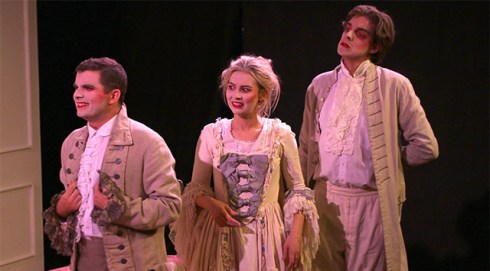
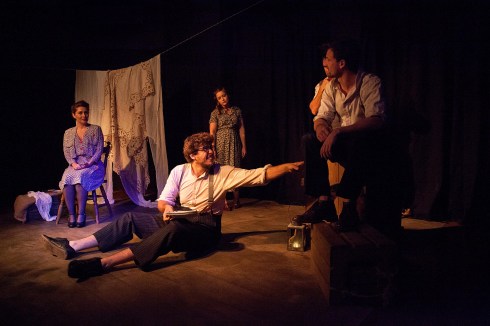
In Trade we follow the fortunes of a dodgy investment company. Manipulate the share price and buy or sell at the right time. And, when one deal goes spectacularly wrong and squillions are lost, it’s time to point the finger. Who is responsible? The fund manager has a golden parachute (literally and hilariously.) Sure, she does time… white collar time. In the meantime, the rest of her team reinvent themselves. Capitalism can be ethical, can’t it?  Greed is Good, that’s from the Sermon on the Mount, isn’t it?

Trade

Devised by the ensemble (Melissa Hume, Mathias Olofsson, Dymphna Carew, Alison Bennett and Alicia Gonzalez) and with words by Melissa Lee Speyer, this is sharp, very entertaining theatre.

Director Alison Bennett and movement director Dymphna Carew create a visual space that’s fun and fluid, evocative of a world where funds slip away, ethics slip away. “No risk. No reward.”

Performances are both precise and playful. Trade is very funny.

And wonderfully pointy. Just when you’re comfortably smug in your superiority to these coke-addicted high-flyers, you’re reminded: where, exactly, does your interest, your superannuation, come from?

There was a time when the question was not Who am I? but What is to be done? Exciting, vibrant and new, theatre like this takes me back, and can take us all forward.

Paul Gilchrist


Trade by Hurrah Hurrah

at the Old 505 Theatre until 15 April

tix and info here
Binary Stars and Best Lives

30 Mar

What stories do we tell ourselves? Living in a pluralistic society, we’re well aware there’s more than one possible narrative.

It’s a choice, of course. Samantha Hill’s charmingly eclectic Binary Stars and Best Lives outlines some of the many, many options. There are indigenous stories, Ancient Greek myths, astrophysics, particle physics, New Age mantras, and the Aussie Everyman banter of the TV presenter.

How do you choose? The play amusingly suggests some stories are problematic. The Ancient Greek myth that explains the creation of the constellation the Pleiades is clearly misogynistic. But other narratives can be more insidious, promising personal empowerment but delivering a crippling sense of isolation and guilt. (For example, a mantra that says You can achieve anything if only you try quickly turns on its user and becomes You haven’t achieved so it must be your fault.) In choosing our narratives, we must choose wisely.

But there’s also a political battle for the control of the narrative. Tell yourself whatever story you like in your head, but we’re creatures of culture, and must live in a social world. The play explores several examples of this tussle to control the story. Cleverly subverting the Uncertainty Principle, any fascination with the indeterminate nature of particle reality takes on a wholly different importance when discussed by Schrödinger’s cat herself. In a similar exploration of hegemony, Babe understands that her troubled relationship with her TV celebrity husband will be discussed publicly, but knows only too well which of the two of them has the greater power to shape the way events are perceived.

redline3

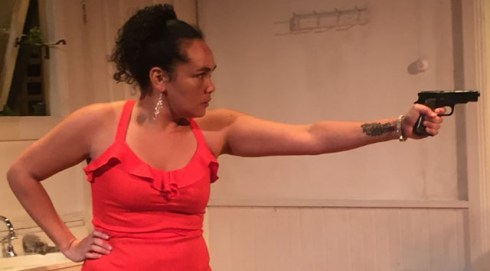
Babe, and her world of domestic violence, is an echo of the current main stage production at the Old Fitz, Crimes of the Heart. And that’s an aspect of the New Fitz program of which this play is a part: contemporary Australian writers responding to existing works. I’m not quite sure what to make of the idea: is compulsory intertextuality simply an acceptance of the realities of the cultural landscape? Or is it an attempt to control the narrative*?

Whatever the case, the Old Fitz has provided a space for the cast and creatives behind Binary Stars and Best Lives to make a fun and thought-provoking new work.

Paul Gilchrist


Binary Stars and Best Lives by Samantha Hill

Directed by Michael Abercromby

at the Old Fitz til 8 April

tix and info here


*which is why I write about theatre.

The Age of Bones

28 Mar

And your taxes are paying for it.

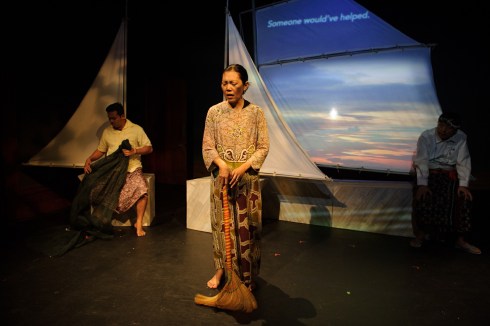
An Indonesian man points directly at the audience.

His comment is simple and powerful; at least 60 Indonesian minors have been jailed in Australia for working on asylum seeker boats.

This injustice is the focus of Sandra Thibodeaux’s play. It tells the story of fifteen-year-old Ikan (Imam Setia Hagi) who finds himself imprisoned here, a foreign country. The Australian authorities seemingly make little attempt to contact his family, and his parents (Imas Sobariah and Budi Laksana) are grief stricken at his disappearance.

Age of Bones

The lost boy, of course, is Down Under, and this allows for a brilliant conceit: Ikan doesn’t languish in a cell, rather we see him beneath the ocean, surrounded by an array of bewildering sea creatures, brought to life by extraordinary puppetry (I Made Gunanta and I Wayan Sira) and performance (including Kadek Hobman as a very Aussie hammerhead, loutish yet not incapable of kindness.) This world beneath the sea suggests both the greatest fears of a fishing-based culture, and the absolute absurdity of Ikan’s predicament.

Created through collaboration between artists from the two countries, The Age of Bones is a thrilling mix of English and Indonesian (with the latter translated in surtitles.) Projection, puppetry, and set that’s a wonderful evocation of a sailing boat, make for a visually stunning production.

Working with Thibodeaux’s beautiful play, directors Iswadi Pratama and Alex Galeazzi have created a piece that is amusing, engaging and challenging.

Great theatre confronts its audience, asking crucial questions. The Age of Bones asks have we lost our way?

Paul Gilchrist


The Age of Bones by Sandra Thibodeaux

Riverside Theatre, Parramatta

Produced by Performing Lines / Satu Bulan / Teater Satu

This production has closed in Parramatta, but plays in Darwin 30 March to 9 April.

Tix and info here

A Period Piece

23 Mar

The title is a pun.

Menstruation.

It’s one of the things we’re not allowed to talk about. Ok, my modality is too high; it’s one of the things we’re reluctant to talk about.

Why?

Because it’s a bodily function? Because it’s related to sex and reproduction? Because it’s female?

glitterbomb1

One of the best skits in this revue-style production has two men in a gym bragging about their periods; whose is the biggest, whose is the most painful. It’s glorious satire in the if-men-could-have-babies-abortion-would-be-a-sacrament vein.

Another wonderful skit posits a female astronaut – calm, cool, strong, and clearly the best candidate – who’s rejected from the space program because where are they going to fit to all those tampons. “Don’t make us have to say it,” she’s told.

Created by Carissa Licciardello, Gretel Vella and the company, there’s some absolutely wonderful comic writing in this snappy hour long piece. The performances by Julia Robertson, James Wright, Matthew Lee and Julia Christensen are comic gold. And original songs from a three piece band (Mikaela Atallah, Hannah Cheers and Clare Hennessy) create a satisfying texture and provide plenty of giggles.

Of course, everyone is dying to know what this male writer thinks about menstruation. Why is menstrual blood so problematic? After all, there are few healthier ways to lose blood, and we seem to have little problem soaking our screens with the more violent manners of doing so. Is it because the natural cycle of menstruation is a reminder (one of many, and, yes, a reminder to us all) that we are not superior to the earth, but of it?

Paul Gilchrist


A Period Piece

produced by Glitterbomb

at Old 505 until 25 March

Tix and info here here

Crimes of the Heart

22 Mar

This is a heart-warming comedy.

Though, I do declare, it took me some time to pick the tone. Which is sort of weird, since I usually find any play in which the actors speak in an accent other than their own rather funny. (Maybe I’m just a country hick.)

Crimes of the Heart by Beth Henley is set in the South of the USA. It was first produced in 1979 and it won the Pulitzer in 1981.

It’s the story of three sisters facing one hell of a bad day.

CRIMES OF THE HEART (c) Rupert Reid

Photo by Rupert Reid

Director Janine Watson’s production has class. The set by Jonathan Hindmarsh looks terrific. The cast are great fun to watch, creating kooky, vivacious, engaging characters.

Some would call these characters Larger-than-Life, but I find the phrase rather parochial; Life is plenty big enough to fit all we can ever throw at it.

The phrase a ‘bad day’ is also problematic, but in this case because it’s a vast understatement. On this particular day, Babe (Renae Small) has just shot her husband and faces prison. Her glamorous sister Meg (Amanda McGregor) returns home at the news and is forced to admit her show biz pretensions are a fraud. And Lenny (Laura Pike), plain, simple, strong Lenny, who’s stayed at home to care for their ailing grandfather, has just turned 30, and no one’s noticed. And hovering behind all this is the dreadful knowledge that their mother took her own life in this very house – because of a ‘bad day’.

Yes, it is a comedy; funny, feel good, and like all of the best comedy, with a vision of Life not to be laughed at.

For what’s the solution to bad days? Just keep having more of them, and acknowledge you’re not alone in it.

Paul Gilchrist


Crimes of the Heart by Beth Henley

at Old Fitz til 8 April

Info and tix  here

Consensual

21 Mar

This show is about sex.

Tix available here

New-Theatre-Consensual-photo-by-Bob-Seary

Photo by Bob Seary

No, seriously, it is about sex. Yucky sex; not the joyful type, the type that’s like spring and sunshine and sausages (as in ‘democracy sausages’- the ones that make you feel we’re all in this together.)

No, it’s about icky sex; the type whose mythology is that sex is wild and dangerous and so, so, so ‘rock and roll’ (in the sense that it’s shallow, repetitive and, on the rare occasions when it is actually good, over far too quickly. Just like the participants.)

Consensual is set in a school environment. The students are obsessed with sex. One boy seeks…..something, and finds it (oh so briefly) with a staff member.

The play throws up issues like these (or, at least, I felt I was thrown up on):

What exactly is consent?

Should there be an age of consent?

What harm is done when the current laws are broken?

In what situations might these laws be broken?

Is our society simply too sexualized?

First performed in London in 2015, Evan Placey’s play is sharply written, at times funny and at times moving, and guaranteed to lead to lengthy conversation in the bar afterwards.

Director Johann Walraven’s production is top quality. The cast are eminently watchable, making challenging characters come alive. Paul Whiddon, as the boy, gives a fascinating performance, provocatively balancing anger, manipulation and vulnerability. Lauren Richardson as the staff member gives a similarly riveting portrait, presenting a woman whose naivety plays hide and seek with her duplicity.

For me, one of the most engrossing aspects of the play is the second act.  It’s a neat dramatist’s trick, but due to the ‘no spoiler rule’, I can only tease and titillate. I’ll say this much: the second act is an extraordinary commitment to what I’ll call (no doubt unhelpfully) platonic naturalism – the belief that theatre can present what is hidden but what is real.  This can happen, the dramatist says, even though what I am presenting is fiction.  Of course, Placey is not the only writer to play this card (it’s part of our grand tradition) but because of the issues at hand, it’s particularly intriguing.

Paul Gilchrist


Consensual by Evan Placey

at New Theatre ti 15 April

Tix and info here


The Laden Table

21 Mar

Does talk solve anything? It’s often said that the belief that it does is the great liberal myth. But it’s a belief shared by the axial age religions, that great movement that mysteriously flowered between about 600 BCE and 700 CE, and birthed (among other things) Buddhism, bhakti Hinduism, Christianity, Judaism and Islam. What made this flowering so extraordinary, and seemingly different from what came before, was the new-found emphasis on compassion and empathy.

The Laden Table is a piece that’s had a long development.  Six women (Yvonne Perczuk, Nur Alam, Raya Gadir, Chris Hill, Marian Kernahan and Ruth Kliman) have been coming together for the last nine years to talk and share stories from their diverse backgrounds.

The resultant play is built on a simple conceit: two families, one Islamic and one Jewish, each meets to celebrate a festival. These two families don’t interact with each other (well, they do, but that’s spoiler territory) – their separate evening meals are presented simultaneously on stage, and the impact is to suggest that the different families are really not so different after all.

Both know love. Both know suffering. And both know how to argue among themselves.

THE LADEN TABLE photo credit Natasha Narula

Photo by Natasha Narula

A large ornate table stands centre stage, and lit by Benjamin Brockman and designed by Courtney Westbrook, it’s a visual feast, and a powerful symbol of both the possibility of communion and the weight of tradition. Director Suzanne Millar has put together a strong ensemble, and she and her team work the space well, effectively juxtaposing the imposing presence of the table with the creation of vibrant, passionate, living characters. There are some standout performances, including Jessica Paterson as a young Australian Jewish doctor who’s witnessed the horrific consequences of political violence, and Sarah Meacham, who plays a young Australian Islamic woman navigating family expectations.

And back to those arguing families: The play’s main aim is to take on prejudice, and one of its major sources, ignorance. After all, evil does evil, but not half as well as stupid.

Where does bigoted thinking come from?

We teach children it’s immoral, but that’s only the half of it. It’s also the result of intellectual error. All Jews are…. All Palestinians are…. These sorts of statements fail to convince, unless pain and grief skew our thinking, and simplicity appears as a solution, rather than what it is – a great denial of Life, in all its glorious complexity.

Perhaps ironically, considering its origins, the play doesn’t present talk as leading to a resolution. The playwrights are sensibly modest in this regard. How could such huge problems be solved so quickly, so easily?

But, of course, it’s the conversation with the audience that ultimately matters. The Laden Table is vital, exciting, invigorating theatre.

Paul Gilchrist


The Laden Table by Yvonne Perczuk, Nur Alam, Raya Gadir, Chris Hill, Marian Kernahan and Ruth Kliman

Produced by bAKEHOUSE

at Kings Cross Theatre til March 25

tix and info here


Are We Awake?

6 Mar

This is part of the New Fitz program; the idea being that the Old Fitz will commission Australian dramatists to write responses to each of their main stage works. Are We Awake? is notionally a response to David Hare’s The Judas Kiss. Having missed opening, I haven’t been able to get along to Hare’s play, and since it’s been 18 years since I’ve seen it, I have little sense of what dialogue might be going on between the two pieces. I doubt it matters.

Are We Awake? by Charles O’Grady is a beautiful stand-alone new work. I congratulate Redline and PlayWriting Australia for making it happen.

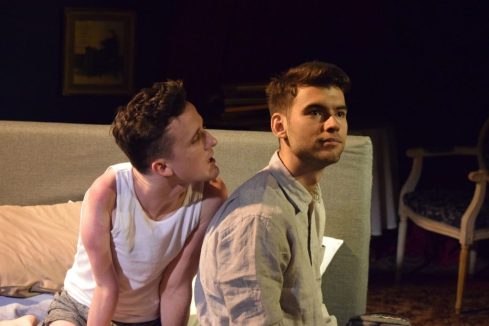
It’s the story of two lovers, directed with a powerful simplicity by Sean Hawkins and played magnificently by Daniel Monks and Aleks Mikic. The lovers face a test that is common, though not commonly staged: one of them is disabled and in poor health.

are-we-awake

The play is built on the question of What is Love?
Is it sharing or is it caring?
Is love the sharing with a partner of Life’s most joyous moments? Or is it the caring that becomes necessary when your partner faces Life’s challenges? (Or is that just a false dichotomy, the collapse of which heralds the arrival of real love?)

Are We Awake? is a small gem, a tender exploration of some awfully big questions.

Paul Gilchrist


Are We Awake? by Charles O’Grady

At the Old Fitz til 11 March

Tix and info here

Member

28 Feb

Member, written and performed by Ben Noble, is a powerful indictment of gay hate crimes.

If you’re privileged and naive, like me, it can sometimes be hard to imagine they actually occur. What motivates them? Of course, it should be no surprise: our inability to allow same sex marriage is indicative of a deep seated homophobia. Assaults and deaths happen, in shocking numbers. This production focuses on the epidemic of violence that occurred in Sydney in the 70’s through to the 90’s, in which up to 80 people were murdered. The show’s impact is to draw attention to this awful and ongoing failing in our society.

ben-noble-photo-credit-deryk-mcalpin

Photo by Deryk McAlpin

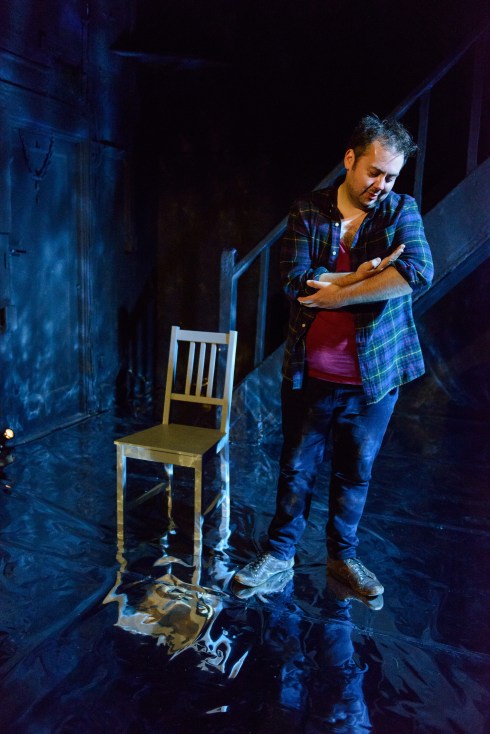
Noble’s performance is compelling and passionate. He presents a range of characters, but the focus is on Corey, father to a man who now lies hospital, a victim of a bashing. As the story unfolds, it’s revealed that Corey himself has been a perpetrator of violence, and continues to struggle with his confusion and guilt.

That the sins of the fathers will be visited on the sons might seem a dramatic convenience, but it is sociologically truthful. The society we live in is one of our own creation. If we are cold and uncaring, cowardly and violent, what world do we think we will make for ourselves?

Member has its origin in a multi-playwright project, and this still sometimes shows in its complexity. But the kernel of the piece is incredibly moving. A lost child falls in with the wrong crowd and commits a terrible evil. He seeks guidance from the one adult he trusts…… and gets nothing. It is the way things are, he’s told, as inarguable as the movement of the sea.

But we know it’s not. This piece is a timely reminder that equality is something we make, and that we must.

Paul Gilchrist


Member by Ben Noble

Blood Moon Theatre til March 4

Info and tix here

Big Crow

27 Feb

Congratulations again to Brave New Word. They’re a company dedicated to new work. Our culture needs it.

Big Crow by Mark Langham is a provocative confection. Set in 1930’s rural New South Wales, it’s concocted from elements of sitcom, black humour and Australian Gothic. This is challenging for performers but fascinating for audience members.

big-crow-3

Photo by David Hooley

The play’s concern is the oppressed: exploited workers, mistreated women and the dispossessed, original inhabitants of this land.

Like much Australian Gothic, there’s an overarching sense of dread, a sense that crimes committed are yet to be fully acknowledged. Something’s not right with the world.

Langham’s recurring motif is the crow. Ominous and evoking death, they perpetually scratch at the roof above us. They’ll have our eyes out, I fear, if we don’t learn to see our failings.

Paul Gilchrist


Big Crow by Mark Langham

til 4 March at The Actor’s Pulse, 103 Regents St, Redfern

Info and tix here