Blue Italian & Nil by Sea

4 May

Every boundary serves three purposes.

The first two purposes are obvious: to keep people out, to keep people in.

The third I’ll come to later.

Katie Pollock’s plays Blue Italian and Nil by Sea are powerful and poetic. They’re fascinating explorations of human movement.

Despite the nationalistic stories we tell ourselves, we’ve been on the move the entirety of human history. Advances in technology simply mean we’re faster now and so the habit has become more obvious, and more fraught.

Why do we do it? Currently, the movement tends to be out of Australia if you’re bored by privilege (this we call travel) or into Australia if you’d like the opportunity to be bored (this we call migration). For many Australians, travel has become a rite of passage. For many people outside Australia, migration is often a matter of life or death.

Directed by Rachel Chant, with set and lighting design by Benjamin Brockman and sound design by Tom Hogan, the two pieces are stunningly sensual. Leichhardt Town Hall is a big cavernous place, but it’s used beautifully. There’s a sea of barricades, complete with flashing lanterns, lit evocatively from the ground. There’s a striking moment when the high overhead fans take on a most ominous presence. And, of course, the town hall is directly below the flight path. Usually this would be an annoyance, but here it’s worked wonderfully into the pieces, the passing planes become suggestive of our drive to move.

Photo by Zorica Purlija

Photo by Zorica Purlija

The cast (Jennie Dibley, Nat Jobe, Alex Malone and Sarah Meacham) do terrific work, delivering textured performances of a host of characters, creating an image of a world in flux.

The first of the two pieces, Blue Italian, is an intriguing meditation on travel and migration.  The title refers to a design on a Royal Dalton dinner set. Amongst much broken crockery, the shattered image becomes a symbol of the refusal of the world to stand still or human society to remain stationary.

In the second of the two pieces, Nil by Sea, three neighbours stare at a stain on the roadway. Where did it come from? Its source is tragic; a desperate man attempting to overcome a boundary. Will the stain ever come off? Good question, and a damning indictment of our current policy on asylum seekers.

And so to the third purpose of boundaries: To define, through opposition.

This is me. That is you.

This is us. That is them.

These are boundaries we need to break down. And these two magnificently provocative pieces of theatre – anti-naturalistic, subversive, and fresh – are the sort of tools we need.

Veronica Kaye

Blue Italian & Nil by Sea by Katie Pollock

til May 17 at Leichhardt Town Hall

Deathtrap

24 Apr

“The play was so well crafted that even a gifted director couldn’t ruin it.”*

This is one of the many very funny lines in Ira Levin’s Deathtrap, a hugely self-referential almost-parody of the thriller genre.

It is an exceedingly well crafted play. And director Jo Turner doesn’t ruin it. (That’s not to imply he’s not gifted.) Turner allows the actors to explore and fill the big playful characterizations this script requires.

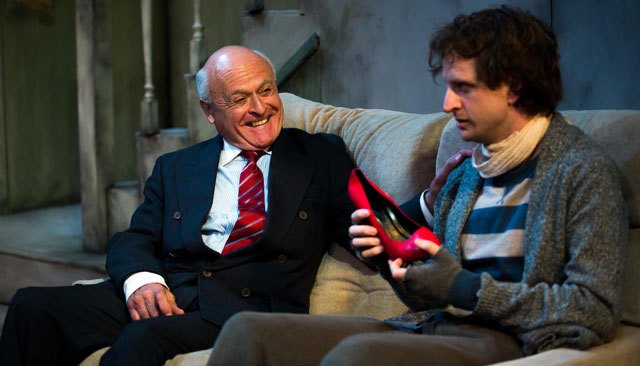
Andrew Mc Farlane plays Sidney, the once successful playwright, desperate to relive his glory days. But how far is he willing to go to make this happen?

It’s difficult to discuss this play without spoilers. Let me just say that the performances are wonderful and the production is engaging.

Photo by Helen White

                   Photo by Helen White

I called it an almost-parody. If it was a total parody, then I think spoilers would be no problem; we’d be there for the humour, not the plot. But Deathtrap has it a little both ways. It’s hilarious, but there’s also genuine intrigue.

I found this duality unappealing. But then I find the whole thriller genre rather manipulative. I feel, that for the sake of the thrill, thrillers devalue human life. And they portray human nature in a most disturbing manner. In ‘thriller world’, people seem to commit murders the way they change superannuation plans.

But, of course, Ira Levin is fully aware of these type of criticisms. He has great fun with them. And clearly the audience I was part of enjoyed the show immensely…. and, I suspect, went off into the night quietly glad that thrillers are fundamentally dishonest.

Veronica Kaye

*Apologies to Ira Levin if I have misquoted. In ‘thriller world’ that’s cause enough for murder.

Deathtrap by Ira Levin

Eternity Playhouse til 10 May

http://www.darlinghursttheatre.com/eternity-playhouse

Orphans

24 Apr

Recently, as I passed my local RSL, I noticed posters for I Still Haven’t Found What I’m Looking For, the U2 Tribute Show, and Holding Back the Years, the Simply Red Tribute Show.

When I was younger, these sort of performers were called ‘cover bands’. I’m too uncool to know whether this term is still in fashion. However, I am cool enough not to be especially interested in this type of performance. I have no doubt the musicians in question are superb. In fact, they could well be better than the artists they are imitating. But still, there’s something less than satisfying about the form.

Few people seem to share my quibbles about what I call ‘cover theatre’. Whenever I see a local company produce a foreign play, or a play we have all seen before, I’m a little bemused. It feels like borrowed authority. Part of me wishes we could……I don’t know…… just transcend it.

Orphans is, of course, ‘cover theatre’. It’s also wonderfully done.

Photo by Rupert Reid

                   Photo by Rupert Reid

By Lyle Kessler, the play is set in Philadelphia’s underworld. (Why are artists attracted to stories about criminals? To quote the musical Chicago, is it because neither group ‘got enough love in their childhood’?)

Orphans is funny and thought-provoking. Director Anthony Gooley elicits from his cast terrific performances, deliberate hyperbolic, close kin to cartoon. It’s delightfully physical (which has its dangers; on the night I attended a crucial reveal came too early because a hidden prop suddenly popped into view.)

Treat and Philip (played by Andrew Henry and Aaron Glenane) are two adult orphans desperately in need of a father figure. Treat needs to learn moderation. Philip needs to learn to be brave. And so Harold arrives (played by Danny Adcock.) Harold might be a gangster, but he offers ‘encouragement’.

It’s an engaging production, with some powerful set pieces. Harold, who is also an orphan, speaks of the time he and the other orphans escaped the home where they were cruelly treated. They roamed the city, and then returned to the orphanage only when their hunger got the better of them. But “they had seen what they had to see.”

A play about parenting is a play about authority. We need it. And we need to transcend it.

Veronica Kaye

Orphans by Lyle Kessler

Old Fitz til 9 May

http://www.oldfitztheatre.com/

Haircuts

16 Apr

Recently a friend suggested to me that there were too many positive reviews being written in Sydney. I found this a curious statement.

If it’s true, one can only ask ‘Why?’

Here’s some possible explanations:

Perhaps reviewers are just writing irresponsibly in order to secure free tickets. (To shows they don’t like?)

Perhaps reviewers just enjoy status. (I’m reluctant to despair of human nature so easily.)

Perhaps the standard of theatre in Sydney is, in fact, improving. (In comparison to what?)

Perhaps the current crop of reviewers and my friend simply don’t share the same aesthetic values.

Let me expand a little on this idea.

I go to the theatre because I enjoy the art form. What I enjoy most is its fundamental duality. It puts into conflict multiple voices, yet these multiple voices are orchestrated by the one artist, the writer. (Of course, I’m talking about script based work, and I don’t want to undervalue the collaborative nature of theatre.)

Haircuts 076

Take Haircuts, directed simply and beautifully by Lex Marinos and performed by a very skilled cast. Written by Con Nats, the show is built on a contrast between two different fathers (John Derum and Adam Hatzimanolis). Fascinating tensions arise. Old wisdom versus new business sense. Parents versus children. Words versus silence.

But these tensions, these multiple voices, build a cohesive universe, and in Nat’s universe, the essential aspect is that human relationships are fractious. The pain of this is intriguingly explored through humour. Broadly, this humour comes in two forms. It’s either gladiatorial, as characters trade insults. Or it’s based on gender or ethnic stereotypes, as characters try to come to terms with the ineffable mystery of the Other.  This vision of life – of a world of damaged human beings desperate to make connections – is what makes Nats an interesting and valuable voice on the Sydney theatre scene.

Veronica Kaye

Haircuts by Con Nats

The Greek Theatre til 26 April

http://www.trybooking.com/Booking/BookingEventSummary.aspx?eid=117988

http://conats.wix.com/haircuts

The Rocky Horror Show

15 Apr

With a production like this, if you write it up well, you get to see your words on the side of a bus.

The night is certainly a bit of fun; right down to the venue’s playfully ironic name. (The Lyric Theatre – where I heard about 30% of the words.)

I was in row U. In most other theatres I would have been in another theatre. (Row U is ‘Just a step to the left, and then 4000 steps to the ba-a-a-a-ack!’  Ok, I didn’t need to hear the lyrics. Many of us know them by heart.)

First produced in 1973, the question is ‘Does the show survive the test of time?’ (From where I was sitting, it struggled with the test of distance.)

Photo by Brian Geach

Photo by Brian Geach

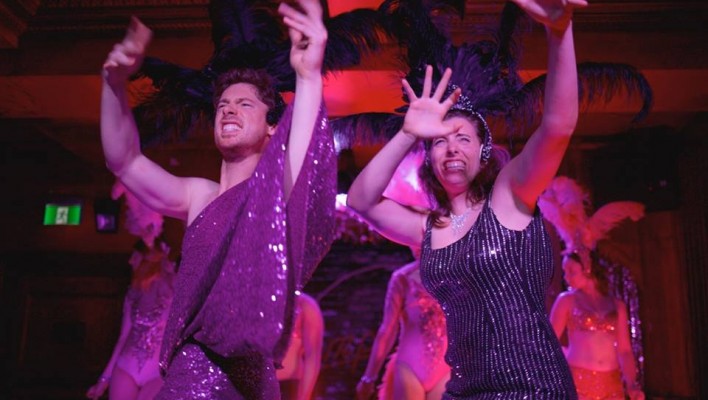
I suspect the element of The Rocky Horror Show that’s a tribute to B grade horror and sci-fi films is lost on contemporary audiences. The show has become a cultural icon for other reasons.  It’s a paean to sensual pleasure, in all its diverse forms. It’s an adult pantomime. (The audience particularly appreciated Craig McLachlan’s constant breaking of the fourth wall.)

The show is the sort of silly mayhem that is our culture’s punishment for having at various times endorsed Puritan prudery and Victorian propriety.  (And, perhaps, it’s a mischievous reminder that we’re being too tardy on marriage equality.)

The show didn’t float my boat. (A phrase which Frank N Furter might repeat back at me, raising his eyebrows and pushing the double entendre, unnecessarily.)

But as Frankie says, when Janet is unimpressed with Rocky, “Well, I didn’t make him for you!”

Judging by the audience’s response last night, there were plenty of people it was made for.

Veronica Kaye

The Rocky Horror Show by Richard O’Brien

Sydney Lyric Theatre til 7th June

www.rockyhorror.com.au

Seeing Unseen

12 Apr

Here’s a list of the top ten plays currently on in Sydney (for the comfort, convenience and edification of the understandably cautious consumer):

Number 1:

I’m not actually going to give any such list.*

That would be to exacerbate the very problem Seeing Unseen addresses so well.

We’re in danger of becoming a society obsessed and dominated by pop consumer sociology.  Statistics supposedly collected to serve us instead come to control us.

Seeing Unseen is a beautiful production. Devised by the company and directed wonderfully by Gareth Boylan, it’s simple, powerful and magnificently performed.

Kerri Glasscock and Michael Pigott play a couple whose every move is watched. Michael Cullen plays the unidentified monitor. He is omnipresent. He records. He gives advice.

Want to know the top ten places for takeaway in your neighbourhood? Want to know the most popular flavour of pie? Want to know the best place for coffee?

Seeing Unseen

Choices are recorded, tabulated and then declared. The effect is dire. What began as freedom, hardens to habit, and finally solidifies into destiny.

It’s a petrifying feedback system.

So, want to know the top ten ways of relaxing? Various drugs make the list, and the monitor is more than happy to administer them. An alternative is animal clips on YouTube. Bed time stories for adults.

The result of all this coddling is the loss of the very realm that best represents our adult autonomy – morality. Kerri Glasscock’s character asks ‘Is this racist?’ She doesn’t want to be racist. Perhaps a survey told her racism was wrong, but she no longer has the ability to recognize it.

Refreshingly, the major target of this satire seems to be us. Sure, there are forces and institutions that will attempt to control our life choices, but Seeing Unseen acknowledges that this is often only possible with our collaboration.

Seeing Unseen is funny, visually stunning and delightfully challenging.

Veronica Kaye

Seeing Unseen by Gareth Boylan, Michael Cullen, Kerri Glasscock and Michael Pigott

Old 505 Theatre til 26 April

http://venue505.com/theatre

*Though, if I had to list my top ten animal clips, one mentioned in this show would certainly make it – Honey Badgers of the Kalahari. I’ve seen what those determined little maniacs can do to a cobra. I’m not taking any chances.

Experiments in Text Two (2): The Seagull

27 Mar

The idea of experimentation in theatre has created in my non-theatrical friends much hilarity.

‘What are you experimenting on?’ they laugh. ‘The audience?’

Which is, of course, true of every piece of theatre.

Putting on a production is like firing up a particle accelerator.  You get a small number of very excited particles and send them hurtling at a larger, more inert mass. Then, after the collision, you know more about the universe.

A director friend of mine points out that he doesn’t put on theatre to garner praise or to make money (once again I hear my friends’ laughter.) He puts on theatre to learn about the world.  What audiences find interesting, repulsive, charming or dull teaches him about people.

This production is an experiment in ensemble work. The cast have worked together (and without a director) for some time, exploring the character dynamics in Chekhov’s play.

The result is a production that’s a joy to watch. The reactions of the actors alone are worth the admission price. These are fascinating performances. (Personally, I was especially taken by Jade Alex as Nina, Daniel Csutkai as Konstantin, and Alison Bennett as Irina – but in an ensemble piece such as this everyone builds on everyone else’s work and the sum is far more than the individual performances.)

Nina

Another way in which this production could be viewed as an experiment is its pop up nature. Here’s a late C19 Russian classic performed in contemporary Australia –without the traditional theatre space which so often facilitates the suspension of disbelief. Performed in the round in a shop front in the Rocks, there’s a stimulating disparity between the Chekhovian characters (and their costuming) and all that surrounds them.

The script, a translation by Peter Carson, is English, but not Australian. Could it be? This is another fascinating experimental aspect. Combined with the space and the staging, the language asks ‘Am I relevant?’ while simultaneously and boldly dismissing as irrelevant that very question.

I haven’t really talked much about the play, which is what I usually do.

Pascal suggested all human problems are the result of our inability to sit still in a room. A ridiculous claim, and probably a correct one.

Chekhov’s also has a ridiculous-but-right claim. It could be stated like this: All our difficulties derive from our desire to be special. In The Seagull, several characters want to be famous. Several characters are. Other characters love characters they shouldn’t. Pining over unrequited love is the archetypal example of that deeply painful and entirely understandable error; the desire to be the centre of attention.

Which is the perfect time for my byline

Veronica Kaye

Experiments in Text Two (2) The Seagull

produced by The Hot Blooded Theatre Co and Hurrah Hurrah

Shop 2.03   140 George St, The Rocks

til 28 March

http://www.trybooking.com/Booking/BookingEventSummary.aspx?eid=120490

Short and Sweet Wild Cards Week 7

6 Mar

As I’ve said before, winning is for losers.

I’m not a fan of contests. I don’t think comparison is a helpful way to approach art.*

When I was a child, my father would draw back the curtain in my room. He would greet the morning with the statement “What a great day for the race!” The first time he said it, imagining some important sporting contest, I asked “What race?”

He replied “The human race.”

I wonder whether any other race matters.

But you can go to Royal Randwick and ignore the results. You can focus on the frocks, drink the champagne, and enjoy the spectacle.  And have a good time. Which is what I did.

Ten very different ten minute pieces, each a different vision. You don’t need to agree with these visions, or how they’re presented. It’s just good to be shown, or reminded, they exist.

But it would be obtuse, bordering on perversion, to suggest I didn’t have favourites.

All Clear, written and performed by Omri Levy, Daniela Stein and Natasha Reuben, and directed by Samantha Bauer, was pacey with sharp, well executed movement.

Feather, written by Pamela Western, was the intriguing story of two women unhappy with their very different lives. Cleverly directed by Lisa Thatcher, and performed with humour and poignancy by Kate O’Keeffe and Amelia Cuninghame, the play was a thought-provoking exploration of how helping others doesn’t need to get quagmired in moralising.

Winter Retreat by Abigail Somma told the story of two lost souls at a meditation retreat. Directed by Anne Brito, the performances by Edric Hong and Nell Nakkan were both funny and moving.

Now, if some pieces speak to me and others do not, who is it exactly that needs to be judged?

Our friends have a moral duty to terrify us. Paradoxically, it reminds us we’re not alone.

Theatre serves the same purpose. Theatre is otherness. A window to other worlds.

So draw back the curtain, let in the light, and enjoy the view.

Veronica Kaye

* Unless you’re running the contest.

Short and Sweet

http://www.shortandsweet.org/festivals/shortsweet-theatre-sydney-2015

Vampire Lesbians of Sodom

1 Mar

Due to the title, the more discerning theatre-goer might suspect this is not a piece of naturalism.

What it is, is a superb piece of nonsense.

Written by Charles Busch and directed by Samantha Young, this tale of two vampires whose rivalry spans the ages is seriously well performed silliness.

lesbian-708x400

It can be easy for these sorts of shows to become sloppy. One wink at the audience too many and suddenly you’re sitting in the studio audience of The Footy Show.

But the performances from this entire cast are tight. This is top class nonsense. Hilarious, high energy and terrific fun.

Eliza Reilly and Nicholas Gell as the two tussling vampires excel (in what are easily the most truthful performances of Sapphic blood lust I’ve seen for millennia.)

This cast and creative team has built upon the outrageous script, adding even more jokes and some clever musical numbers. (Busch’s classic piece is like a well made sandpit; the gifted and youthful at heart will build in it something wonderful, while the strays will use it for other purposes.)

Being insufferably self important, I always write about what a piece makes me think about.

So what is Vampire Lesbians of Sodom about?

Is it just a welcome pause from Life’s earnestness?

Or is nonsense like this actually subversive?

A Mardi Gras show, Vampire Lesbians has the exuberance of the medieval carnival. And exuberance is in itself subversive; a reminder that dull complacency should not be allowed to reduce our mysterious, miraculous world.

Veronica Kaye

Vampire Lesbians of Sodom by Charles Busch

Produced by Brevity Theatre

Kings Cross Hotel til March 7

http://www.brevitytheatre.com.au/vampire-lesbians-of-sodom.html

Beyond Therapy

4 Feb

The title is ambiguous.

Are these crazy characters so far gone they’re beyond therapy?

Or is the play offering a vision of Life that is beyond the need for therapy?

The characters are certainly out there. And they’re absolutely brilliantly performed. From his cast, director Johann Walraven elicits comic performances that are vibrant, energetic, and fully committed to the madness. They’re a joy to watch.

Beyond Therapy

David Hooley and Rebecca Scott as the unlikely lovers are utterly engaging – likeable and deliciously kooky.

Nadia Townsend and Andrew Johnston as the therapists in need of therapy are magnificently ridiculous.

Jasper Whincop (as the jilted gay lover) and Tel Benjamin (as the attractive waiter) take characters that are carefully constructed clichés and play them to the hilt, enthusiastically and gloriously.

Back to that title. Beyond Therapy.

(Here’s a working definition of therapy: therapy is the acknowledgement of our need for support in our attempt to live a life that is both fully conscious and deliberate.)

Does the play present an attitude towards therapy? Is it suggesting therapy is something we should go beyond?

In other words, is the play a satire?

I’m not sure.

Playwright Christopher Durang doesn’t provide a ‘straight man’, someone who might serve as the centre of our responses. All his characters are hilariously over the top. And there’s a deliberately playful meta-theatricality, which reminds us that it’s not ‘Life’ that Durang’s holding a mirror to.

So I’m not sure if it is satire.

But it’s certainly an immensely enjoyable 80 minutes of theatre.

Veronica Kaye

Beyond Therapy by Christopher Durang

King Street Theatre til 14 Feb

http://www.kingstreettheatre.com.au/