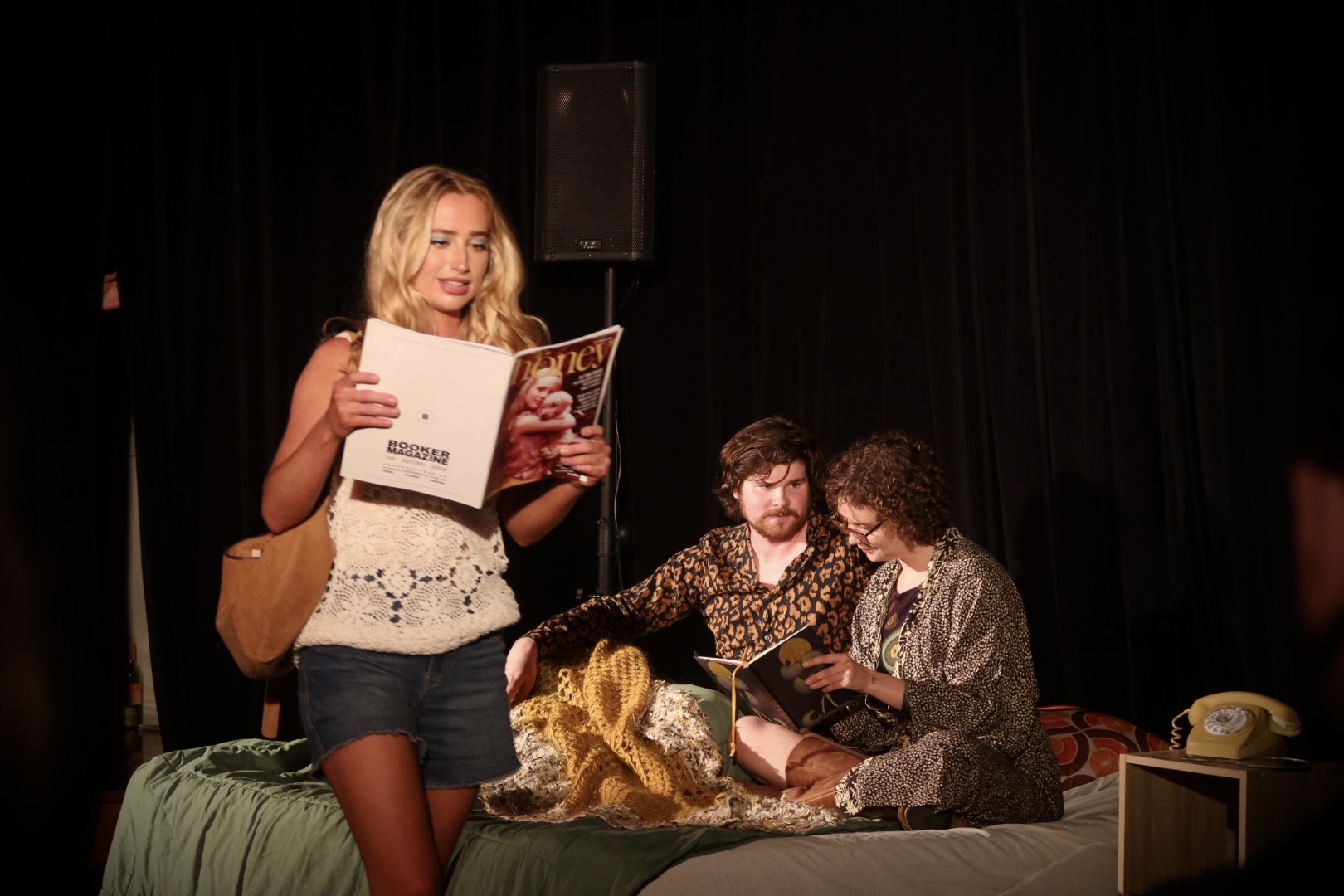
Written and directed by Mariika Mehigan, this is a delightful historical comedy.
It took me a while to clock that it actually was a historical piece – though the costumes, and the presence on stage of a landline, should’ve been a giveaway. (I guess it’s a symptom of my obtuseness – and of something far more important, which I’ll discuss later.)
Agony is set in the 1970’s, at the height of second wave feminism and the sexual revolution. And high school student Bronnie has just had sex for the first time.
It was less than satisfying.
She seeks advice from Tanya, the “agony aunt” for teen magazine Honey. Problem is Tanya’s having problems of her own in the bedroom.
This raises the thorny question: Who of us has sufficient authority to hand down advice? How easily the handing down of advice slips into the laying down of law. Tanya is unlikely to abuse her position, but she’s aware that a young woman genuinely asking for guidance may well receive instead only instruction in the conventional, heteronormative, patriarchal narrative (which is like asking for bread and being given stones.)
The script is funny and cleverly structured, evocatively juxtaposing the stories of two women seeking their authentic selves.
Mehigan’s characterisations are superb, surprisingly and stimulatingly subtle for a 50 minute comedy. And as director she draws from her cast captivating performances (though occasionally there could be a little more attention to vocal projection.)
Laetitia Opie as teenage Bronnie is excellent, having a wonderful stage presence, and displaying top class comic skills as she delivers her advice-seeking monologues. Her repeated refrain, that her boyfriend is a bit of a prick, beautifully recalls the deliberate ambiguity of the world of Puberty Blues, where self-assertion and tragic resignation combine to create both humour and pathos.
Sophie Newby plays both Dean (the above mentioned prick) and Kay, Bronnie’s best friend. Newby’s performance is admirably versatile. Dean is stupidly and suitably self-centred, and Kay (gay though never explicitly labelled as such) is an inspiring model of quiet confidence and independence.
Louie O’Carroll plays Tanya, the advice columnist, and gives an engaging presentation of that trickiest of positions: the dizzyingly, enervating dance of determination and doubt. She marvellously captures the poignancy of the play’s closing moment.
Callum Wilson as Tanya’s boyfriend, Sean, offers a terrifically amusing portrait of evolving masculinity. In response to the women’s libbers (who clearly terrify him) he’s too nice to adopt the chauvinistic cliché of the dismissive swagger. Ironically, his supposed sensitivity only further muddies Tanya’s journey to authenticity.
I began by suggesting that I didn’t immediately recognise Agony as a historical piece. That’s a testament to its contemporary relevance. The tension inherent in sexuality is that while it’s deeply personal, it can’t be entirely private. Individual desires can only be fulfilled in the social world (even if we try to reduce that world to the supposed secrecy of the bedroom.) The tensions navigated by the characters in Agony are still faced by young people today. And to be reminded of what happened in the 60s and 70s, when activists strove to bring into the open these tensions, and to have sexual diversity honestly acknowledged, is a glorious gift of hope.
Paul Gilchrist
Agony by Mariika Mehigan
at the Emerging Artist Sharehouse (Erskineville Town Hall)
as part of the Sydney Fringe, until 13 Sept
Image supplied.
 Theatre Red