Tag Archives: Belvoir

POV

3 Jun

This is an intriguing one.

It has layer upon layer, making it a very rich theatrical experience.

Let me try to explain the basic set-up.

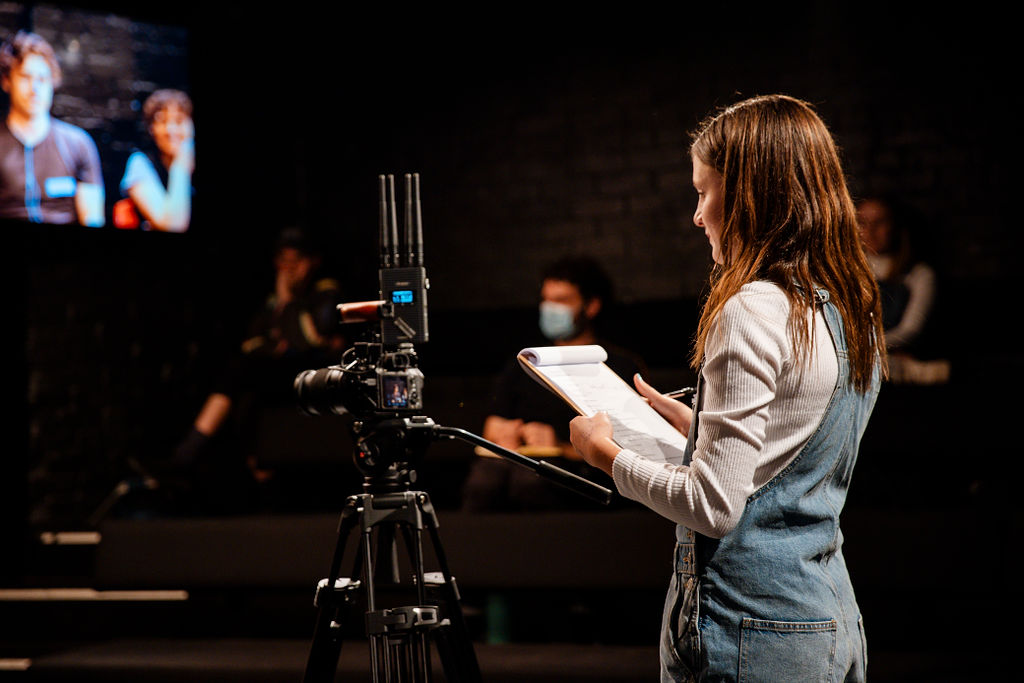
Each night of the production a different pair of actors play the mother and father of an 11 year old child. The child actor, either Edith Whitehead or Mabelle Rose, is prepared. The adult actors are not.

The child actor helps the adult actors through the performance, telling them where to stand, helping them understand their roles, ensuring they’re reading their lines from the right source (printed script or electronic screen.) The child’s director-like role is facilitated by the fact that the story being told is one in which the child, Bub, is making a documentary film about her parents. The complication is that mum is suffering a mental illness, and dad is uncertain how to help his daughter navigate this. (Bub writes to the legendary documentary film maker Werner Herzog for advice, and receives responses.)

What’s the impact of all this? I’ll break it into four points. (And I choose the noun consciously, points being sharp, and this piece written by Mark Rogers and directed by Solomon Thomas is whip smart.)

Firstly, and most obviously, the piece is a poignant reminder of what mental illness can do to its sufferers and to those they love. However, the emotional impact is tempered by the set-up; we’re never really encouraged to forget these are actors playing roles. And Bub’s additional role of ring master means any confusion or fear this child character might experience is diluted. But representational realism, a request to believe in the veracity of imagined characters and the world they inhabit, is clearly not the aim.

Secondly, the set-up highlights the wondrous skill of the actors. On the night I saw the show, Yael Stone and Benedict Hardie played the parents. To see gifted actors adapt to the tricky conditions and explore roles they knew nothing about only minutes before is a true delight, a testimony to the mastery of these performers. And 13 year old Edith Whitehead is utterly brilliant, confident and composed. Rogers’ script has much fun playing with stereotypes of the precocious child – and Whitehead lands each joke like a pilot with a life-time of experience. This second point, about the performances, develops the first: we’re being asked to pay attention to the art more than the reality it could represent.

And the third point makes sense of why we’re being asked to focus on the art. The improvisational form of the piece operates as a metaphor for how we actually deal with challenges like mental illness: we make it up as we go, trying to make the best of what is thrown at us. Despite endless media articles bearing absurd titles like “What not to say to someone who is depressed” or “How to talk to your child about bi-polar” there never will be a definitive correct response to Life’s wildness. (In the performance I saw, Stone twice ad-libbed lines. On one of those occasions, the piece invited her to do so, asking her to share how she might explain mental illness to a child. Her answer was beautiful – humble and wise. On the other occasion, she simply broke character and said “I didn’t think it would be this hard.” This stepping out of the art form and reflecting on the process was the most moving moment of the show. To find this to be the case is quite a provocation, and links with my final point.)  

Which is…. the filming of the documentary also operates as metaphor. A cynic might suggest that the whole film motif simply allows the theatre makers to play with technology. But creating a documentary (as the term suggests) is an attempt to document the Truth. And that’s what we so desperately try do when confronted with wildness – we try to control it, we try to make sense of it, we even try to find the mysterious alchemy that might transform our pain and bewilderment into beauty. With Herzog always hovering just out of sight, the piece can hint that making art is akin to dealing with Life’s bigger challenges. “Every man should pull a boat over a mountain once in his life,” says Herzog. And once again, this is an exciting provocation. The statement is normative. Should? Many of us don’t have much choice.

POV is an extraordinarily inventive piece, one sure to send audiences out into the night with minds burning with questions about the theatrical form, and with hearts relit with compassion for those who suffer.  

Paul Gilchrist

POV

Text by Mark Rogers

At Belvoir as part of 25a until June 16

belvoir.com.au

Nayika (A Dancing Girl)

6 May

In this one actor show, a Sydney-sider tells us of her youth in Chennai. Her Indian family are working abroad and, as a teenager, the protagonist is sent to the city to study dance. She learns to present the eight heroines, all of whom are lovers. (Can a whole artistic tradition fail the Bechdel test? The answer is obviously yes, though I claim no expertise regarding this one.)

A catch-up with an old school friend and a phone call with her mother bring back memories of her youth.

As teenager, a clandestine relationship with a boy turns from romance to fear as he increasingly exhibits controlling, violent behaviour. The adults are absent – even the ones she asks for help – and our protagonist has no idea what to do.

Co-created and co-directed by Nithya Nagarajan and Liv Satchell, this is a brilliantly crafted work. Its fluid movement from the present to the past highlights how an individual’s personal history can underpin their now. The motif of the dance lessons operates on multiple levels, creating a counterpoint to the passing of time, but also hinting at attempts to bring order to a universe slipping into chaos. The script’s many references to Hindu myth further this conceit: these seemingly timeless representations portray a world both grand and frighteningly wild. (The fact that the Hindu pantheon includes Kali, the goddess of death and destruction, is one of the reasons that religious tradition is a pinnacle of human culture. It’s tempting to try to bury misery, to pretend it can’t touch us, but it takes courage, of the transformative kind, to acknowledge with clear eyes the existence of violence.)  

Vaishnavi Suryaprakash performs this piece beautifully, moving between characters and time periods with a masterful ease. Musicians Bhairavi Raman and Marco Cher-Gibard provide a magnificent soundscape for both the dances and the emotional growth of the character.  

It’s difficult to discuss what this play does without breaking the spoiler rule (which is a tribute to its superbly tight construction.) But if the eight heroines fail to serve as models, and if the past is not forever to determine the present, a new vision must be found – and, here, gloriously, it is.

Paul Gilchrist

Nayika (A Dancing Girl) co-created by Nithya Nagarajan and Liv Satchell

at Belvoir until 19 May

belvoir.com.au

Image by Brett Boardman

Lose to Win

3 May

Mandela Mathia has an extraordinary stage presence – warm and generous spirited.

Lose to Win is his autobiographical sharing. It tells of being born in South Sudan in the midst of conflict, moving to Egypt in the hope of making real the dream of coming to Australia, and the final arrival in the so-called Promised Land.

The journey is difficult. When the average Australian has never gone hungry, it’s a soul expanding wake-up call to be told We went to funerals because there was food.

Director Jessica Arthur allows the tale to be told with suitable simplicity, an appreciation that truth needs no ornamentation.

Musician Yacou Mbaye supports Mathia, providing evocative rhythms that help transport a fortunate audience to distant lands.

Mathia tells us there were several forks in the road, moments where a poor decision could lead to moral collapse. This is an especially powerful assertion when it is apparent his tale is one of Little People being caught in Big History, ordinary people facing forces so overwhelming that individuals can seem robbed of all choice.

On several occasions, Mathia suggests the choice was between Anger and Love. (Perhaps this is THE CHOICE in Life.)

I’ve written a lot about the preponderance of sharings on our stages. I think it’s odd that we’ve come to think that theatre is about telling our stories in the autobiographical sense. One thing I haven’t mentioned previously is the challenge that autobiography creates for the theatre maker. Get it wrong and the audience response is Why am I hearing just about you? Get it right and the audience response is I want to hear more! This is not how it works with fiction. Awkward and potentially confusing analogy: make a beautiful vase and its joy is in its containment, its completeness. Its beauty doesn’t make you want the vase to be bigger. (Though it may make you want there to be more vases.)

Because Mathia’s story is wonderfully told we want to know more – but he has to stop somewhere! By the time the story gets to Australia, concrete details become fewer. Mathia talks about racism, but we hear more about the media and Peter Dutton than his own experience. It might be hard for the audience to hear, and hard for the performer, but …

But, I did refer earlier to THE CHOICE. Anger versus Love. What makes this show such a beautiful gift is that it forefronts this choice, and is gloriously clear which side must win.          

Paul Gilchrist

Lose to Win by Mandela Mathia

at Belvoir until 19 May

belvoir.com.au/productions/lose-to-win/

Image by Brett Boardman

Not Now, Not Ever: A Parliament of Women

19 Mar

This is the silliest thing I’ve seen for quite a while.

It purports to be a modern adaptation of Assemblywomen by Aristophanes, but the connection with the ancient text is tenuous.

Fans of the original will be disappointed (so I suspect there won’t be much disappointment.)

The original play would be distasteful to most modern audiences. In it, the women of Athens take over the assembly, certain that they can do a better job of running the city than the men. Aristophanes is satirising the male leadership of his time, suggesting even women could do better. (It’s akin to a sporting slur like Even my grandmother could bowl faster, which is difficult to interpret as being in praise of grandmothers.)

The original play was written two and a half thousand years ago but Margaret Thanos, creator of this adaptation, has clearly not made much use of the time.

Instead of a closely worked, razor sharp script, her goal has been to create a space in which high energy comic performance can thrive, and in this she has excelled, presenting a production that is gloriously exuberant.

Thanos and the cast of co-writers leave Aristophanes behind. Despite the title, there is no parliament of women. The story revolves around two of the ancient Greek gods vying to get their chosen candidate elected to the modern Australian Parliament; we never actually see that institution. The point is that we as a nation have trouble electing women. But the gods of Olympus don’t exist as characters in the ancient text, and their addition here is more about creating opportunities for crazy mayhem, rather than sharpening any satire.   

Satire is not really the goal. Yes, the protagonist Prax pretends to be a man in order to be considered seriously as a candidate. But the implied criticism of Australian society is weakened by the fact this strategy is urged, not by a member of the Australian public, not by a cynical member of one of our established parties, but by Athena, the ancient Greek goddess of wisdom, played by a male actor in a skirt. And oddly, the election appears to be about choice of prime minister, which is not a feature of our system. Similarly loose, one of Prax’s campaign policies is Equal Pay for Women, though at no time is it suggested how the legislature might achieve this, considering it was legally established in Australia in 1972. But then, another of the policies touted is Votes for Animals.

So, no, not really satire. But wonderful fun! Much of the humour is what snobs call undergraduate (a term which has always left me wondering about the nature of post-doc humour.) But there’s a shit pile of scatological jokes, simulated masturbation and sex, including one orgasm featuring the traditional whipped cream, and not one, but two examples of that much underrated mirth maker: bestiality.

Thanos has gathered a brilliant cast and guides them all to top class comic performances. Emma O’Sullivan as Prax is a delightful mix of bewilderment and determination. Matt Abotomey as the opposing candidate is enormous fun, portraying with consummate comic skill the man who knows, that in this male world, you only have to be that least inspiring of things: a good bloke. Richard Hilliar as Athena has an absolutely divine stage presence. Hannah Raven gives a superb parody of the stereotypical vamp. Clay Crighton as Hermes gives a beautiful portrait of sanity amidst madness, the axis around which this crazy world spins.

A female PM? Not now.

Not ever?

If a more just society can come about through sheer energy, then the answer to that question is soon.

Paul Gilchrist

Not Now, Not Ever: A Parliament of Women created and directed by Margaret Thanos

Downstairs Belvoir until 31 March

belvoir.com.au

Holding the Man

14 Mar

I saw this play in 2007, during its first run at Belvoir. I left the theatre deeply moved, but a friend was less so. After some grumbling, he admitted the cause of his dissatisfaction. The play had said only the obvious. His partner snapped that it wasn’t so “obvious” to a lot of people. This was before the Marriage Equality Act, and not long after homosexuality had been decriminalised.  (1997 in Tasmania.)

But my friend persisted, theatre should push the envelope. And, up to that moment, I probably would have agreed.

But the 2007 Belvoir production of Holding the Man changed me. It made me realise that we have to celebrate the values we think matter. Generosity of spirit. Openness. Kindness. Love. These are not obvious. No heaven underwrites them. Their promise lives only in our stories, their impact only in our actions.

This production by Eamon Flack is as beautiful and moving as that I saw in 2007.

It’s a love story. A true story. Tim and John meet in high school and fall in love. There’s acceptance of their love, there’s rejection, and hovering over it all – this is the 1980’s – the spectre of an enormous human tragedy. The threat of HIV/AIDS is still with us, but those who lived through its early years remember the horror of its blind, bewildering cruelty.

Danny Ball and Tom Conroy are utterly superb as the lovers, and the ensemble cast is brilliant.

The first act brims with humour. There’s a gleeful, glorious commitment to the comedy. We’re warmly invited to laugh, with both nostalgia and a more universal recognition, at the dagginess of life. The awkward enthusiasms of our teenager years. Our oh so suburban families. Our seriously naïve university activism. Even the drama school that will teach us truth by having us roll around the floor.

All this anchors the story in the everyday, and the pay off in the second act is of immense emotional impact. Playful theatricality makes way for a simple honesty that honours the human tragedy. The beautifully understated performances of the second act are grounded in the genuine.

No angry cry for justice, no burning resentment, gets in the way of Truth.

As Wilfred Owen would say, the pity is in the poetry, or in Murphy’s case, his complete command of the Australian vernacular.

I haven’t read Timothy Conigrave’s memoir, but Murphy’s adaptation is absolutely masterful, and Flack’s production is hilarious, heartbreaking, and so very vital.

Paul Gilchrist

Holding the Man by Tommy Murphy, from the book by Timothy Conigrave

at Belvoir until 14 April

belvoir.com.au

Image by Brett Boardman

Tiny Beautiful Things

6 Feb

This wonderful piece brims with wisdom. There are deeply moving exhortations to forgiveness, acceptance, love and personal empowerment. (I’m uncomfortable with the last member of that list; I’ll get back to it.)

Tiny Beautiful Things is an adaption by Nia Vardalos of a book by Cheryl Strayed. Strayed wrote an advice column, anonymously fielding questions from those who anonymously asked them.

The piece attempts no standard narrative. It simply consists of three actors (Stephen Geronimos, Nic Prior and Angela Nica Sullen) presenting the letters sent to the column and Strayed (Mandy McElhinney) giving her answers. She does this as she tidies her house late at night.

This tidying of the house is a beautiful touch; having problems and seeking solutions is not some sort of aberration – it’s the very stuff of everyday Life.  There’s no need to go to the mountain top for enlightenment. Tiny beautiful things are all around us. As the Zen koan says: Before enlightenment, chop wood and carry water. After enlightenment, chop wood and carry water.

Director Lee Lewis elicits magnificent performances from the cast. Playing multiple characters, Geronimos, Prior and Nica Sullen capture brilliantly the bewilderment of uncertainty, the agony of its opposite, and the delight of being heard. McElhinney plays Strayed with an absolutely charming combination of good sense and humour, vulnerability and strength.

As her pseudonym, Sugar, Strayed fields questions about friendship, marriage, sex, grief…. anything and everything, and answers them with heartwarming anecdotes and electrifying figurative language. She claims no expertise, except what she’s learnt from her own mistakes and from the love of her mother.

Here’s an abbreviated example of the sort of thing we get (but I emphasise, this one I made up myself):

Dear Sugar, I’ve been happily married to a wonderful man for ten years but now etc …. Signed Confused.

Dear Confused, It’s no wonder you’re confused. It’s easy for us to imagine that things will stay as they have been, especially when they’ve been so good. When I was first married etc… Signed Sugar.

This question/answer structure may not seem like the material of theatre, but I was utterly mesmerised for the entire 95 minutes.

And, of course, despite its oddness, its uniqueness, Tiny Beautiful Things does what all good theatre does. Theatre artists always present a vision of Life, and we as the audience are in the business of deciding if that vision can help us in some way. Perhaps the show is simply good fun, and so it reminds us we can let go of the worries of the day. Perhaps the show represents an aspect of our experience we feel has been previously unacknowledged, and so it reminds us we’re not alone. Perhaps the show models behaviour to which we aspire, and so we leave the theatre determined to be more kind or more courageous. Regardless of the vision of Life offered, we respond to it as a type of advice.

Let me come back to personal empowerment, that term I stumbled over initially. Strayed never uses the term. (Perhaps, like me, she feels it has an unpleasant odour, something suggestive of real estate agents beating their chests as they gee themselves up for the next big sale.) But both Strayed and the play explore something important here.

It’s worth noting that Tiny Beautiful Things never shows us whether the advice Strayed offers is any good. She’s clearly loved by her readers, but we don’t know if any individual who asks for advice ever acts on it, or if they do, whether it makes any positive impact on their lives. It’s we, the audience, who must judge if what Strayed says is of any value.

It’s a funny phenomenon, advice. In Australia, it’s unfashionable. These days, if we’re bothered at all, we’re more likely to tell someone exactly what they should do, rather than offer them a suggestion. But this show, this beautiful thing, reminds us that it’s always a suggestion, that it’s you as an individual who always has agency. It is you who chooses to ask for advice, you who chooses to see its value, you who chooses to act on it, or not. You. And that’s a good thing.    

Asking for advice is not a relinquishing of responsibility, and giving advice is not a form of coercion. The giving and taking of advice is an acceptance that all of us are neck deep in this mysterious muddle called Life.

This show is a gloriously humane reminder, that faced with Life’s challenges, no one has the answers, but we do have each other. And one thing we do for each other – in conversation, in theatre – is make real the magic of choice.  

Paul Gilchrist

Tiny Beautiful Things by Nia Vardalos (adapted from a book by Cheryl Strayed, co-conceived by Marshall Heyman, Thomas Kail and Nia Vardalos)

At Belvoir until 2 March

belvoir.com.au

Image by Brett Boardman

Tiddas

18 Jan

This play continues Belvoir’s magnificent commitment to indigenous theatre.

It’s an adaptation of Anita Heiss’ novel by the writer herself, directed by Nadine McDonald-Dowd and Roxanne McDonald.

Six women meet regularly as members of a book club and we witness their changing relationships as each faces their own individual problems.

This is, of course, not new territory. However, presented from an indigenous perspective, it’s fascinating.

Yes, there are several challenges involved in using this type of plot in theatre. One is that the positing of five (or is it six?) protagonists makes it difficult to give sufficient time to each individual story. Secondly, by setting many of the scenes in the actual club meetings – an exclusively female space – the main problem each woman appears to face is her relationship with other women. And to achieve dramatic tension, these women bicker and fight. In a tale which aims (I think) to ultimately valorise sisterhood, that tension is disconcerting.

But is it a truthful representation? I wouldn’t know.

And that raises the issue of theatre that purports to tell our stories. As an outsider, am I to take all this as reportage?

I suggested initially that the following of the standard tropes of a sisterhood story was made more intriguing by its indigenous perspective. How?

Firstly, all the books discussed by the club are written by indigenous writers (once again, I think). We’re spared lengthy discussions of texts we may not be familiar with, but it’s curious that what the characters often value about the chosen books is their focus on what might be called political issues. Valuing a novel for its content or theme is not what is usually done. A book about, say, native title might be well written or it might be poorly written. Consider the enormous range in quality of novels about, say, love. When an artwork is valued primarily for its content or theme it suggests either a lack of sophistication on the part of the reader, or a glorious relief that finally a deep silence is being broken. (It’s worth noting that the much esteemed Jane Austen wrote six novels about love – which is six more than she wrote about native title.)

Continuing to addressing the deep silences in our nation’s literature, the characters suggest that the great Australian novel would need to include indigenous characters and to have a “message.” The first of these requirement is obvious, but the second is highly debatable. Heiss’ Tiddas is playfully asking us to think about fiction (I’m deliberately avoiding the phrase our stories.)

In a gorgeously provocative twist, though the novels the club reads are often valued for their focus on indigenous political issues, most (though not all) of the issues Heiss’ characters face are more universal; sexual relations, procreation, and friendship. (I’ll point out a fascinating blurring of this: one character uses the word “sovereignty” to describe the experience of personal autonomy or individual independence. It will be interesting to see, over the next few years, the changing usage of this oddly legalistic word.)  

If I take Tiddas as reportage, I should also point out that a fundamental aspect of the characters’ experience is an intense awareness and assertion of distinctions: Blak as against white, Aboriginal as against Torres Strait Islander, Koori as against Murri, woman as against man. Definition by opposition can feel empowering. And the characters’ emphasis on nomenclature (which word or phrase is the correct or acceptable one) expresses both a desire to be accurately represented and a desire for power. Considering this nation’s appalling colonial history, both desires are utterly understandable. (That knowledge is readily aligned with power is highlighted in a scene in which the sole white character apologises for her terrible behaviour, saying “There is so much I need to learn.” Learn? Is ignorance really her fault? Though it seems counter-intuitive, to emphasise her moral culpability would be to further underline her power. Ascribing ignorance to her weakens her, particularly when what counts as knowledge is beyond her remit.)   

The cast – Louise Brehmer, Lara Croydon, Jade Lomas-Ronan, Roxanne McDonald, Anna McMahon, Perry Mooney and Sean Dow (playing all the male roles) – are very watchable, and warmly invite us to share their characters’ frustrations and joys.  

I’ll finish by describing a golden moment in the performance. It’s understated and unobtrusive. The spoiler rule prevents me giving much detail, but it’s a piece of stage business involving two glasses of alcohol and which of two characters is drinking what. It’s a delightful subversion of stereotypes, and a wonderful example of the dramatic form’s ability – through its juxtaposition of voice with voice, and words with actions – to remind us that the world will refuse to fit our theories (our stories?) and will constantly challenge us to growth.   

Paul Gilchrist

Tiddas by Anita Heiss

At upstairs Belvoir (as part of the Sydney Festival) until Jan 28

belvoir.com.au/productions/tiddas/  

Image by Stephen Wilson Barker

Darwin’s Reptilia

19 Nov

This is a playful puzzle of a piece.

Written by Charlie Falkner, it works a few standard tropes: begin with a death that draws together some unlikely characters, then add some sort of natural phenomena (flood, avalanche, snowstorm, or the like) that prevents these characters escaping each other. Here it’s Renata and Flicks’ mother who has died, and so the dissimilar sisters meet for the very first time. The imprisoning setting is Darwin, and more particularity the daggy Palms Motel, where the guests are trapped by marauding crocodiles.

Director Samantha Young elicits suitably wacky performances from the terrific comic cast. Ainslie McGlynn is wonderful as Renata, the self-obsessed American self-help author (self-help reductio ad absurdum.) Mathew Lee as John, her goofy devotee, delivers a beautiful study of naivete, awkwardness and fixation. Danny Ball as Declan, Renata’s partner, is a giggle-inducing self-important hypocrite. Running the motel is Flick, in Zoe Jensen’s delightful portrait of the parochial local. Aiding her is Leilani Lau’s Bobbi, a kindly kook who provides plenty of laughs with Lau’s perfect delivery of Falkner’s malapropisms.

I call the piece a puzzle because I had difficulty seeing the connection between the different strands. (Of course, being a writer of theatre criticism, I’m not the sharpest tool in the shed.) I’m not sure why Declan was Irish (though I am familiar with the stereotype informing the decision to make the other two interlopers American.) I also didn’t understand the meaning of the motif that Declan could smell blood (that is, to the degree usually attributed to sharks, rather than their distant cousins, the Irish.) Similarly, what actually had happened to the sisters’ mother began as a mystery and, for me, remained one to the end. I’m not sure why Bobbi kept a wild rat in a cage (though it might’ve been a substitute for her missing husband, who was a despicable love rat.) I don’t know why Flick suffered from something akin to narcolepsy.

Perhaps the last of these puzzles hints at the solution to the rest: faced with climate catastrophe (the sort that drives crocodiles out of their natural habitats and to the streets) these quirky characters are all asleep – and so the whole thing functions as a crazy, oddball satire on myopia.

Paul Gilchrist

Darwin’s Reptilia by Charlie Falkner

at Downstairs Belvoir (as part of 25A) until 26 November

belvoir.com.au

Image by Phil Erbacher

The Master and Margarita

17 Nov

I’ve tried to read the book. Twice. Admittedly, not in Russian. Maybe it reads better in Russian. Maybe I should learn.

Eamon Flack’s adaptation of Mikhail Bulgakov’s famous book is rollicking good fun and an extraordinarily invigorating night of theatre.

Satan has come to Stalin’s Russia. (A tautology?) There he meets Margarita, who is mourning her lover. She has nicknamed him “The Master” because of the beautiful novel he has written. But his beautiful novel has got him into serious trouble and now, for all she knows, he languishes in a cell, or worse. His novel is about Pontius Pilate. Why? I guess because Pilate was one of the men who persecuted an innocent, well-meaning philosopher. Very Stalin’s Russia.

Is the production faithful to Bulgakov’s original novel? It presents as being so. (Clearly, I wouldn’t know.) The book itself is usually there on stage (even though, in this minimalist design, often little else is, except a revolve.) Matilda Ridgway as the narrator supposedly reads from the book. With her warm, intelligent stage presence, I’d like Ridgway to read me the whole thing.

The impact of this creative choice is to emphasise the novel as something distinct from this performance, something truly valuable, a cultural treasure. (It is, of course, Bulgakov who is The Master in Flack’s version. )

The whole narrator thing on a stage with a revolve (did I mention this? I’m thinking of getting one installed at home) also facilitates a gleefully impish tone, and Flack has some astonishing stage tricks up his sleeve. (I was told by the publicist to say no more, and one thing I learnt from the play, and as much as the book as I got through, is that it’s very dangerous for a writer to challenge authority.) The cast fully embrace the crazy and it’s an absolute delight. Paula Arundell as Satan crackles with mischief. Gareth Davies as Azzazelo, with perfect comic timing, is perfectly creepy. Anna Samson as Margarita is splendidly and inspiringly audacious. Josh Price as the devil’s cat and heavy is glorious goofy fun.

An intriguing texture is achieved by interspersing the madcap zaniness with scenes from The Master’s novel. Brilliant in Bulgakov’s book, they’re absolutely brilliant here. Marco Chiappi as Pontius Pilate gives a poignant portrait of a man used to wielding authority but beginning to sense both its awful weight and its surprising vacuity. Mark Leonard Winter, who is The Master in the Russian scenes, is Yeshua (Jesus) here, and delivers a performance that is divine: a luminous portrayal of the simple, truthful soul, one of those iconic characters radiating through out Russian literature, and making it a moral lamp to humankind.

Another interspersion is all Flack’s: there’s a terrific parody of the Q & A that commonly accompanies theatre and too often only illustrates the triviality of our supposedly serious critical discussions compared to the work itself. Chiappi as the chair is pathetically and hilariously unable to comprehend the experience of so many artists under communist Russia, a world in which genuine commitment braved perpetual danger.  

Full disclosure: I didn’t understand the end. (Thank God for the spoiler rule, which means no one will ever, ever know.)

But one repeated line has had me thinking ever since: the greatest sin is cowardice.

It’s said to Pilate by Yeshua. Is it true? It may have been Pilate’s greatest sin, but as a maxim it’s difficult to universalise. Courage seems a secondary virtue, it’s value determined by what it’s applied to. A Nazi might be a coward, but most of us would think that the least of his sins, and one that might even be conducive to lessening the evil of which he is capable. Or is cowardice being defined in a grander way?

It’s a provocative invitation, and one fitting a piece of theatre which made me fall in love again with the art form.  

Paul Gilchrist

The Master and Margarita by Eamon Flack (adapted from the novel by Mikhail Bulgakov)

at Belvoir until 10 December

belvoir.com.au/

Image by Brett Boardman

Lady Day at Emerson’s Bar and Grill

18 Sep

Billie Holiday was one of the greatest jazz singers of all time, but she had a difficult life.

She faced racism and abusive partners. She had serious trouble with drugs and drink. She spent a year in gaol.

This production of Lanie Robertson’s play captures brilliantly both the genius and the pain.

The piece consists of a single gig at Emerson’s Bar and Grill. Holiday sings and, between songs, banters.  

Zahra Newman’s performance of Billie is absolutely outstanding. Supported by a seriously classy band (Kym Purling, Victor Rounds and Calvin Welch), Newman’s rendition of Holiday’s songs is pure gold. But it’s her performance of the banter that makes this extraordinary theatre. Robertson’s script is an astounding tight rope walk; what could be the drunken ramblings of a traumatised individual becomes a glorious invitation to empathy. Holiday has been hard done by, and despite the beautiful dream that suffering makes us saints, it rarely does. (The fact suffering does not automatically make you better is at least one of the reasons we call it suffering.) Billie is both flawed and worthy of our deepest respect; not because she was a star, but because she was a person. Newman’s portrayal of this Billie is superb, a true image of humanity, a window into the soul.

The only reservation I have about this production is Pepe. Pepe is a dog. Pepe is carried onstage. Pepe may have loved the experience, but it didn’t seem to me he did. I might be wrong; thanks to Newman’s performance, I can understand what it might have been to be Billie, but I really have no idea what it is to be Pepe. We definitely live in the age of call out culture, and if I see injustice, I am to name it. (This appears to be the criteria for modern sainthood.) But, here, I don’t have the necessary certainty; I can only record that Pepe’s presence made me feel uncomfortable.

Paul Gilchrist

Lady Day at Emerson’s Bar and Grill by Lanie Robertson

at Belvoir until Oct 15

belvoir.com.au

Image by Matt Byrne