Tag Archives: Carriageworks

Aphrodite

22 Jun

Ava, an academic, has written a book entitled The Aphrodite Complex. It’s been sufficiently successful that a documentary has been filmed about the subject. During the making of this documentary, Ava becomes aware that a particular member of the crew – Hector – appears to be fascinated by her.

After the shoot, waiting at Athens International Airport, she flirts with Hector. 

Will it go anywhere? 

When Ava mentions her desire to look a particular way, Hector responds But aren’t you about 50?

And so begins an absolutely beautiful exploration of beauty.

Alone, in her room, (it’s a two hander) Ava is visited by Aphrodite herself. (We’re told the goddess is the most beautiful of all because she was ranked us such by the man Paris.)

Aphrodite sings of being irresistible in a world that’s insatiable. She sings that externals are what matter. She promises power through beauty.

Under her spell, Ava responds I am my thick hair. I am my hairless body. I am my plump skin.

By now, of course, alarm bells are ringing for the audience. It’s a bold move to allow Ava, an academic, to be so reductionist in her thinking – but it’s indicative of the seductiveness of the worldview she’s being sold.

And with this evaluation by male standards ultimately questioned, it’s also a bold move to posit a man’s judgement as the catalyst of this doubt. It’s indicative of the ubiquity of the problem.

In some ways, the libretto by Laura Lethlean is a riff on feminist insights as found in such as Naomi Wolf’s The Beauty Myth. In other ways, it could be read as a reflection on ancient Greek sensibilities – the primacy of the body, the value of competition – compared with what I’ll call a Christian sensibility. (I’m thinking of the vision so miraculously shared by Dante, that the body and the soul are of equal value and only complete when together, and that Love is Charity rather than Eros.)

I’ve focussed on theme and concept, but direction by Alexander Berlage brings it all to glorious actuality.  The design by Isabel Hudson is outstanding, a lush domestic realism, ideal for the representation of both the luxury and commonality of sexuality. Under the video design of Morgan Moroney, the live feed marvellously evokes the concept of the gaze, of being always an object to be observed. It also facilitates our enjoyment of the extraordinary dramatic performances.

Both in voice and movement, Jessica O’Donoghue as Ava and Meechot Marrero as Aphrodite are utterly mesmerising. Their vocal performances are superbly nuanced to emotion: the exultation of sexual power, the languor of seduction, the agony of self-doubt.

Performed by Omega Ensemble and conducted by Jack Symonds, the music by Nico Muhly has a sense of melancholic sweetness (like Tennyson’s remembered kisses after death.) It ripples with the poignancy of distance; though a work about desire, we never see the lover.

After the revolution, lipstick will be lipstick. And that’ll be a good thing.

But, sometimes, I wonder.

Though this piece can be validly read as a strong and necessary feminist statement, it can also be viewed through another lens. Aphrodite takes on one of the great irresolvable tensions in the human condition (which is probably what makes great drama).

Everybody desires to be desired. At times, it’s as though we want to be an object. The active longs to be the passive, to be swept up in something beyond our small selves. Sexuality uses us, and we want to be used. It’s one way we find connection – with the community, or the Life Force, or whatever you want to call that which is bigger than us. It assures us a place in the chaos. Yes, there remains the deep wish to be appreciated as more than just a body, to be accepted as a full, complete, complex, independent, dynamic Other – but there, in the very heart of that wish, is the desire to be accepted. We want to be evaluated (even though we don’t.)

At only 60 minutes, Aphrodite is a wonderfully rich theatrical and musical experience.

Paul Gilchrist

Aphrodite music by Nico Muhly, libretto by Laura Lethlean

presented by Sydney Chamber Opera, Carriageworks in association with Omega Ensemble

at Carriageworks until June 28

carriageworks.com.au

Image by Daniel Boud

Hamlet Camp

17 Jan

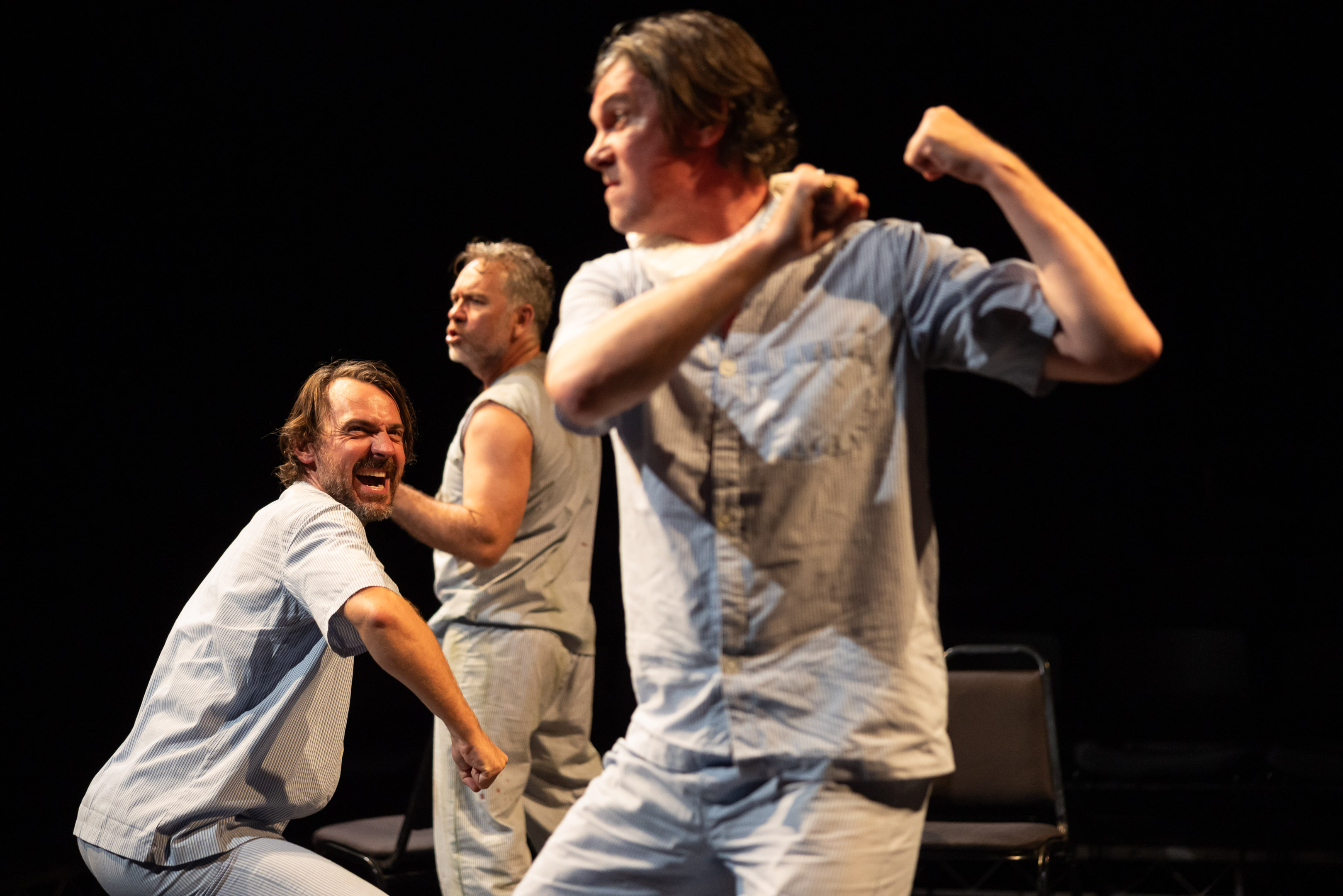
This is a fun night of theatre, one we’re privileged to share with three contemporary legends as they muse on the dramatic form.

It’s also a tantalising potpourri.

It begins with Toby Schmitz, Brendan Cowell and Ewen Leslie each performing a self-written monologue. Schmitz’s monologue is about an actor currently working in a second-hand book store in Newtown; still a purveyor of art, but in rather reduced circumstances: tale teller now retailer. Cowell’s monologue explores how the actor’s life of perpetual rootlessness impacts their relationship with material objects. Leslie’s presents the journey of an out-of-his-depth child TV actor to maturity as a lover of the craft. Each monologue is richly poetic and very funny.

Are they autobiographical? Sort of. I guess. I don’t know. Truth is certainly tempered by poetic licence and the hyperbolic needs of humour. I did take away the sense that the character being presented in each piece was a moderately successful actor. What a disparate, contradictory, explosive mix of words that is! It also operates as a suitable tonal introduction to the madcap comedy that follows.

That’s because – after Claudia Haines-Cappeau’s beautifully evocative dance as Ophelia – there comes the title piece, an extended skit in which three actors who’ve played Hamlet are now going through rehab. It’s written by Schmitz, Cowell and Leslie, three actors who’ve played Hamlet and are now…

If the monologues might be autobiographical, the skit certainly isn’t – at least not if read as realism. It is, however, a puckish peep into the weirdly overwhelming experience that playing the Dane apparently is. As suggested, the play’s the thing.

Or can rehab help them realise that it’s just a thing? One thing among many.

The skit is terrifically amusing, a wonderful opportunity for three great comic actors to strut their stuff. It sparkles with insights into what it is to be a performer. (There are plenty of in-jokes about particular past productions, and these are marvellously mischievous, but they don’t dominate.) Frustration is expressed at directors and their determination to own a play by imposing some bizarre idiosyncratic vision. As one recovering Hamlet says, I’d love a director to say ‘Let’s just do the play.’ Also grumbled about are reviewers. Cowell’s character is disturbed that one reviewer described his Hamlet as mercurial. This observation hints at the sensitivity of performers, but it also left me wondering if the greatest tragedy in theatre is not Hamlet, but that reviews are taken seriously.

Another provocative observation is that we romanticise Hamlet, which I took to mean we overvalue both the character and the performance of that character. One of the sessions at the rehab centre is entitled Offstage Women. It seems to refer to the play’s representation of women and how Hamlet himself mistreats them. It also refers, I think, to how male actors lost in the role mistreat the women in their own lives. I make no comment about the impact playing the famous protagonist might have on an actor’s personal relationships, but I find fascinating the suggestion that audiences are asked to admire Hamlet. Perhaps an actor needs to find that connection, but as an audience member I’m more than happy to dislike a protagonist or, more precisely, to hold such a personal response to a character in abeyance. (Perhaps, like the suspension of disbelief, it’s the key to a mature appreciation of fiction.) Take Macbeth and, to a lesser degree, Lear: the achievement of these tragedies is that we’re presented a monster yet, beneath all, we still see their humanity. (I admit this probably doesn’t accurately describe what’s happening in, say, Othello or Romeo & Juliet – so perhaps there are audience members out there who do actually like Hamlet as a person.)

That’s the joy of Hamlet Camp, it’s a deliciously playful invitation to thought.  

Paul Gilchrist

Hamlet Camp by Brendan Cowell, Ewen Leslie and Toby Schmitz

Presented by Carriageworks and Modern Convict

At Carriageworks until 25 Jan

carriageworks.com.au

Image by Daniel Boud

Gilgamesh

27 Sep

This is a world premiere, a collaboration between Sydney Chamber Opera, Opera Australia and Carriageworks, in association with Australian String Quartet and Ensemble Offspring.

Yes, that’s a lot of talent and expertise.

It’s an adaptation of an old tale, seriously old, possibly the oldest written tale we have. The original source was created in ancient Mesopotamia and was bubbling around in different forms from around 2100 BCE. It settled into The Epic of Gilgamesh around 1800 BCE and was rediscovered in the late nineteenth century. Since then it has increasingly become an inspiration for modern artists, including the novelist Saddam Hussein.

A more skilled adaptation is this one by Australian artists composer Jack Symonds and librettist Louis Garrick. (Though you can imagine my disappointment when I found the libretto was in English, not Ancient Sumerian. Ten Tuesday nights at a community college for nothing!)

One of the attractions of the tale is its sheer age. But why does age create an aura? Age doesn’t automatically guarantee value. (Left Field Example: Though no longer young, I still have my appendix – but that ancient organ is still here not because it’s valuable; it simply hasn’t tried to kill me yet.)

But Gilgamesh’s tale is so old it seems to come from the dawn of civilization. It feels like an origin story, and that genre is often used to explain inherent, irresolvable tensions.

In this particular tale, the tension is between civilization and nature.

Gilgamesh is king of Uruk, but he has become a tyrant (a danger inherent to all civilization.) To weaken him, the gods create Enkidu, a wild man, a natural man. However, before Enkidu confronts Gilgamesh, he’s prepared for life in the community – by a temple priestess. (So much for our idea that sex is so rock’n’roll; it’s actually one of the great glues of human society. Nature? Or civilization?)

Gilgamesh and Enkidu fight, and are revealed as equals. They become close friends and lovers. United, they challenge the monster who guards the Forest of Cedar, a natural resource that Gilgamesh has long coveted. (Once again, civilization versus nature.)

Not actually being fluent in Ancient Sumerian (the community college brochure promising more than the course actually delivered) I’m not sure whether this nature versus civilization motif is a layering of modern concerns on an ancient tale. I’m not sure it matters.

Whatever the case, the environmental strand disappears for a while as the tale explores the relationship between Gilgamesh and Enkidu, using it as a lens to consider fundamentals of the human condition, such as longing and mortality. Perhaps the environmental strand of the story doesn’t so much disappear as deepen, as human ambition and desire for dominance are questioned at an existential level.  

Symonds’ score is superb, sufficiently traditional to evoke the past (or at least the relatively recent past in which opera was created and the ancient world was rediscovered) and sufficiently contemporary to give the tale a vibrant immediacy. Its performance is thrilling, emotive and utterly engaging.

Director Kip Williams elicits from the cast brilliant physical performances. Mitchell Riley as Enkidu, his wildness slowly tamed but never completely erased, and Jeremy Kleeman as Gilgamesh, his arrogant regal bearing tested by the gods, are both outstanding.

Williams’ use of space is a delight. With costumer designer David Fleischer, set designer Elizabeth Gadsby and lighting designer Amelia Lever-Davidson, he creates a stunning visual world. In the vast stage of Bay 17, symbols of nature gradually mix with those of civilized decadence, and the final scene that completes this portrait of perpetual tension is theatrical magic.  

Paul Gilchrist

Gilgamesh by Jack Symonds and Louis Garrick

At Carriageworks until 5 Oct

carriageworks.com.au

Image by Daniel Boud

Counting and Cracking

3 Jul

This is theatrically exciting and dramatically thrilling.

Written by S. Shakthidharan with Eamon Flack, and directed by Eamon Flack with S. Shakthidharan, it spans two continents and several generations. It’s grand storytelling at its best.

In the early 2000’s in Sydney, Siddhartha lives with his mother, Radha. (Siddhartha is played by Shiv Palekar with delicious charm. Nadie Kammallaweera as Radha is the backbone of the production, and she’s suitably spiky and magnificently strong.) Siddhartha was born here, but his mother fled Sri Lanka during its time of civil conflict. The play jumps between the past in Sri Lanka and the turn of the century both there and here.

Three ideas explored in this production make it extraordinarily vital.

The first of these ideas is encapsulated in a line delivered by Radha’s grandmother (played with engaging verve by Sukania Venugopal). She repeatedly asserts “Weddings are more important than politics!” We’re now so accustomed to the mantra that the personal is the political that we blur the difference between the two spheres of life, potentially to the detriment of both. Here’s a working definition: the political is what can only be done with others, and the personal is what can only be done alone (or, at least, in the intimacy of what we call personal relations.) A full life requires acknowledgement of the separate existence of both of these spheres. If you don’t, you run the risk of living a personal life that’s selfish and parochial or a political life that’s shallow and inhumane.

The second idea that makes the production so timely is this: Don’t court division. Apah (played superbly by Prakash Belawadi) is the only Tamil in a Sinhalese dominated cabinet. He believes in unity and equality, and he distrusts tribalism. When escalating violence challenges his convictions, his granddaughter, the young Radha (played wonderfully by Radhika Mudaliyar), urges him to keep his nerve – and it’s an electrifying scene. “There’ll never be another Gandhi ji!” he cries, and it’s the intensity that the dramatic form facilitates that turns this despairing lament into a direct challenge to us. Currently, our culture is tempted to conflate assertions of difference with the attainment of justice. It’s also being seduced into valorising anger and justifying violence. There are several reasons for these disturbing trends, but a key one is the sheer historical ignorance born of privilege. This production gives a frightening glimpse into the hell of civic disorder – and is a powerful cautionary tale. 

The third idea is implied in the play’s title, and gains clarification in the scene I’ve just referred to. What exactly does the political sphere consist of? Is it always either the counting of heads that is voting OR the cracking of skulls that is physical coercion? Does the political reduce solely to the various manifestations of brute power? Or are there other things at work? Perhaps too late, young Radha urges those fearful of the imminent violence to seek refuge with the people they can trust. A just and peaceful civic society is dependent on the building of relationships.

I began by suggesting the production was theatrically exciting. This is thanks to Belvoir’s trade mark rough magic house-style. Actors become a clothes line. A beach is represented in the most delightfully nostalgic way. Scene changes are fast, fluid and gloriously energetic. Perhaps a quarter of the text is in languages other than English and this is translated “live”, with a gleeful awareness of translation’s tricksy nature. All this adds up to a production that constantly reminds us that it is telling a story – this story.  Not too long ago, this particular story was unlikely to appear on our main stages, and we’re being cordially invited to celebrate that change.

I also suggested the play is dramatically thrilling. It makes the most of the multi-voiced nature of the artform. I don’t mean there’s explicit tension between characters (that’s just the bread and butter of drama). What I mean is that there’s also grand unspoken tensions, the ones that explain why Life’s big problems are so notoriously difficult to solve.

Take this as an example: In the Sri Lanka of last century, we’re presented characters who warn of the dangers of tribalism. Meanwhile, in 21st century Australia, Siddhartha and his girlfriend Lily (played with an enchanting stage presence by Abbie-lee Lewis) are embracing their tribal identity. We assume it’s the right thing for these generous-hearted young people to do. But when does the positive form of tribalism start to become the other, more hazardous, form? The play doesn’t explicitly offer an answer; it doesn’t even explicitly acknowledge the possible danger. It simply places the two forms side by side with beautiful honesty.

Paul Gilchrist

Counting and Cracking by S. Shakthidharan with Eamon Flack

a Belvoir production at Carriageworks until 21 July

belvoir.com.au

Image by Pia Johnson