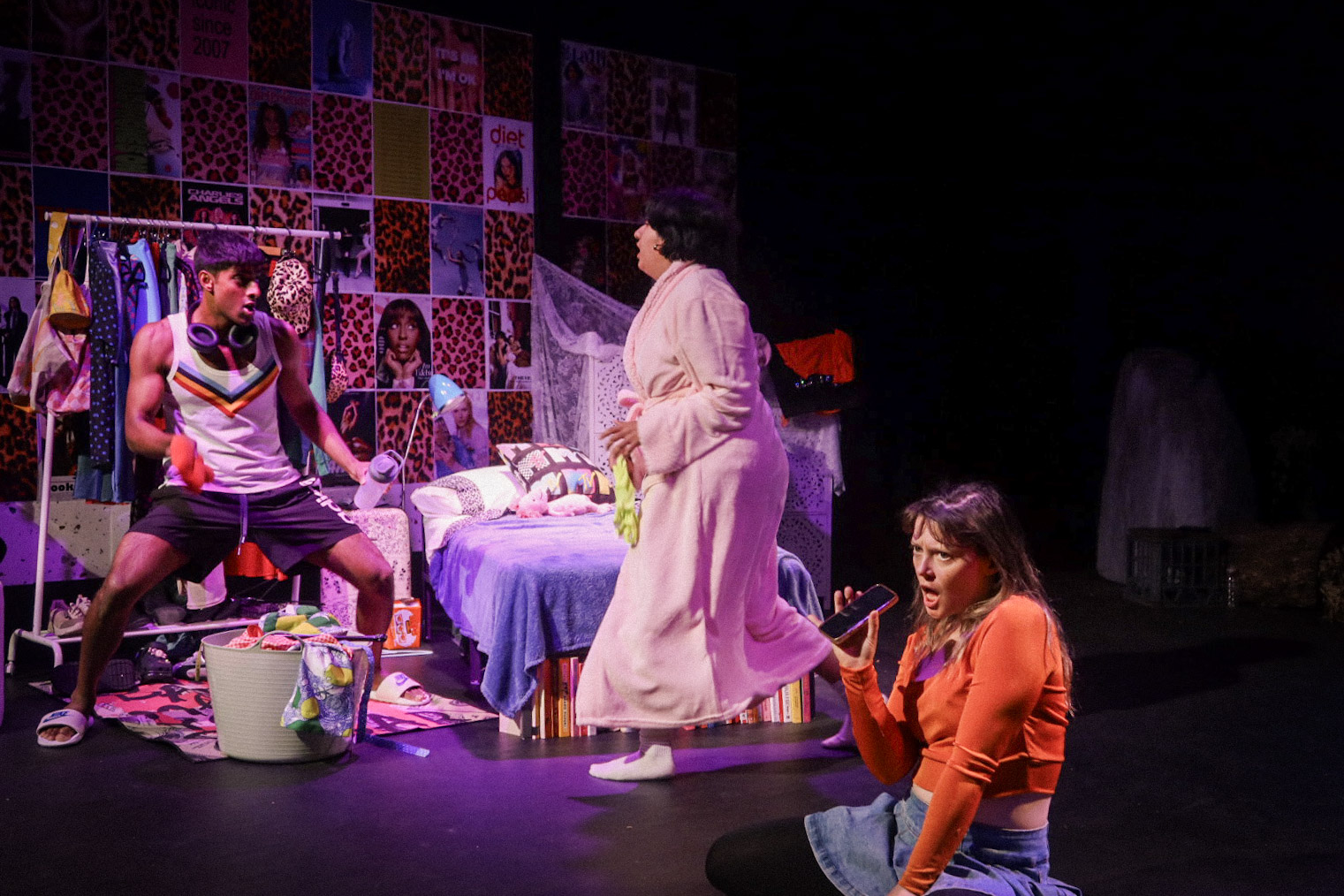
This is a fine comedy.
It’s written by Eloise Aiken, this year’s winner of the Katie Lees Fellowship.
The Fellowship is designed to support young female/female identifying theatre makers, and here it has once again shown itself to be a vital contribution to the Sydney theatre scene.
Crotchless is about how contemporary teenagers and their parents navigate the cultural reactions to feminism.
Aiken has a great ear for comic dialogue; the script is funny and truthful and shit. (And, in case it’s not obvious, the last of those three adjectives is meant as an admiring imitation of Aiken’s uncanny ability to portray the language use of the young, rather than some vocab-deficient, mean-spirited evaluation of the play.)
Teenage Shona has dating issues, but it’s her twin brother Owen’s dive into the rabbit hole of misogyny that especially troubles her. Trish, the twins’ single mum, acknowledges Shona’s concerns but is less certain how to prevent her son’s disturbing moral diminishment.
The piece is driven by some fascinating tensions.
One tension is that between the broader culture and personal agency. Owen is admonished for listening to misogynistic podcasts and told to read feminist texts. Of course, what we put into our heads is important, but we’ve come to view ourselves almost as if we were passive computers: just load the correct software and we’ll run appropriately. It’s an understandable but disconcerting assumption – because it seems to erase the possibility of both critical thinking and moral discernment. (But, we do live in a culture that has rather suddenly become aware of the concept of Culture, and everyone who’s seen Terminator 2 knows the frightening consequences of suddenly becoming self-aware. Skynet isn’t alone in its over-reaction to the unexpected advent of choice.)
Closely related to the tension between instruction and intellectual agency is that between confrontation and love. Should we simply condemn those who disagree with us? Or, as Trish suggests, will that just drive them further away? Is a strict insistence on moral conformity merely counter-productive? Must individuals learn for themselves?
That Crotchless posits both sides of these tensions suggests its maturity of vision, its beautifully honest awareness of the complexities of Life. If it ultimately comes down a little too heavily on one side of all this, the feel-good-tell-it-how-it-is-for-victory-and-empowerment side, that’s completely understandable. After all, it is a comedy. (And, anyway, is the conclusion of a play actually the sum of its meaning and value? Especially when it’s a comedy. Perhaps the comic happy ending is just one more dramatic convention, as meaningful, say, as the fourth wall.)
Madeleine Withington’s direction is splendid; the pace and bounce is spot on.
Performances are comic excellence.
Esha Jessy is thoroughly engaging as Shona, the quick-witted teenage girl caught between vigorous assertions of female worth and a risky desire for the rather unworthy male Other.
As Owen, Ashan Kumar brilliantly captures the inarticulate energy of the teenage boy, the hilariously non-threatening high-modality, informed with just the right hint of danger: a cute, clumsy oversized wolf cub trying out his fangs.
Sarah Greenwood is utterly superb. Her performance dances with the lightness of comedy, yet her portrayal of Trish truthfully represents the challenges of maternal love, in all its poignant mix of strength and vulnerability. Greenwood also doubles as Shona’s best friend, Malory, and delivers a playful-almost-parody that is a delight in itself, but also serves to highlight the glorious complexity of her portrait of the more mature of the women.
Paul Gilchrist
Crotchless by Eloise Aiken
At Flight Path Theatre until Nov 8
Image by Alex Macleay
 Theatre Red