Tag Archives: Flight Path Theatre

Teenage Dick

22 Jul

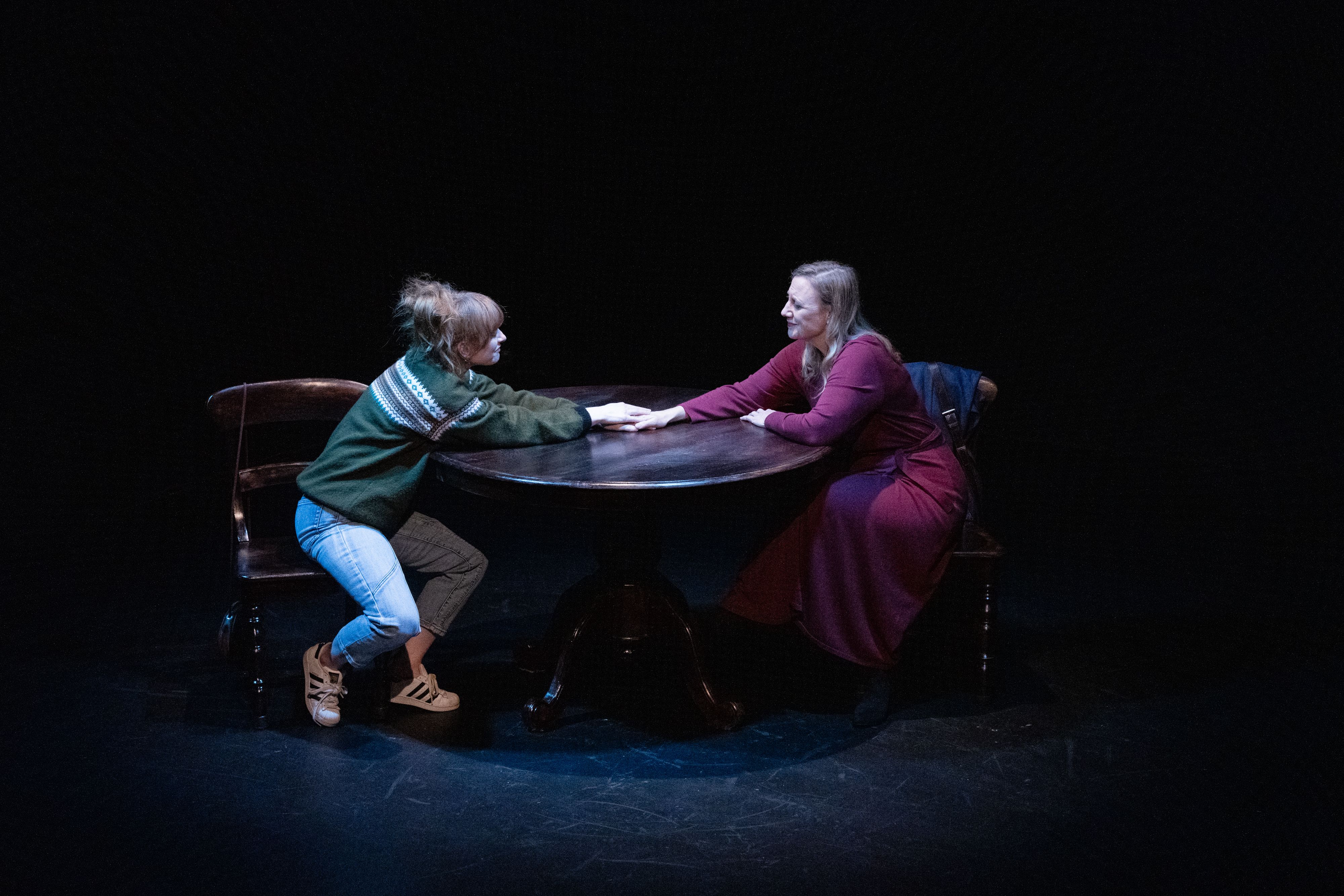
Teenage Dick by Mike Lew is a brilliant play and director Dan Graham’s production is superb.

Lew takes elements of Shakespeare’s treatment of Richard III and places the action in a modern American high school.

Like Shakespeare’s Richard, Lew’s protagonist has a disability that pushes him to the periphery. Both characters respond by focusing on the pursuit of power. Shakespeare was clearly exploiting the Elizabethan fascination with the Machiavellian villain, and Lew’s play makes that explicit: the students are asked to discuss The Prince. Is it better to be feared than loved?

Dean Nash as Richard is absolutely magnificent, a mesmerising stage presence. (I suspect Richard Burbage, the original Richard in Shakespeare’s company, would be thrilled by what Nash does.) Graham provides Nash with a wonderful supporting cast. Chloe Ho as Anne Margaret offers a deeply moving portrait of vulnerability. Rocco Forrester is terrific as the self-obsessed school jock, Eddie. Holly-Jane Cohle’s Buck is gloriously no-nonsense wit.  Amy Victoria Brooks, in a performance both hilarious and disturbing, nails the hapless teacher, Miss York.

The character names evoke Shakespeare’s play and, if you’re familiar with the Elizabethan text, the conversation between this play and the earlier one is intriguing. But no knowledge of Shakespeare is required.

This is an extraordinarily timely play. We live in an era in which some of us so passionately strive to right previously unacknowledged injustices that we valorise rage and grant ourselves moral holidays. Richard desperately wants power because he’s so denied it, but are the means he chooses defensible? Are they even effective? This play does what theatre is made to do: honestly present the fracture lines in our vision of Life.

Shakespeare called his play a tragedy. Lew’s extraordinarily powerful final scene leaves us asking if his is too.

Paul Gilchrist

Teenage Dick by Mike Lew

Presented by Flight Path Theatre & Divergent Theatre Collective

At Flight Path until 5 August

flightpaththeatre.org

Image by Andrea Magpulong

Ladybird Ladybird

3 Jul

Though fiction, this is theatre that bears witness. (Of course, all theatre does – in a way – but it’s not all that it does.)

But bearing witness is certainly a focus of contemporary theatre making. We’re keen to present what we believe are under-represented voices.  

Ladybird Ladybird by Linda Nicholls-Gidley bears witness to the often unacknowledged suffering of many women, both before they give birth and after. In powerful images and in script built from deeply affecting monologues and insightfully sharp dialogue, we’re presented pain both physical and mental.

Director Anthony Skuse and designer Henriette Gabreal give the characters a simple, stark, stepped stage. There’s nowhere to hide; there’s only climbing to do – an almost Sisyphean image of pain unending.

Supported by a very capable cast (Leilani Loau, Danielle Stamolous and Silvana Lorenzo de Shute), Nicholls-Gidley’s performance as the protagonist, Veronica, is brilliant. Her control of both the language and physicality is outstanding. Veronica’s suffering elicits tears and offers no consolation.

Absent from the stage is Veronica’s husband. This absence highlights his personal culpability, but also functions as a potent symbol of the patriarchy’s deliberate obtuseness regarding the challenges of motherhood.  

But another provocative consequence of Nicholls-Gidley’s decision to people her story with solely female characters is to challenge any superficial faith in the sisterhood. Veronica’s mother and supposed friends oscillate between making narrow unsympathetic judgements and offering glib unwanted advice. It’s the brutality of this portrait that gives the piece a soul-stretching veracity, that asks us – all of us – to listen more closely, more openly, to the people in our lives.

And theatre that does that, has done a wonderful thing.

Paul Gilchrist

Ladybird Ladybird by Linda Nicholls-Gidley

Produced by Vox Theatre

at Flight Path Theatre until 15 July

flightpaththeatre.org

Image by Becky Matthews 

Rabbits on a Red Planet

18 Jun

Rabbits on a Red Planet (book by Andy Leonard and Irving Gregory, score by Ryley Gillen) is a sci-fi satirical musical. It’s wonderful to see a new Australian musical on stage. Congratulations to the producing company and Flight Path Theatre.

Following environmental degradation (and possibly other hijinks), giant mutant rabbits are wreaking havoc across the planet. In response, and in the hope of big profits, tech billionaire Rob Muskas (Leonard) funds the alteration of the Martian environment to enable human habitation. Light and fun, the piece satirises a range of intertwined contemporary issues: the appalling impact of colonialism; the bull-headedness of both conspiracy theorists and those who deny crises; the lack of empathy for those seeking safety; environmental irresponsibility; and the self-seeking nature of capitalist ambition. In all this, there are some good laughs and valid points.

Gillen’s score is entertaining, and “King of Mars” (performed by the ensemble with Leonard as lead) is particularly catchy. Isabella Kohout and Jenna Wooley have exceptionally beautiful voices.

Having so many elements, musicals are an especially ambitious form of theatre, and in this production the lyrics and the dialogue – both content and delivery – could do with some sharpening.

But theatre is not space flight; when you get it wrong, no-one dies.

We just don’t get to visit new worlds.

(So, I guess, theatre is like space flight.)

Paul Gilchrist

Rabbits on a Red Planet (book by Andy Leonard and Irving Gregory, and score by Ryley Gillen)

at Flight Path Theatre until 24 June

www.flightpaththeatre.org

Image by Anthony Stone

In This Light

15 Nov

This is big, bold storytelling.

Spanning generations and continents, Noel Hodda’s In This Light is a grand tale of longing and reconciliation. It’s a wonderful addition to that most glorious of theatre traditions – the honest acknowledgement of the pains of life, paired with the promise that beauty is still possible.


Occasionally there are challenges in the stage logistics demanded by such a substantial story, but Des James has put together a brilliant cast. Still raw from the agonising death of an elderly parent, Sandra and Chris must confront again questions of what makes a worthwhile life – and Sophie Gregg and David Adlam play the siblings with a grippingly truthful mixture of warmth and desperation. Tom Cossettini is Peter, an Australian abroad, where he meets French woman, Camille, played by Omray Kupeli. The portrayal of these young lovers is utterly charming. (And it’s always a delight to hear a language other than English on stage.) David Woodland plays an artist living in rural Australia in isolation– until he gets an expected visitor. Woodland presents an absorbing fusion of frustration and acceptance, a sparkling miniature of the play’s vision of the human condition. Similarly, Kate Bookalil plays a woman whose past won’t let go, and her portrayal of a soul that has felt the cold touch of steel is inspiring.    

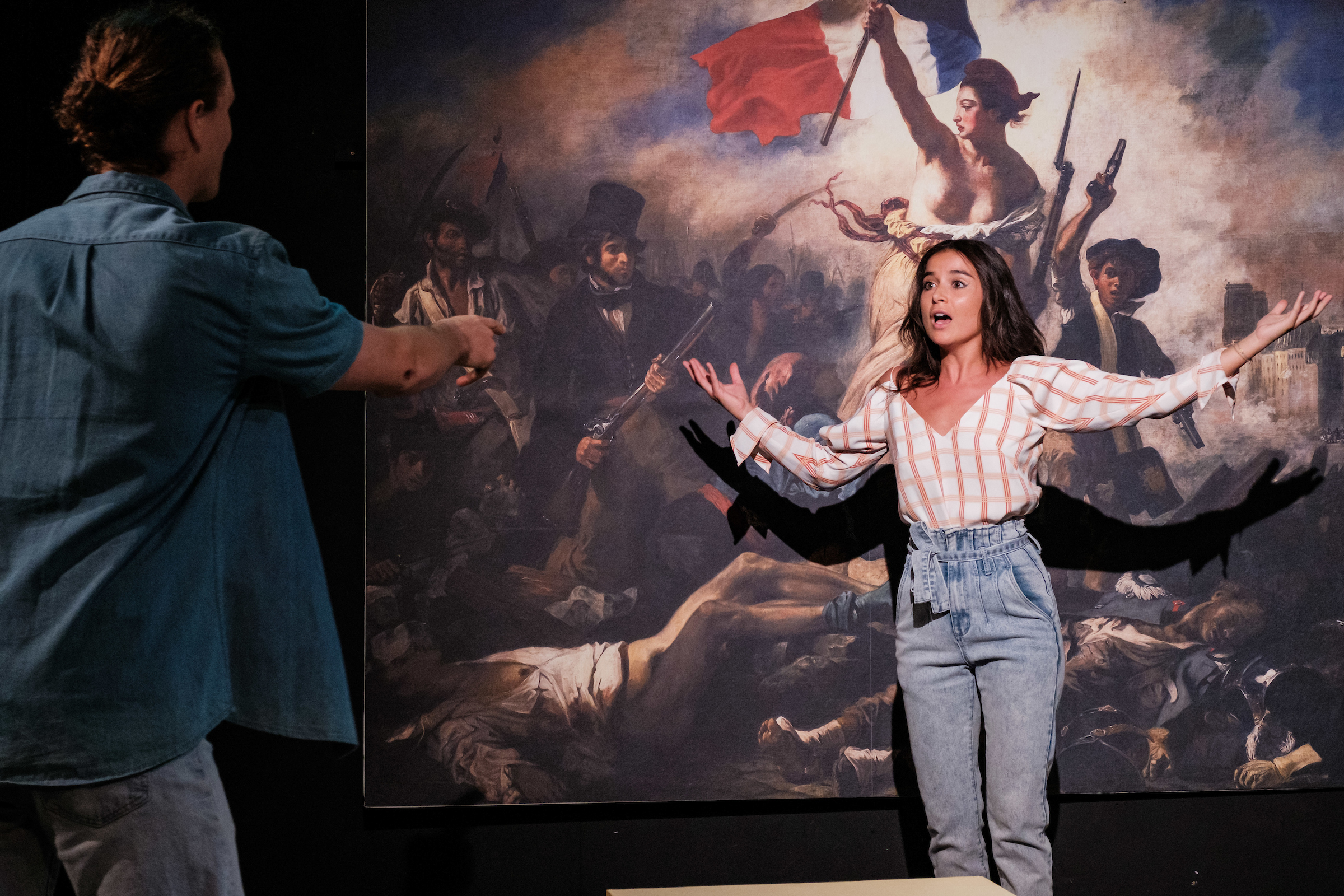
Standing before Van Gough’s Wheatfield with Crows, one character asks “What do the crows mean?” My answer? Texture; a profound awareness of the competing currents within Life – for that’s the deeply honest and compassionate vision this play offers.

Paul Gilchrist

In This Light by Noel Hodda

Flight Path Theatre until Nov 19

www.flightpaththeatre.org  

Image by Robert Catto

Chain Play

23 Sep

A chain play is created by a team of writers. Each writer drafts one scene, having read only the scene that directly precedes hers. Obviously, no-one expects the resultant script to be a paragon of textual integrity. Chain plays are a type of theatre game; and therein lies the key word – game.

This Chain Play by Slanted Theatre is a riotous celebration of Asian-Australian theatrical talent. The writing is sharp and funny, and the performances are mischievously exuberant.

Chain Play actually consists of two distinct works, each written according to the chain play methodology.

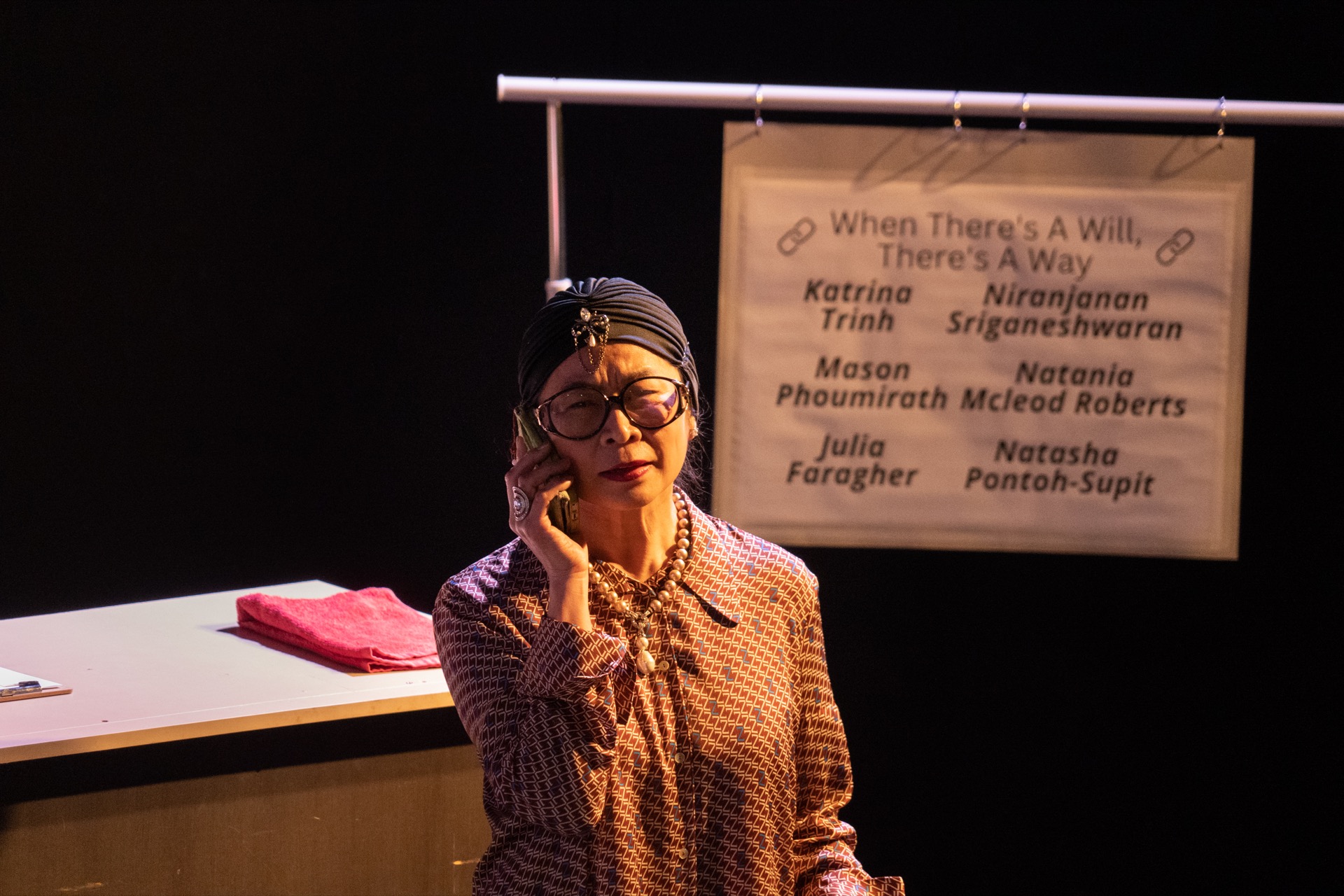
Where There’s a Will There’s a Way is written by Katrina Trinh, Mason Phoumirath, Julia Faragher, Niranjan Sriganeshwaran, Natasha Pontoh-Supit and Natania McLeod Roberts, and is directed by Katie Ord. It lands in the genre of sit-com, with plenty of great one liners and characters that are the Asian-Australian cousins of those in Commedia.

Susan Ling Young in Where There’s a Will There’s a Way

How Asian are You? written by Matt Bostock, Alan Fang, Grace Hu, Christina Kim, Eezu Tan and Simone Wang, and directed by Sammy Jing, is more conceptual.  Each scene digs into assumptions about Asian-Australian identity, and does so in ways that are both hilarious and poignant. (I’d like to see this type of digging continue in the Sydney theatre scene, digging deeper and deeper to see what we might find ……hopefully gold, and not just some gaping big hole.)

And, to conclude, a possibly utterly irrelevant philosophical digression: every play ever written is part of a chain play. We write informed by what is directly before us, sometimes only vaguely conscious of where we fit into the larger arc of history. And what we write then goes on to inform our near contemporaries, contributing to the intellectual and emotional environment to which they respond. Every playwright suffers from an inevitable myopia. Perhaps that’s no great tragedy; after all, if you can see too much further ahead than your audience, you’re not a prophet, you’re just irrelevant.

But a chain play, for all its playful nonsense, reminds us that we not only have to deal with the social environment in which we find ourselves, but we must also leave something for those who follow.   

Paul Gilchrist

Chain Play by Slanted Theatre

at Flight Path Theatre as part of the Sydney Fringe until Sept 24

https://sydneyfringe.com/events/chain-play/

Image by Aaron Cornelius

Labyrinth

23 Aug

This production is inspiring for its sheer energy and effort.

Beth Steel’s play, first produced in 2016, is set in the 1980’s. It’s the story of a crash: the over lending by American banks to Latin American countries, and the dreadful consequences.

It’s tempting to say this particular production is about finance and furniture removal; this epic play has many scenes, many locations and, as a result, changeovers make up a significant part of the action. Director Margaret Thanos, movement director Diana Paolo Alvarado, and a spirited cast handle these with aplomb. It all becomes a magnificent spectacle – which is thrilling to the degree to which one classes oneself as a spectator or as an audience member. But the time that must have gone into building and rehearsing these changeovers is mind blowing, and throws the gauntlet out to other theatre makers.

The tile is odd. Is it ironic? Few plays would be more obvious in their meaning: greed is bad. Some may feel it’s a story that doesn’t especially need to be heard (and judging by the soundscape that played through some of the scenes this might be a view shared by the creative team.)

Performances are truly exuberant, and generally effective. Matt Abotomey as the protagonist, John, is eminently watchable, embodying with bold physicality and emotional power the literary trope of the man seduced by power. Angus Evans and Brendan Miles both evoke the frightening obtusity of the privileged. Camila Ponte Alvarez’s Grace, a journalist who flags the wanton irresponsibility of the American lenders, is a wonderful portrait of intelligence and sanity in a small, crazy world. Tasha O’Brien and Rachael Colquhoun-Fairweather produce some comic magic.

I implied earlier that the story was an obvious one. Perhaps that’s a criticism. Or perhaps it’s not. That injustice is as familiar as dirt, as dust, simply urges on us fresh ways to shake off our complacency.

And both play and production give it a good hard shake.

Paul Gilchrist

Labyrinth by Beth Steel

Flight Path Theatre until Sept 3

www.flightpaththeatre.org

Image by Clare Hawley

Ugly Love

19 Jul

Writer director Lucy Matthews’ musical Ugly Love consists of a fine collection of songs, performed by a very tight band and some wonderful vocalists.

And it’s original. And it’s about sex.

But, for all its newness and sexiness, Ugly Love is deliberately grounded in middle-class ordinary. Jess is a teacher. Sam is a lawyer. They are married. They live in Newtown. They are not happy.

They decide to try an open relationship: an entirely rational option considering their exclusive relationship is based on bickering about who should put out the garbage. Intimacy has become him flossing in front of her – so looking elsewhere has an obvious appeal…..

… as long as it remains only physical – which raises the first of the play’s tantalising questions about sex.

What is the difference between physical involvement and emotional involvement? For many of us, the default assumption is that the two are different, and that it is possible to separate them – but then we’re not surprised, at all, if something that begins as only physical morphs into the emotional. This is what happens for Jess; she becomes emotionally involved with another woman. Why do we assume the categories physical and emotional are meaningful when the boundary between them is so very permeable? And what emotions do we expect to be excluded from encounters supposedly exclusively physical? Perhaps sex that is only physical is simply bad sex. And, if so, the persistence of the category suggests there’s a hell of a lot of bad sex out there.

(And before I’m drawn back inevitably to sex, I best talk about the cast and creatives. Performances are rich and satisfying. LJ Wilson and Lincoln Elliott present a poignant portrait of a conventional couple, simultaneously attracted and repelled by the world they’ve accepted. Cypriana Singh as Lola offers an invigorating vivacity, tempered by a sorrowful awareness that verve is not always enough. Likewise, Madelaine Osborn’s portrait of the wisecracking Maddi is movingly shaded with hints of darkness. The design by Kate Beere appears to effortlessly lift a black box theatre into an arena in which suburbia battles fantasia – what is versus what could be – and the lighting by James Wallis, in its contrast between the simple and the shimmering, magnificently evokes small lives imagining more.)

Now, that other question about sex. Is it possible, in the full knowledge of all concerned, to have sexual or romantic relationships with several people at the same time? (The corollary, of course, is why would you want to?) Though characters in the play attempt to have polyamorous relationships, no one is represented as doing this entirely happily. But that creative choice, far from dismissing the possibility of polyamory, represents the experience truthfully (warts and all: ugly love).

Which brings me back to ordinariness. At the heart of Matthews’ thought-provoking musical is a thrilling rejection of the ordinary, the predictable, the socially expected, the socially accepted. In making her characters inhabit a world so very ordinary, Matthews invites us to dream a world beyond.

Paul Gilchrist

Ugly Love by Lucy Matthews

Flight Path Theatre until July 23

https://www.flightpaththeatre.org/

Image by Katje Ford

The Sweet Science of Bruising

23 Jun

I’m a huge fan of historical work. It transports you to the exotic, to another time and place. This facilitates big, bold story telling.

But the very fact you’re in a time and place other than your own inevitably forces a question: “What relevance does this have to my world?” (It’s all a neat way of eliciting a personal response from an audience without being too personal.)

First produced in 2018, Joy Wilkinson’s The Sweet Science of Bruising tells the story of female boxers in nineteenth century London. Because it’s about fighting, it’s the perfect parable for the ongoing struggle for equality. And it raises two salient questions: 1. Do women have to become like men to win? (The play asks this explicitly) and 2. Will the fight require women to fight each other? (The play obviously does ask this, but chooses not to make it the dramatic nub, settling rather for a broader promotion of sisterhood. In regard to this issue, I wish it had taken the gloves off, instead of just loosening the laces a little. But the most pointless theatre criticism of all is of the if-I-had-written-this-play variety. And, anyway, see my final comments.)

The story presents four equal protagonists, each a woman who takes to boxing for her own reasons. This makes for a longer show than average – two and a half hours of stage time – but a very engaging two and a half hours it is.

Period plays lay traps for actors; it’s easy to be blinded by our progressive prejudice and assume the past was not peopled with….well, people, but types. For the main, this production avoids this trap. The four leads (Sonya Kerr, Kian Pitman, Kitty Simpson and Esther Williams) are wonderful, creating rich, utterly captivating portraits of transgressive women. Cormac Costello as Professor Charlie Sharp, the arranger and promoter of the fights, gives a performance that crackles with gleeful possibility. The scenes between boxer Polly (Williams) and he are heart-warming magic.    

Period plays (especially the big and bold) also posit challenges for directors: How should I costume? What is my set? How real to make the physicality? Carly Fischer, with the help of a great design team, turns these challenges into fun opportunities.

Historical fiction poses one more question: how much is history and how much is fiction? (And, yes, there was female boxing in the nineteenth century.) Pedants love finding anachronisms, getting great delight out of pointing out that gramophones (say) weren’t invented until XXXX, or characters in XXXX were unlikely to express values not common until XXXX. In contrast, grownups appreciate the nature of fiction; you don’t find the truth in a tale by stepping on it, but by letting it wag. It’s in the joy it expresses, in its gift of hope; not in what it asserts about the past, but what it suggests for the future – and this play is a gift.

Paul Gilchrist

The Sweet Science of Bruising by Joy Wilkinson

Flight Path Theatre until July 2

https://www.flightpaththeatre.org/whats-on/sweet-science-of-bruising

Image by Becky Matthews 

A Hundred Words For Snow

19 May

This is a brilliant presentation of a brilliant play.

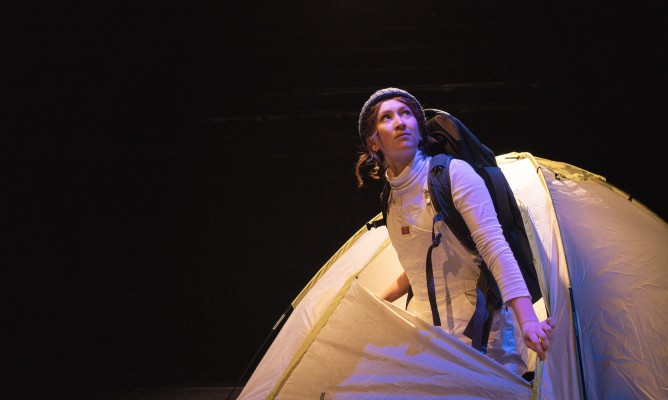
In Tatty Hennessy’s beautifully rich monologue, Rory has just lost her father. Before an untimely accident, he’d been planning to take her to the North Pole…..so teenage Rory decides the next best thing is to take his ashes there.

Her journey of discovery – into a lonely world of ice and cold, and unexpected beauty – is a gloriously gentle, deeply moving metaphor for grief.

Both Rory’s father and her younger self were enamoured by tales of the early polar explorers, men desperate to reach the Pole before modern technology reduced the ordeal to a difficult, but ultimately doable, tourist jaunt. These men who dared the unknown, the vast blank spaces on the map, showed extraordinary resilience, extraordinary hubris, and many died horribly. Rory is suitably fascinated by both their strength and their stupidity.

For all their hardship, much of the blank space they aimed to conquer had been traversed before. Perhaps if they’d spoken to the Inuit people, instead of dismissing them as savages, their journeys might have been easier.

But first times will be experienced as such.

Much of life consists of experiencing for the first time what’s in actuality being experienced for the billionth time. We walk the road alone, but the road is well trodden. (It’s a phenomena Rory herself acknowledges, not about her grief, but about her first serious sexual encounter; for all its uniqueness for her, it’s been experienced by all who came before.)

Eddie Pattison is magnificent as Rory, capturing her sadness, her fear, her humour, and her wonder, and creating a character so complete it feels less like a performance than an embodiment. Director Gavin Roach’s touch is light and wise, allowing this piece to achieve the dramatic miracle: the realisation of the individual that intimates the universal.    

Paul Gilchrist

A Hundred Words For Snow by Tatty Hennessy

Flight Path Theatre until 28 May

https://www.flightpaththeatre.org/whats-on/a-hundred-words-for-snow

Images: Cameron Grant (Parenthesy)

a body is all that remains

12 May

A single performer stands on a bare, dimly lit stage. He speaks to us in a soft, gentle voice. There is a soundscape of lapping water.

This is Lungol Wekina, an indigenous Papua New Guinean storyteller. He shares with us the brutal impact of colonisation on his people and his desire for connection with his ancestors.

Is it possible to be guilty of writing a spoiler in discussing a show such us this? You might think not, but you might be wrong.

Wekina speaks of his people drowning. Or, more precisely, of being made to feel they have always been drowning.

The culprit? “The Project”.

It’s an interesting choice of phrase. It’s colonialism. It’s capitalism. And it suggests deliberate intention.

There’s beautiful poetry in Wekina’s telling – sparse language, but rich, with seemingly simple figurative language that gradually blossoms into glorious fullness.

Initially, the monologue is thick with the abstract language of cultural studies, the terminology of post-colonial theory. This is a tendency that’s become almost conventional in contemporary theatre – but Wekina does something wonderful with it. His sharing is short on specifics, on the concrete – and that’s his point: it’s gone. All gone. Taken from him.

He suggests the colonisers burnt down his people’s library, destroying their cultural heritage. But he acknowledges this is a metaphor, just a metaphor, and one he has built from the language of the oppressor. That is their power.

So he builds another metaphor, this time of the dancer. In her movements, and in her voice, the dancer encapsulates Wekina’s cultural heritage, his connection with his ancestors. He tells us, that after the shocking violence of first contact between indigenous people and the colonisers, the Project became more insidious, slipping gently on stage with the dancer, and slowly replacing her steps, her voice, with its own.

The old world is lost. The dance is lost.

But the motif of the dancer facilitates another perspective. As Yeats observed (sort of) how can you tell the dance from the dancer?   

And by now the stage is no longer dimly lit. There is the performer, and only the performer, in full light. And, as he speaks in his gentle voice, he ever so subtly evokes the movement of the dance.

If I say more, I feel I will be guilty of a spoiler.

I say only this: the finale is poignant and sorrowful. But it’s also hopeful, a vision of connection … with ancestors … and with all humankind.  Because what do we share?

Paul Gilchrist

a body is all that remains

written and performed by Lungol Wekina

as part of the Everything but the Kitchen Sink Festival

Flight Path Theatre until Thurs 12 May ( the festival runs to Fri 13)

https://www.flightpaththeatre.org/whats-on/everything-but-the-kitchen-sink