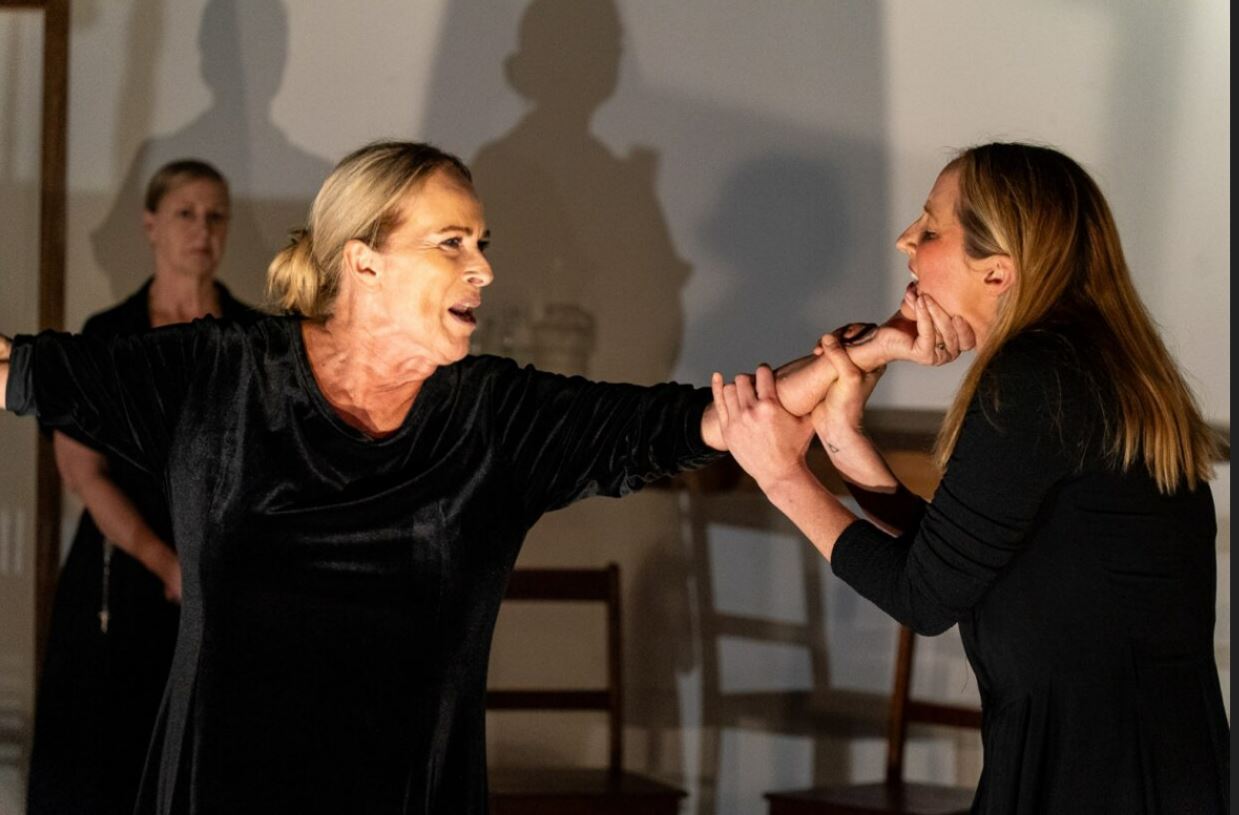
This is a terrific production of a fascinating play.
Written in the mid-1930’s, the last work by the great Spanish playwright Federico García Lorca, it features only female characters.
After her husband dies, Bernarda, matriarch of the family, insists her five unmarried daughters mourn in the ultra-traditional way. Prohibited from engaging with the wider world, prisoners of patriarchal standards, the household of women live an overwrought, claustrophobic existence.
But eldest daughter Angustias is still permitted to speak to her suitor, Pepe, a man whom we never see or hear. The problem is that she is not the only member of the household with feelings for Pepe.
Previously, I’ve expressed doubts about the efficacy of plays that purport to indict injustice but show only the victims. I know and support what drives this creative fashion, but the resultant work often feels lopsided, unintentionally granting the perpetrators a moral leave pass.
Despite being set in a patriarchy but presenting only women, Lorca’s play avoids these pitfalls. He was an extraordinary playwright, but I suspect freedom from the later theoretical apparatus of second wave feminism might have helped. This type of theory serves a necessary purpose, but not always one useful in the theatre. Sometimes, we can be so soaked in the simplicity of theory – as against the dreadful messiness of human reality – that we represent injustice as though it was merely the result of a few poor or selfish decisions at the last staff meeting. The value of the dramatic form is that it can acknowledge that problems are deep and painfully complex.
In Lorca’s play, women are presented as finding men irresistibly attractive, despite – or perhaps even because of – their brutish behaviour. It evokes for me God’s punishment of Eve in Genesis: “Your longing will be for your husband, and he will dominate you.”
And, in Lorca’s play, it’s the matriarch who’s the main enforcer of oppression. Now, the idea that individual women will betray the sisterhood to further their own power is not unheard of, but is this what Bernarda is doing? Does she really perceive any alternative?
One of her daughters cries To be born a woman is the worst punishment in the world. She doesn’t offer any corollary. She doesn’t suggest that being a woman is a punishment in this particular time and place, but if only we were to raise our children differently, or if only we were to spend more money on public awareness campaigns, or if only we were to adopt a gender quota in the entertainment sector… No, it’s a cry of eternal despair. And, in the play, this sense of terrible inevitability is further emphasised by the fate of one woman who breaks the seemingly everlasting laws governing female behaviour: no human being discovers and reveals her crime, but rather the dogs of the street. It is as though the blind forces of the universe itself will punish transgressions.
But all this doesn’t mean female oppression is inevitable. What a play represents and what a play invites are not the same thing. It’s one of the weaknesses of our current theatre culture to conflate the two. We’ve come to feel that theatre should represent a situation, tell us what to think about it, and then tell us what to do about it. The churches are all empty, because everyone who wants to preach is in theatre. But theatre that imitates a sermon, or can be reduced to a slogan, is not worth either the time or the ticket price.
It might seem odd to suggest a play with such a bleak vision is invigorating, but a deeply affecting portrait of the human experience like this production is an inspirational invitation to make the world better – and this is the rub – because we’re not being told to do so. Give the audience something to do, and they will love you for it. Less is more.
Director Kim Hardwick’s approach to the whole production follows this maxim, and the result is theatrical brilliance. Set and lighting are minimal, but the use of the space is majestic, a place for a script and a cast that are both superb to shine. An utterly mesmerising languidness, effectively expressing the enervation of oppression, provides the perfect detonation zone for the explosions of tension that come.
Sarah Chadwick as Bernarda is magnificent, a frightening portrait of a cold heart and an iron will. Linda Nicholls-Gidley as Poncia, her housekeeper, offers a gloriously complex depiction: resentful in servitude, exulting in the little power she has, gleeful in her expression of earthy desire, and fearful in her awareness of the trouble ahead. Romney Hamilton as Angustias wonderfully captures the petulance and insecurity of privilege in a world where it is so very scarce. Teodora Matović is marvellous as the sister pushed from weary despair to sudden and dangerous desperation. Estelle Davis as youngest sister Adela portrays youthful passion and defiance in all its tragic poignancy.
Paul Gilchrist
The House of Bernarda Alba by Federico García Lorca, in a translation by Barry Nielsen.
Presented by Frantic Muse.
At Flow Studios until 17 November
Image by Holly Mae Steane Price
 Theatre Red