Tag Archives: Genesian Theatre

An Inspector Calls

13 Jan

JB Priestley’s classic play is a subversion of crime fiction. It initially presents as typical detective fare – and then we realise it’s doing something far bigger, more important, and much more thrilling.

The Birlings are celebrating the engagement of daughter Sheila to Gerald. They’re respectable people. When the ladies retire after dinner, and the men remain for a glass of port or two, Mr Birling takes the opportunity to share his wisdom. Every man need only look after himself and his own, the successful businessman pronounces to the younger men. Do that, and all will be right with the world.

And then an inspector calls.

Disrupting this privileged party, the inspector informs them of the recent suicide of a desperate young woman and, through an utterly enthralling chain of questions, asks them to consider their possible culpability.  

I call the play a subversion because crime fiction usually asserts that it’s the detective’s commitment to rationality that will restore order to a fracture world. But this piece places its hope not in logic but in the human heart. If only we’d listen to the still small voice within, we’d realise that it’s not every man for himself, that we’re all in this together and, if the world is fractured, it’s we who might make it whole again.

It’s a beautifully rich piece and, under the direction of Ali Bendall and Mark Bull, this production is both thought-provoking and very entertaining. (That’s no small achievement. Drawing room dramas are notoriously difficult, their seemingly static world can appear to restrict creative choice. And, as a historical piece, set in a distant past even when Priestley first wrote it, Truth could all too easily atrophy into lifeless stereotype.)

The cast handle the challenging material well. David M Bond as Mr Birling is delightfully pompous, and Annabel Cotton as Mrs Birling is deliciously all prickle and pride. The younger generation, newer to the tired old ways of the world, are perhaps a little more shaken. Simon Pearce as Gerald presents moments of touching vulnerability. Rebecca Liquorish as Sheila effectively juxtaposes a frantic fear with the wondrous relief of honesty. Harry Charlesworth as younger brother Eric, the impulsive child who only Shame might mature, offers a moving portrait of moral growing pains.

And Vincent Andriano as the inspector is wonderful, a subtle physical awkwardness that underlines his outsider status contrasting brilliantly with a gloriously authoritative voice that clearly speaks command and consequence.

This is the Genesian Theatre Company’s first production in their new Rozelle home. Fans of the Kent Street proscenium arch will be pleased to see that house preference retained, and fans of engaging theatre will hope this show is an accurate portent of many things to come.

Paul Gilchrist

An Inspector Calls by JB Priestley

Presented by Genesian Theatre until 22 Feb
genesiantheatre.com.au

The Hound of the Baskervilles

8 Jun

It’s fascinating (to me, at least) that Arthur Conan Doyle’s The Hound of The Baskervilles and Joseph Conrad’s Heart of Darkness were written within a year or so of each other.

It’s common knowledge that the phrase “Elementary, my dear Watson” never actually appears in any of the novels or short stories featuring Sherlock Holmes. But its spirit permeates their pages. Logic will discover the criminal, and order will be restored. Despite appearances, all is ultimately simple and secure.

But while Conan Doyle was writing this paean to rationality, Conrad’s colonialist Mister Kurtz was having another vision. A too privileged glimpse into the savagery of the human heart drew from Kurtz the cry “The horror, the horror”. It’s another type of simplicity, but one void of any security. Enter the 20th Century.

It probably seems I’ve begun far too seriously for a response to the Genesian Theatre’s production of The Hound of the Baskervilles. After all, Steven Canny and John Nicholson’s adaption is a silly spoof. And, under the direction of Richard Cotter, it’s splendid fun.

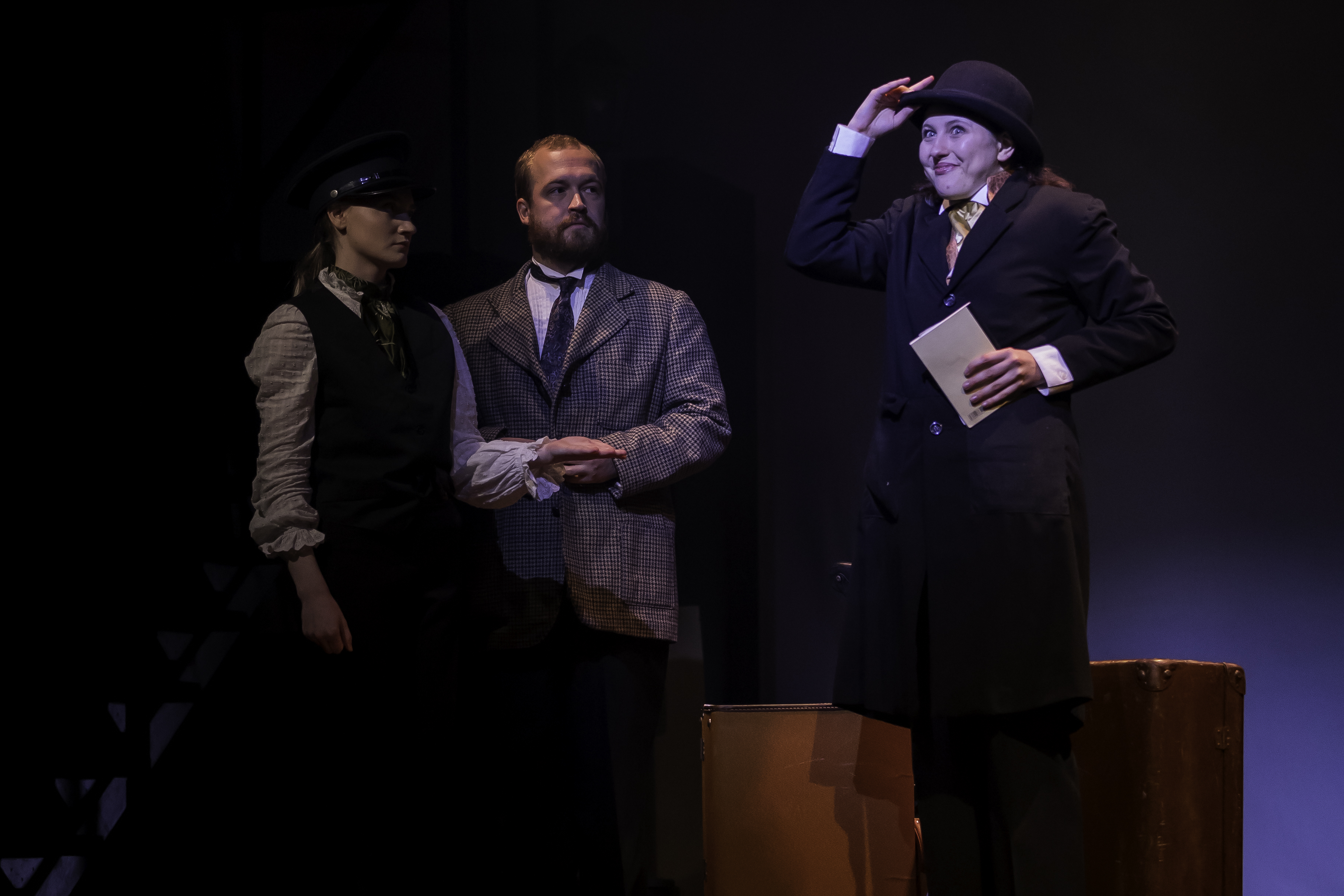
Three actors – Alyona Popova, Kate Easlea and Oliver Harcourt-Ham – play all the characters, and do so brilliantly. Cotter creates a theatrical space in which verbal play and physical humour thrive.

Popova as Sherlock Holmes captures the hilariously hyperbolic confidence of the great detective. (And, in another of her roles – a yokel attempting to wrangle an recalcitrant and unseen horse – her physicality is point perfect.) It’s an absolutely superb performance.

Easlea is terrific as her Dr Watson navigates playing second fiddle to a man who would be the entire orchestra. Her movement is also wonderful, either standing in Edwardian rigidity, arms at angle in a great coat, or nonchalantly pulling a pistol on some harmless, and imagined, sheep.

Harcourt-Ham as Henry, the Canadian heir to the Baskerville estate, draws huge laughs with his excellent comic timing and his gentle straight-faced matter-of-fact-ness. His yokel with cow, inexplicably and gloriously in a hessian bag, is also very funny.

Overall, it’s tremendously enjoyable.

But why do we enjoy spoofing works like The Hound?

I guess it’s because there’s something very quaint about their world view. For example, Henry sees Miss Stapleton (another role for Popova) and instantly falls in love, a fantasy mocked in a beautifully realised dance sequence. Similarly, the three lead male characters behave like such good-natured chums. (They’re gentlemen after all, and Englishmen at that – except for the Canadian, who is an honorary one while Britannia blithely rules the waves and the map of the world remains stained pink.) Easlea and Harcourt-Ham, in their giggly roughhouse, marvellously encapsulate the childlike aspect of this.

But most importantly, Holmes restores order through logic.

I suspect we’re no longer sure that’s possible.

And the hound never appears on stage, an omission that keeps the horror, the horror at bay.  

Paul Gilchrist

The Hound of the Baskervilles by Arthur Conan Doyle (adapted by Steven Canny and John Nicholson)

at Genesian Theatre until 17 June

genesiantheatre.com.au

Image by LSH Media

A Streetcar Named Desire

2 May

Tennessee Williams’ play was first seen on Broadway in 1947. This production, co-directed by Tom Massey and Meg Girdler, captures what makes it a timeless classic.

Blanche, down on her luck, comes to stay with her sister. She expresses shock at where Stella lives and most particularly at Stanley, the man her sister has married. In Stanley and Blanche, Williams presents the eternal conflict between instinctual brute spontaneity and deliberate fanciful pretence. The beauty of Williams’ characterisation is that neither character is solely one nor the other.

And it’s this complexity that this production presents so well. Riley McNamara’s Stanley is strikingly both animal energy and gossipy pedantry. Georgia Britt’s Blanche is both airs and graces, and longing sensuality.  Britt’s performance is magnificent, and the sense of fragility she evokes is utterly heartbreaking.  

Where can Blanche find some sort of shelter?

Perhaps with Stanley’s ex-army buddy, Mitch (played by Matthew Doherty with a moving mixture of quiet hope and angry disappointment.) If not, surely Blanche will always have her sister, Stella (played by Ali Bendall with a beautifully truthful combination of patient tenderness and bewildered frustration.)

Because, up to now, Blanche has “always depended on the kindness of strangers” – perhaps the most poignant line in modern theatre. When Britt delivers it, the pathos is extraordinary, and the production achieves what the play was made for: the awakening of pity for all who are lost.

Paul Gilchrist

A Streetcar Named Desire by Tennessee Williams

at the Genesian Theatre until 7 May

genesiantheatre.com.au 

Image by Luke Holland 

Hercule Poirot’s First Case

26 May

When considering who is the culprit responsible for the crime that is detective fiction, Agatha Christie is a prime suspect.

Not that she originated the fraud; Wilkie Collins and Conan Doyle were guilty long before her.

But she’s probably the most notorious perpetrator of detective fiction.

However, I’m more of the blame-society-rather-than-the-felon school of analysis. Why are these tales (in which the most important event, a murder, is relegated to backstory) so enormously popular?

This humble investigator proposes that the rising rate of detective fiction in the late 19th Century and early 20th Century was the direct consequence of three social developments:

1. Increased violence in rapidly growing urban populations;

2. Increased reportage of this violence by an expanding popular press;

3. And, most crucially, the desire to counter the above disturbing developments with the best tool at hand: logical and scientific reasoning (which had, ironically, ignited the Industrial Revolution and its attendant population explosion in the first place.)   

Detective fiction says the world is crazily chaotic and frighteningly violent – but here’s an extraordinarily rational individual who will restore order.

In comedy, order is often restored by a marriage (or something dreadfully like it). In crime, order is restored by an arrest. So, as it’s been quipped previously, it’s either “Dear Reader, I married him” or “The butler did it.” (Though, in this play, I should point out, he doesn’t.)

I expected this production to be a comedy, which is simply indicative of my inability to draw a logical conclusion from the available (marketing) evidence.

Hercule Poirot’s First Case is detective fiction, though the script’s fast pace, brought to the fore by some deft work by director Tom Massey, makes it an even closer cousin to comedy than such plays usually are. Giggles and guesswork make this an engaging show.

The title is a misnomer. It’s not Poirot’s first case. Played by Peter Gizariotis with charm, Poirot arrives in the story fully formed. It’s Poirot’s first case in that the script by Jon Jory is based on Agatha Christie’s first novel, The Mysterious Affair at Styles. For aficionados of detective fiction, this might be a rare treat.

Veronica Kaye

Hercule Poirot’s First Case by Jon Jory, based on an Agatha Christie novel.

Genesian Theatre until July 2

www.genesiantheatre.com.au

Image by Tom Massey

Much Ado About Nothing

1 Feb

Needless to say, this is not new work. The play was written in 1598. It’s been performed a few times since then.

This production, by director Deborah Mulhall, is fun and intriguing.

When you choose to produce a play like this you’re in an interesting situation. Your audience will be made up of a whole range of people, some of who virtually know the play off-by-heart and others who are experiencing it for the first time. You’re either in conversation with a vast tradition or casting fresh magic.

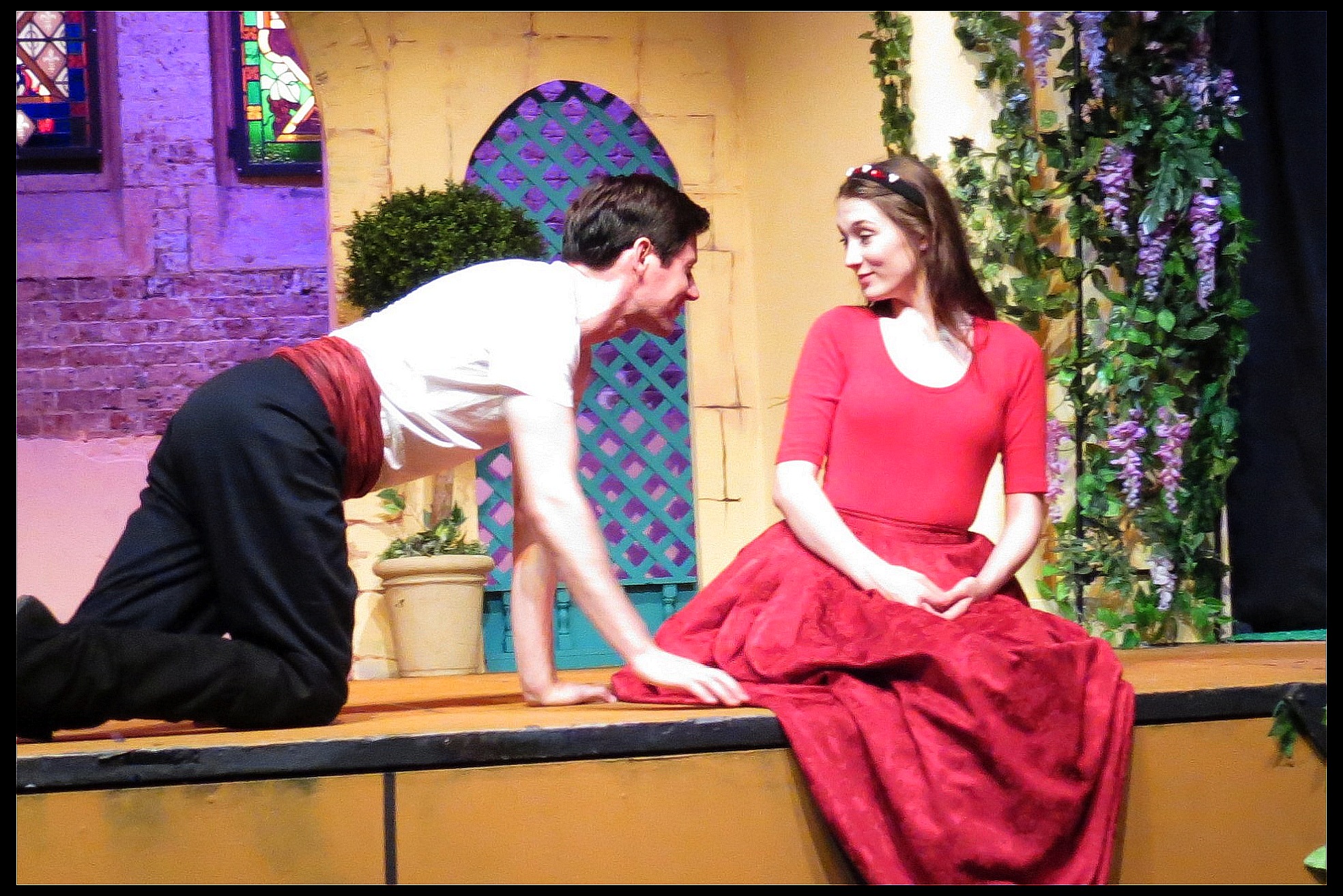
img_7645

Photo by Grant Fraser


Mulhall finds in the play not just the oft played “merry war” between the sexes but also the fight for equal rights for women. There’s scriptural basis for this. Beatrice makes the impassioned plea “Oh God, that I were a man!” But the nub of this interpretation is the characterization of Hero. Here’s her journey in a nut shell (yes, a spoiler): She’s wary of marrying her suitor, but accepts him anyway. She then happily helps in the light-hearted plot to get a husband for her cousin. At her own wedding, she is defamed by her foolish fiance, and is so shocked she struggles to defend herself. When her husband-to-be is forced to acknowledge his breathtaking injustice, she criticizes him for his behavior, and marries him anyway. And then in the final moments she playfully teases her cousin for falling in love. Back and forth between refusal and acceptance of societal expectations; which is no problem, except Shakespeare only gives her sixty lines to do it in. Catherine Lewis as Hero is wonderful, an engaging stage presence, but if the character is to symbolize the struggle to end gender inequality perhaps the role is being asked to do too much. If you’re part of the great conversation with the text, it’ll give you plenty to talk about into the night. See it and make up your own mind.

But, as I said earlier, it’s an enjoyable night. Mulhall elicits some good performances from her cast. The comedy works well – not always an easy feat with Shakespeare.  The two characters who have long dominated the way the play is received, Beatrice and Benedict, are played marvelously by Emma Wright and Ted Crosby. They‘re articulate, charming and smart.

Possibly Shakespeare’s greatest insight into the human condition is that love, which can seem a type of madness, doesn’t necessarily make us stupid. We can both woe and be wise.

Paul Gilchrist

Much ado About Nothing by William Shakespeare

Genesian Theatre til 25th February

Tix and info  here

The Winslow Boy

28 Jan

Terence Rattigan is often considered a master craftsman of the ‘well made play’. As a natural result, his work goes in and out of fashion.

Adding to this potential for supposed redundancy is the fact The Winslow Boy is set in the years before the First World War.

But the play is a historical drama. It was written a quarter of a century after the time it is set. If elements of the plot and aspects of the characters seem quaint they’re deliberately so. It’s as though Rattigan is looking back at a past era with a gentle nostalgia.

And it’s an oddly gentle play.

Or should I just say it’s odd? Not the overly simple ‘well made play’ the fashionable might dismiss it as.

What’s it about?

Ronnie Winslow’s reputation has been besmirched and must be cleared. It’s a fight for justice.

But the play’s not a court room drama. Set entirely in the Winslow’s sitting room, we’re not seriously expected to follow the legal machinations.

Plenty of people tell the Winslow’s not to bother, so perhaps it’s an exploration of an obsession with justice and its cost.

But the stakes are deliberately set low. Ronnie Winslow is a school boy who is accused of stealing a postal note and is expelled. “Let right be done” becomes the catch cry. But the sacrifices needed in order to achieve this ‘right’ are much smaller than might be imagined. Indeed, it’s quite possible to argue that many of the characters are better off because of their sacrifice, and I don’t mean on some nebulous quasi-spiritual level, but rather on a mundane common sense level. And it’s rather telling that little Ronnie is not particularly concerned about the outcome of the case.

So am I criticizing the play?

Perhaps.

But I can’t overstate how engaging it is. Rattigan seems incapable of writing a dull scene.

Photo by Mark Banks

Photo by Mark Banks

And this production, directed by Nanette Frew, is a very enjoyable night of theatre. The cast provide some excellent performances. David Stewart-Hunter as Ronnie’s fixated father delivers an intriguing mix of humour, pigheadedness and pathos. Sonya Kerr as Ronnie’s suffragette sister Catherine is intelligent, witty and humane. It’s a beautiful role and Kerr does it magnificently. Roger Gimblett’s Sir Robert Morton is brilliantly articulate and perfectly pompous. Tom Massey’s Desmond Curry is a wonderful portrait of the likeable loser.

(Considering Catherine’s relationships with these three men is hard to believe Rattigan hadn’t swallowed his copy of Pride and Prejudice whole.)

But back to my discussion of the play.

What’s it about?

About two and a half hours of enjoyment.*

Veronica Kaye

The Winslow Boy by Terence Rattigan

The Genesian Theatre til 14 Feb

http://www.genesiantheatre.com.au/

* Like Rattigan, I’ve done some swallowing and regurgitating with this line.

Amadeus

30 Oct

Envy is a stupid vice.

Perhaps all vice is. Plato certainly thought so. And he’s not alone.

It’s a common belief that reason and virtue are inextricably linked. To this school of thought, vice is simply the result of faulty thinking.

Envy is usually based on the belief that life is a zero sum game. In other words, your gain is my loss. But is this actually the case? Why would your happiness exclude mine? And, really, how happy could I be if I knew you weren’t?

Peter Schaffer’s Amadeus is a brilliant study of envy, and this production by director Stephen Lloyd-Coombs is terrific.

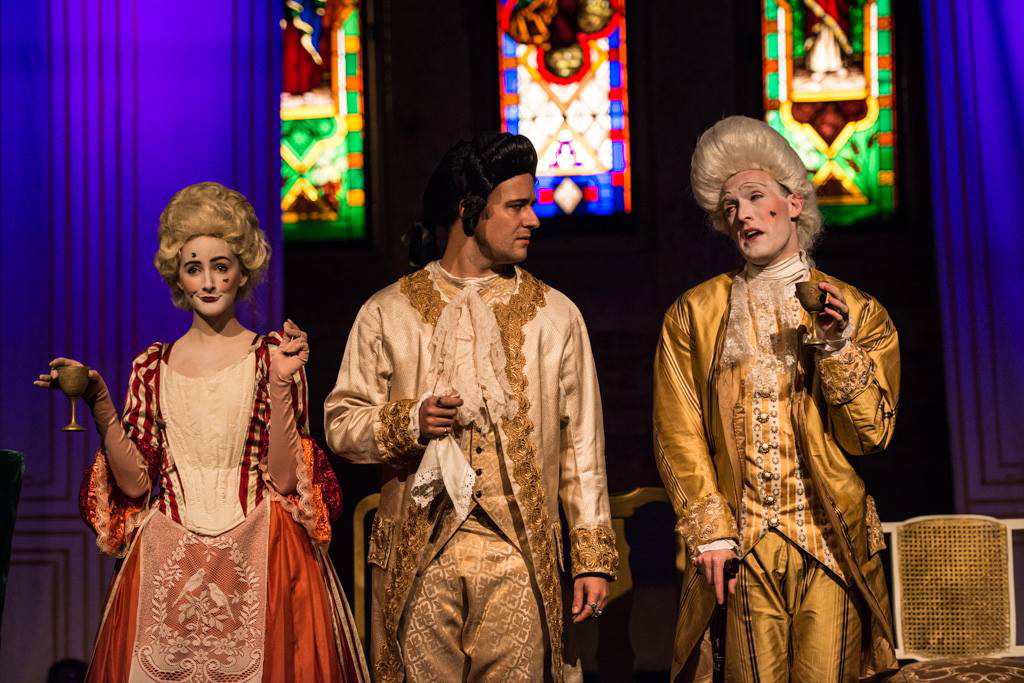
Amadeus Sal and Vent

Salieri, played wonderfully by Nick Hunter, is faced with the phenomenon that is Mozart. To him it is obvious Mozart is the better composer, and it destroys him. The strength of this play is that Salieri is not reduced to mere cattiness. He’s cold and clear. But his envy is convoluted with his concept of justice. Rather than perceiving justice as something human beings must strive to create, Salieri makes the mistake of believing that it’s a quality inherent in the universe. Such a belief is a recipe for tragedy.

Schaffer’s other major theme is genius. Jasper Garner-Gore’s Mozart is eminently watchable, a big likeable child. Salieri can’t help but acknowledge Mozart’s ability, but is shocked to find him so crass. But why? Why should we be all of one piece? (Curiously, it’s the same type of thought structures that won’t separate reason and virtue.)

The concept of ‘genius’ – which is not used in the play – is an intriguing cultural trope. (I call it a trope because it’s not as if there’s a scientific test for it.)

Why do we like the concept of ‘genius’? What is this trope’s purpose? Does it help us relax, by telling us that we can’t possibly compete?

Or is the label an attempt to quarantine our evaluations from the disease of subjectivity? ‘It’s not just my opinion. He was a genius!’

Of course, an important aspect of the story is that Mozart’s ‘genius’ does go unrecognized, except by Salieri. It’s an appealing notion. Who doesn’t want to believe that their own genius has been under-appreciated? (That Mozart’s ‘genius’ did go unrecognized should make us realize that all evaluations are just human, all too human.)

Which leads me to more of my own evaluation.

The leads are supported by great work by the rest of the cast. Nicole Wineberg as Mozart’s wife, Constanze, gives a captivating portrayal of frisky fidelity. Anthony Finch and Claire Stewart-Moore are marvelously flamboyant as Salieri’s spies and representations of malicious triviality. The costumes by Peter Henson and the set by Ashley Bell are a visual delight.

This is a very entertaining and thought-provoking production.

Veronica Kaye


Amadeus by Peter Shaffer

Genesian Theatre

til Nov 29

http://www.genesiantheatre.com.au/


Hotel Sorrento

21 Jan

Australia Day is controversial, especially because of the date we choose to celebrate it.  Are we being patriotic, or just parochial?

It’s curious that the people most keen on Australia Day are often the very people most cynical about the only thing that actually makes us Australians. And that is? The fact we vote, pay taxes and are under the legal jurisdiction of the federal government. Australia is a political entity.

Hannie Rayson’s play is not about Australia Day, but it is about being Australian.

Rayson’s characters argue about Australians; their attitudes to art and artists, and their supposed inability for emotional sophistication.

Meg is the Booker nominated expat. On one level, she has little time for what she sees as Australian smallness. Dick, a leftist journalist, argues passionately against her. How would you know? he says. You haven’t been here for 10 years!

Of course, the play itself is 24 years old. Are Meg and Dick both wrong? Have we changed as a nation?

Or are Meg and Dick both guilty of a simple category error? Is ‘Australia’, as a cultural entity, merely a generalization? How useful is the word ‘Australian’ at all?

This is far from a criticism of the production. It’s what the play made me think about. And if I’d paid for a ticket I would’ve said it was money well spent.

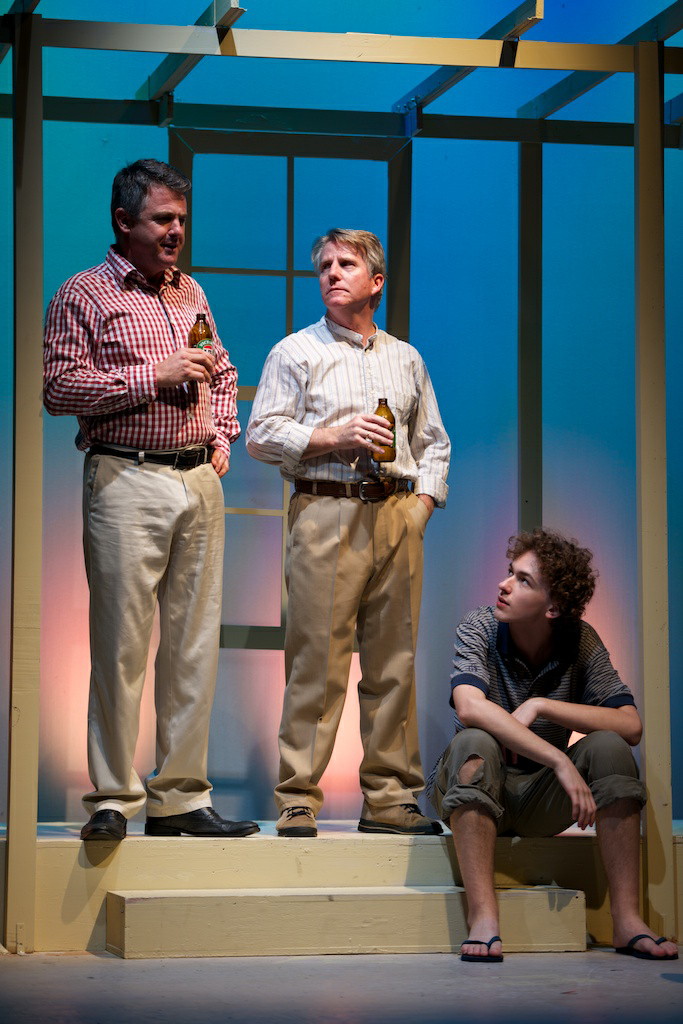
Photo by Mark Banks

Photo by Mark Banks

It’s a funny, moving and very thought-provoking night of theatre. Director Shane Bates has elicited some good performances from her cast. I especially enjoyed Melanie Robinson as Meg, Martin Bell as Edwin, her husband, and Rob White as Dick.

The play also made me think about representational art. Marge paints ‘still life’. At one point, she praises the ability of good art to capture the essence of things. Meg’s novel does this, we are told. As does the work of Helen Garner; it showed Marge something she had always been aware of, but had been unable to articulate or even acknowledge.  In the words of T S Eliot (quoted in the play):  “the end of all our exploring will be to arrive where we started and know the place for the first time”. And, in the middle of this paean to representational art, Dick grabs an apple and bites into it, unaware that it’s part of the ‘still life’ Marge is trying to paint. It’s a cheeky symbol from Rayson.

Is representation what art should attain to? It would be churlish to suggest it wouldn’t be a magnificent achievement. I’m just not sure art can show us the Truth.

A vision of art as Truth is conservative, an always looking backwards, an approach that can inadvertently deny Life, and its possibilities.

Art might be a microscope or a telescope, but it’s also a kaleidoscope. Representational art takes elements of what previously existed and plays with them. Like the Uncertainty Principle in nuclear physics, when we describe the world, we affect it. And that’s not a bad thing. It’s empowering.

There is not an Australia to represent. Australia is not a thing, it’s a happening.*

Let’s see what we can make happen.

Veronica Kaye

*Apologies to E P Thompson, a writer Dick would be quite familiar with.

Hotel Sorrento

til 22nd Febuary at the Genesian Theatre

http://www.genesiantheatre.com.au/

Dangerous Corner

30 Jul

Only God knows the complete Truth. And She’s not sharing.

JB Priestley’s brilliantly intricate play Dangerous Corner is a fascinating exploration of the concept of Truth.

The premise of the play is that everyone has secrets. It’s a popular myth, because it suggests we are more than we seem. It’s a myth that says, despite appearances, that we are actually endlessly fascinating and intriguing. “He must live a double life,” the more catty among us say, “because his life couldn’t really be as dull as all that.”

And much of Priestley’s play involves the unraveling and revealing of the character’s secrets. Director Peter Lavelle, with an intelligent light hand, makes this enthralling theatre. His cast very skillfully present characters torn between the desire to conceal and the seeming relief of letting it all come out.

Photo by Craig O'Regan

Photo by Craig O’Regan

But the play does more. It’s not just an Agatha Christie style whodunit. It raises some very thought provoking ideas about the very concept of Truth itself.

Any chain of questions aimed at discovering the reality of a situation must come to an end, and that end, really, is rather arbitrary. What we call the Truth is simply the point at which we cease asking questions. The Truth is merely the point at which we abandoned the search.

Perhaps only a four year old can perpetually ask ‘why?’ And perhaps that’s why we are told we must become like little ones if we are to enter the kingdom of heaven.

Because all they know is that they don’t.

Veronica Kaye

Dangerous Corner

at The Genesian Theatre until 10 Aug

http://www.genesiantheatre.com.au/index.php?mode=now