Tag Archives: historical drama

The Half-Life of Marie Curie

18 Jun

It’s the summer of 1912, and Marie Curie’s good friend and colleague Hertha Ayrton invites her to England to escape the scandal that threatens to destroy her.

Curie has had an affair with a married man, and so now she’s not only a two time Nobel laureate, but also a home-wrecker. The second of these monikers, it would seem, trumps the first. (It can be difficult to believe the misogynistic, hypocritical rage directed at Curie. Or it should be. Unfortunately, history proffers too many examples.)

The wonder of Lauren Gunderson’s play is – that with a focus on this one brief historical moment, and with only two characters – she creates something of incredible beauty and richness.

The critique of the patriarchy is suitably sharp, but even more stimulating is the representation of the complexity of female relationships.

Firstly, there’s a depth to their experience of men. Institutionally, socially, at large, men are unjust: fearful little soulless moustached marionettes, incapable of granting women equality. But on a personal level, both women, now widows, have had husbands who were the best of humankind. William Ayrton called his wife BG (beautiful genius) and Pierre Curie refused a Nobel Prize unless it was shared with his wife. Even Paul, the married man who Curie loves, for all his vacillation, offers an undeniable joy. And it’s worth noting that Ayrton has taken her first name from a poem by a man: “Hertha” by Algernon Swinbourne. His poem, she says, gave her the courage to believe in her own worth as a woman.

And secondly – for those concerned the play might not pass the Bechdel Test – (it does, with flying colours) – the friendship between the two woman themselves is portraited brilliantly. There’s fierce loyalty and honest admiration. There’s shared humour (and whisky) and the glory of two top class minds in conversation. But there’s also an unspoken (delightful and light-touched) homoeroticism. And there’s an argy-bargy that sails awfully close to bullying. Ayrton asserts that Curie is strong, is resilient, can transcend the scandal – but she asserts it just a little too often. Curie is wounded. She doesn’t know who she is anymore, and being told you’re an otherworldly goddess, when you’re feeling so very human, is akin to erasure.

Directed by Liesel Badorrek, Gabrielle Scawthorn and Rebecca Massey give utterly engaging performances. They play each note of Gunderson’s script with a meticulous awareness of its possibilities, bringing to the fore both the delicious humour and the deep humanity. Scawthorn’s Curie is a terrific portrait of power in pain, fraught but ever able to inspire awe. Massey’s Ayrton is beautiful bustle, fire-hearted affection, and no nonsense determination. On a stripped back stage, the physicality of the actors is paramount, and these two are extraordinary: powerfully embodying both suffering and exultation.

(This is probably the time to mention design. James Browne provides a raised transparent podium, which can be encircled by a transparent curtain. It’s spare but layered, aligning with a script that presents a seemingly single, simple historical moment only to reveal its complexity. The choices of lighting designer Verity Hampson and projection designer Cameron Smith wonderfully evoke this complexity – as well as the unseen physical forces that these two scientists explored.)

I was saying Curie is feeling so very human – with all the vulnerabilities and vagaries that entails. And that’s why Gunderson chooses this moment to set her play. Gender tensions might be crucial to the piece, but so is another tension: that between the supposed objectivity of science and the unavoidable subjectivity of the people who work in it. Curie says she loves science, but not scientists. Both women muse on the fact that proof is real, but recognition is political.

And just as the tension between the sexes is represented with a humane richness, so is this tension between knowledge and its knowers. The women’s belief in inviolable proof is undercut by their greatest conflict. The spoiler rule prevents me giving detail about the moment, but the tension is one in which scientific findings are disputed, where two passionate, intelligent women debate when – and if – knowledge can ever become complete. Truth maybe immutable, but Science remains an all too human endeavour.

Constructed from such vital tensions, and presented with such mastery, Ensemble’s production of The Half-Life of Marie Curie is superb theatre.

Paul Gilchrist

The Half-Life of Marie Curie by Lauren Gunderson

at Ensemble Theatre until 12 July

ensemble.com.au

Image by Prudence Upton

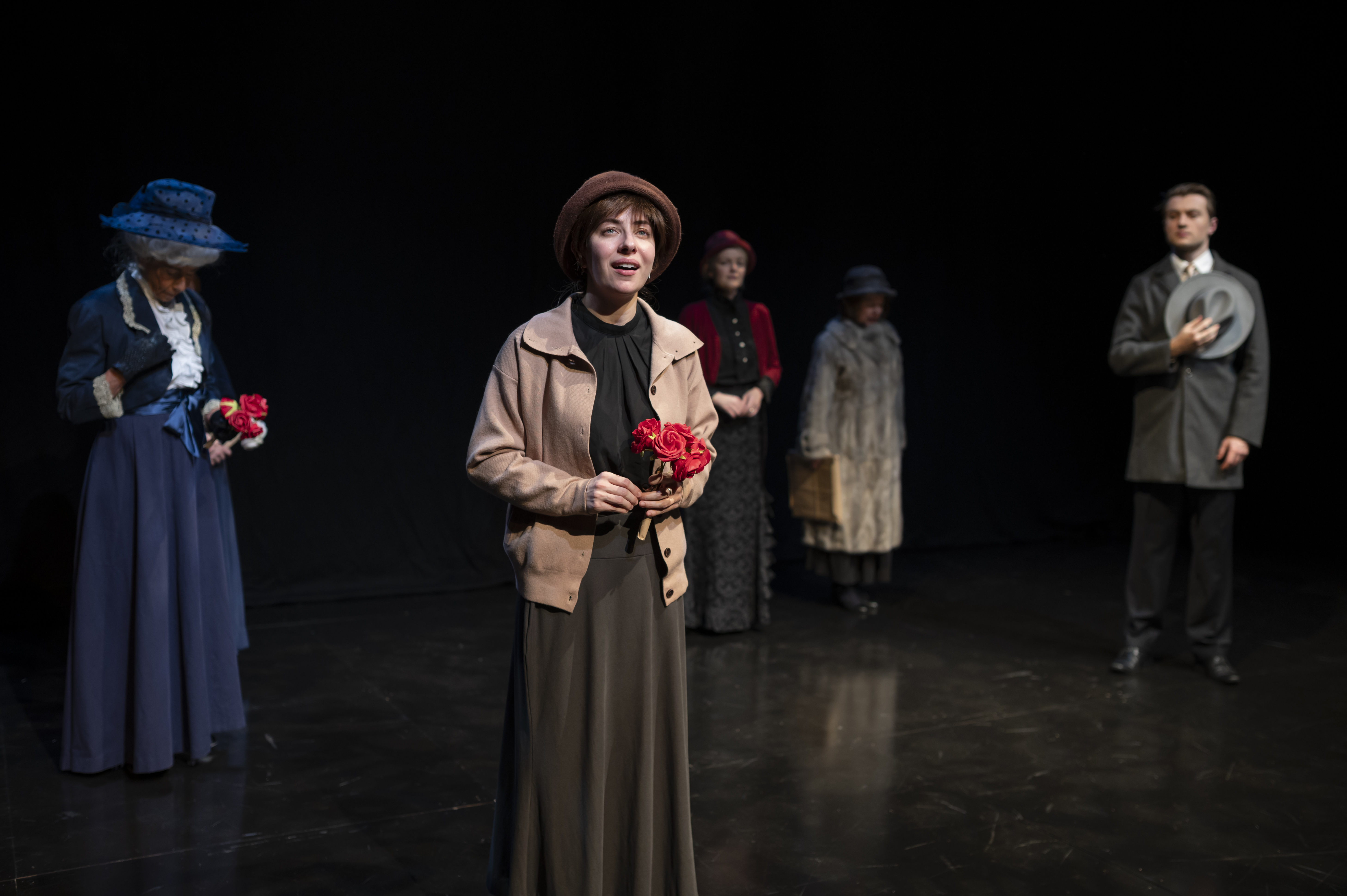
Silent Sky

26 Apr

This is an engaging production of an extraordinarily beautiful play.

Written in 2011 by American playwright Lauren Gunderson, Silent Sky tells the story of astronomer Henrietta Swan Leavitt. Despite the patriarchal prejudices of the early 20th Century, Leavitt made paradigm-shifting discoveries in her field.

Her work was crucial in determining the distance to faraway stars and has helped us appreciate that our Milky Way is merely one galaxy among many. Thanks to her, and those who developed her insights, we’ve been offered intimations of the true majesty of the universe.

Though obviously critical of misogyny, Gunderson does not reduce Leavitt to a woman solely defined by this challenge. The play is an enchanting exploration of vital ideas, ones that offer liberation beyond the passing evil of patriarchy. For simplicity, I’ll reduce these ideas to two, what I’ll call the two ‘P’s’.

The first of these ‘P’s’ is patterns. Like all scientists, Leavitt worked on the assumption that if the universe is to be comprehensible, we must find its patterns. The trick is to find the right pattern. Or, perhaps more importantly, not to commit to the wrong pattern. (Patriarchal prejudices are a perfect example of commitment to the wrong pattern, exacerbated by the fact that this misplaced conviction is ultimately self-fulfilling. If women have not proved great scientists, any assertion that they can’t be is indubitably one of the reasons they haven’t been.) True wisdom consists in being able to see patterns, but also in being able to see more than patterns. In philosophy, it’s the perennial battle between the systemisers and the existentialists, between those who are committed to a grand theory that explains all existence and those who are constantly startled into an invigorating awareness by existence’s inexplicability.

The other ‘P’ is perspective. Leavitt’s insight that helped calculate the distance to the stars was one of perspective: Does a star appear bright because it’s close? Or does it appear close because it’s bright? I won’t spend time explaining the science with which Leavitt solved this problem – but the playwright does it with a splendid lightness of touch that leaves her tale utterly accessible to all. And the motif of perspective is threaded cleverly through the entire work. Einstein’s theory of relativity – at the time new, fresh and controversial – reminds both the characters and the audience that no perspective can be automatically privileged. Perspective is about being maturely aware that you will inevitably suffer from bias, an unavoidable consequence of seeing the world from a particular place. And Gunderson uses the gentle friction between Leavitt and her sister to highlight the concept of perspective in a slightly different way. Margaret says You would think a world war would make the stars seem trivial only to be answered with You would think the stars would make a world war seem trivial. At another moment, Leavitt asserts Life is about being appropriately upset. Perspective is not just the awareness that there are competing points of view; it’s also about keeping one’s own multifarious experiences in mature relation to each other (what is commonly referred to as keeping things in perspective.)      

But I don’t want to give the impression the script is heavy – it’s not at all, it’s gloriously rich. Gunderson’s brilliance in telling this tale of magical wonder is that her touch is gentle, humorous and heart-warming, as soft as starlight.

Except for a couple of hiccups that can be put down to opening night gremlins, director Tracey Okeby Lucan’s production is captivating. The Theatre on Chester is a proscenium arch, but the limitations of this type of theatre are turned by Okeby Lucan into opportunities. The depth of the stage facilitates an appropriate sense of vastness, aided by deft lighting by Mike Brew and Milo McDermird and evocative design by Michael Arvithis and Okeby Lucan.

The cast do some great work. Angela Pezzano captures magnificently Leavitt’s determination and wonder. The scenes with her sister, played by Tida Dhanommitrapap, are sweet. As Peter, David Eisenhauer navigates the journey from nemesis to admirer and beyond with likeable humour. As Leavitt’s two colleagues, Annie and Williamina, Julie Moore and Anna Desjardins are excellent: Moore creating a gravitas inclusive of tenderness, and Desjardins a delightful, mischievous playfulness.

Paul Gilchrist

Silent Sky by Lauren Gunderson

At the Theatre on Chester until 17 May

theatreonchester.com.au

Image by Carla Moore

The Amazing Lucas Girls

25 Apr

This is set in Ballarat during the First World War and its direct aftermath.

The Lucas Girls are the women who work in E. Lucas & Co, a clothing and corsetry factory.

They’re Amazing because of their response to the war. Losing husbands, lovers, brothers and fathers to the conflict, they work to give solace to those who grieve, and they fight against the introduction of conscription to ensure no other lives are unnecessarily sacrificed.

Writer and director Cate Whittaker tells this tale through a focus on two sisters, Tilly and Clara. The tensions and affections between the siblings are well presented by Joanne Booth and Amy Joyce. The sisters work in sales and management, and so are not the working class factory hands. In the main, these women are left off stage, represented only by Casey Martin, who portrays a wonderfully cheeky Mavis.

Martin also briefly plays Vida Goldstein, a character whose mere mention drew applause from the audience. This underlined one of the play’s unmistakable goals: to recognise the efforts of the women who have made our society more humane.

As an opportunity to present possibly forgotten historical facts, the play ticks the boxes, but Whittaker also works hard to give us an engaging character-driven story. Though both purposes are laudable, sometimes they seem at loggerheads. On some occasions, characters give slightly unnatural speeches of historical exposition. On all occasions, I was left uncertain whether these particular people once lived or whether they’re simply fictional creations. (The Lucas Girls are undeniably real, but I’m not so sure about these specific characters.)

Such are the perennial challenges of historical drama.

But I have to admit, I love the genre.

In contemporary theatre we often talk of sharing our stories and giving voice to particular communities, phraseology that creates the impression that theatre is merely a type of reportage.

But historical drama is clearly not reportage: when a play is set in a distant historical period the creating artists were simply not there. No matter how much research has been done, we know things are being made up, that we’re being thrown back onto fiction, and that’s a delightful thing. Rather than merely informing the audience, fiction is a glorious invitation to engage, to enjoy, to flourish.

It’s right to recognise and honour those who came before us. And from them we can take inspiration, whether they were made of flesh and blood, or of the stuff of dreams.  

I saw the first night of this run, and production values will hopefully improve. The play has a large number of scenes, which means a large number of exits and entrances – and these could do with more pace and pizazz. Similarly, on this first night, operation of the lighting was patchy, including at least one occasion when the house lights were raised mid-action. (I’ve never felt more seen by a piece of theatre.)

But, seriously, who is seen by this piece of theatre? Everyone who works to make the world a better place.

Paul Gilchrist

The Amazing Lucas Girls by Cate Whittaker

presented as part of the HERStory Arts Festival

at Wharf 2 until 26 April

herstoryfestival.com

Image supplied

Big Girls Don’t Cry

14 Apr

There’s something thrilling about historical drama, a sense of being transported to another time and place.

Big Girls Don’t Cry, written by Dalara Williams and directed by Ian Michael, is set 1966 in Redfern. The fundamental question – how far have we come in sixty years? – is clear. The answer is less clear (for reasons I’ll return to later.)

The piece feels more like a slice of life than a narrative. Not that things don’t happen, but the purpose seems more the capturing of indigenous experience than the weaving of a story.

Queenie (Megan Wilding), Lulu (Stephanie Somerville) and Cheryl (Williams) are preparing for their debut. It’s the first one being held for indigenous women. Trouble is, Cheryl’s man Michael (Matthew Cooper) is overseas, fighting in Vietnam, and the other two women seem to be having difficulty finding a partner. Ernie (Guy Simon) has just returned from the Freedom Rides, with a vision of a better world, and with a friend, Milo (Nic English), who’s interested in Cheryl….

It’s a snap shot of a time and place, brimming with heart and humour.

The scene in which Ernie and Queenie work out their differences – or work out what’s at the heart of the differences – is comic gold.

But the piece is not merely light-hearted fluff. Within the first few minutes, we hear our first story of racial injustice. And this builds, until the end of the first act. By the time we’re confronted with a scene depicting racist brutality, we’ve heard several speeches complaining about its (incontestable) ubiquity, and afterwards we hear more. A play of this length – 2 hours 50 minutes with interval – would benefit from a greater trust in showing rather than telling.

As a historical drama, it’s oddly dissatisfying, partly stuck in the present while at other times lost in the past.

Sometimes, there’s a whiff of anachronism. Perhaps this is inevitable; we chose to tell a story set in the past but our purpose is still to speak to the present. I’ll begin with something really small (which might simply be an example that underlines my ignorance). The characters speak of living in the colony and ask others whether they’re allies to the indigenous cause. This language feels very 21st century, but perhaps it has taken sixty years for these usages to move beyond the indigenous community to the non-indigenous community.

Another potential anachronism is the presentation of the 1967 referendum. The play’s action occurs in the build up to this historical event and the referendum is referred to – but generally negatively, with responses like It won’t do enough and Who are they to make decisions about us? No doubt, this was part of the indigenous response. But, because of the iconic status of the referendum in the history of the civil rights movement, if it was so displeasing to indigenous people I would have loved to have had this displeasure more fully explored, especially in relationship to the hope manifest in movements like the Freedom Rides. But I suspect what we we’re getting is not a response to the 1967 referendum, but rather a response to the more recent, failed, one.

Yet, despite these examples suggesting the play speaks more of now than then, in other ways it’s firmly located in the past – and one that seems a foreign country.

Events lead up to the inaugural Sydney Indigenous debutante ball of 1966, but we’re left with tantalising gaps. How did the ball happen? Why did it happen? Considering a debutante ball is the epitome of privileged white upper middle class aspirational culture, and that Ernie uses the term assimilation in a totally understandably scathing way, I wanted to know more about how and why these women navigated this extraordinarily weird experience. (I know I’m probably being unreasonable, wanting more sociological analysis than a play like this – one sourced, at least partly, from personal testimony – can offer.)

How far have we come in sixty years? It’s difficult tell.

But there’s no doubt we’ve further to go.

Paul Gilchrist

Big Girls Don’t Cry by Dalara Williams

At Belvoir until 27 April

belvoir.com.au

Image by Stephen Wilson Barker