Tag Archives: historical-fiction

The Half-Life of Marie Curie

18 Jun

It’s the summer of 1912, and Marie Curie’s good friend and colleague Hertha Ayrton invites her to England to escape the scandal that threatens to destroy her.

Curie has had an affair with a married man, and so now she’s not only a two time Nobel laureate, but also a home-wrecker. The second of these monikers, it would seem, trumps the first. (It can be difficult to believe the misogynistic, hypocritical rage directed at Curie. Or it should be. Unfortunately, history proffers too many examples.)

The wonder of Lauren Gunderson’s play is – that with a focus on this one brief historical moment, and with only two characters – she creates something of incredible beauty and richness.

The critique of the patriarchy is suitably sharp, but even more stimulating is the representation of the complexity of female relationships.

Firstly, there’s a depth to their experience of men. Institutionally, socially, at large, men are unjust: fearful little soulless moustached marionettes, incapable of granting women equality. But on a personal level, both women, now widows, have had husbands who were the best of humankind. William Ayrton called his wife BG (beautiful genius) and Pierre Curie refused a Nobel Prize unless it was shared with his wife. Even Paul, the married man who Curie loves, for all his vacillation, offers an undeniable joy. And it’s worth noting that Ayrton has taken her first name from a poem by a man: “Hertha” by Algernon Swinbourne. His poem, she says, gave her the courage to believe in her own worth as a woman.

And secondly – for those concerned the play might not pass the Bechdel Test – (it does, with flying colours) – the friendship between the two woman themselves is portraited brilliantly. There’s fierce loyalty and honest admiration. There’s shared humour (and whisky) and the glory of two top class minds in conversation. But there’s also an unspoken (delightful and light-touched) homoeroticism. And there’s an argy-bargy that sails awfully close to bullying. Ayrton asserts that Curie is strong, is resilient, can transcend the scandal – but she asserts it just a little too often. Curie is wounded. She doesn’t know who she is anymore, and being told you’re an otherworldly goddess, when you’re feeling so very human, is akin to erasure.

Directed by Liesel Badorrek, Gabrielle Scawthorn and Rebecca Massey give utterly engaging performances. They play each note of Gunderson’s script with a meticulous awareness of its possibilities, bringing to the fore both the delicious humour and the deep humanity. Scawthorn’s Curie is a terrific portrait of power in pain, fraught but ever able to inspire awe. Massey’s Ayrton is beautiful bustle, fire-hearted affection, and no nonsense determination. On a stripped back stage, the physicality of the actors is paramount, and these two are extraordinary: powerfully embodying both suffering and exultation.

(This is probably the time to mention design. James Browne provides a raised transparent podium, which can be encircled by a transparent curtain. It’s spare but layered, aligning with a script that presents a seemingly single, simple historical moment only to reveal its complexity. The choices of lighting designer Verity Hampson and projection designer Cameron Smith wonderfully evoke this complexity – as well as the unseen physical forces that these two scientists explored.)

I was saying Curie is feeling so very human – with all the vulnerabilities and vagaries that entails. And that’s why Gunderson chooses this moment to set her play. Gender tensions might be crucial to the piece, but so is another tension: that between the supposed objectivity of science and the unavoidable subjectivity of the people who work in it. Curie says she loves science, but not scientists. Both women muse on the fact that proof is real, but recognition is political.

And just as the tension between the sexes is represented with a humane richness, so is this tension between knowledge and its knowers. The women’s belief in inviolable proof is undercut by their greatest conflict. The spoiler rule prevents me giving detail about the moment, but the tension is one in which scientific findings are disputed, where two passionate, intelligent women debate when – and if – knowledge can ever become complete. Truth maybe immutable, but Science remains an all too human endeavour.

Constructed from such vital tensions, and presented with such mastery, Ensemble’s production of The Half-Life of Marie Curie is superb theatre.

Paul Gilchrist

The Half-Life of Marie Curie by Lauren Gunderson

at Ensemble Theatre until 12 July

ensemble.com.au

Image by Prudence Upton

The Amazing Lucas Girls

25 Apr

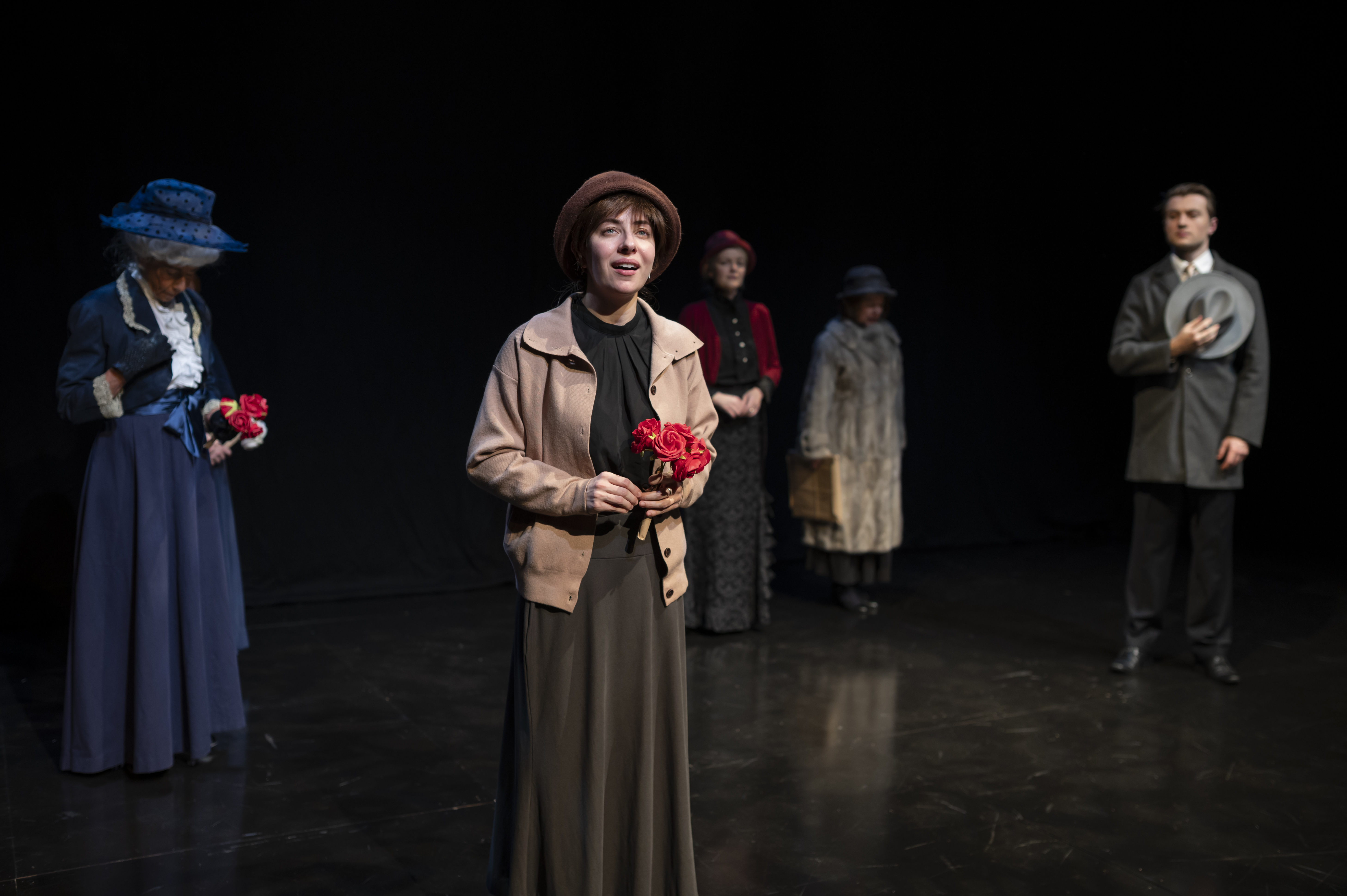
This is set in Ballarat during the First World War and its direct aftermath.

The Lucas Girls are the women who work in E. Lucas & Co, a clothing and corsetry factory.

They’re Amazing because of their response to the war. Losing husbands, lovers, brothers and fathers to the conflict, they work to give solace to those who grieve, and they fight against the introduction of conscription to ensure no other lives are unnecessarily sacrificed.

Writer and director Cate Whittaker tells this tale through a focus on two sisters, Tilly and Clara. The tensions and affections between the siblings are well presented by Joanne Booth and Amy Joyce. The sisters work in sales and management, and so are not the working class factory hands. In the main, these women are left off stage, represented only by Casey Martin, who portrays a wonderfully cheeky Mavis.

Martin also briefly plays Vida Goldstein, a character whose mere mention drew applause from the audience. This underlined one of the play’s unmistakable goals: to recognise the efforts of the women who have made our society more humane.

As an opportunity to present possibly forgotten historical facts, the play ticks the boxes, but Whittaker also works hard to give us an engaging character-driven story. Though both purposes are laudable, sometimes they seem at loggerheads. On some occasions, characters give slightly unnatural speeches of historical exposition. On all occasions, I was left uncertain whether these particular people once lived or whether they’re simply fictional creations. (The Lucas Girls are undeniably real, but I’m not so sure about these specific characters.)

Such are the perennial challenges of historical drama.

But I have to admit, I love the genre.

In contemporary theatre we often talk of sharing our stories and giving voice to particular communities, phraseology that creates the impression that theatre is merely a type of reportage.

But historical drama is clearly not reportage: when a play is set in a distant historical period the creating artists were simply not there. No matter how much research has been done, we know things are being made up, that we’re being thrown back onto fiction, and that’s a delightful thing. Rather than merely informing the audience, fiction is a glorious invitation to engage, to enjoy, to flourish.

It’s right to recognise and honour those who came before us. And from them we can take inspiration, whether they were made of flesh and blood, or of the stuff of dreams.  

I saw the first night of this run, and production values will hopefully improve. The play has a large number of scenes, which means a large number of exits and entrances – and these could do with more pace and pizazz. Similarly, on this first night, operation of the lighting was patchy, including at least one occasion when the house lights were raised mid-action. (I’ve never felt more seen by a piece of theatre.)

But, seriously, who is seen by this piece of theatre? Everyone who works to make the world a better place.

Paul Gilchrist

The Amazing Lucas Girls by Cate Whittaker

presented as part of the HERStory Arts Festival

at Wharf 2 until 26 April

herstoryfestival.com

Image supplied

The Flea

11 Feb

This is terrific fun. It’s also a very clever use of both the dramatic and theatrical forms.

Written by James Fritz and first produced in 2023, it’s inspired by the 1889 Cleveland Street scandal, in which it was claimed that gentlemen, high ranking members of British society, were frequenting a male brothel. (The accusation is obviously absurd, akin to suggesting that there are women who engage in homosexual activity.*)

One aristocratic visitor to this house of ill repute was Prince Edward, grandson of Queen Victoria, and second in line to the throne. Or so the scuttlebutt goes, and scuttlebutt it most certainly was – because the men who worked in this brothel were from a much, much, much lower class of society. Telegram boys, apparently, from the General Post Office. As if a gentleman would employ a telegram boy for anything other than the quick delivery of something urgent and rigidly to the point.

So, The Flea is an exploration of class and discrimination. Its title highlights one of the ways we try to avoid acknowledging the impact of these forces. How did these particular men end up working at a brothel, and why did it end for them the way it did? The play’s title implies that it was all just a case of bad luck, an unfortunate chain of causation beginning with an event as random and insignificant as a bite from a tiny insect. But that, of course, is dramatic irony. The play shows us something quite different; it powerfully presents the dreadful machinations of privilege and prejudice.

The Flea is beautifully written, fast paced and very funny, yet with deep emotional impact. It even manages that most difficult of achievements, what is the pinnacle of the dramatic artform: it engages us emotionally with both sides of the conflict. One way it does this is by building on motifs of intimidation; the intimidator in one scene becomes the intimidated in the next. It’s both amusing and disconcerting (like that nightmarish nursery rhyme There was an Old Lady who Swallowed a Fly.)

Director Patrick Kennedy creates an environment of theatrical playfulness while skilfully maintaining the strong narrative drive. His cast is brilliant, delivering great comic performances and embracing the script’s wild doubling. Sofie Divall is magnificent as the Queen and as Emily Swinscow, a no-nonsense working class mother, garnering wonderful laughs from both roles, and drawing tears with the latter. Similarly, Samuel Ireland doubles as the Prince of Wales and Emily’s son Charlie, and he’s delightfully entertaining as the first and heartrendingly poignant as the second. Jack Elliot Mitchell is marvellously versatile, playing Lord Euston, suave aristocratic man about town, in glorious contrast to Hanks, a super conscientious constable. James Collins achieves an equally laudable elasticity, jumping neatly between swaggering working class telegram boy and frightened upper class seeker of illicit love. Mark Salvestro balances portrayals of pimp and policeman, ingeniously highlighting the expected differences and the surprising similarities.  

Kennedy also designs, and all is gorgeously exuberant. The set, with its red and white colour scheme, its subversion of conventional lines and its inversion of traditional curves, evokes John Tenniel’s illustrations for Alice in Wonderland. And that’s appropriate – the production presents as an enchanting madcap cartoon, but it’s also a portrait of a disturbing world, one in which innocence finds no safety.

Paul Gilchrist

The Flea by James Fritz

At New Theatre until March 8, as part of Mardi Gras

newtheatre.org .au

Image by Chris Lundie

* Unlike male homosexual acts, female homosexual acts were not illegal in Britain; it doesn’t seem to have occurred to the establishment that they were possible.