Tag Archives: Mardi Gras

Possession

17 Feb

Full disclosure: I come to this piece, if not an opera virgin, then certainly a novice to the artform (but still a seeker of Truth and Beauty.)

When I do what I usually do – which is write about theatre – I like to give the impression that I’m a knowledgeable expert. I get away with this because theatre audiences are used to actors pretending to be someone they’re not, and I guess it’s not too big a jump for them to continue playing this fun game when they read my reviews.

But I won’t pretend expertise here. I’ll write as someone fortunate enough to have been shown a doorway to an exciting new world.

Directed by Adam Player, Possession is what I might call a pocket opera – less than an hour, and presented in a beautiful, intimate venue. It would be a marvellous introduction to the artform. (With its simple but evocative staging, it’s also a model for how opera could be enjoyed by a greater number of people than only those who can get to the Opera House and can afford those tickets!)

Mezzo soprano Ruth Strutt, accompanied by pianist Michael Curtain, presents samples from the works of Gioachino Rossini, Gaetano Donizetti and Ethel Smyth.

The Rossini is his Giovanna d’Arco, the solo cantata presenting Joan of Arc’s farewell to home before battle. It’s inspiring, it’s poignant and Strutt’s performance, in both voice and physicality, beautifully captures the character’s emotional range.

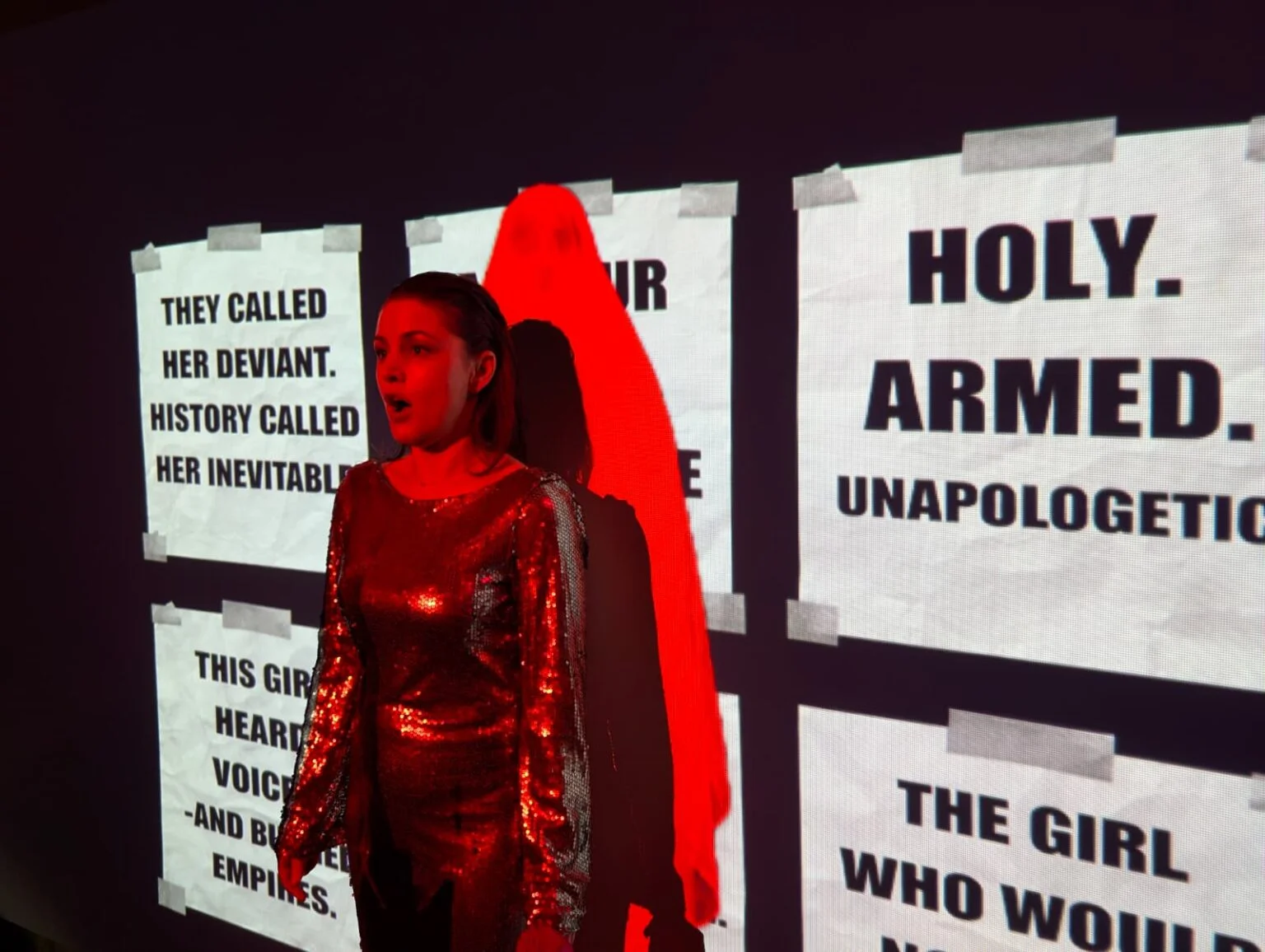
The Donizetti is his Saffo, which gives voice to the ancient Greek poet. Here Strutt has the opportunity to portray a character with even more vulnerability, and she embraces this with mesmerising passion. The Italian libretto is presented in English surtitles, as it was for the Joan piece, and it’s a wonderful chance for the creative team to use projection to establish setting and mood. Here Sappho’s lament for lost love is presented as though it were a series of text messages, and it’s a cheeky decision that underlines the universality of the experience, that Sappho’s 7th century BC concerns, via the medium of Donizetti’s 19th century opera, are still very much ours.

The Smyth pieces are her Nocturne and Possession. The latter is her work dedicated to suffragette Emmeline Pankhurst. Here surtitles are no longer necessary, and Smyth’s romantic influences are apparent. Performed with a luscious, welcoming warmth by Strutt, the melodies are rich and accessible.

Why Joan, Sappho and Smyth? These are voices of female resistance, but none has been flattened to mere slogan by the weight of opposition. Each is deeply human, acknowledging challenges while all the time reaching for joy.

Under the direction of Player, Curtain and Strutt give us a gem, a small piece that dazzles (for me, a jewel given at the threshold of a previously unexplored land, a promise of treasures, of Truth and Beauty.)

Paul Gilchrist

Possession, consisting of works by Rossini, Donizetti and Smyth,

14 – 15 Feb,  

at the Substation, Qtopia, as part of Mardi Gras.

qtopiasydney.com.au

Image by Adam Player.

Perfect Arrangement

9 Feb

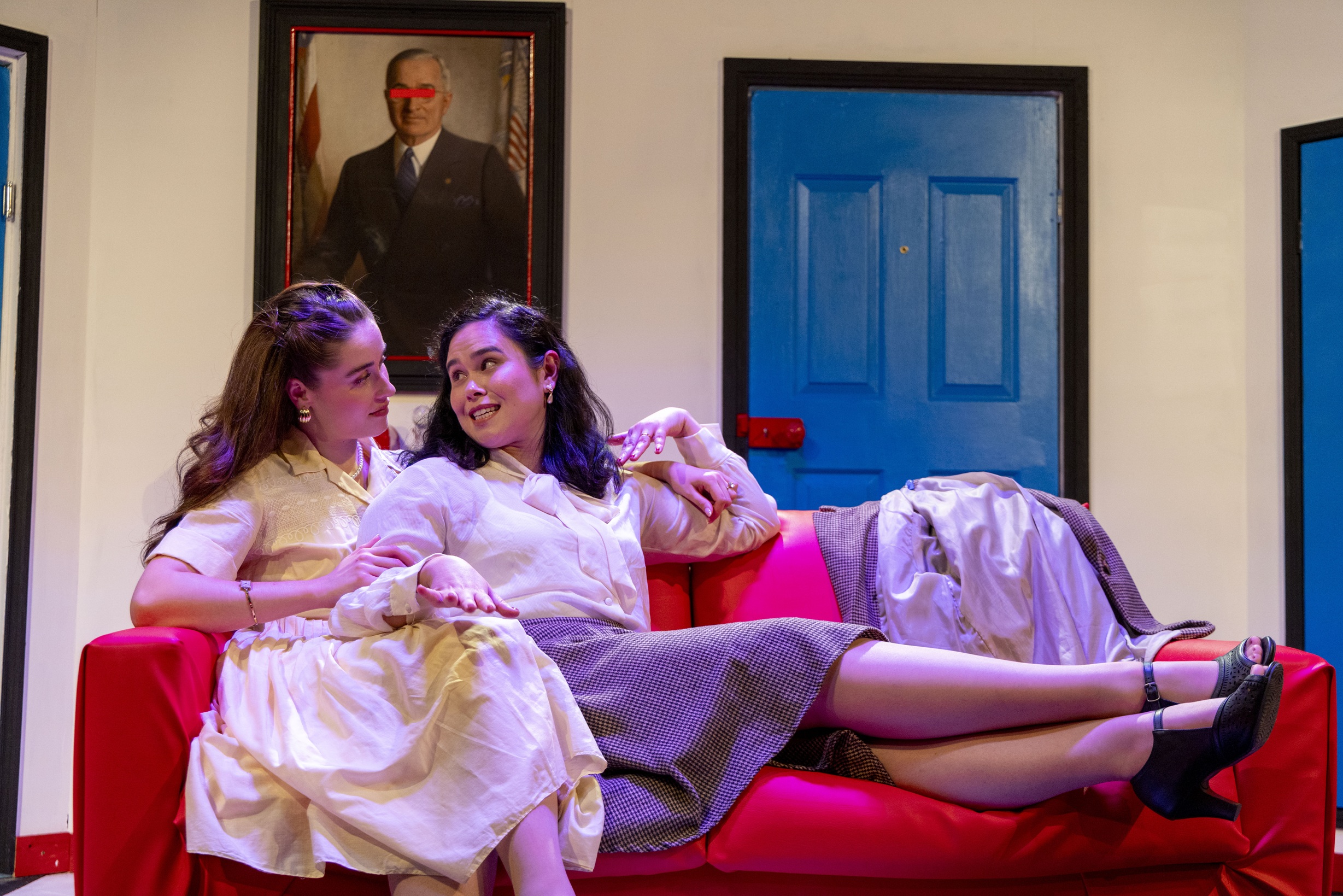
Millie loves Norma.

And Bob loves Jim.

But it’s 1950, so Millie is married to Bob, and Norma is married to Jim.

It’s a Perfect Arrangement.

The irony of the title is indicative of the humour of much of the piece; we’re invited to laugh at that pretence of contentment we’ve come to see as endemic to post-war America.

The humour is superbly playful. Both the script by Topher Payne and design by Patrick Kennedy and Tom Bannerman lean into a meta-theatricality that underlines the performative aspect of the characters’ lives. There’s the suggestion they’re being filmed on a TV set, complete with an offstage camera and an Applause sign. There’s allusions to the advertisements of the times in which chipper housewives give glowing endorsements of household products. There’s moments when the whole set deliberately lurches forward, highlighting this existence’s lack of a solid foundation. And perhaps most revealingly, there’s the mischievous conceit that when the characters exit this pretence of perfection, they retreat into a closet.

Clearly, what is being espoused is authenticity. And despite the wonderful comedy, the injustice of enforced secrecy is powerfully represented.

Director Patrick Kennedy creates a theatrical world that has a fun sit-com wrapping and soul-provoking centre. His cast beautifully bring to life both the humour and the tension.

Luke Visentin is excellent as the serious, authoritative Bob, whose playacted conservatism risks convincing even himself. Brock Cramond as Jim is lighter, a contrast to his lover that rings wonderfully true (in the disconcerting way that Truth both threatens danger and promises liberty.) Dominique Purdue as Norma bristles with defiance. Jordan Thompson as Millie gives a brilliant portrait of stifled potential, one that is intelligent and inspiringly pathos-free. Huxley Forras as a State Department official is appropriately stuffy. Brooke Ryan as his wife is delightfully silly. Lucinda Jurd shines as the brassy, unabashed Barbara.

The historical impetus for the play is the Lavender Scare of the early 50’s (or the period just prior to it) when homosexuals were hounded out of the US State Department. They were perceived as susceptible to blackmail and hence a security risk. (The logic is painful; why not accept homosexuality and watch the risk dissolve? It appears that option – sane and human – was inconceivable.)

Perfect Arrangement was first performed in 2013. Like most historical dramas, it has a whiff of anachronism about it. This is probably inevitable. Consciously or not, when we choose a story set in the past, we’ll focus on what most resonates with a contemporary audience.

Here that resonance is our current tendency to apportion blame to unlikely parties. It’s a tendency typified today in certain slogans you see at rallies or on social media, ones like If you’re not part of the Solution, you’re part of Problem or Silence is Violence. (I suspect this coercive attitude is one reason the Right has recently gained in support; accusation is a poor creator of fellow feeling, and guilt an imperfect motivator.) This play reflects the contemporary tendency to allocate blame to parties other than the obvious perpetrators – and it does so in an even more surprising manner than my above examples.

Perfect Arrangement could be read, not primarily as an indictment of the prejudice of the narrow-minded majority, but rather as a criticism of the victims of that prejudice who are too fearful to denounce it. Near the climax, Bob is told in no uncertain terms that he is the problem.

Digging further into this reading, Perfect Arrangement is not a protest play, but rather a play about protest.

But does it really blame those unwilling to object to the status quo?

Or rather, will those who suffer find in it the possibility of empowerment, an inspiring reminder that if one seeks authenticity, it can only begin with oneself? (Authenticity also ends with oneself; it’s the middle that’s the tricky bit, the bit where it helps if the majority come onboard.)

If it weren’t for the publicity requirements that push every reviewer of theatre to publish as soon as they reasonably can, I could write so much more about this piece – it’s rich, energising, and vastly entertaining.

Paul Gilchrist

Perfect Arrangement by Topher Payne

presented at New Theatre as part of Mardi Gras until March 7

newtheatre.org.au

Image by Bob Seary

The Flea

11 Feb

This is terrific fun. It’s also a very clever use of both the dramatic and theatrical forms.

Written by James Fritz and first produced in 2023, it’s inspired by the 1889 Cleveland Street scandal, in which it was claimed that gentlemen, high ranking members of British society, were frequenting a male brothel. (The accusation is obviously absurd, akin to suggesting that there are women who engage in homosexual activity.*)

One aristocratic visitor to this house of ill repute was Prince Edward, grandson of Queen Victoria, and second in line to the throne. Or so the scuttlebutt goes, and scuttlebutt it most certainly was – because the men who worked in this brothel were from a much, much, much lower class of society. Telegram boys, apparently, from the General Post Office. As if a gentleman would employ a telegram boy for anything other than the quick delivery of something urgent and rigidly to the point.

So, The Flea is an exploration of class and discrimination. Its title highlights one of the ways we try to avoid acknowledging the impact of these forces. How did these particular men end up working at a brothel, and why did it end for them the way it did? The play’s title implies that it was all just a case of bad luck, an unfortunate chain of causation beginning with an event as random and insignificant as a bite from a tiny insect. But that, of course, is dramatic irony. The play shows us something quite different; it powerfully presents the dreadful machinations of privilege and prejudice.

The Flea is beautifully written, fast paced and very funny, yet with deep emotional impact. It even manages that most difficult of achievements, what is the pinnacle of the dramatic artform: it engages us emotionally with both sides of the conflict. One way it does this is by building on motifs of intimidation; the intimidator in one scene becomes the intimidated in the next. It’s both amusing and disconcerting (like that nightmarish nursery rhyme There was an Old Lady who Swallowed a Fly.)

Director Patrick Kennedy creates an environment of theatrical playfulness while skilfully maintaining the strong narrative drive. His cast is brilliant, delivering great comic performances and embracing the script’s wild doubling. Sofie Divall is magnificent as the Queen and as Emily Swinscow, a no-nonsense working class mother, garnering wonderful laughs from both roles, and drawing tears with the latter. Similarly, Samuel Ireland doubles as the Prince of Wales and Emily’s son Charlie, and he’s delightfully entertaining as the first and heartrendingly poignant as the second. Jack Elliot Mitchell is marvellously versatile, playing Lord Euston, suave aristocratic man about town, in glorious contrast to Hanks, a super conscientious constable. James Collins achieves an equally laudable elasticity, jumping neatly between swaggering working class telegram boy and frightened upper class seeker of illicit love. Mark Salvestro balances portrayals of pimp and policeman, ingeniously highlighting the expected differences and the surprising similarities.  

Kennedy also designs, and all is gorgeously exuberant. The set, with its red and white colour scheme, its subversion of conventional lines and its inversion of traditional curves, evokes John Tenniel’s illustrations for Alice in Wonderland. And that’s appropriate – the production presents as an enchanting madcap cartoon, but it’s also a portrait of a disturbing world, one in which innocence finds no safety.

Paul Gilchrist

The Flea by James Fritz

At New Theatre until March 8, as part of Mardi Gras

newtheatre.org .au

Image by Chris Lundie

* Unlike male homosexual acts, female homosexual acts were not illegal in Britain; it doesn’t seem to have occurred to the establishment that they were possible.