
The Loading Dock Theatre is a brilliant addition to the Sydney scene.
I was privileged to see the first show produced there, Michael Gow’s Toy Symphony, presented by Ad Astra.
The play was first produced in 2007 at Belvoir. It tells the story of Roland, a famous playwright suffering writer’s block (though don’t you dare use that phrase in front of him.)
There are three curious aspects to the play.
The first is that it’s almost theatre in the first person. I’m not suggesting it’s autobiographical (who knows?) but it’s fascinating that the focus is so firmly on one central character. And this is highlighted by the fact that good chunks of the play appear to be this protagonist’s personal memories. Furthermore, the protagonist’s problem is quite particular: can he continue to write theatre? (Admittedly, anything of concern to any individual should be of interest to a truly cosmopolitan person. That Gow assumes his audience consists of such broadminded people is a beautifully generous-hearted vision.)
Another curious aspect of the play is its structure. This production was two and a half hours (including intermission) and there are scenes which left me wondering why they were there. They’re interesting in themselves, but I was uncertain of their purpose or value in the play as a whole. Why do we get a scene explaining copyright law? Why are the childhood memories of Como Primary School so thorough? Why do we get a lengthy monologue in which Roland tells an unseen character what he said at his mother’s funeral? These vignettes further suggest the play’s affinity with autobiography, a form which acknowledges that the entire truth of a life can never be told, but that certain select moments will be its best intimation. The truth is clearly outside the text, not inside. This is probably true of all theatre, but to vastly varying degrees. Some plays seem to deliberately ask us to judge whether they’re a fair representation of reality (or, increasingly, they simply assert they are.) Other plays focus instead on drawing us into their world, inviting us to go for the ride. Toy Symphony is the first type, because the vignette form means the world of the play is inherently fractured and incomplete, but the challenge for us is that the truth being represented seems so especially precise, and potentially personal, that it’s difficult for us to judge the representation’s success.
The final intriguing aspect of the play is a recurring conceit. As a child, Roland can conjure people. He thinks of them, and they appear – but not to his mind’s eye alone, to everyone else as well. On one level, this is a literalisation of what playwrights do when they create characters … but the conceit resists such easy interpretation. If it’s meant to suggest the potential creative power of playwrights, you might respond that surely the play itself is an attempt to display this power, and so the conceit begs the fundamental question of realist theatre. (It’s as though a carpenter made a table out of little tables in order to clarify what she can do.) As a result, the play feels like a shot fired in a very Australian culture war, part of that battle in which artists desperately feel they must justify their own existence.
Clearly, this play sent me off into the night with a bundle of questions – exactly what I want from theatre.
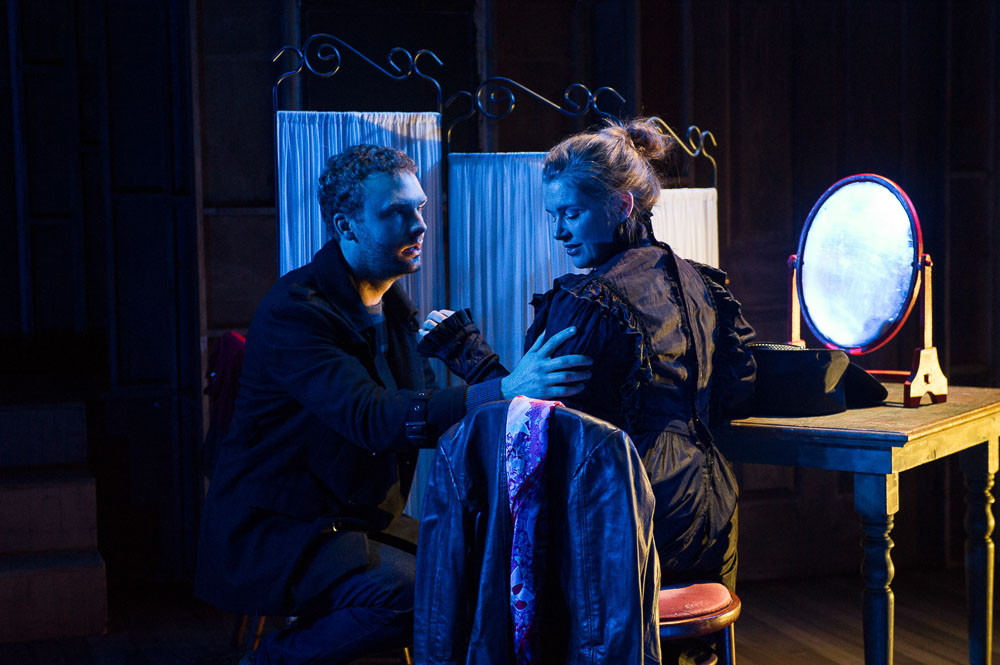
Director Michelle Carey deals with this provocative play by presenting it with boundless energy. Gregory J Wilken as Roland gives a performance that’s vibrant and always engaging; juxtaposing the wide-eyed child with the jaded artist. The supporting cast matches his energy, bouncing between realistic portrayals of adult professionals to theatrically enthusiastic children. Let me cherry pick some favourites. Wendi Lanham is eminently watchable as Roland’s therapist. Felix Jarvis as Daniel, an actor in training, gives a wonderful portrait of that youthful mix of confidence and insecurity. Bernadette Pryde is mesmerising in her evocation of the gentle, good humoured primary school teacher. Sam Webb as the school yard bully is suitably both intense and dense, and John Michael Narres’ school principal is deliciously meanspirited.
It was a pleasure to see this piece in an exciting new venue.
Paul Gilchrist
Toy Symphony by Michael Gow
at the Loading Dock Theatre, Qtopia, until 27 April
qtopiasydney.com.au/performances/
Image by Bojan Bozic
 Theatre Red