Tag Archives: New Theatre

Plenty of Fish in the Sea

23 Sep

Firstly, this is top-class physical theatre.

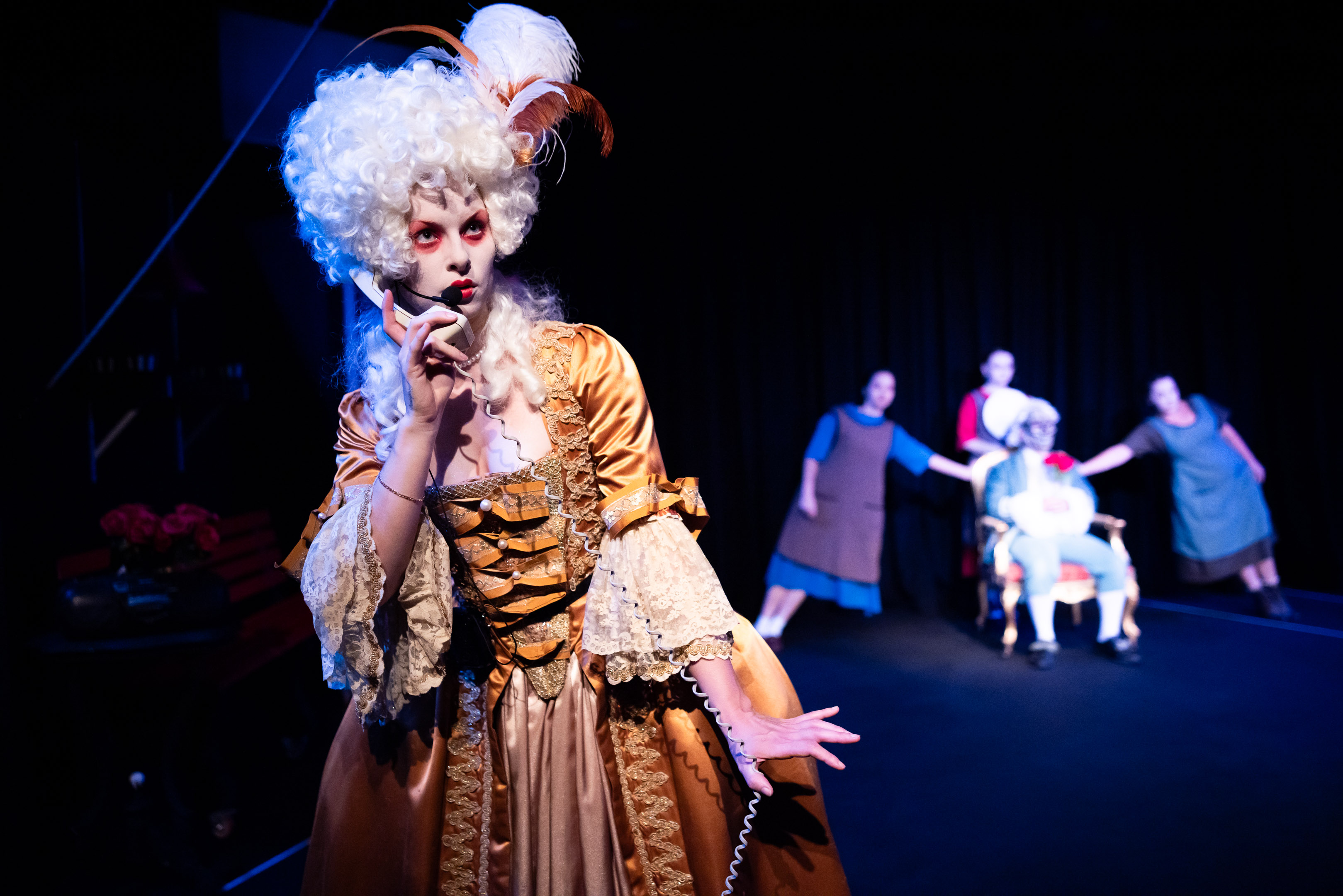
Created and directed by Emily Ayoub and Madeline Baghurst, and performed by these two artists and Christopher Carroll, Plenty of Fish in the Sea is a visual wonder.

The choreographed movement is extraordinary, and the individual clowning a treat – replete with hilarious visual gags and moments of playful poignancy.

Tobhiyah Stone Feller’s design is both beautiful and inventive and, mounted all on wheels, it dances with the performers. The soundscape with composition by Daniel Herten is enchanting and fun, and the performers’ interaction with it is superb. Victor Kalka’s lighting design is a gorgeous game of light and shadow, creating a magical aura that invites us into the play’s fabulous world.

Which brings me to Secondly: What is it all about?

On the surface, a French speaking nun (Je ne pourrais pas) and her silent novitiate go fishing and catch – with a hook – a man. They then want to teach him to fish. He learns. They catch a huge amount of fish. He says too many. And I’ll leave it there.

Except for the sex. I really should mention the sex.

Fables don’t usually have sex (which is probably why they’re of little interest to most people.) I guess the piece is a fable about excess, in particular sexual excess; a sort of allegorical presentation of the endless opportunities offered in our society for hooking up, and the way that can lead to hyper-sexualisation (which may, or may not, be a good thing.)

You can probably sense a little doubt. I’m uncertain about the meaning of the piece for two reasons. One reason is the work’s potential for sensory overload, which (for me, at least) results in semantic overload. In addition to the extraordinary visuals and soundscape, there’s also spoken word. A recorded voice over reads from a book the women have given the man. The book appears to be some treasured text about fishing, but it’s salted with symbolism and mischievous hints of higher meaning (or perhaps lower meaning; see earlier comments about sex.) I found the VO difficult to follow; I’m not sure if that was because of a technical thing or an accent thing. There’s also a lot of talk from the French speaking nun which, va sans dire que, I didn’t understand. The only spoken word accessible to me was the dialogue of the male character, and I felt positioned a little like him – bewildered, charmed, and ultimately fucked over (in the nicest possible way.)

The second reason I’m uncertain about the meaning is that I’m not sure the piece really does operate as a fable or an allegory.

Perhaps, instead, it does what abstract art can do: that is, present a mood that resists or escapes linguistic statement. (Picasso, or somebody, said something about not wanting to paint what trees look like, but rather how they make you feel.)  

Or, perhaps, the piece functions as a sort of Zen koan; a teasingly deliberate denial of certainty; a cheeky refusal to flatten into a dull, explicit meaning; a type of tricksy epistemological illusion that offers intimations of spiritual liberation.

Whatever the case, seek depth, if you want – but know for sure this work delivers true delight.

Paul Gilchrist

Plenty of Fish in the Sea by Emily Ayoub and Madeline Baghurst

Played at New Theatre, as part of the Sydney Fringe,

17 -21 September

Image by Geoff Magee
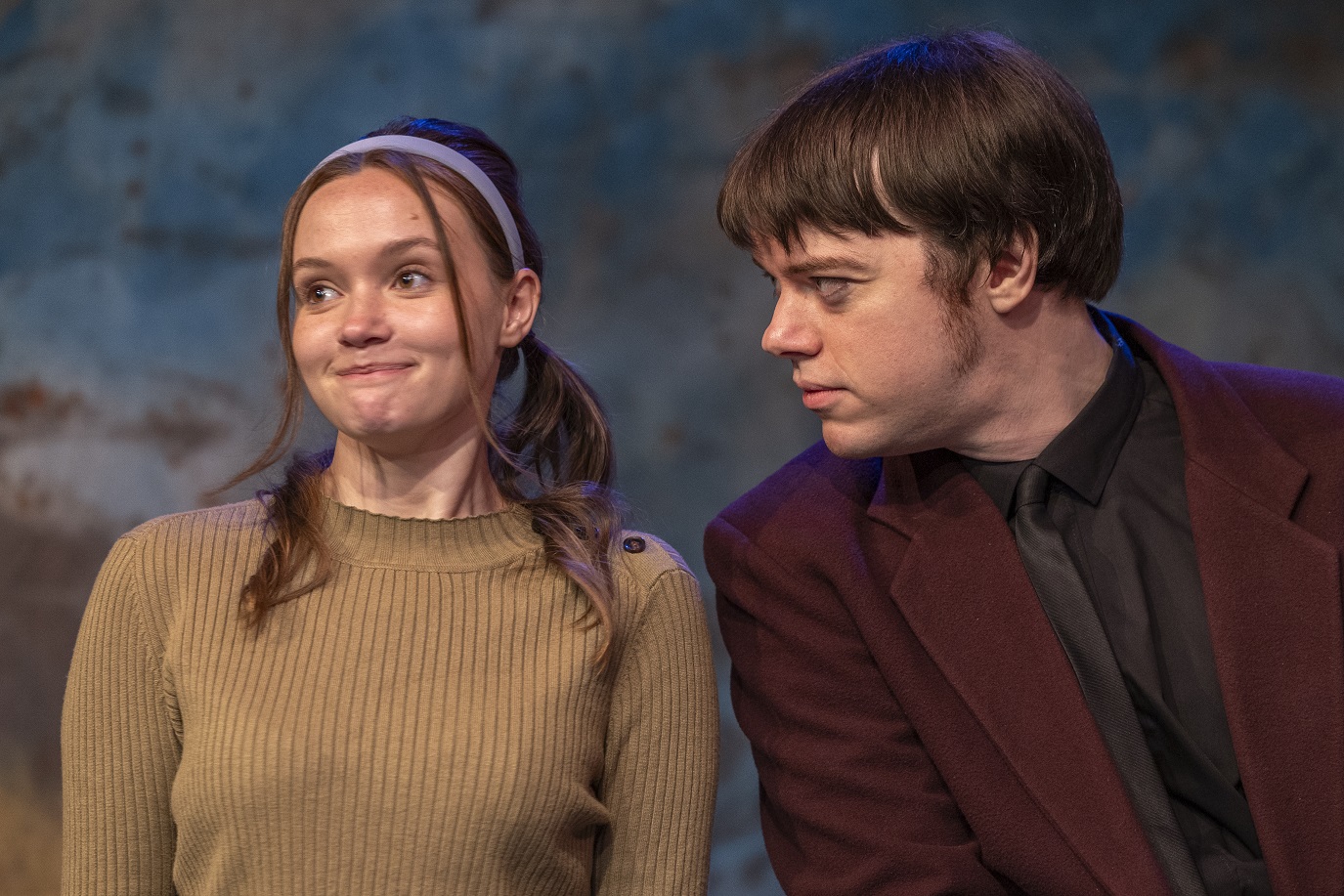
Hangmen

19 Aug

I don’t believe in theatre awards. (Not that they exist, but that they have much validity.)

But Hangmen by Martin McDonagh won the 2016 Olivier Award for Best New Play, and it’s certainly an extraordinarily well-crafted comedy.

Set in 1960’s northern England, it purportedly features the last hangmen employed by the British Crown. But capital punishment has just been abolished, and at least one of these men feels that now is the time to bask in a little celebrity.

But fame is a lure that attracts some truly strange fish.

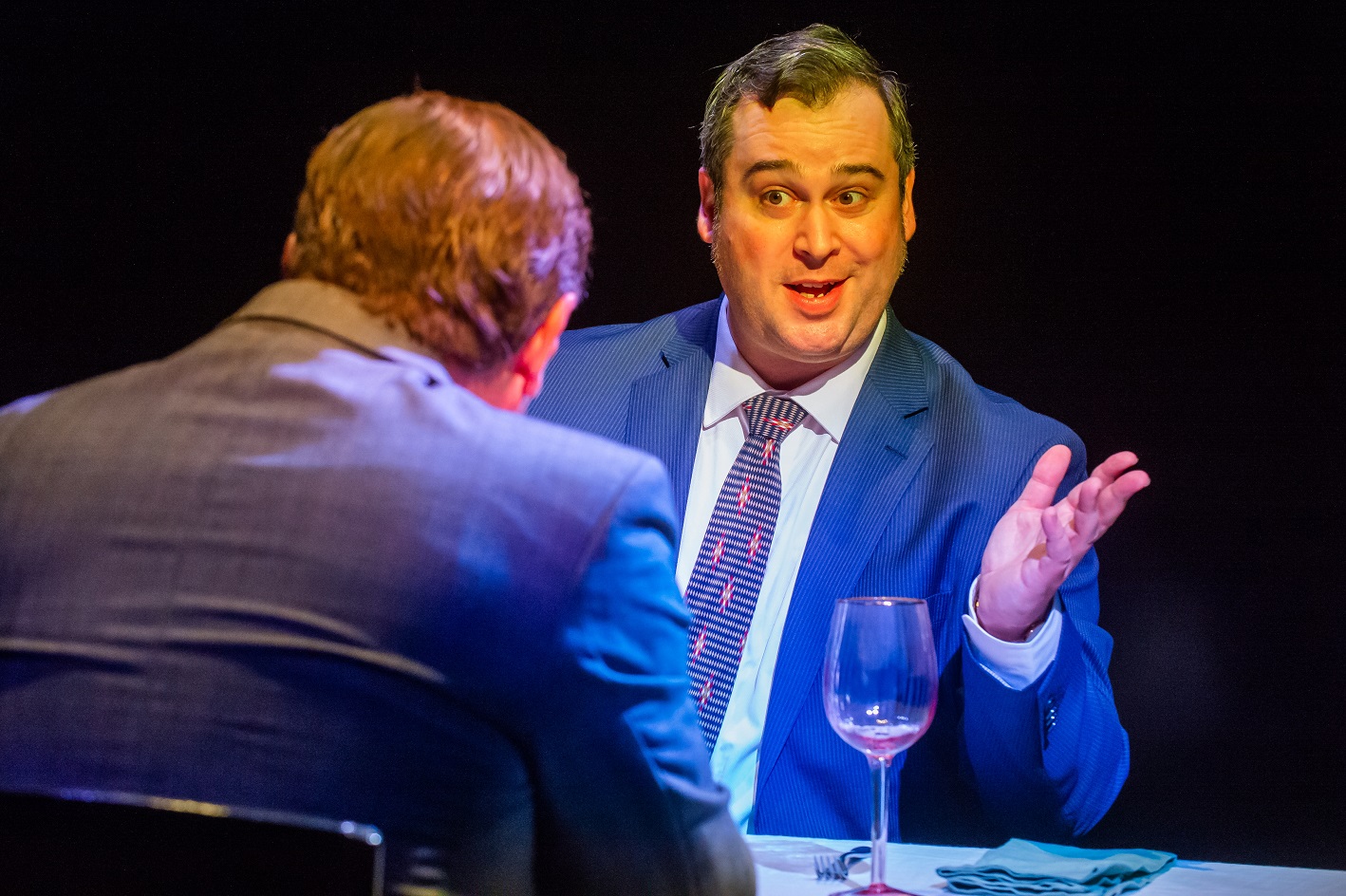
Directed by Deborah Mulhall, this is a terrific production. The entire cast do brilliant comic work. (A few highlights: Nathan Farrow as the bragging, bullying publican and ex-executioner is point perfect. Sonya Kerr, as his wife, beautifully balances the no-nonsense strength of a woman who runs a pub with the vulnerability of a mother only too aware of the dangers faced by her daughter in a brutal, male-centric world. Kim Clifton as that daughter is excellent, offering a marvellous portrait of that quintessentially teenage mix of awkwardness, defiance, naivety and wonder. Robert Snars as the stranger who appears at the pub is superbly menacing.)  

Hangmen is a black comedy, and black comedy is a very particular taste. (Not particularly mine.)

How can we laugh at violence?

There is most certainly a strand of spiky satire, a mocking of the inadequacy of those whose administer justice, and a poking at pretension, egoism and heartlessness.

But it’s the last of these – the attack on heartlessness – that undermines black comedy for me. It’s as though we’re being invited to respond to the heartlessness of violence with …. heartlessness. It can feel a little like the pot calling the kettle black (or, at least, somewhat grimy.)

And this show demands a pitiless physicality. Horrific violence reportedly happens offstage, but we must also witness horrendously violent acts onstage. Frustratingly, the spoiler rule reduces me to a nebulous imprecision – but let me say that an act is represented that more sensitive souls may not wish to see, let alone be inclined to giggle at. (But more on this latter.)

Comic violence is extraordinarily difficult: how much do we want the audience to believe it? If the representation fails to achieve verisimilitude, our attention is drawn to this seeming defect. But, if the representation does appear realistic, it’s unlikely to be funny. (Again, more on this later.)

And adding to the challenge of representing such violence on stage is the spell-breaking fear that the stunt may go dreadfully wrong. Safety procedures mean that it won’t – but, as you hastily make that assessment, you’re dragged out of the world of the play.

But back to my annoying More on this later refrain.

Despite my doubts about black comedy, I know the genre is deliberately edgy. It’s meant to make us feel uncomfortable. And discomfort can be soul-expanding, and in our lives of privileged complacency and self-righteous moral certainty, a little expansion wouldn’t do any harm.

Perhaps our laughter at black comedy is just how we hide from a horrible truth. Perhaps it’s merely our way of refusing to acknowledge seriously that a temptation to violence dwells in the human breast.

Or, perhaps our laughter at black comedy can surprise us. Perhaps it can be a delightfully disarming revelation that we too share in humanity’s darker tendencies.

And, if it helps us realise that we’re in this grand mess together, then it’s a good thing.

Paul Gilchrist

Hangmen by Martin McDonagh

until 14 Sept at New Theatre

newtheatre.org.au

Image by Bob Seary

Ink

10 Jun

With a title like this, I was expecting the story of a giant squid. I was expecting a hideous creature from the murky depths, a cold blooded monster from that mysterious world down under, a frightening phenomenon with a disturbing multiplicity of arms, arms that grab at everything we hold dear, at every civilised thing, at that fragile ship we call society, and drag it all down, down, down.

So, you can imagine my surprise when I found this show was about Rupert Murdoch.

Written by James Graham and first produced in the UK in 2018, Ink tells the story of the first year of Murdoch’s ownership of the newspaper The Sun and the impact on the Fleet Street scene.

In some ways it’s ancient history; despite Murdoch still being with us, the play is set over 50 years ago. Whatever was the impact then, you might wonder whether it’s worth crying now over spilt ink. I grew up in a world in which the damage was already done.

It’s a grand piece of storytelling, with a huge dramatis personae and 2 hours 30 minutes stage time (and an interval.) Director Louise Fischer marshals a fine cast.

Despite this grandeur, the piece has a curiously small focus. This is a result of three of the playwright’s creative decisions.

Firstly, The Sun’s editor, the now deceased Larry Lamb, gets far more stage time than Murdoch, and the media mogul is presented as almost reluctant to accept some of his editor’s more trashy strategies. (Lamb is played wonderfully by Nick Curnow, in a performance that drives the production.)

Secondly, we’re shown only Fleet Street, so the point of debate – whether The Sun’s tawdriness actually affected society or merely reflected it – is reduced to competing assertions from characters within the parochial world of the press.

And finally, the complaint many people have had about Murdoch over the years is his political impact, his alleged pushing of the working class towards the Right. However, in the year represented in the play, that tentacle is yet to surface. The Sun’s sin is that it’s low brow, not that it’s fascist.

Not that the play is oblivious to the possibility of political influence; in the final moments there’s an ominous swirl in the inky waters.

And it will no doubt be a discussion starter.

I’ll get the ball rolling. The role of the media in civic society is always ambiguous. The media can help and it can hinder. Democracy may die in the dark, but neither does it cope well with noise.

And we’re often tempted to ignore the role of the media’s audience. It’s easy for us to assume that the audience are passive consumers who unthinkingly accept whatever they’re told. (Fortunately, this is an error we ourselves never, ever commit.)

In a capitalist society – in any society – can we be surprised when the media chases an audience?

How are both civic society and culture created?

Where does responsibility, and power, lie?

Paul Gilchrist

Ink by James Graham

at New Theatre until June 29

newtheatre.org.au

Image by Chris Lundie

The Front Page

28 Apr

This is fast-talking, wise-cracking American comedy, of the style brought to a world audience during the Golden Age of Hollywood.

First produced in 1928, The Front Page by Ben Hecht and Charles Macarthur is the play that became the film His Girl Friday, starring Rosalind Russell and Cary Grant.

Set in a Chicago courthouse newsroom at the eve of an execution, it’s satire of cynical journalists, police officers and politicians is nothing new now (though still it rings true.)

This production, directed and adapted by Nicholas Papademetriou, has a beautiful bouncy, brassy spirit. Except for the opening scene, which on the night I attended lost necessary pace because of line stumbles and awkward props, the show honours the grand comic tradition of which it is part.

Papademetriou follows the lead of the writers of His Girl Friday and makes the play’s protagonist a woman. Hildy has worked for The Examiner for years, and though it’s a man’s world, she is clearly their ace reporter.  However, with the offer of marriage to a respectable man, she’s tempted by the quiet of domesticity.

Can she leave the game behind? Her boss, Walter, wants her to stay, for more reasons than one.

Rose Treloar as Hildy is extraordinary. Rosalind Russell would be proud. From the moment she enters, Treloar’s energy is stellar, and she drives the production with a gloriously assured exuberance.

Andrew Waldin as Walter is brisk and nimble, and achieves that most difficult of comic tasks: the portrayal of a charming con-man.

The large supporting cast generally does good work. Let me cherry pick just a few favourite performances. Diego Retamales as the man on death row is superb, his physical comedy top class.  Callum Stephen slips into the shoes of the ex-gangster with such laughter-inducing ease that we readily believe the character has helped many a chump slip on shoes of the concrete variety. Braydon May, as a messenger in the Governor’s employ, works the classic trope of the pedant in a world of action with hilarious effect. Georgia Nicholas as the only other female reporter in the newsroom has a wonderful stage presence, positioned perfectly in regard to Hildy’s energy, and establishing with tight rope precision the competing needs created by a patriarchal environment, the requirement for both female feistiness and sisterly support.      

Brash, buoyant, confident, this is comic theatre with old school swagger.

Paul Gilchrist

The Front Page by Ben Hecht and Charles Macarthur (adapted by Nicholas Papademetriou)

at New Theatre until 18 May

newtheatre.org.au/

Image by Chris Lundie

Homos, or Everyone in America

12 Feb

I’d be terrified to direct this one. It runs 105 minutes straight through. It’s made up of an enormous number of rather short scenes. The majority of these scenes are played solely by the same two actors. The scenes are not in chronological order. They’re set in a small number of locations (which might appear to make things easier, but actually robs you of the opportunity for variety). And it being New York 2016, it’s all played in accent. Oh, and there’s sizable chunks of overlapping dialogue. It’s a director and performer’s nightmare.

Director Alex Kendall Robson and his cast are to be congratulated for making it work, creating an engaging evening of theatre.

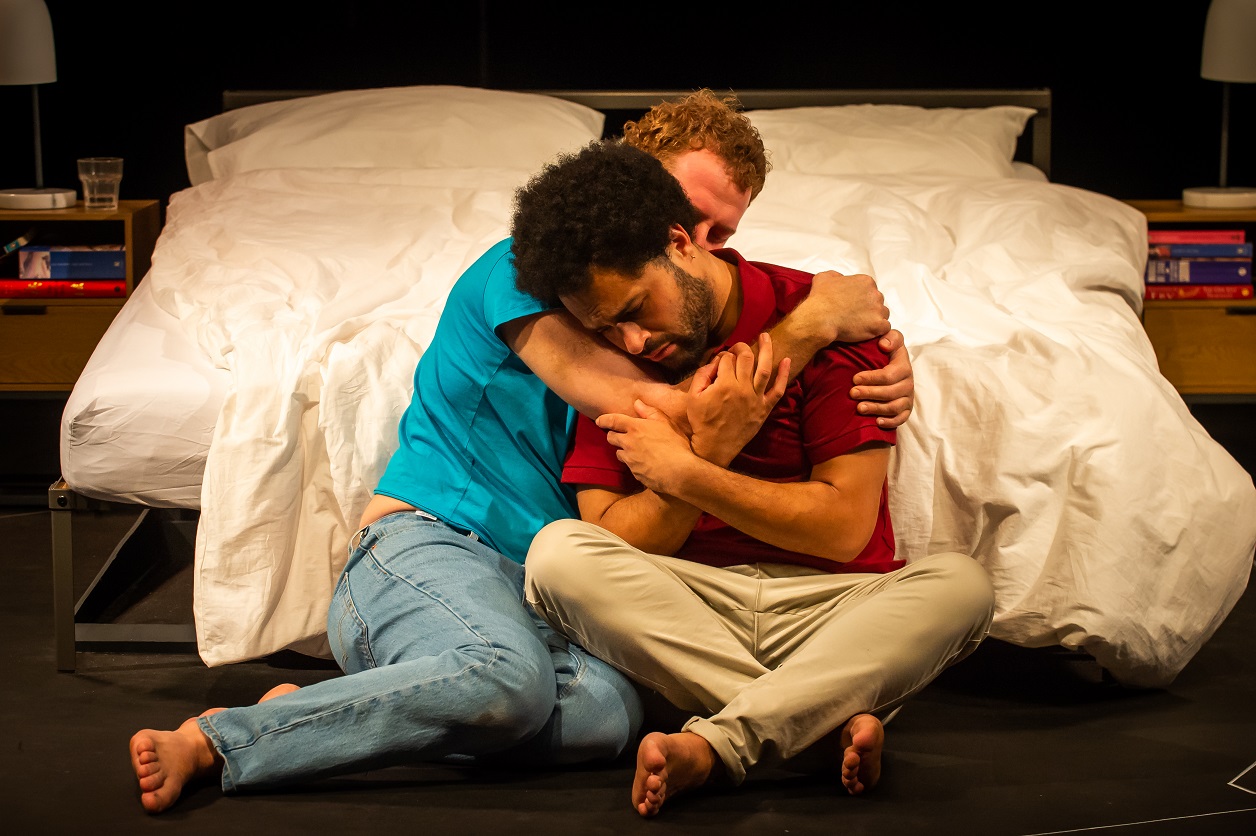
Homos, or Everyone in America by Jordan Seavey presents the relationship between a “Writer” and an “Academic” over a handful of years. But by referencing events both from their childhood and before, and events contemporary to the writing of the play, their relationship evokes the gay male experience in America over the last fifty years.

Except for an absolutely show stealing scene in which Sonya Kerr creates both humour and pathos as a sale assistant at Lush, the play revolves entirely around the discussions between the two gay male lovers, and with their gay male single friend, Dan. Reuben Solomon as “The Writer” and Eddie O’Leary as “The Academic” are on stage for an extraordinary amount of time and they’re gloriously vibrant. With a performance that effectively suggests both the desire for inclusion and the awareness of exclusion, and as such is less vocally intense, Axel Berecry’s Dan gives the production a pleasing texture.

The lovers either flirt or bicker. You might think that a depressing image of romance. But is it actually possible to present the reality of romance on stage? Can romance, in itself, in its odd smallness, in its reduction of the wide world to one person, be the stuff of drama? We like to say Love is blind, but it’s actually just myopic. Romcoms employ humour because without the laughs, and the predictable beauty of the youthful characters, no one would be interested.

Perhaps we avoid a realistic portrayal of romance in theatre because, understandably, the audience thinks they already know enough about it. It is, after all, a rather garden variety human experience. When some Shakespearean character says nonsense like “The sun doth rule the heavens”, the rest of the cast don’t point flaming torches at the stage in the hope of suggesting something about the nature of sunshine. The audience knows what it is – and so the play gets on with its real business.

So what is actually happening when we purport to put romance on stage? What is the real business? Plays that represent gay romances tend to do so for two reasons.

Firstly, they remind us that they’re an everyday occurrence. And, yes, in a heteronormative society, that’s still desperately needed.

Secondly, they present the gay political experience. (Any decent play about heterosexual romance is also about politics. Name one well known play that’s actually about the romance itself, the personal experience of the lovers? To clarify, let me shift focus to another artform. All those nineteenth century novels ending with Dear Reader, I married him are bildungsromans, stories of young people growing up and either accepting their role in society or actively challenging it. They’re about politics.)

In this play, politics are particularly highlighted because that’s what the lovers bicker about. They fight about whether closet gays should be outed, about the gendering of language, about intersectionality and objectification, about the perpetuation of stereotypes, about homophobic violence, about the gay community. (What exactly is a community? There’s an entire play just in that. And like all good plays, it wouldn’t give an answer, only elucidate how complex is the issue.)

It’s a modern day cliché that the personal is the political, and the phrase’s popularity can be partly attributed to its nebulous nature, to the ambiguity of its terms. Many people use the phrase to express nothing more than their refusal to be alienated from sources of power: I will not be told that my actions are without influence. Other people use it to police the lives of those closest to them: You will behave this way because your actions have an impact you can’t see (though I can.)

Of course, the phrase the personal is the political could be simply read as what rhetorically it is: a paradox constructed from the juxtaposition of opposites. The personal is what we can do alone. The political is what we can do together. Viewed this way, every relationship belongs in the political sphere, and the much quoted phrase is, in effect, the denial of the very existence of the personal sphere.

This denial serves theatre well. As an artistic form, it’s never been particularly good at representing the personal sphere of life. That’s why it naturally privileges the presentation of individuals in their dealings with other individuals. It struggles to show us the inner world.

Perhaps that’s why Homos, or Everyone in America is fascinating. It’s very lack of ambition, its focus on a single romantic relationship, might be its strength. Theatre might glory in representing relationships, but what if romance is the most personal of relationships? Might we be getting somewhere new?

Or perhaps, as a cynic might say, romance is actually the least personal of relationships. It’s just blind biology that drives us together, rather indiscriminately, and the most positive thing we can say is that desire unconsciously creates one of the great glues that holds together …. community. Ah, that word again.

Homos, or Everyone in America is a beautiful acknowledgement of the experience of romance, and a teasing invitation to thought.

Paul Gilchrist

Homos, or Everyone in America by Jordan Seavey

At New Theatre until 9 March

newtheatre.org.au

Image by Chris Lundie

Sophia = (Wisdom): The Cliffs

25 Jan

Not to be told what to think … how wonderfully refreshing!

It’s pure relief to see a play that doesn’t have a blatant message. It’s a burst of cool, clean air – one which the Sydney theatre scene badly needs. All too often our audiences are offered productions in which the artists have something to say, and boy are you going to hear that something good and hard.

I’m not such a nihilist that I object to a message per se. It’s just that the message is often either painfully obvious, bereft of any complexity, or simply utterly lacking originality. You don’t need to go to the theatre for this sort of thing; you could go to your local church. The performance there has every chance of being more entertaining. And, honestly, the message might be richer. And I guarantee you’ll need to throw far less into the collection plate.

Artists, if you can say it in a slogan, maybe you don’t need a story. You certainly don’t need the dramatic form, whose particular magic is multiplicity. Yes, I’m being harsh, but we really must re-explore theatre’s potential. All justice and no joy makes theatre a deathly dull and dangerous toy.

Directed by Patrick Kennedy, Richard Foreman’s Sophia = (Wisdom): The Cliffs is a wondrous gift of a piece. It playfully invites us to think: about wisdom, about theatre, about being an audience. Or perhaps it’s more tongue in cheek than that. Perhaps it’s allowing us to not think at all.

Light on both narrative and characterisation, it’s constructed from a deliciously beautiful use of space (some of the most brilliant I’ve ever seen), a glorious use of colour and costume, and an extraordinarily eclectic and evocative soundscape. All design is by Kennedy and it’s a magnificent achievement. Foreman has created a marvellously mischievous meta-theatrical template and Kennedy makes the most of its wild potential.

The cast do terrific work, inhabiting a performative world in which flat realism is almost entirely replaced by near mechanically-precise movement and vocal work. This joyfully jolts us from any risk of deadening complacency, reminding us we’re not passive witnesses and that what occurs on the far side of the fourth wall can’t (in itself alone) be Life.

And, every now and then, the lights dim and the house lights come up. We become witnesses to ourselves, and we might recall, that despite all the fabulous work on stage, it’s our response that’s crucial. We’re not mere recipients of a message. We’re co-creators of the magic.

And what magic it is!

Paul Gilchrist

Sophia = (Wisdom): The Cliffs by Richard Foreman

Produced by Patrick Kennedy Phenomenological Theatre

At New Theatre until 27 Jan

newtheatre.org.au/sophiawisdom-the-cliffs/

Image by Daniel Boud

The Ballad of Maria Marten

4 Dec

We know Maria is dead from the beginning. She tells us. We’re going to be shown how it happened. It’s an interesting creative choice, especially considering that the dead Maria accuses us of coming along just to see her murder (a crime I was previously unaware of, and a crime that it wasn’t me who chose to write a play about.)

But, apparently, Maria’s terrible fate is well-known, and has been the subject of ballad and theatrical treatment many times before.

The poor woman was murdered by her male lover in Suffolk in 1827.

Here playwright Beth Flintoff presents it as the story of a woman who suffers from gaslighting and coercive control.

There are other intriguing decisions being made: the key one being that men are substantially written out of the tale. In the first act, the only two male characters who appear are played by women. Rhiannon Jean and Olivia Bartha create these two wonderfully: Jean’s Thomas encapsulates small obtuse selfishness, and Bartha’s Peter is a terrific portrait of genuine personal affection battling social expectation.  

In the second act, no male character appears on stage at all. It’s a brave decision. By privileging the female experience, the risk is run of making it less comprehensible – considering the topic is the relation between the sexes. Maria drives the play, and Naomi Belet’s performance is eminently watchable, a pathos inducing mixture of glorious exuberance and traumatised doubt. The script’s decision to exclude the culpable male character effectively centres the victim’s torment, but does so at the cost of making it less certain. The gaslighting and coercion are not shown, and so perhaps Maria really is a fool or mad – though I’m pretty sure that’s not the tale’s conscious purpose. In addition, choosing not to show men behaving badly can have the unintended consequence of imply their agency is irrelevant, and that the problem of violence against women is solely, and unfairly, up to women to solve.  

Such a tale as this is indicative of the ambiguity in our current use of the word “story”. We constantly say things likeour stories should be told”, meaning our lived experience should be acknowledged or seen. But that isn’t the only meaning of the word “story”. A good story is not simply a true one. The feminist assertion that most stories have expressed male lived experience is entirely valid, but in the pain of exclusion, to conclude that is all stories do is to miss their potential. Stories are not merely records of experience; they are invitations to judgement. Representation is not approval or assent; audiences can, and do, judge the actions of characters. Human beings delight in discernment; it’s the basis of our agency in the moral universe. In its invitation to judge, theatre is a type of enjoyable work out, a necessary training for the real thing.

Director Louise Fischer’s female ensemble do some great work, but the conclusion of the piece also prodded me into thought. I’ll be wary of spoilers, but the play’s presentation of female solidarity is fascinatingly indicative of the current zeitgeist. Is the freedom of throwing off the dominance of one group only to be found by being subsumed into another? And is political action always to be symbolic?

My vagueness is no doubt frustrating, but see this work – and then read about the historical events on which its based – and you’ll see that it is burningly relevant, both in its powerful indictment of misogyny, and in its thought-teasing presentation of contemporary political assumptions.

Paul Gilchrist

The Ballad of Maria Marten by Beth Flintoff 

at New Theatre until 16 December

newtheatre.org.au

Image by Bob Seary

A Very Expensive Poison

30 Aug

What would you call this? A reportage play? A recent history play? Whatever you call it, it’s a happening genre. Recent events, covered by the media, become a work of theatre.

The reasoning is simple: what the media provides is problematic. The media throws information at us helter skelter, bit by bit, hour by hour, and then moves on. The media isn’t trying to help us make sense of the world; it’s simply trying to get our attention. It treats us like children; it shakes a rattle, it plays peek a boo. For those of us who have achieved object permanence, this can feel a little dissatisfying. I’m informed that such and such happened, but I often don’t know what happened before such and such, and I rarely find out what happens after. A lack of understanding of how motivations, actions and consequences interconnect is a recipe for disempowerment. The media purports to offer information, but often is only selling passivity and impotence.  

Dramatists, and writers of other forms, have realised there’s a place for an extended narrative that makes sense of the helter skelter of the media, joining the before and after of an event into a coherent whole.  

In 2017, Luke Harding wrote A Very Expensive Poison: The Definitive Story of the Murder of Litvinenko and Russia’s War with the West. In 2019, dramatist Lucy Prebble adapted it, presenting the story of Alexander Litvinenko, poisoned by Russian agents in London in 2006.

Of course, the challenge of this type of writing for theatre is that some of it will naturally be invention. Did Putin really say that? Fiction can be taken as fact. Prebble guards against this through the use of a playful meta-theatricality, reminding us to remain alert, that the passivity endemic to television viewing is no option.

The point of all this – apart from entertainment, and this play and this production are hugely entertaining – is to impart political insight. Sure, some of these insights may appear too obvious to earn that title. That expediency often trumps justice, that determination is necessary if justice is to be ultimately achieved, are assertions unlikely to enlighten anyone – but in any seriously engaged political life they bear repetition.

Other insights offered are more drama-ish. (Yes, a made up word.) By it I mean the insights that drama is particularly suited to give. These are often of the giving-voice-to-the-devil type. Several men whose ethics we might find reprehensible are given voice in this piece. One tells of Russia’s history of suffering, suggesting that our moral objections might, from another perspective, seem merely irrelevant self-indulgent scruples. Not for a moment does Prebble suggest that Litvinenko deserved to be murdered; her intention is clearly to indict a Russian regime capable of such an atrocity, and to critique Britain’s reluctance to seek justice.  But it remains a valid point, that despite our deepest wishes, moral systems are not universal. To successfully live with others (other countries, other individuals) and to retain the hope that we might nudge the world a little closer to the ideal we desire, we need to know this.

Have I made all this seem rather heavy? It’s not. Prebble’s script is brilliant, and director Margaret Thanos’ production allows it to shine. With movement director Diana Paola Alvarado, Thanos gives a show brimming with pace, energy and pizazz.

Performances are excellent. Richard Cox as Alexander Litvinenko gives a moving portrait of the relationship between moral exertion and woe. Chloe Schwank as Marina Litvinenko beautifully portrays a journey from fear and frustration to strength and resoluteness. Tasha O’Brien as Putin is absolutely marvellous; she gloriously embraces the comic possibilities of the role while simultaneously presenting a character whose personal awkwardness and deep mistrust make a truly dangerous enemy.

Paul Gilchrist

A Very Expensive Poison by Lucy Prebble

at New Theatre until Sept 16

newtheatre.org.au

Image by Bob Seary

Off The Record

20 Jul

I’m loving New Theatre‘s commitment to new work.

Chris Aronsten’s Off The Record was shortlisted for the 2021 Silver Gull Play Award and here it is on New’s stage. (New Theatre deserves congratulations for continuing this award – as does whoever initially established it.)

Off The Record is a fun comedy that deals with serious issues.

In some ways, it’s a curious example of contemporary Australian writing; for instance, it’s set in contemporary England.

There are laughs aplenty, but there’s also a powerful exploration of what it takes to blow the whistle.

Corporate heavyweight Tony has done wrong. Employee Janine and TV journalist Jenny seek justice for the victims. But Jenny is an alcoholic and Janine is … well, eccentric. (Tony complains – and perhaps I paraphrase – “You can’t call a woman crazy anymore.”)

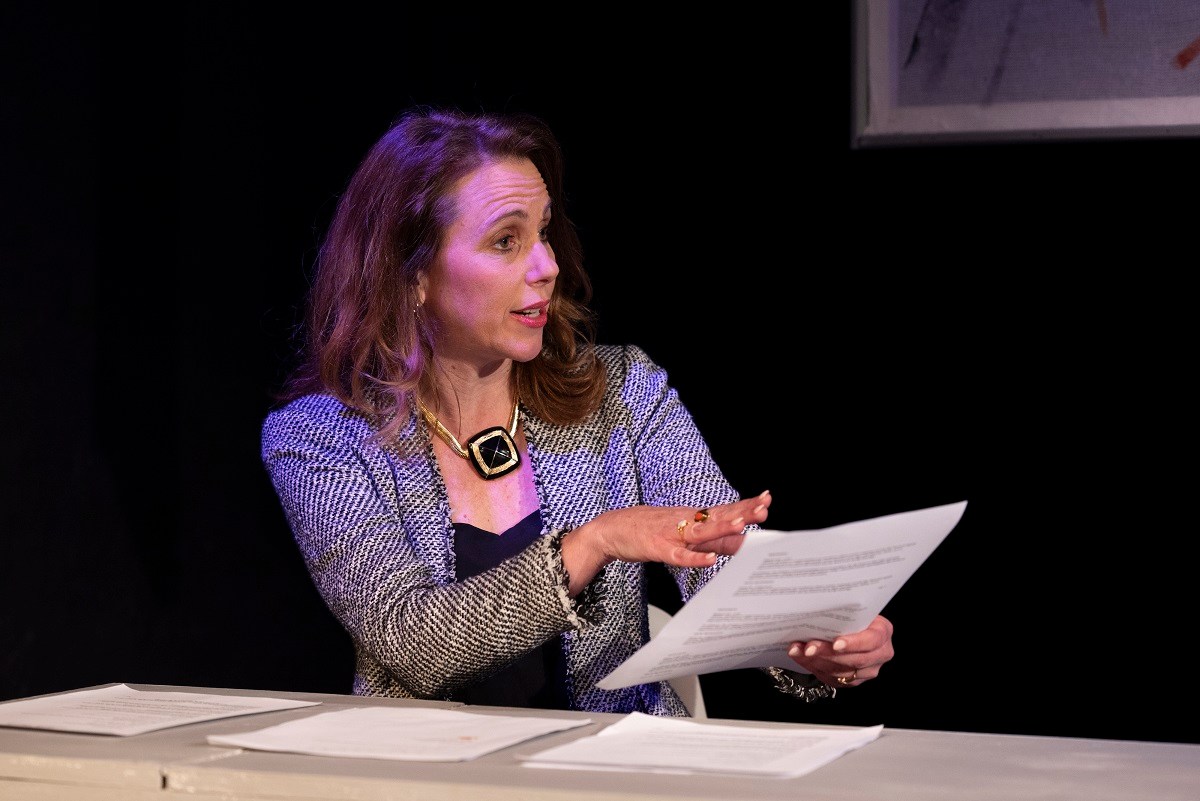
Director Jess Davis’ cast deliver wonderful performances. Michela Noonan as Jenny magically blends sass and vulnerability. Suzann James’ Janine is both very funny and very moving. Belinda Hoare as Jenny’s AA sponsor has a magnificently truthful delivery; simple, honest and raw. Joe Clements as Tony gives a suitably disturbing portrait of pompous privilege.

The script has some intriguing absences. Tony’s sin is outlined but (fortunately) not shown. His guilt is never really up for question, but is what he’s done a crime? Or is it an abuse of power? Abuses of power are not automatically illegal. (Perhaps this was all clarified and I simply missed it.)

The other absence is the victims. They remain off stage.

The result of these creative choices is that the whistleblowers, flaws and all, are placed front and centre. And what we get is a beautiful portrait of what it is to do right, to try to do right. To make a better world, saints are not required. We’ll do.

Paul Gilchrist

Off The Record by Chris Aronsten

at New Theatre until  5 Aug

newtheatre.org.au

Image by Bob Seary

All My Sons

1 May

Arthur Miller’s All My Sons premiered in 1947 (yes, over seventy five years ago) but this American standard is still searingly relevant and utterly engaging.

It was originally an antidote to American triumphalism. Following victory in the greatest conflict in human history, Miller was determined his nation didn’t slip into self-satisfied complacency.

The scenario is simple. Chris has invited Anne back to her hometown. She was the girl-next-door, and he wants her and she wants him. But the problem is this: she was once his brother’s sweetheart. Larry has gone missing in the war and his mother, Kate, still awaits his return. To this domestic drama – the universal tension between the way things were and the way they might be, dreadful enough in itself – Miller adds an ethical dimension. The fathers of both lovers were convicted of supplying faulty aircraft components that resulted in the deaths of twenty-one American pilots. Chris’s father, Joe, has since been exonerated, and is now a wealthy man. Anne’s father is still in gaol.

Joe can claim to have been simply “practical”, getting ahead when the opportunity arose, and this might conflict with his son’s “principles”, but Miller suggests this tension is not merely academic. The worm at the heart of capitalism spoils everything.

This is intensely emotional theatre, and director Saro Lusty-Cavallari elicits brilliant performances from his cast. Kath Gordon’s Kate is a deeply moving portrait of obsessive denial. Kyle Barrett’s Chris encapsulates both the inspirational strength of the morally engaged individual and the bewilderment that comes with the realisation that his lone efforts may not be enough. Bridget Haberecht’s Anne is beautifully rich, capturing both the wild hope for a happiness she thought had passed her by and her growing fear at the enormity of the obstacles that remain. Her pain is palpable; it’s an extraordinary performance.  

This is a wonderfully powerful production of a classic play, a necessary indictment of any society in which getting ahead matters more than those that might be left behind.

Paul Gilchrist

All My Sons by Arthur Miller

at New Theatre until 27 May

newtheatre.org.au

Image by Chris Lundie