Tag Archives: New Theatre

The Pillowman

23 Mar

It’s funny what we’ll laugh at. Context has a lot to do with it. I usually don’t find torture and the murder of children especially amusing.

But in the context of a finely produced, thought provoking play, I apparently do.

Director Luke Rogers’ production of Martin McDonagh’s play is a top night of theatre. The cast is uniformly excellent.

The Pillowman promo Web (1)

The Pillowman explores storytelling. Katurian is being interrogated about his fiction. What drives him to tell stories? What are the consequences of listening to them?

The answer is a rather vicious circle. It’s what the world inflicts on us that drives us to create stories. And our stories, in turn, affect how we see the world, and what we inflict on it.

In The Pillowman, all of the characters write stories, tell stories, or eagerly listen to them – with, admittedly, some pretty dreadful consequences.

The play presents us as a story driven species.

And that’s a story we’ve been telling ourselves quite a bit lately. It’s the idea behind much  of post-war European philosophy and contemporary American pragmatism.

Of course, it’s not the only story we can tell ourselves.

I often think that the difference between conservatives and progressives is summed up in their attitudes to narrative.

The progressives acknowledge that we tell ourselves stories, all the time. And they tell the tale that all stories are equal.

The conservatives assert there’s only one story, but argue about which one it is. And prefer to call it The Truth.

I tell myself I’m a progressive. It’s a story that boosts my ego.

But, after 140 minutes of high stakes storytelling, The Pillowman left me feeling that perhaps I’m neither progressive or conservative. It left me feeling that maybe there is something to Zen Buddhism and the ideas of Simone Weil. It left me feeling that perhaps we need to learn to shut the f*#*# up.

This is not a criticism. You gotta pay a play that’s utterly absorbing in performance and deeply troubling in the days that follow.

But The Pillowman did make me question the value of stories. It made me feel that perhaps we need to learn to stop the chatter, that maybe we need to learn to be quiet, and wait.

Veronica Kaye

The Pillowman

at New Theatre til 13 April
http://www.newtheatre.org.au/

MilkMilkLemonade

14 Feb

Creation is God playing Hide and Seek with herself.

She knows herself.

And now she doesn’t.

She becomes the role.

Then remembers she’s the actor.

Milk Milk Lemonade is that sort of exuberant game. Director Melita Rowston’s production of Josh Conkel’s play is superb.

‘Do you mind if I take off my shoes? I can’t dance in them,’ says Emory, played brilliantly by Mark Dessaix. It’s a poignant moment, a moving symbol of liberation. Yet it’s said by a young boy play acting he’s an older girl at her high school prom.

Hide and Seek.

Towering over this production is a giant chicken, designer Antoinette Barbouttis’ ingenious way of presenting the processing plant that dominates the poultry farm where the play is set. Chain smoking Nanna, played by Pete Nettell with a wonderfully larger than life small mindedness, tells Emory that it’s the chicken’s role to be eaten.

And there’s that enormous chicken – an ominous warning. Whatever roles we choose to play, we can’t let others decide them for us.

And Linda the Chicken, played by Sarah Easterman, fights the role Nanna gives her, delivering a beautiful hard-boiled-in-ya-face stand up routine, one of the many crazy elements in this joyous play.

Keiran Foster as Elliot, Emory’s love interest, gives an energetic jack in the box performance. Elliot is painfully trying to push his burgeoning sexuality back into a more conventional box, only to have it explode out again.

We’re not all of one piece, and to underline the point, Conkel gives Elliot an evil parasitic twin, played to kooky perfection by Leah Donovan. “Punch the faggot” the twin says to Elliot.

At another moment Donovan is Starlene, Emory’s doll, forbidden to the boy by narrow minded Nanna.  And it’s Donovan’s performance, as Starlene, of I’ve been to Paradise (but I’ve never been to me) that sums up the play.

It’s a performance that’s deliciously subversive. It asks ‘What – exactly – is a genuine life’?

We play roles. We forget we play roles. We remember. That is the glorious game of life.

And everyone should be allowed to join in.

Veronica Kaye

MilkMilkLemonade

New Theatre til 2 March

http://www.newtheatre.org.au/

The Small Poppies

21 Jan

I like to sit in the front row. And I usually get what I want, especially when it’s general admission. I’m fast, I’m nimble, and I’m not held back by manners.

But at The Small Poppies it was on for young and old.

I was surrounded by little people. There was wriggling. There was giggling. And there was a refreshing absence of pretension. (No comments of the “I see a lot of theatre” type. Not a single six year old sniffed anything like “I saw the 2000 production. At Belvoir. Geoffrey Rush was superb”. Whenever someone begins a comment with “I see a lot of theatre” I’m left wondering whether it’s a claim of expertise, or just a cry for help.)

Felicity Nicol’s production of David Holman’s play is high energy from the get go. I’d only just finished elbowing a five year old when I was assaulted by a cacophony of Outside Voices being used inside.

Yes, Inside.

Children love that sort of thing. And rightfully so. They appreciate there’s little point to theatre if it’s not subversive.

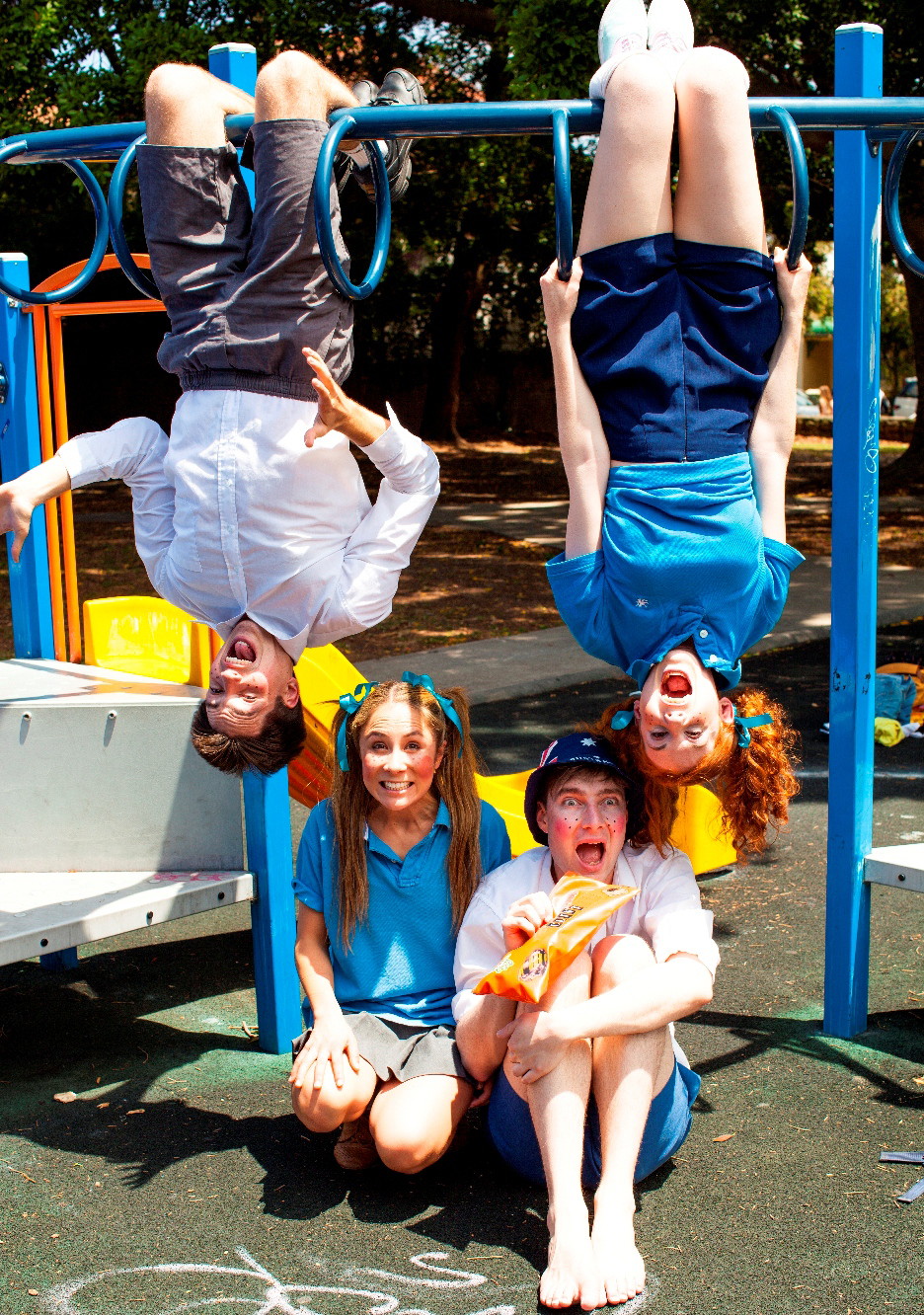
But David Holman’s play is not just for children. Nicol’s ensemble is superb. Playing both adults and kids, they deliver a fun and moving story of three kindergarten children and their parents.

The Small Poppies 5s

But it’s also the story of the extraordinary institution that is school – one the great experiments in human history. Universal schooling, based on the belief  knowledge should be shared equally, is democracy in action. Because we all went through it, we assume it’s natural. It’s not. It has to be made. And made right. And the play honours those who have tried to make it so.

The play is also the story of an ethnically diverse society. Set in the 80’s, the demographics might have changed, but many of the challenges remain. Rosie Lourde’s moving portrayal of Lep, the 5 year old Vietnamese refugee brought me to tears.

Multiculturalism is another of our great experiments. We struggle with it. I’m not proudly Australian. I’m not proudly anything. But watching The Small Poppies I felt we’ve had a go. There’s more to do. And the job, such is its nature, will never be complete. But we’ve had a go. We’ve used our Outside Voices.

And let’s continue to do so. Because, as kids know, that’s what Voices are for.

Veronica Kaye

The Small Poppies by David Holman

New Theatre til 26 Jan

http://www.newtheatre.org.au/

The Venetian Twins

17 Nov

Ah, colour and movement! Give it to the groundlings. Provide it for the plebs. Combine it with a scrap of bread, and it’s enough circus to keep the masses content.

And what’s so bad about that? Does joy have logic? Does delight need depth? Does fun require an arc? The Venetian Twins is joyous, delightful and fabulous fun! It’s great to see a play that’s seriously that – ‘play’ful.

And now I get serious. (Oh, Veronica, you can be such a bore. Admittedly, you never rain on a parade, but must you always over think them?)

Mistaken identity is a common old dramatic trope. Because they saw far fewer stories than us, earlier audiences were quite thrilled at the concept of representation of identity. (It’s worth remembering that some cultures are uncertain as to whether we can do it at all. Or whether we should. There have been times and places where drama has been entirely banned. If you can’t see why, you haven’t seen it done well.)

But we’ve become soaked in it. We believe it, which is just another way of saying we no longer think about it.

But it has been newish, a novelty, and so it was played with. Having just moved beyond a theatre dominated by the stock types who inhabit commedia and morality, the idea of the unique individual had not become fixed. It was the catalyst to much speculation. (And Nick Enright and Terence Clarke’s take on the original play by Carlo Goldoni retains this potential to induce wonder.)

Mistaken identity is also (clearly) a great opportunity for laughs. Jay James-Moody as the twin brothers Tonino and Zanetto gives a brilliant comic tour-de-force.  Director Mackenzie Steele’s production bubbles over with laughter and song. His whole cast is superb and the evening is a real treat for both the eyes and ears.

But laughter derived from mistaken identity can, in its own madcap way, make us question identity altogether. How different are we really? How different do we want to be? Is there really a ‘real me’ that exists outside and apart from the wild confusion of life?

Mistaken identity in theatre is the source of much comedy. In real life, it’s the source of much misery. Too often we allow our invented idea of ourselves to get in the way of genuine connections with others.

But how can we transcend this obsession with the imagined ‘me’?

Seriously playful theatre might do the trick.

Veronica Kaye

The Venetian Twins 

By Nick Enright and Terence Clarke

New Theatre til 15 Dec

http://www.newtheatre.org.au/

The Knowledge

15 Oct

School can be a pretty horrible place. And we condemn our kids to 13 years of it. You get less for murder.

The Knowledge by John Donnelly presents a very troubled school. Obviously, the play is not set in Australia. (My teacher friends will recognize my irony. It’s the mother tongue of all who wish to serve but feel constrained by an institution whose purpose is allegedly the same.)

It’s about 140 years since most developed countries introduced universal schooling. One reputed motivation was to remove kids from the misery of the factories. But, being so concerned with the welfare of children, clearly efforts were made to retain some continuity.

With humour and passion Rebecca Martin’s production superbly captures all the flaws of the system. Her extraordinary cast brings to life the struggles of not just one lost generation but three.

For the power of this play is that it reminds us that we don’t actually know what to teach our kids. What exactly is the wisdom we want to pass on?

Literacy and numeracy?

These are beautiful gifts, but without more they easily diminish into mere access to the gutter press and the desire to take out loans.

What should we pass on? It’s a real question.

And schools aren’t equipped to answer it. Why should they be? They’re not – despite some painful similarities – factories, driven by the power of specialization of labour.

The teachers in this play don’t know the answer. That’s its strength. (I’m not espousing the idea that plays raise questions rather than answer them. I think plays very often answer a whole raft of questions; it’s the source of their textual integrity.)

Here the answer is plain: it’s not up to teachers. If we insist on institutionalizing education it’s up to all of us.

The Knowledge is an engaging night of theatre. And like all good theatre, it leaves us with homework.

Veronica Kaye

The Knowledge

New Theatre til 3 Nov

http://www.newtheatre.org.au/

Vernon God Little

17 Aug

What do we value? Success? Glamour? Notoriety?

Based on the novel by DBC Pierre, and adapted by Tanya Ronder, Vernon God Little is a satire on all that’s crass, trash and shallow.

Director Louise Fischer has cast wonderfully – these incredibly vibrant actors have created a world of bold, bright, fun characters.

Poor Vernon, played marvelously by Luke Willing, is their hapless victim.

A lot of satires pull down – there’s always plenty of healthy demolition work to do. But this one also builds, offering a passionate plea for compassion.

But can I talk of one more value? It’s neither pilloried nor promoted [directly] in the script, but informs the whole production. That value is exuberance [or, perhaps more accurately, EXUBERANCE!!!]

There’s extraordinary energy on this stage, a beautiful vitality.

It is tempting to think honesty is found only in understatement. That quiet is somehow truthful.

But we all come kicking and screaming into this world – or that’s how it should be. And if Life doesn’t continue to shock us, surprise us, confront us – ravish us – then we’ve made an unholy, unhealthy peace with it.

It’s a strange expression ‘larger than life’. Life will always stretch to fit.

How high is the sky? As far as you can see.

Veronica Kaye

Vernon God Little

New Theatre til 15 Sept

http://newtheatre.org.au/

Lord of the Flies

13 Apr

Last night at New Theatre we were presented with a spectacle of brutality and barbarism, a savage world of tooth and claw, barely hidden behind the thinnest veneer of civilization. But then the champagne ran out, and we were all politely ushered out of the foyer and into the street, to continue our revels elsewhere.

Director Anthony Skuse’s production of Lord of the Flies – tight, disciplined, and inspired – puts the lie to William Golding’s myth of the savagery barely below the surface.

Written after the horrors of World War Two and during the Cold War threat of nuclear holocaust, Golding’s novel must have rang true for many people.

This stage adaptation by Nigel Williams doesn’t ask an audience to consider the truth of the myth. The powerful performances from the entire cast make it quite believable.

What is valuable about this play is that it reminds us that the question is not merely “Is this true?” (The only honest answer to which is “who knows, and who could know, humanity’s ‘true’ nature?”)

What a strong production like this does is remind us that the question is also “What is the impact of me believing this myth to be true?” What behaviour is encouraged, what choices are endorsed, by the myth encapsulated in the slogan “All men are born evil”?

As our revels continued elsewhere, this question was discussed, in depth and happily without heat. We were almost civilized.

Veronica Kaye

Lord of the Flies

New Theatre  until 12 May

http://www.newtheatre.org.au