Tag Archives: New Theatre

The School for Scandal

5 May

Changing sexual mores might lead us to think the concept of Reputation is old fashioned.

But, of course, it’s still going strong. Reputation, and its evil twin Scandal, have just moved on to aspects of Life other than what’s done between consenting adults.

In our fluid, supposedly-classless society, the disputed territory labeled Reputation now centres on our professional life. You only have to listen in a theatre foyer to sense the pleasure derived from destroying the good name of others.

Director David Burrowes’ take on Sheridan’s classic School for Scandal is a terrifically fun night of theatre.

The performances are brilliant. Sheridan is one of our greatest wits, and Burrowes allows that to shine. This is a night pleasing to the ear – and to the eye; Burrowes has assembled a cast of virtuoso physicality.

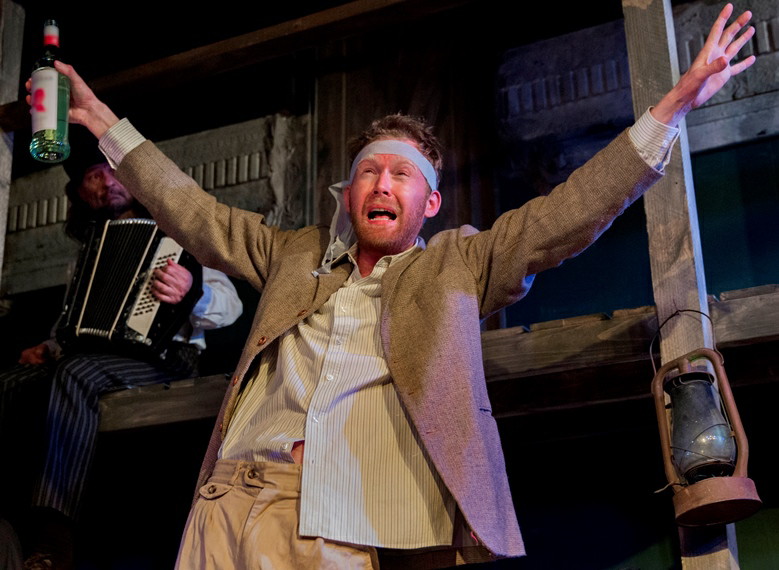
Eleanor Stankiewicz gives a tremendous performance as the gleefully manipulative Lady Sneerwell. She’s languid, confident and self assured. Jacob Warner as the conniving Joseph Surface is a delight to watch. As his plans unravel and his desperation mounts, even the smallest piece of furniture seems to get in his way. Sasha Dyer as Maria, despite being Sheridan’s designated ‘good girl’, gives a superb turn as the drunken teenager attempting to hide her intoxication. Her catching of a ‘dropped’ vase is worth the admission price alone. Marty O’Neill’s Sir Peter Teazle has made the mistake of marrying a woman thirty years his junior, and the physical dynamics between him and his wife, played by Madeleine Withington, are a master class in odd couple tensions and frustrations. Emma Harvie, as a servant girl, gives a brilliant comic portrayal of mechanical obsequiousness, layered ever so gently with a pathos that suggests a vast hidden emotional life.

(pic by Matthias  Engesser)

(pic by Matthias Engesser)

And the entire cast allows the very clever dialogue to crackle. Richard Cotter is marvelous as Sir Oliver Surface, negotiating his many disguises with joyous ease. Samantha Ward, as Ms Candour, is blithely verbose, delighting in the destruction of people’s reputations under the guise of friendly honesty. And Rhys Keir as Charles Surface, the supposed profligate, is charisma at its most agreeable.

Production designer Isabella Andronos gives us a simple white box, a chic minimalist aesthetic and costumes that are modern and very sexy. It’s beautifully done. It’s very easy on the eye, and it’s the perfect uncluttered space for the very talented cast to do their magic.

Sheridan’s play is satirical, and it only takes a little serious self-reflection to realise it’s still relevant. Why do we take such satisfaction in bringing others down?

But it’s worth noting that The School For Scandal is a traditional comedy with a traditional happy ending and (surely this is not a spoiler), the Truth being ultimately revealed, each character gets what they deserve. I used the word traditional – because the play can hardly be the final word on Reputation. The childish satisfaction we find in Scandal is something we obviously must grow beyond, but perhaps even the concept of Reputation, with its inherent conservatism, can be transcended……

Veronica Kaye

The School for Scandal by Richard Brinsley Sheridan

at New Theatre til 30 May

http://newtheatre.org.au/

Book of Days

16 Jul

There’s a powerful set piece in the first act of Book of Days. I won’t spoil it, but suffice to say it deals with the way the announcement of a death is received. Beautifully staged and cleverly written, it perfectly presents the predominant theme of the play – hypocrisy.

Langford Wilson’s play is sort of Thornton Wilder’s Our Town, but with murder. (It’s not an appropriation. It’s definitely a subversion.)

Both plays are set in small Midwest towns.

Photograph © Bob Seary

Photograph © Bob Seary

Ultimately, Our Town presents small town life through the lens of the eternal; its mocking of the parochial is gentle to the extreme, and the play firmly asserts the value of the everyday, and of every life.

Book of Days offers a vision far less comforting. There are some seriously bad people in this play – and they’re respected members of the community.

Some audience members might find the second act unusual, undecided about the way the play becomes somewhat smaller, folding down to a whodunit.

But I think that’s the play’s purpose. It’s part of the American culture wars. It’s saying ‘What’s wrong with our simple dream?’ And it finds guilty parties.

Elsie Edgerton-Till’s production is terrific and her use of the space is magical. The performances are sensational. Kate Fraser creates a brilliantly engaging Ruth Hoch, the salt of the earth no-nonsense truth teller. The conceit of this play is that Ruth is playing Joan of Arc in George Bernard Shaw’s play. And like Joan, Ruth fights both Church and State. I’d further draw the contrasts and comparisons between Ruth and Joan, but I’d be guilty of dreadful spoilers.

In this play, there are characters guilty of far worse: Kyle Walmsley gives a chilling portrait of the intelligent, urbane and frighteningly calculating Reverend Bobby Graves. Simon Davey creates a marvelous portrait of a manipulative snake of a politician.

And a final word on Georgia Hopkins set design: a beautifully space to play, clean and pure, punctuated by only a single tree. The Garden of Eden? The Tree of Knowledge? The Fall from Paradise?

Veronica Kaye

Book of Days by Lanford Wilson

til 9 August

http://newtheatre.org.au/


Why Torture is Wrong, and the People Who Love Them

10 Jun

Firstly, Why Torture is Wrong, and The People who Love Them is  ‘good’ theatre.

Now a digression:

A while back, standing in a crowded foyer, a friend of a friend shocked me by saying “Bad theatre is like being tortured”.

My heart went out to her.

I felt awful. I had thought she was just another complacent, comfortable, middle-class theatre goer.

But no. Perhaps, I thought, she’s a recovering victim of some deranged sociopath. Or, possibly, she’s an escaped dissident from a brutally repressive regime.

Or most likely, like myself, she was just another complacent comfortable middle class theatre goer who enjoyed indulging in absurdly hyperbolic language simply because her life of unparalleled privilege supplied her with everything she needed – except the occasional jolt of excitement to remind her she was alive.

This might be wild speculation, but I suspect sitting through an hour or so of less-than-engaging theatre bears very little resemblance to having electrodes attached to your genitals.

But if you choose to dumbly divide the entirety of existence into the simple categories of the good and the bad, with everything either on one side or the other of that enormous world-dominating watershed, then I guess torture and ‘bad’ theatre might sit on the same side, the very same side as suffering a terminal illness and having dandruff.

Digression over.

Photographs © Bob Seary

Photographs © Bob Seary

Why Torture is Wrong, and the People Who Love Them is a very funny and fabulously performed satire.

Director Melita Rowston does a fantastic job with Christopher Durang’s script. The performances are joyfully hyperbolic.

Terry Karabelas and Peter Astridge present perfectly pitched in-your-face alpha males.

The female characters are fascinating responses to the male absurdity. Ainslie McGlynn gives us a wonderfully flighty small ‘l’ liberal. Romy Bartz gives us Hildegarde, painfully and hilariously in love with a right wing lunatic. (What’s Sylvia Plath’s line about every woman adoring a fascist?*) And Luella is my comic favourite, played brilliantly by Alice Livingstone. Luella retreats from her domineering husband, and reality in general, through an obsession with theatre. (Yes, lets worry about theatre. There’s nothing else important going on in the world. Like torture.)

And while having terrific fun with these over-the-top characters, the final scene is thought-provoking, and an acknowledgement that satire is not the solution to the great world-dominating watershed between left and right.

It’s a brave move, laying down your greatest weapon, but it’s probably the way forward.

Veronica Kaye

* The line is “Every woman adores a Fascist”.


Why Torture is Wrong, and the People Who Love Them By Christopher Durang

at New Theatre til 28 June

http://newtheatre.org.au/


To Kill a Mockingbird

8 Apr

To be honest, I’ve never especially enjoyed the novel. It’s too episodic. And then there’s the whole told-from-a-child’s-point-of-view thing. It’s not the way I like my politics.

And there’s the message. And there is a MESSAGE: that you need to walk in someone else’s shoes before you can judge them. So bleedingly obvious!

Of course, I’m being facetious. I’m one of the many who’ve been unconsciously shaped by this classic.

Photographs © Bob Seary

Photo © Bob Seary

To Kill a Mockingbird is one of the most popular stories of the 20th Century. It encapsulates the drive for social justice that’s one of the crowning achievements of our culture. Or, it could be strongly argued, the novel didn’t so much encapsulate as cause. Like Dickens in the 19th century, Harper Lee was one of those voices that pushed our society to something better. (Yes, I believe literature can change the world.)

Christopher Sergel’s stage adaptation retains the power of the novel. Annette Rowlison’s production is amusing, engaging and very affecting. Lynden Jones as Atticus Finch has an extraordinary vulnerability that makes his performance deeply moving. The child actors (Teagan Croft, Hudson Musty and Kai Lewins) must carry a large part of the story, and they’re some of the best young performers I’ve seen. Dave Kirkham’s Sheriff Tate is a wonderful portrait of the simple but good man struggling with issues he’d rather avoid.

Set designer Sasha Sinclair gives us the town of Maycomb as a series of run down houses, evoked by their front doors. This might seem awkward when the story becomes a courtroom drama, but ultimately it’s an incredibly effective image. To Kill a Mockingbird is not really Scout’s story. It’s Maycomb’s; the larger world’s. Maudie Atkinson is given a narrator’s role in the stage version, and she’s played with a warm intelligence by Sarah Carroll. Maudie has the feel of the omniscient stage manager from Thornton Wilders’ Our Town, and her voice reminds us it’s Maycomb that’s really on trial. That the town can’t stand Atticus’ defence of Tom Robinson shows it’s guilty of a social blindness that’s deep and abiding.

Exactly how far we’ve come in the last fifty years regarding racial bigotry is an open question.  But theatre like this leads us to continue to ask that question. And to ask where else our blindness might lie.

For in fifty years, will later generations say that we had our doors shut tight, blind to the bleedingly obvious.

Veronica Kaye


To Kill a Mockingbird

New Theatre til 19 April

http://newtheatre.org.au/whats-on/season-2014/to-kill-a-mockingbird/

Privates on Parade

17 Feb

Set in British Malaya during the 1948 “Emergency”, this is a story of the birth pains of a new world.

Alice Livingstone’s production is also great fun. Overflowing with humour and playful musical numbers, it’s entirely captivating.

Imperialism? They say, to really understand a man, you have to walk a mile in his shoes. What they don’t say, is that in order to do so, the time honoured approach is to first take the man’s shoes from him. (Please excuse the gender specific nature of the language – but it seems appropriate in the context of imperialism.)

Gandhi was fond of saying that imperialism hurt the conquerors just as it hurt the conquered (though not necessarily as much).

Photo by Bob Seary

Photo by Bob Seary

As a British performing military troupe, the men presented in Privates on Parade find themselves in a super heated atmosphere. There’s a troubling juxtaposition between what they do and the military conflict that surrounds them. In this jungle of political intrigue they’re utterly lost, but far from the cloying comfort of home, something begins to grow. Relationships, that for the sake of tidiness would be torn out at the roots in Britain, are allowed to blossom.

Aided by marvelous musical accompaniment, the entire cast does brilliant work. Diana Perini and David Hooley are superb as two lovers, searching for a path through racial prejudice. Jamie Collette and Martin Searles give a moving portrayal of two men in love, painfully aware of the value, and fragility, of their relationship in a closed society. Matt Butcher’s villain is wonderfully (and consciously) pantomime, and achieves both humour and real menace. James Lee gives a show stopping performance as cross dressing Acting Captain Terri Dennis. And Peter Eyers as Major Giles Flack, the local representative of British small mindedness, gives a hilarious portrait of right thinking.

Peter Nichols’ script and Denis King’s music captures a world that needed to change. But the play is also a contemporary call for a more open society. And this production presents it with such life affirming exuberance that you leave the theatre feeling we can make it happen.

Veronica Kaye


Privates on Parade by Peter Nichols. music by Denis King

at New Theatre until 8 March

http://newtheatre.org.au/

Short and Sweet Cabaret

9 Jan

I realized sometime ago that Life was, in fact, not a cabaret.

At times, I’ve felt Life should lift its game, and would greatly benefit from adopting some of cabaret’s virtues – its sense of mischief, its playfulness, its exuberance.

And last night’s Short and Sweet Cabaret was overflowing with these very qualities.

I’ve made no secret of the fact that I don’t like competitions. Winning is for losers. But the competition that is Short and Sweet is easily ignored, overwhelmed by the vitality of the performances.

Festival director Kate Gaul has assembled a great night of entertainment. And Daryl Wallis as musical director, and spending much of the night on the keyboard, has created magic.

I’m not going to attempt to discuss all thirteen acts, but rather focus on several that especially spoke to me.

Oh, My Shattered Illusions, performed by Kelly Young, is delightfully naughty, and deals with copulation and its two most challenging consequences – STIs and children.

Cienda McNamara’s Hardly The Portrait of a Lady is cleverly written and beautifully sung. It’s a very funny tale of the character’s rivalry with Nicole Kidman, and an insight into the dangers of competition.

Harry + Liv, performed by Charlotte and Evan Kerr, is a perfect vehicle for the artists’ considerable talents, both vocally and on the piano. A simple but charming at home moment between brother and sister is brought alive by two wonderful voices.

Maryann Wright. Photo by Diana Popovska

Maryann Wright. Photo by Diana Popovska

Nuts, performed by Maryann Wright, is a playful presentation of some of history’s eccentrics, and Wright has a brilliant voice.

Another brilliant voice belongs to Josipa Draisma. Her Keep Moving was a marvelously presented collection of songs about the power of dreams.

Brendan Hay "Dance with DeVil"

Brendan Hay “Dance with DeVil”

Also in possession of an amazing voice is Brendan Hay. His Dance with DeVil was polished and witty, and performed with great stage presence.

Jade Yeong’s appropriation of some classic Australian anthems in her Wok Off to Where You Came From is both inspiring and subversive.

Similarly, Bali Padda’s Token Brown Guy raises vital questions about our society’s values. His Hindi rendition of a classic Aussie TV theme is riotous in all the right ways.

I usually make much of the fact that I don’t write ‘reviews’ but rather what I call ‘responses’. A night like this beats my best intentions because there is just so much – a deluge of surprises and spectacles, a torrent of wonders and revelations.

Like the annual flood of the old Nile, it overwhelms Life, and it feeds Life. Of course, it is Life. (Old Chum)

Veronica Kaye

Short and Sweet Cabaret Week 1

til Sat 11 Jan at New Theatre

The cabaret element of the Short and Sweet festival runs til Jan 19

http://www.shortandsweet.org/festivals/shortsweet-cabaret-sydney

Dying For It

26 Nov

To live, it is said, we must have a purpose. And so, it follows, we must die for one. Sort of.

In Dying For It, adapted by Moira Buffini from the original play by Nikolai Erdman,  Semyon is contemplating suicide. Virtually no-one tries to save him. Instead, they try to co-opt him into dying for their own chosen cause.  

In 1920’s Russia, the idea of living for a purpose was in the zeitgeist, and not just on a pop culture level, but as a government directive. You will live for the People’s State. It is this, I suspect, that drove Erdman to write the play. And then earned him time in Siberia.

Photo by Bob Seary

Photo by Bob Seary

It’s an interesting play to choose now. How many of us feel a pressure to live for a cause? Our sad experience, if anything, (and if I can borrow a phrase) is the unbearable lightness of being. The only serious attempt to suggest we live for a purpose comes from the infantile world of advertising. 

So why the popularity of the play? After all, Buffini is not the only modern writer to adapt it. Simon Stone was at it only a few years ago.

Well, it’s certainly funny. And director Peter Talmacs makes this clever farce come alive. Johann Walraven does a brilliant job as the bewildered Semyon, and the entire cast shine with the exuberance that makes this a truly fun night. (And Tom Bannerman’s set deserves a mention. Imposing and appropriately ramshackle, it evokes the claustrophobia of the human spirit oppressed.)

Perhaps the play’s attraction is the contemporary spectre of terrorism; the tragedy, and horror, of dying for a cause when it might have been better lived for.

But there’s also the end of the play.

Stone’s take, I recall, was rather different. Semyon was left in his coffin, inadvertently forced to play dead when he was not – a poignant symbol.

The conclusion of this version is even more powerful. A killer punch. Sure, it may be an ill-judged hope that any ideology could encapsulate the wildness of Life, but this final scene is a reminder that this failure does not give us leave to run from Life.

For we are not in it alone.

It is the true People’s State.

Veronica Kaye

Dying For It

adapted by Moira Buffini, from the original play by Nikolai Erdman

New Theatre til 21 Dec

http://www.newtheatre.org.au/

Fully Committed

27 Sep

The customer is always right.

Are there five words that better encapsulate our absurdly mercantile and materialistic society?

Sam, played by Nick Curnow, is the one of the team who takes the reservations for a super trendy Upper Eastside restaurant. It’s the sort of place that’s booked out months in advance, or ‘fully committed’, as the celebrity chef insists. Sam struggles to deal with the demands of both employers and customers.

nick-curnow-233209

Fully Committed is a one man show designed to show off an actor’s virtuosity. And it does. Nick Curnow is superb, creating thirty eight characters in fifty minutes.

Sam is Curnow’s primary character, but he launches into the others with breathtaking energy. Curnow’s ability to delineate such an enormous cast of characters is awe inspiring. The laughs come thick and fast. His vocal work is nothing short of extraordinary.

The script, by American Becky Mode, is witty and wonderfully structured. Director Alexander Butt has facilitated a lively night of fun, and thought.

The customer is always right. The slogan is well known because employers ask their employees to abide by it simply because it encourages return business. But customers parrot it, as though it was a moral truth. ‘I am paying, so I must be right.’ But aren’t both parties entering into the transaction in good faith? You give me this, I’ll give you that. Why should one party be privileged?

There are few more injurious attitudes to a democratic society than this false sense of entitlement.

And one of the funniest and sharpest moments is when Sam’s agent (he is, of course, a struggling actor) tells him how he could do better at castings. He must develop an aura of self-entitlement. This is silver service satire.

Veronica Kaye


Fully Committed

New Theatre

Two shows remaining Fri 27 Sept and Sat 28th Sept

http://2013.sydneyfringe.com/event/theatre/fully-committed-becky-mode

Skazka, Told by Night

24 Sep

And they were happy.

Appearing at the end of a tale this line seems simplistic.

Anywhere else it is ominous.

Happiness will be disrupted. The power of the folk tale, despite its exotic and anti-naturalistic setting, is its assertion that we want peace, but it shall be denied us.

This is their insight: not the denial, but the desire.

skazka1

Told By Night is a series of adapted Eastern European folk tales. They are deeply moving tales of family and death.

Beautifully written by Jonathan Dunk, Finn Davis and Jem Rowe, their strength comes from their simplicity.

They are presented somewhere closer to a telling than a dramatization. Directed by Dunk, the performances are absolutely captivating, with both voice and movement seemingly balanced between improvisation and choreography.

This creates a spellbinding immediacy which enhances one of the most fascinating aspects of this piece. These tales were told to the audience, but also to (and with) those present on stage. We hear and see the tales. We hear and see the responses to them.

Stories don’t represent reality. (Especially not folk tales.) They are not truthful. They play us.

The wind chime doesn’t ask if the wind is true.

Veronica Kaye


Skazka, Told by Night

New Theatre

2 shows left Wed 25 Sept and Sat 28 Sept

http://2013.sydneyfringe.com/event/theatre/told-night

Jane Austen is Dead

22 Sep

It is a truth universally acknowledged that a critic reviewing a play alluding to Jane Austen will assert their authority by appropriating an obvious famous quotation.

But I’m not a reviewer. I’m what I call a responder.

Any authority I have regarding Austen comes from a course I did at uni. For six months I surrendered myself to six great novels about love. Disappointing – the class consisted of ninety nine women and one gay male couple. It wasn’t only Austen’s prose that awakened my sense of irony.

jane media image SQ 350px

But Mel Dodge’s Jane Austen is Dead isn’t just for Austen aficionados and it certainly isn’t gender specific. An exploration of the modern dating and mating game, it’s terrific fun. Dodge’s performance is absolutely brilliant. She plays multiple characters, treating the audience to a heap of hilarious insights and a good sprinkling of poignant moments.

Dodge’s main character is Sophie, who is battling the influence of fiction in her life. Where can Mr Darcy be found?

We need stories. And we need to escape them.

They help us look to the stars. But they don’t get us there.

Or to offer another analogy: when the heart goes a hunting, we shouldn’t treat stories as maps. They don’t actually tell us what’s out there.

Perhaps stories are more like gun sights, helping us zero in on what we want. Violent imagery, I know, but they’re powerful, dangerous things.

Love stories, but never ever trust them.

Veronica Kaye


Jane Austen is Dead

New Theatre

One more show in Sydney – Mon 23 Sept

http://2013.sydneyfringe.com/event/theatre/jane-austen-dead