Tag Archives: Old Fitzroy Theatre

Masterclass

15 Jan

It’s tempting to call this a masterclass in comic acting, and not just because as a writer about theatre my natural default position is banality posturing as wit. Created by Gareth Davies and Charlie Garber, Masterclass is very funny and brilliantly acted.

Davies and Garber give beautifully measured performances. Both their physical and vocal work has a wonderful texture. They know when to go exuberantly large, and they know when to defer to a casual everydudeness. (OK, that’s probably not a word. Or at least not til now.)

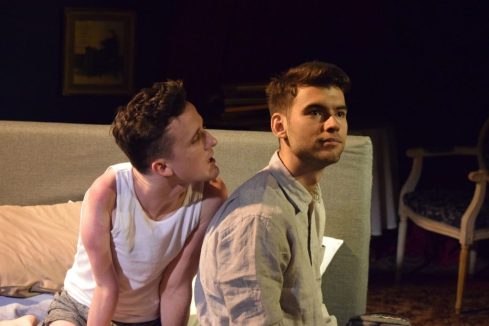
Davies plays a great actor. Garber plays one of his creations. Garber attempts to convince Davies to return to the stage. However, the actor feels the risk to a potential audience is just too high – because of the enormous power of his performances.

Photo by Marnya Rothe

Photo by Marnya Rothe

Some people might call it undergraduate humour. It delights in silliness. It takes aim at tropes that the more world weary amongst us have long recognized and now thoughtlessly accept.

The play is an exploration of our obsession with the great actor. It’s a disturbing element of our theatre culture, and here it’s playfully parodied.  (An analogy of my own perverse invention: the obsession with acting in the drama theatre is like an obsession with anesthetic in the surgical theatre. Of course you have to get it right, but it’s hardly the point of the process. )

Masterclass also raises interesting philosophical questions about the concept of character. Clearly, characters are not real people and the play has a lot of self aware fun with this idea. Characters lack autonomy. That’s the worm in the heart of our grand tradition of representational theatre: our ‘great’ theatre that purports to tell us the way things actually are. Of course, it doesn’t, and can’t; not if it struggles to present the dynamic of choice. Though some might say my argument is merely undergraduate.

Veronica Kaye


Masterclass by Gareth Davies and Charlie Garber

presented by Red Line Productions

Old Fitzroy Theatre  til 31st Jan

http://www.oldfitztheatre.com/tickets-masterclass

The Mercy Seat

30 Jun

Two mean spirited people with American accents remain in a room and argue about their relationship for 100 mins (including a 15 minute interval).

For many people, this would be the archetypal modern play. Which is why they stay at home.

But, in this case, context is all.  Our couple are arguing about their future while the rest of America, and much of the world, is in shock.

It is New York. It is September 12, 2001.

What to many was an unfathomable tragedy is to our couple an opportunity. They’re having an affair. He is married with children. Perhaps yesterday morning he was in one of the towers when the planes struck, instead of at his mistress’ place having his penis sucked. Is it their chance to just disappear and start again?

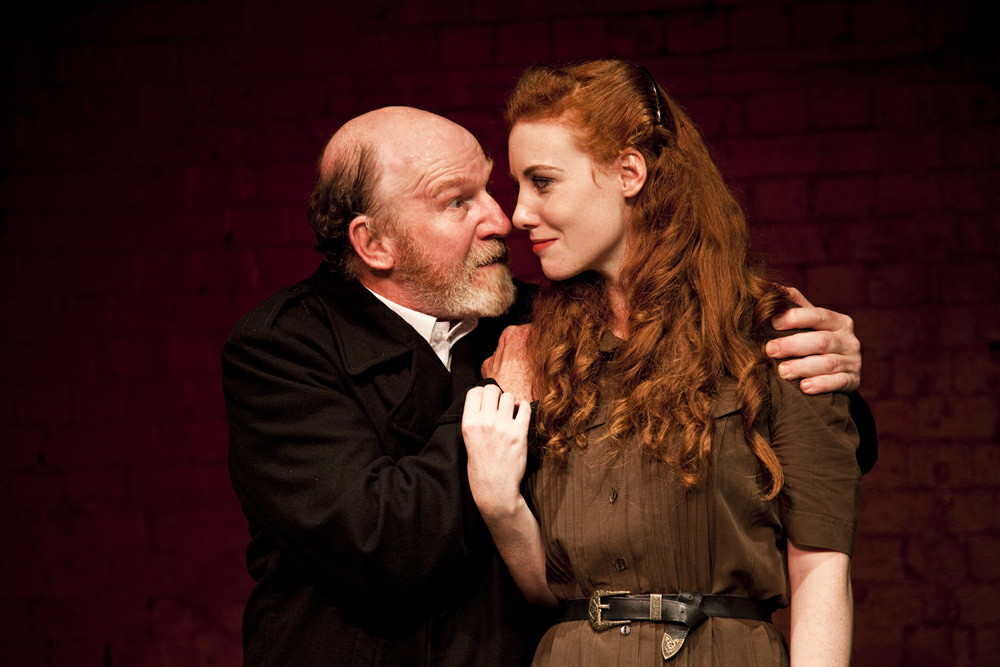
photo by Katy Green Loughrey

photo by Katy Green Loughrey

This production of Neil LaBute’s play is both funny and confronting. The performances by Rebecca Martin and Patrick Magee are powerful and intriguing.

Are we meant to take the characters as real people? Is this play gritty naturalism? If it is, it’s a vision of humanity so bleak that it approaches the immoral. (There’s a school of theatre that equates negativity with truthfulness. It’s the philosophy of those who wish to grant themselves moral holidays. If it’s just human nature to act dreadfully, how can my behaviour be at fault?)

The challenge of this play is the context. Presumably none of us have been in the situation represented.

Or have we?

Many of us are tempted to think the world is screwed, that it’s a chaotic mess, and that we’re all going to hell in a hand cart. I call it a temptation because it allows us to believe that it’s justifiable to be entirely self seeking. After all, in extremis, the call goes out “Every man for himself”.

The Mercy Seat is an intelligent and thought provoking production, a timely reminder that we must not use the magnitude of our society’s problems as an excuse to grant ourselves moral holidays.

Veronica Kaye


The Mercy Seat by Neil LaBute

Old Fitzroy Theatre til 5 July

http://www.sitco.net.au/

Scenes from an Execution

19 May

Few people write dialogue better than Howard Barker; it’s funny, vibrant and explosive. And Barker’s Scenes from an Execution is a brilliant play.

It explores the relationship between the artist and society.

Galactia has been commissioned by the State to paint the Battle of Lepanto. She does, and the State is not happy. Galactia portrays war as something dreadful. The State wants it viewed as something glorious.

The play is set in Renaissance Venice. But, of course, it’s not. This is not a piece of historical realism. Barker’s characters could be here and now.

Photo by Katy Green Loughrey

Photo by Katy Green Loughrey

And director Richard Hilliar’s production is wonderful. His cast does terrific work. Lucy Miller as Galactia is magnificent; passionate, determined, and joyfully articulate. Carpeta is her lover. He’s another (competing) painter. Jeremy Waters delivers a beautifully pitched portrayal of cowardice that can’t help love its superior. And Mark Lee’s Urgentino, the Doge of Venice, is comic brilliance.

This is very rich theatre. Barker shares a swag of stimulating ideas. A particularly fascinating one involves the way society tames even the greatest art (but I’m not sure I can explore this one without a spoiler.)

So let me focus on just a single idea: the way society tries to control what art says.

In Galactia’s world, it’s the Church and the State who are the obvious powers. I began this response by suggesting it would be a mistake to assume this play is historical, to assume its message is that only in the dark past did we treat artists poorly.

This play demands we ask ourselves NOW what forces determine what art is allowed to say.

Our current patrons are the state, critics and the audience. What do they demand art say?

Let me offer the following list of absurd generalizations:

  1. Australian theatre must not question the extraordinary privileges that most of us enjoy in comparison to the majority of the world’s population.
  2. Australian theatre must not present characters that are intelligent, powerful political agents, as this would imply it might also be true of its audience (which would challenge the complacent acceptance of demand 1.)
  3. Australian theatre must be ‘professional’. That is, regardless of what the art says (not excepting demands 1 and 2) the focus of discussion must always be on the virtuosity of the production. This demand perpetuates a bourgeois emphasis on career, reduces art to a commercial product, and encourages the competition necessary for a capitalist society.

See this play. It’s very, very good. And come up with your own list.

Veronica Kaye


Scenes from an Execution by Howard Barker

Old Fitzroy Theatre til 31st May

http://www.sitco.net.au/

Everything I Know I Learnt From Madonna

21 Feb

It’s an unlikely claim.

Wayne Tunks shares with us some of his family history and a lot of his love life.

Spliced into his monologue are Madonna lyrics (which made me aware of how few of her songs I know.)

I’m not exactly sure what Tunks has learned from Madonna. But his tale is engaging; funny at times, and at other times offering insight into the challenges of navigating romance and expressing sexual identity.

Photo by Katy Green Loughrey

Photo by Katy Green Loughrey

The “Everything I Know I Learnt From….” aspect of the title is cheekily appropriated, and suggests much about the tone of this show: confessional and playful.

Does everyone have mentors? Perhaps. Mine are Simone Weil and Catherine of Siena. (I’m guessing Tunks doesn’t know any of their songs either.)

Years ago I was doing a tour of the Whyalla steel works. (Remember, mentor Simone Weil). We met the guide in a lunch room that was adorned with a single safety poster. “Smart People Learn” it said. I laughed. And have been thinking about it ever since.

What have I learnt? And how do I learn? These questions must be asked. They’re the path to wisdom and happiness. The unexamined life is not worth living, says Socrates. Though not as amusingly as Wayne Tunks.

Veronica Kaye


Everything I Know I Learnt From Madonna 

written and performed by Wayne Tunks

Old Fitzroy Theatre until 22nd Feb

http://www.sitco.net.au/


King Lear

6 Dec

King Lear is a brilliant play. And much discussed.

I’ve always been intrigued by Simone Weil’s reading. She saw a tussle between power and honesty, and concluded they were mutually exclusive. The opening sequence certainly prepares us for this view. Regan and Goneril sing their father’s praises in exchange for property. Cordelia is discreet, and is punished for it.

Orwell has a famous essay about Shakespeare and Tolstoy. He reminds us that Tolstoy didn’t especially warm to Shakespeare and had a particular dislike for this play. The story, it would seem, was too close to the bone for the great Russian writer.

I, too, find the story confronting. It’s the tragedy of the great moral gesture.

The play begins with Lear’s grand renunciation. The problem is he can’t maintain the grandness. Leof Kingsford-Smith’s portrayal is wonderfully and heartrendingly accurate. There’s a pomposity to the early Lear. We don’t dislike Lear for it – it’s common enough in older men. In fact, it awakens our pity. As the Fool later says, aren’t we supposed to grow wise before we grow old? Lear hasn’t. Will we?

But like us all, Lear doesn’t understand himself. Having made the grand gesture he wants gratitude, and is devastated when he doesn’t receive it. Who hasn’t been in the same situation? You are kind, and then you’re not acknowledged for that kindness, and so you become bitter. If you choose kindness (or any other moral gesture) perhaps it’s best to stick with it all the way.  (A lonely path, I suspect. But to what vistas might it lead?)

Lear

Director Richard Hilliar’s production is moving and engaging. Kingsford-Smith’s marvelous Lear is amply supported by some strong performances. Amy Scott-Smith presents an admirably icy Regan. This is nicely balanced by Hailey McQueen’s Goneril; a beautiful portrait of a small soul, troubled by inklings of self knowledge, but lacking the courage to confront them. Danielle Baynes as Cordelia is dignity and honesty personified.

And, in the world of the play, there’s no place for a character like Cordelia.

Many eighteenth century productions rewrote the final scenes. In their original form they were deemed too painful.

Or were they just too honest?

Is virtue really so little rewarded in this world?

Who knows? For most of us, it’s too hard to stick to, to find out.

And that’s the tragedy.

Veronica Kaye


King Lear

at the Old Fitzroy Theatre, as part of the Sydney Shakespeare Festival with Measure for Measure

until 21 Dec

for program dates http://www.sitco.net.au/

Blood Pressure

28 Aug

At times of acute stress I’m prone to foolish thoughts. Might a debilitating accident get me out of this? Could a shocking diagnosis suddenly absolve me of all responsibility? The hospital bed has a seductive simplicity.

Theatre that explores death can be escapist.

In asking ‘how are we to die?’ it can avoid an even greater question – ‘how are we to live?’

I have felt this at times, reflecting on plays about euthanasia. They frustrate me in the way that horror films often do.  They can be built on the premise that before the “monster” everything is dandy. There’s nothing to question. Life, with its myriad of possibilities, is a ‘given’.

Blood Pressure, a cleverly constructed two hander by Mark Rogers, asks us to consider the effect of sickness and death on the healthy. And director Sanja Simic draws top performances from Wade Briggs and Alexander Millwood.

There’s no greater isolation than that of the sick, and we will all die alone. But Life is a group activity, and every death diminishes us.

In this powerful piece, as one man faces the inevitability of his brother’s fate, a simple starkness gives way to a deeper insight: that none of us will experience our own death; it’s what we leave to others.

And it’s with that ‘given’ that we must determine how to live.

Veronica Kaye

Blood Pressure

til Sept 1 Old Fitzroy Theatre

http://rocksurfers.org/2012/04/blood-pressure/

Best We Forget

14 Feb

Memory, as the saying, goes.

We forget. Which is weird. But not as weird as the fact we remember anything at all.

Best We Forget created by isthisyours?  is fun and thought-provoking. In mock panel discussion style it explores memory and forgetting – with a focus on the latter.

To focus on forgetfulness is like being obsessed with death. Surely the miracle is life? It’s like being most interested in the moments when actors drop lines. “The best part was when he forgot his lines. You know, just after if he found out he’d killed his father and slept with his mother.”

So what is memory? Little unconscious representations of reality? But what is “reality”? And what can it mean to “represent” it?

Which are questions that spring to mind when I think of drama.

Memory as theatre? Theatre as memory?

We are told at the beginning of Best We Forget that tomorrow we will only remember 25% of the performance.

Or maybe it was 35%.

Whatever.

But I’m still thinking about the show.

Veronica Kaye

Best We Forget

Old Fitzroy Theatre   til 25 Feb

http://rocksurfers.org/2011/12/best-we-forget/