Tag Archives: Opera

Possession

17 Feb

Full disclosure: I come to this piece, if not an opera virgin, then certainly a novice to the artform (but still a seeker of Truth and Beauty.)

When I do what I usually do – which is write about theatre – I like to give the impression that I’m a knowledgeable expert. I get away with this because theatre audiences are used to actors pretending to be someone they’re not, and I guess it’s not too big a jump for them to continue playing this fun game when they read my reviews.

But I won’t pretend expertise here. I’ll write as someone fortunate enough to have been shown a doorway to an exciting new world.

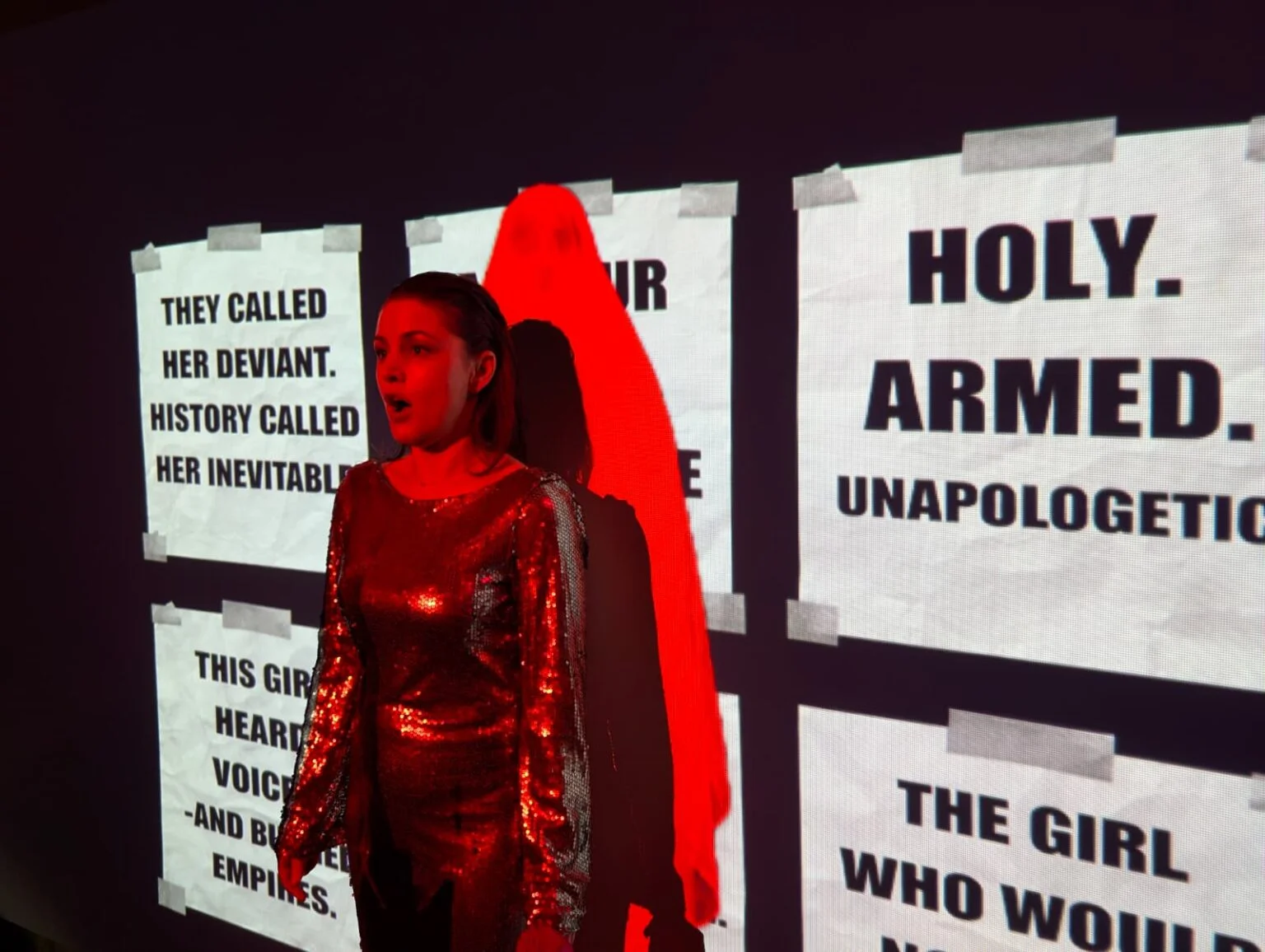
Directed by Adam Player, Possession is what I might call a pocket opera – less than an hour, and presented in a beautiful, intimate venue. It would be a marvellous introduction to the artform. (With its simple but evocative staging, it’s also a model for how opera could be enjoyed by a greater number of people than only those who can get to the Opera House and can afford those tickets!)

Mezzo soprano Ruth Strutt, accompanied by pianist Michael Curtain, presents samples from the works of Gioachino Rossini, Gaetano Donizetti and Ethel Smyth.

The Rossini is his Giovanna d’Arco, the solo cantata presenting Joan of Arc’s farewell to home before battle. It’s inspiring, it’s poignant and Strutt’s performance, in both voice and physicality, beautifully captures the character’s emotional range.

The Donizetti is his Saffo, which gives voice to the ancient Greek poet. Here Strutt has the opportunity to portray a character with even more vulnerability, and she embraces this with mesmerising passion. The Italian libretto is presented in English surtitles, as it was for the Joan piece, and it’s a wonderful chance for the creative team to use projection to establish setting and mood. Here Sappho’s lament for lost love is presented as though it were a series of text messages, and it’s a cheeky decision that underlines the universality of the experience, that Sappho’s 7th century BC concerns, via the medium of Donizetti’s 19th century opera, are still very much ours.

The Smyth pieces are her Nocturne and Possession. The latter is her work dedicated to suffragette Emmeline Pankhurst. Here surtitles are no longer necessary, and Smyth’s romantic influences are apparent. Performed with a luscious, welcoming warmth by Strutt, the melodies are rich and accessible.

Why Joan, Sappho and Smyth? These are voices of female resistance, but none has been flatten to mere slogan by the weight of opposition. Each is deeply human, acknowledging challenges while all the time reaching for joy.

Under the direction of Player, Curtain and Strutt give us a gem, a small piece that dazzles (for me, a jewel given at the threshold of a previously unexplored land, a promise of treasures, of Truth and Beauty.)

Paul Gilchrist

Possession, consisting of works by Rossini, Donizetti and Smyth,

14 – 15 Feb,  

at the Substation, Qtopia, as part of Mardi Gras.

qtopiasydney.com.au

Image by Adam Player.

Aphrodite

22 Jun

Ava, an academic, has written a book entitled The Aphrodite Complex. It’s been sufficiently successful that a documentary has been filmed about the subject. During the making of this documentary, Ava becomes aware that a particular member of the crew – Hector – appears to be fascinated by her.

After the shoot, waiting at Athens International Airport, she flirts with Hector. 

Will it go anywhere? 

When Ava mentions her desire to look a particular way, Hector responds But aren’t you about 50?

And so begins an absolutely beautiful exploration of beauty.

Alone, in her room, (it’s a two hander) Ava is visited by Aphrodite herself. (We’re told the goddess is the most beautiful of all because she was ranked us such by the man Paris.)

Aphrodite sings of being irresistible in a world that’s insatiable. She sings that externals are what matter. She promises power through beauty.

Under her spell, Ava responds I am my thick hair. I am my hairless body. I am my plump skin.

By now, of course, alarm bells are ringing for the audience. It’s a bold move to allow Ava, an academic, to be so reductionist in her thinking – but it’s indicative of the seductiveness of the worldview she’s being sold.

And with this evaluation by male standards ultimately questioned, it’s also a bold move to posit a man’s judgement as the catalyst of this doubt. It’s indicative of the ubiquity of the problem.

In some ways, the libretto by Laura Lethlean is a riff on feminist insights as found in such as Naomi Wolf’s The Beauty Myth. In other ways, it could be read as a reflection on ancient Greek sensibilities – the primacy of the body, the value of competition – compared with what I’ll call a Christian sensibility. (I’m thinking of the vision so miraculously shared by Dante, that the body and the soul are of equal value and only complete when together, and that Love is Charity rather than Eros.)

I’ve focussed on theme and concept, but direction by Alexander Berlage brings it all to glorious actuality.  The design by Isabel Hudson is outstanding, a lush domestic realism, ideal for the representation of both the luxury and commonality of sexuality. Under the video design of Morgan Moroney, the live feed marvellously evokes the concept of the gaze, of being always an object to be observed. It also facilitates our enjoyment of the extraordinary dramatic performances.

Both in voice and movement, Jessica O’Donoghue as Ava and Meechot Marrero as Aphrodite are utterly mesmerising. Their vocal performances are superbly nuanced to emotion: the exultation of sexual power, the languor of seduction, the agony of self-doubt.

Performed by Omega Ensemble and conducted by Jack Symonds, the music by Nico Muhly has a sense of melancholic sweetness (like Tennyson’s remembered kisses after death.) It ripples with the poignancy of distance; though a work about desire, we never see the lover.

After the revolution, lipstick will be lipstick. And that’ll be a good thing.

But, sometimes, I wonder.

Though this piece can be validly read as a strong and necessary feminist statement, it can also be viewed through another lens. Aphrodite takes on one of the great irresolvable tensions in the human condition (which is probably what makes great drama).

Everybody desires to be desired. At times, it’s as though we want to be an object. The active longs to be the passive, to be swept up in something beyond our small selves. Sexuality uses us, and we want to be used. It’s one way we find connection – with the community, or the Life Force, or whatever you want to call that which is bigger than us. It assures us a place in the chaos. Yes, there remains the deep wish to be appreciated as more than just a body, to be accepted as a full, complete, complex, independent, dynamic Other – but there, in the very heart of that wish, is the desire to be accepted. We want to be evaluated (even though we don’t.)

At only 60 minutes, Aphrodite is a wonderfully rich theatrical and musical experience.

Paul Gilchrist

Aphrodite music by Nico Muhly, libretto by Laura Lethlean

presented by Sydney Chamber Opera, Carriageworks in association with Omega Ensemble

at Carriageworks until June 28

carriageworks.com.au

Image by Daniel Boud