
This is a consciously cartoon-candy confection.
It’s both deliciously sweet and deceptively sophisticated.
Ostensibly, it tells the story of a young woman seeking the One.
Amber openly acknowledges that this relationship-focussed worldview derives from the rom-coms of Nora Ephron and Richard Curtis, the sit-com Friends, the Twilight series and Peter Pan.
Her journey to secure love is presented with terrific humour and true heart.
This is not new territory; it’s standard fare of fringe shows around the world. But this piece gloriously transcends that genre, offering something as provocative as it is playful.
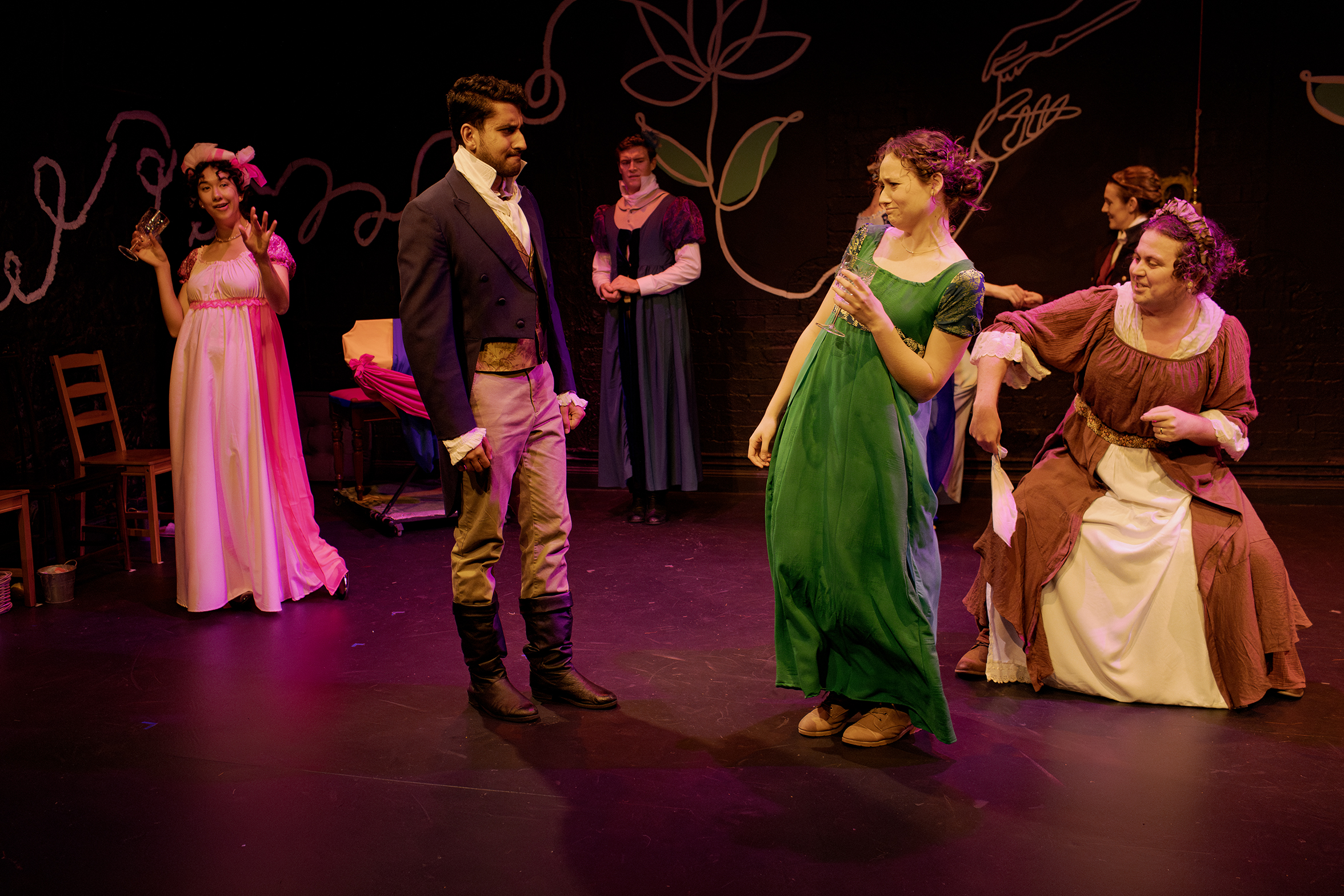
Firstly (and because of my reference to fringe, I should make this clear) the production values are excellent. Director Mehhma Malhi understands the gem of a show she has and allows it to shine. The set by Hailley Hunt is suitably puckish, replete with panels that slide to reveal mischievous surprises. The lighting by Isobel Morrissey is dominated by hues of pink and mauve, wonderfully suggestive of the girlish dreams of the protagonist, but it’s also constructed from a plethora of states that reflect and enhance the bubbly bounce of her narrative.
Secondly, writer and performer Nikita Waldron is brilliant. With a vibrant charm, she breaks the fourth wall, and with self-deprecating humour expresses Amber’s dismay when reality doesn’t align with her chosen narrative. In her scenes with the other characters – the men in her life and her best friend – she creates an Amber who is a superb portrait of the bewilderment of youth, certain and insecure, outward looking but still mesmerised by the miracle of self.
The supporting cast are splendid. As the men, Harry Stacey, Ashan Kumar and Kurt Ramjan all move between characters with impressive versatility, and Esha Jessy as Amber’s best friend, Gabby, is an engaging mix of support and sarcasm.
If you’ve read this far, you might still be wondering what lifts this piece above rom-com. Waldron’s script, for all its seeming fluffy fun, takes on some extraordinarily large concepts. (And, no, I don’t mean socio-political ones. So much new work by early playwrights purports to do this, but these plays are rarely constructed in a way that allows more than the airing of slogans and so, despite aspiring to transgression, remain wholly conventional. Not that Waldron ignores the socio-political. Amber asks in the first scene Am I a bad feminist? and then moves on to bigger game. Race gets similar treatment; in a later scene, at a late-night kebab shop, there’s a hysterical pun, and then we’re off again.)
The big game the show hunts is narrative itself. Amber is clearly trying to make her life fit a story, but the play addresses this all-too-human habit on levels far beyond what the packaging might suggest.
Let me mention just a few instances.
Amber is Catholic. And she talks to God. (He retains his usual reticence.) But, she asks, and – in a way – receives. Several people in her life question her faith, people she deeply loves, and she openly admires their atheism. She doubts her faith herself. But she’s loathe to let it go. Let a story go and you have to replace it, and this one she knows. (Quite understandably, Catholicism has got a bad rap recently. But for all its institutional crimes, and for all its focus on guilt, there’s a song of joy tucked away in there – as there is in so many religious traditions – and it’s owned eternally, not by the hierarchy, but by souls like Amber. Without in anyway being overtly or conventionally religious, this play and this production sing with that joy.)
We’re not being asked to agree with Amber’s religious choices, but we’re shown a character entirely conscious that she’s navigating a grand narrative. (It’s one of the dullest and most disappointing of modern phenomena that educated individuals will reject some grand narrative or other and then tell themselves they’re now realists – which is just another story, one still unconscious of itself. A digression: Catherine of Siena, or one of the other medieval mystics, was once asked whether her visions appeared in the real world or in her imagination? With soul-expanding sanity, she responded, In my imagination, of course. The real world is only known through story.)
The play’s focus on narrative is emphasised by the choice to make Amber, and one of her most important male friends, career storytellers. She’s a novelist, he’s a film-maker. Narrative is something to take seriously.
And the final instance highlighting that the play is, in fact, a profound and rewarding exploration of the phenomenon of narrative is the plot turn that takes it beyond standard rom-com territory: the experience of grief.
We construct narratives to make some sense of the living, to create some stability that might survive their incorrigible dynamism, that perpetual becoming that is the hallmark of the Other. But when they are gone, our narratives are no longer challenged. And so we forget that they are constructed fictions, and they diminish into mere illusion.
Faced with grief, Amber must learn this. And as she does, we’re offered a deeply affecting reminder of the power, pleasure and purpose of story.
Paul Gilchrist
Amber by Nikita Waldron
presented by essential workers,
at Old Fitz until 11 April
Image by Phil Erbacher
 Theatre Red