Tag Archives: Sarah Ruhl

Stage Kiss

24 Mar

The tone is slippery, isn’t it? So says the director of the-play-within-the-play. He’s trying to avoid the director’s job of making decisions, but I felt the line wasn’t just satire, but rather an example of the text being self-referential.

When Sarah Ruhl’s In the Next Room, or the Vibrator Play was first presented in Sydney, I stayed away; the marketing had made it sound like some stupid sex comedy. When I finally saw it at New Theatre in 2025, I was more than pleasantly surprised. Yes, there were sex jokes (possibly too much of the one sex joke) but there was also a joyous profundity.

With Ruhl’s Stage Kiss I was expecting – hoping – for something similar: that the tone might be slippery.

Set in the world of the theatre, there’s wonderful humour. Much of it is parody of bad acting or of bad theatrical writing. In fact, there’s so much of this – like there was of the sex jokes in The Vibrator Play – I was hoping their very excess suggested this play was following what I had assumed to be the Ruhl method … and that soon a glorious profundity would manifest itself.

Someone critical of my approach to writing about theatre might say, that having seen the flowing life blood of the play, I wanted it to congeal.  

(If it were to congeal, the clot would be something like this: the play is an interrogation into the relationship between Art and Life. While rehearsing a play, a terrible 1930’s melodrama, the protagonist reunites with her first love. Similarly, the character she is rehearsing reunites with her first love. Life, it seems, imitates Bad Art. In the second act, we get more of the same, except it’s a new-play-within-a-play, and this time it seems it’s more of a case of a Bad Life imitates Bad Art. The meta-play, Stage Kiss, follows in the grand tradition of warning against Art by using Art. Perhaps Cervantes started it with Don Quixote, telling the tale of the knight errant who tilts at windmills because the books he has read lead him to see them as giants. Austen picks up the baton with Northanger Abbey, in which her heroine – once again because of the books she’s read – sees monstrous gothic plots in the most mundane of circumstances. And pick a Fringe Festival anywhere on the planet, and there’s a good chance there’s a show in which a young actor outlines how they finally divested themselves of the nonsense they learnt from rom-coms or romance novels or similar rubbish. And, as well as the-plays-within-a-play structure, there’s another element of Stage Kiss that suggests Ruhl’s target is the spell of fiction: there’s a comically-heated-discussion about the concept of soul-mates. Now, the existence of soul-mates implies the existence of Fate, which more than implies that Life, rather than being a crazy bunch of stuff that happens, is actually a Narrative. The comically-heated-discussion in question considers Who it is who might be the author of such a meta-Narrative.

But, of course, all of the above is only for you if you’re the sort of person who likes your theatre to congeal.)

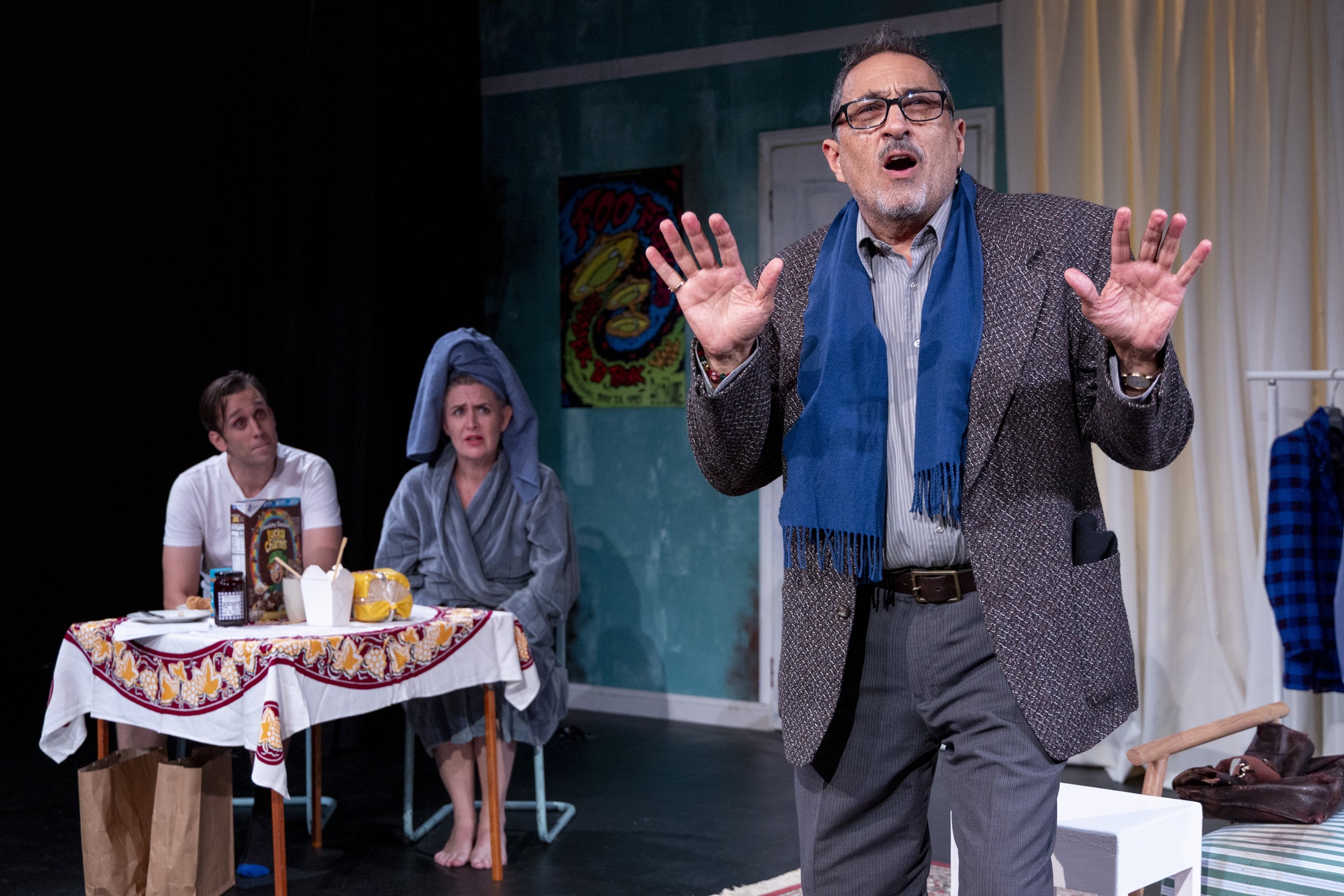
The flowing life blood of Stage Kiss is humour – and director Alice Livingstone’s production nails it. Livingstone has put together a top cast and elicits from them excellent comic performances.

Emma Delle-Vedove is hilarious as the bewildered protagonist. Jason Spindlow as her first love gives a beautifully funny portrayal of a kid-adult. Frank Shanahan as a cast member of the plays-within-a-play excels at that most tricky of tasks for a talented actor: employing your considerable skills to portray bad acting. Nicholas Papademetriou as the undecided director of the-plays-within-a-play is an utter delight.

Paul Gilchrist

Stage Kiss by Sarah Ruhl

At New Theatre until 11 April

newtheatre.org.au

Image by Bob Seary

In the Next Room, or The Vibrator Play

14 May

Written by American playwright Sarah Ruhl in 2009, this sits curiously between farce and something more serious. (I was going to write something more valuable, but who’s to say laughter isn’t worth more than all the world’s profundity?)

Set in late nineteenth century America, in a doctor’s residence and surgery, the play tells a tale of treating “hysteria” with the newly harnessed electricity. Dr Givings employs what we would call a vibrator, and his treatment is rather popular.

Though this farcical element is approached with true comic commitment by the cast, there’s a danger of it all slipping into a one-joke piece. We see the vibrator and its associated technology used on “patients” possibly a few too many times. (Though I have friends who would never tire of such a joke.)

And the basic conceit of the humour, that no-one seems to realise the “patients” are being sexually aroused to orgasm, is a challenging one to accept. Though the medical discourse of the time was dominated by myopic patriarchal attitudes, were the women themselves so very ignorant of their own bodies? Perhaps. Or perhaps the hegemonic discourse simply prevented open discussion. But theatre enables the representation of many discussions that would not otherwise be open. (It could be argued that’s part of its charm.)

But I guess it’s how the piece gains the first of its feminist credentials: if the diagnosis is that the female experience is so entirely dominated by patriarchal perspectives, then revolution is the only appropriate prescription.

And the piece gains its feminist credentials in other ways, representing aspects of the female experience that (still) could do with more cultural airtime. As well as orgasm, we’re shown breast feeding and the terrible fears of childbirth. As Catherine Givings says of the last of these experiences No rational person would go through this twice. This production also powerfully presents the anguish of child-raising, beginning with a desperate Catherine looking on helplessly as her new-born child just … won’t … stop … crying. She muses that it’s odd that Jesus was a man, one who supposedly gave his body in the eucharist, because it’s women who are eaten.

And this religious allusion leads me to consider the other great theme of the piece: the relationship between spirit and body. Electricity has long been associated with spirit, but in finally being harnessed, one more of the universe’s grand mysteries is reduced to a mere human tool. In the face of advancing scientific knowledge, what will become of other great mysteries, like love? Is love any more than pleasure? And is pleasure any more than mechanical? Will the brave new world of technology make us smaller? No, We will be Gods asserts Catherine, but in her lonely desperation she’s compared to a fallen angel. Ruhl builds on this motif, with characters making snow angels. And what is an angel? Spirit without body. Traditionally and conventionally, this is somehow seen as closer to the divine. Yet in the next room, we’re being shown the joy the body can offer. That body and spirit are not mutually exclusive is the salvation these characters must find – and the final (snowy) image of the play is glorious. 

Director Emma Whitehead elicits some terrific performances from her cast, and that’s no mean feat, considering the demands of a script constructed from such dissimilar genres. (Though the reading of the play I outline in the previous paragraph leaves me wondering if some genuine nudity might’ve been a good choice. I also wish the script had given some of the characters more lines to express their fears and enthusiasms, which would not only have made a wonderfully rich play even richer, but – counterintuitively – would have facilitated a quickening in pace that sometimes the production needs.)

Alyona Popova as Annie, Dr Givings’ assistant, gets too few lines, but with what she gets she displays fitting dignity and impressive poignancy. Ruva Shoko as Elizabeth, the wet nurse, has a slow build, but when she gets her big speech she is deeply moving.

Luke Visentin as Leo, the artist who is a male sufferer of “hysteria”, is delightfully exuberant.

Catherine is the heart and soul of the piece, and Sarah Greenwood grabs the opportunity and gives a performance that is utterly superb – funny, fraught and full of life-affirming energy.

Paul Gilchrist

In the Next Room, or The Vibrator Play by Sarah Ruhl

At New Theatre until 17 May

newtheatre.org.au

Image by Bob Seary