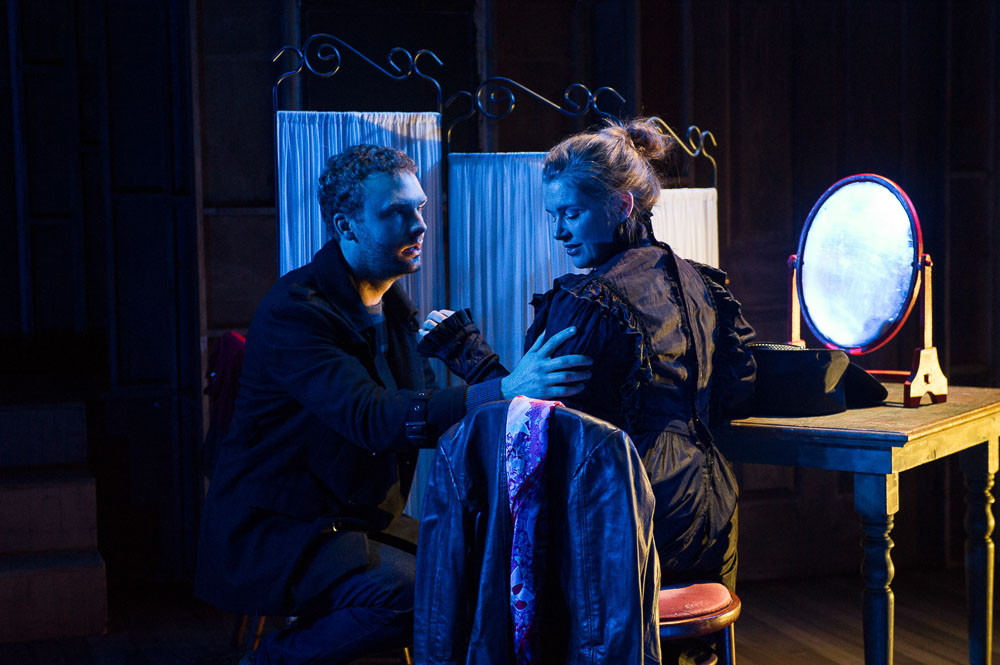
Tag Archives: Seymour Centre

The Legend of King O’Malley

1 Dec

The Faust myth is oddly enduring.

It’s fascinating how we’ll repeat stories in which people sell their soul to the devil for earthly rewards; fascinating because who actually believes in the devil? Or, indeed, the soul?

So what’s its meaning? That if you achieve anything (knowledge, influence, sexual allure) you must pay an enormous cost? A cost so disproportionate that you’d have to be mad with self importance to agree to it in the first place?

Nietzsche might call it a slave philosophy. It seems to suggest that anyone who succeeds in this world is inherently evil, and evil will inevitably come to them. A philosophy like that can only be of comfort to the powerless. (Or those wishing to pretend they are more powerless than they actually are – which I usually argue is pretty much anyone who has the time and money to attend theatre in Australia. Myself included.)

In The Legend of King O’Malley the titular character sells his soul for wealth and power. It’s a particularly strange take on the myth because O’Malley was a real person, an American preacher who migrated to Australia and was elected to our fledgling federal parliament.

As O’Malley was a real person, I think it’s safe to assume that the writers, Michael Boddy and Bob Ellis, have invented the whole ‘deal with the devil’ bit. I’m not sure why. (I’m also not sure why the first act, which deals with O’Malley’s time as a preacher, is as long as it is.)
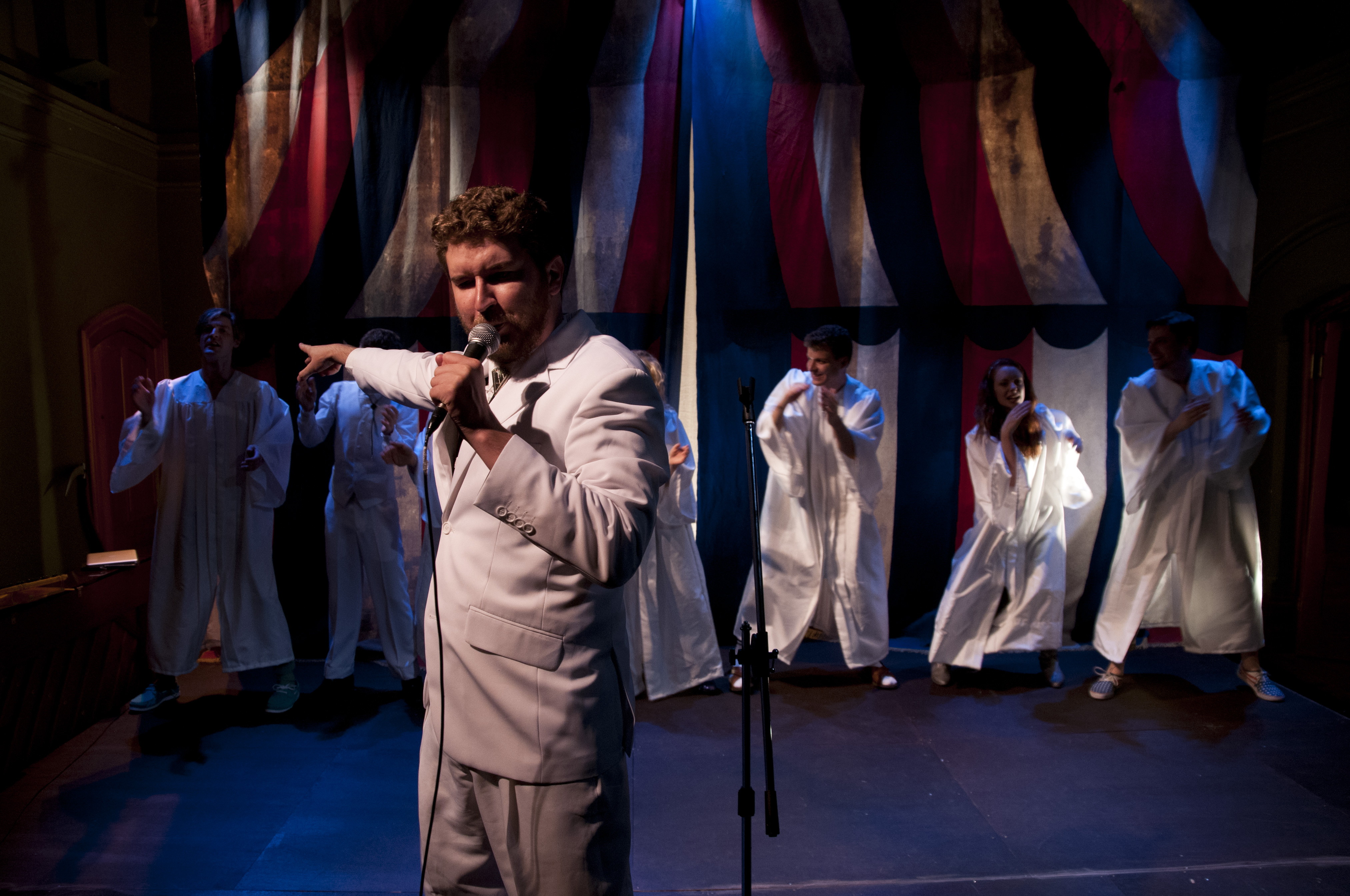
Photo by Afshar Hodar

Photo by Afshar Hodar

Director Phil Rouse’s production is a relentlessly raucous ragtag rat bag revue. (OK, despite being wonderfully high energy, it’s not actually relentlessly raucous. I just got on a roll with the alliteration.) There are beautifully vibrant performances from the entire cast, but there are also some moments of stillness and emotional impact.

James Cook as King O’Malley and Matt Hickey as Billy Hughes do terrific work in the playful scenes, but they change gear magnificently to provide the dramatic heart of the piece.  (Spoiler Alert) It’s during World War One. Prime Minister Hughes supports conscription, but O’Malley does not. O’Malley resigns from Hughes’ cabinet, and then fails to win his seat at the next election. Or indeed any election after that. (O’Malley lived till 1953, and at the time of his death was the last surviving member of our first national parliament.)

When the play was written, in 1970, conscription was Australian policy. We were sending our young men to fight in Vietnam. I suspect this is what led Boddy and Ellis to choose O’Malley’s story. As a piece of political propaganda, arguing that the state exists for the individual and not the opposite, it’s effective and intensely moving.

And perhaps, despite my earlier questioning, the play’s form serves a purpose. Boddy and Ellis’ O’Malley is a shyster and raconteur – so much so that only an appropriation of a grand myth could make sense of him. But he still put us “lazy, dumb” Australians to shame.

Or at least shook us up.

Of course, the Australian people never did vote ‘Yes’ to conscription in the First War. And in 1972, two years after this play was originally presented, we finally voted in a government that ended conscription’s most recent incarnation.

This production is a timely reminder of the power of our elected representatives, and how it’s our responsibility to continue to push them to create a more just society.

Veronica Kaye

The Legend Of King O’Malley by Michael Boddy and Bob Ellis

Seymour Centre til 13 Dec

http://www.seymourcentre.com/events/event/the-legend-of-king-omalley/
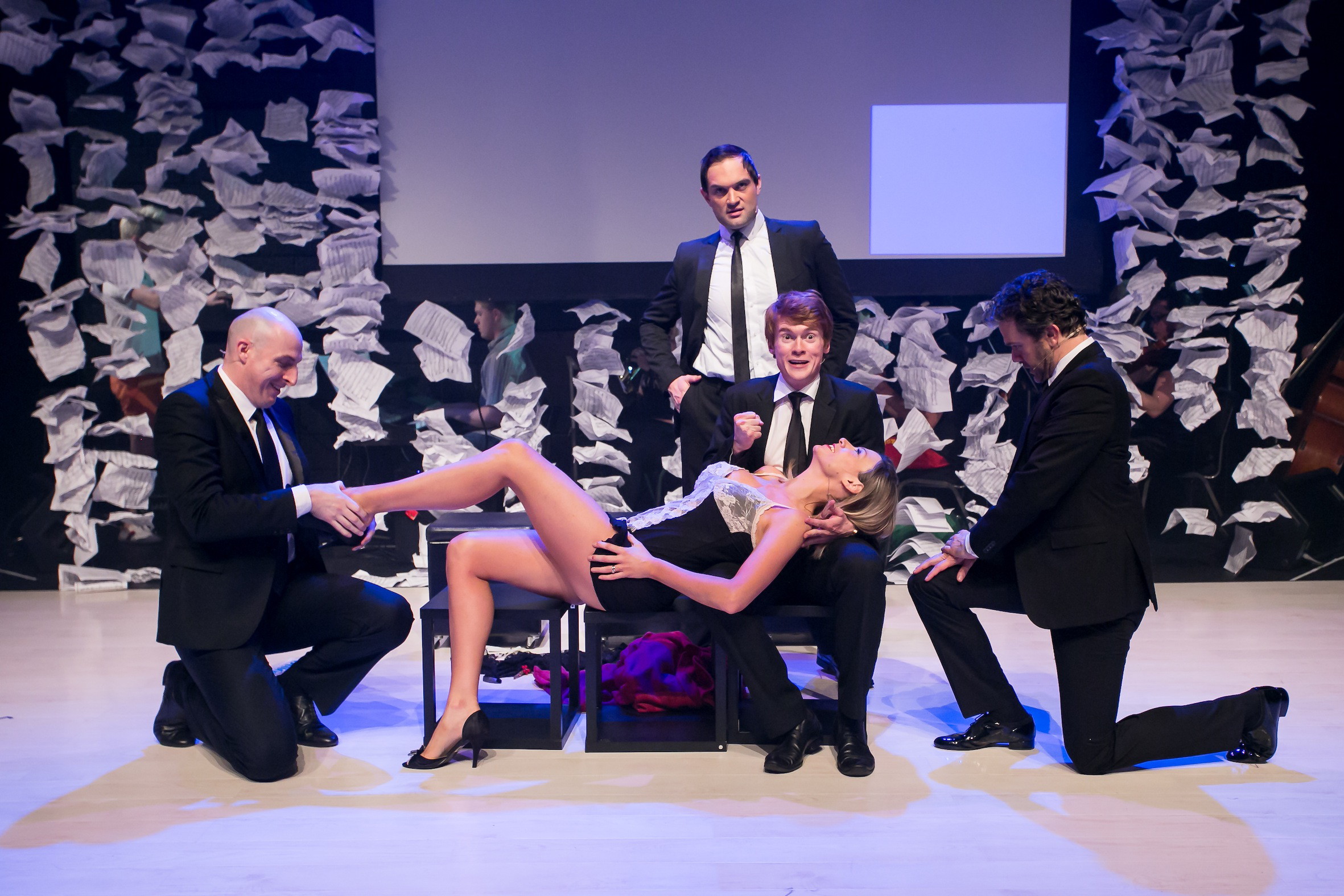
 

Sondheim on Sondheim

7 Oct

A rare night of theatre. I mean in the sense of being uncommon.

It consists of songs performed live by the extraordinarily talented band and cast, interspersed with projections of Sondheim talking.

He talks about his art and life. I left knowing not much about either. I suspect that was the point.

The man has a certain charm, somewhere between imp and self-obsessed genius. At least, that’s his onscreen persona. He drops one mask in order to show another. It is Sondheim on Sondheim, after all.  For a musical ignoramus like myself, another voice would be helpful, one that could begin to place Sondheim’s achievement somewhere in the vast theatrical landscape. But, of course, this is not a documentary. It’s much more playful and entertaining than that.

And it’s certainly an opportunity to hear some of Sondheim’s vast catalogue performed brilliantly. I expect fans of the American legend will absolutely love this show.

Photo by Michael Francis

Photo by Michael Francis

Sondheim doesn’t do melody. (The show jokes about it.) I sort of wish he did, but then, as I’ve said, I’m a music theatre philistine. (If that’s not a tautology.) His lyrics are very clever, and most of the time I could understand them. Presented out of the context of the individual shows for which they were originally created, and with which I’m not familiar, I did have a creeping fear that their intensity was being diluted.

But there’s certainly enough here for the music theatre novice to be intrigued and enticed. Everyone knows Send in the Clowns (performed wonderfully by Debora Krizak), but there are plenty of other gems. One example is The Gun Song, performed powerfully by Blake Erickson, Rob Johnson, Phillip Lowe and Monique Salle. It’s from Assassins (a Sondheim musical I do know!) Telling of the various attempts on the lives of American presidents, it’s a fascinating exploration of violence and identity, and indicative of Sondheim’s ability to take the musical into previously uncharted territory.

I never tire of pointing out that I don’t really write reviews. I write what shows make me think about. (Yes, self-obsession, but without the genius.) And this one? It made me think about the concept of work.

Sondheim has worked for over fifty years. He’s over 80. God only knows how many songs he’s written. There’s some terrific ones in this show. He’s done the work.

Completely left field biblical allusion: Adam and Eve tended the Garden of Eden even before the Fall. Work is not what you do for a reward; it is the reward.

(Not that you shouldn’t come along to this show and enjoy somebody else’s work; the work of Sondheim and the terrific team behind this very entertaining production, Squabbalogic.)

Veronica Kaye


Sondheim on Sondheim

Seymour Centre til 18 Oct

http://www.seymourcentre.com/events/event/sondheim-on-sondheim/

Europe

16 Sep

Old versus new. Stale versus fresh. Sophistication versus naivety. Decadence versus innocence.  Europe versus Australia.

One of these pairs is a false dichotomy: the last one.

Australia is European. (Or Europe is Australian, in case you’re tempted to think I’m making some sort of backward racist statement rather than philosophically dismantling an erroneous distinction.)

Michael Gow’s very funny and thought provoking play was written in 1987, nearly 30 years ago, and it feels like it. It harks back to the experience of an earlier generation, of the 60’s and 70’s, when every Australian intellectual fled to the Old World.

Has Australia become more European in that time? (Is that my ridiculous thesis?) Of course not, but the tyranny of distance has weakened, and we’ve grown more confident.

And that’s the value of James Beach’s very entertaining production; it explores that confidence.

Photo by Kurt Sneddon, Blueprint Studios

Photo by Kurt Sneddon, Blueprint Studios

In the play, Aussie fan Douglas chases European actress Barbara. They’ve had a brief fling when she toured Australia, and he sees no reason why it shouldn’t continue. She’s less certain. (The performances by Pippa Grandison and Andrew Henry are wonderful.)

Just as Barbara is about to go on stage she says ‘I’ll drag my body through this classic again’. (All my quotes are paraphrasing.) She wonders what would happen if she changed the end this time. But, alas, the audience has come to see that particular play. Again. A type of cultural obsessive compulsive disorder?

Barbara continues ‘We constantly redo the classics. Reinterpret them, reclaim them, reject them. And the new plays are just echoes of the old.’ (More paraphrasing.)

Why are we in love with the old? And, no, I don’t buy the whole ‘universals’ argument.

I started this response by suggesting that the obsession with Europe was a thing of the past. But I see the same thought patterns, the same conservativism, repeated every time we choose to produce another Patrick Shanley, Sam Shepherd or Neil La Bute play. (These productions, no matter how well done, often feel like cover bands; the theatrical equivalent of a Madonna Tribute show at the Rooty Hill RSL.) And it’s the same for the rewriting of the classics. Borrowed glory. (And, of course, highly effective pre-marketing. Postmodernism is not the reason why the Broadway musical is now inevitably an appropriation of an earlier text.) And there’s a similar conservatism lurking in our desire to create an Australian canon.

So maybe it’s not Europe. But it’s usually somewhere else, somewhen else. Not here. Not now.

But it could be.

And that’s what this very clever, beautifully performed production made me think about.

Veronica Kaye


Europe by Michael Gow

Seymour Centre til 27 Sept

http://www.seymourcentre.com/events/event/europe/

Seven Kilometres North-East

11 Mar

What is the purpose of Art? To remind the miserable that there is happiness, and the happy that there is misery.

Kym Vercoe’s self devised piece does just that. There are moments that are charming and beautiful, and others that are confronting and disconcerting.

Vercoe narrates her multiple trips to Bosnia, and her growing understanding of the region’s very troubled history. Her stage presence is confident, strong, yet vulnerable – a mix that powerfully evokes the magnitude of the historical events and offers a truly human response.

Seven Kilometres North East is a deeply moving and thought provoking piece.

Photo by Heidrun Lohr

Photo by Heidrun Lohr


One of the most unnerving moments occurs when Vercoe realizes that the men responsible for the most shocking of war crimes are probably still living in the town she has repeatedly visited. An acquaintance attempts to calm her, “Don’t worry. They won’t rape or shoot you. It’s not the 90’s.”

In the 90’s,  safely in Australia, I lost friends to arguments about what was happening in the former Yugoslavia. One friend, of Serbian background, went from simply shaking her head and moaning “They’re all crazy” to an intense and painful partisanship. Another friend, defended the NATO air strikes on Belgrade with a fearsome logic: “But we’re the good guys.”

Has theatre the ability to deal with this sort of political and historical complexity? Does it need to? Vercoe’s focus is moral, and she does not offer analysis; she offers judgement. This is not a criticism, though many might think it is. In navigating the human experience empathy gets you further than explanation.

But the piece is far from simplistic. In fact, it’s provocatively self aware. Vercoe refers to thano-tourism; that is, the touring of sites of genocide and mass death. What is the perverse attraction? And we’re forced to ask, is this what Vercoe has succumbed to? After all, why does she need to tell this story? She wasn’t there at the time. Neither were any of her relatives. It’s not her story. (Unless, of course, you subscribe to the idea that we’re all brothers and sisters. As an idea it’s dreadfully unfashionable, and absolutely vital.)

Veronica Kaye


Seven Kilometres North-East by Kym Vercoe

Seymour Centre til 22 March


The Dead Ones

21 Feb

A woman stands at a podium. She reads from a script, softly and calmly. To her left is projected a series of family photos.  Margie Fischer shares with us her experience of clearing her family house, once the last of her family are gone.

It’s a wonderfully generous sharing.

Dead Ones Margie 2

And it’s fascinating because it encapsulates two of the fundamental features of our world; our materialism and our sense of lost time. Were anthropologists from another time and place to find this performance, it might be their Rosetta stone. (Another time and place – see how I struggle to disentangle myself?)

As Fischer decides what to keep and what to discard from the now empty family home, she’s only too aware of how objects are imbued with value through their connection with people, and that this stored value will slowly leach away. She realizes there’s little use in keeping much.

As we are shown photos of family members who have passed, I’m reminded of the strangeness of the medium. Do photos capture a moment? Or do they stop time? Stop it like a dam stops a river? Stop the flow of a river, and is it a river anymore?

Our culture is obsessed with movement, with the passing of time, with history. And the trouble with history is that, in it, people go. In every culture people die. In ours, they are gone. And photos, often our most treasured objects, can do only what objects do; they retain value for a while, and then they fade to mere history.

Fischer does not make all the philosophical and cultural generalizations I’m making. Her story is personal, honest and powerful. Powerful like the gentle flow of a river.

Veronica Kaye


The Dead Ones by Margie Fischer

Seymour Centre til 22 Feb

http://www.seymourcentre.com/events/event/the-dead-ones/

Singled Out

4 Oct

I had a friend, who desperately needing to get somewhere, stole a car. I don’t know where it was he was so keen to go, but unless his desired destination was Goulburn Correctional Facility, his decision proved an unwise one.

When he was released, I asked what it had been like. Apparently, apart from the obvious fact he couldn’t leave, the experience wasn’t so bad. Free food. Free accommodation. The only problem? The company. “I had to spend a whole year of my life with a bunch of criminals,” he said.

Other people.

They’re a challenge.

And increasing numbers of us are choosing to live alone.

Why we are choosing this, and what are its consequences, is the subject matter of Augusta Supple’s Singled Out.

Josipa Draisma in Grace De Morgan's "Ikea". Photo by Marnya Rothe

Josipa Draisma in Grace De Morgan’s “Ikea”.
Photo by Marnya Rothe

Supple has pulled together a brilliant team of writers and actors. In a series of playlets, this team explores the phenomena from multiple angles. It makes for a fascinating night of theatre. There’s powerfully delivered monologues, cute puppetry and some good laughs.

I don’t write reviews. I write about what theatre makes me think about.

This production made me think about solipsism – the belief that other people don’t really exist.

It made me think this because the choice to live alone smacks strongly of a desire to avoid others. I make no moral judgement. In fact, I’m going to argue the opposite of what you might suppose.

Solipsism, or the question of whether other people actually exist, is a fascinating philosophical issue. I don’t mean it’s interesting in the sort of silly way, that as an undergraduate student, I cut my teeth on arguments about whether the chair I was sitting on was actually there. It’s interesting because it asks me to question how seriously I take the proposition that other people are independent of me and hence equal to me.

The acceptance of the actual existence of others is the great ethical challenge.

A clever monologue begins Singled Out. Performed by Roland Baker and written by Luke Carson, it cheekily asks what are the economic ramifications of the trend to single living. People are reduced to dollars.

It’s only too easy to reduce those around us, both locally and globally, to something less than human. Other people become extras in our private movie, tin soldiers in our conflicts, annoying randoms in the crowd. We don’t take them, or their needs, seriously.

Accepting that other people are independent of us (that is, real) doesn’t mean we’re isolated from them. In fact, the contrary is the case. Acceptance of true otherness is how a relationship begins. Otherwise it’s just exploitation. Or neglect. I can only understand someone else’s needs when I actually listen to them and not merely play games with the toy version of them I have in my head.

The decision to live alone is an assertion of independence. It’s also a potent symbol for an authentic life, the beginning point where both ourselves and others are given the space to be acknowledged and appreciated as individuals.

It was an exciting theatrical decision for Augusta Supple to explore the concept of living alone, and with an engaging and no doubt deliberate irony, the result is stimulating examination of our relationship with others.

Veronica Kaye

Singled Out

Seymour Centre til 12 Oct

http://www.seymourcentre.com/events/event/singled-out/

Writers: Vanessa Bates, Wayne Blair, Sarah Carradine, Luke Carson, Emma Magenta, Grace De Morgan, Tim Spencer, Alli Sebastian Wolf

Performers: Amanda Stephens Lee, Bali Padda, Rosie Lourde, Josipa Draisma, Leofric Kingsford -Smith, Amber McMahon, Roland Baker, Eloise Snape, Richard Cox, Alex Bryant-Smith, Paul Armstrong and Kate Fitzpatrick