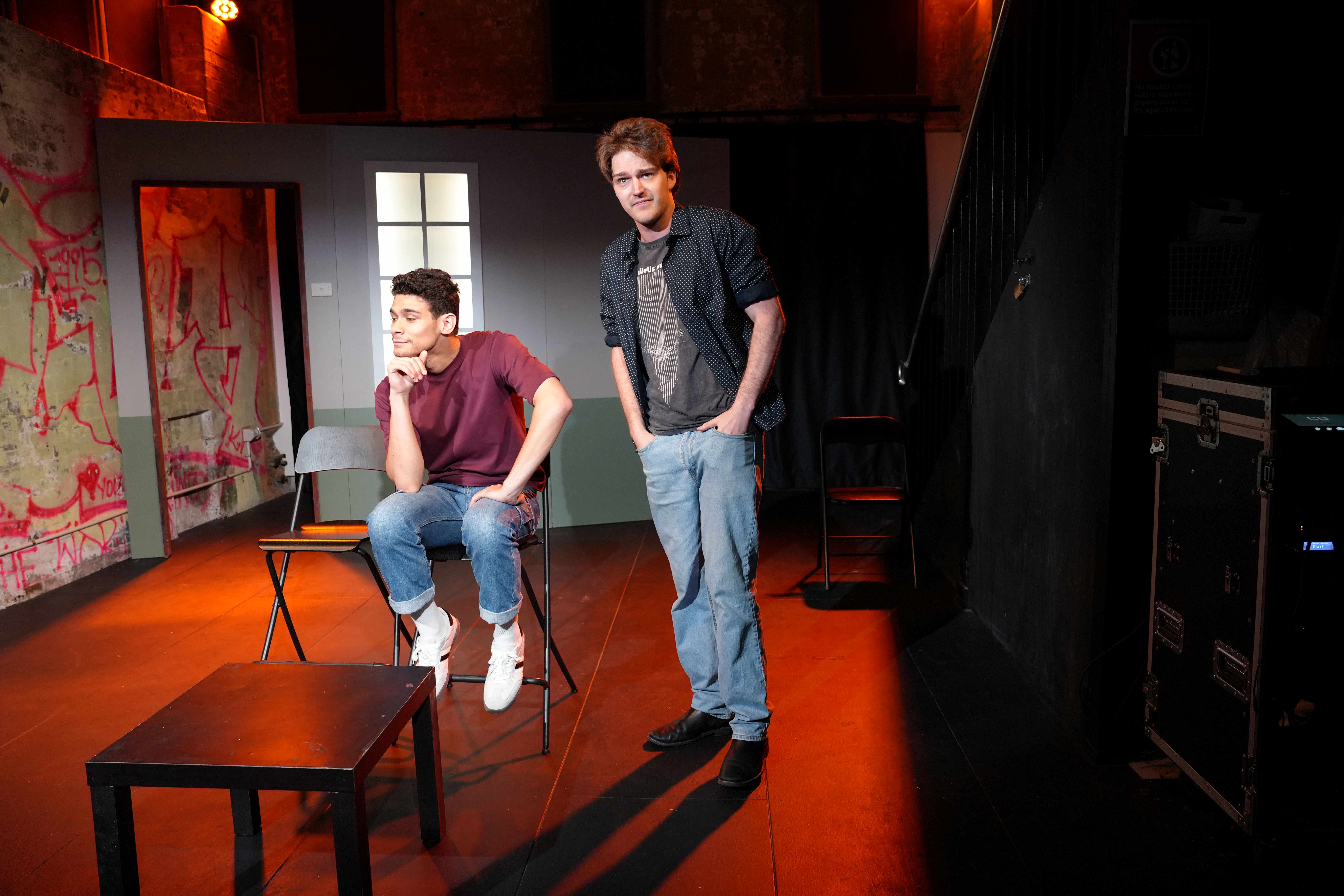
This is a simple, generous-hearted story of the friendship between a gay man and a straight man. It’s funny and engaging.
For the most part, an overly reductive binary opposition between gay and straight is avoided. Instead, directed by Les Solomon and performed by Nathaniel Savy and Tom Kelly, we get rich portraits of two likeable men.
One of the most intriguing creative choices made in Jeffrey Jay Fowler & Chris Isaacs’ script is to reject the convention of presenting a series of dramatic scenes portraying moments in the characters’ relationship. Instead, the two characters directly address the audience, not each other, taking turns to tell us their own version of the unfolding events. This juxtaposition effectively creates humour, but it also makes very apparent to the audience the isolation of the two men, and their differences.
The question is: From where do these differences derive? Because one man is gay and the other straight? Or because, regardless of sexuality, the two men have different psychologies? Or because, at the most fundamental and ontological level, two souls just won’t see the world in the same way – because they have to see it from different places?
The answer is, of course, all three. But it’s the third that’s of particular interest (to me).
Drama struggles to present the inner life of individuals; it’s far more successful in presenting relationships, the life of groups. (If this seems an unusual thing to say, that’s because the Western mind has been so soaked in the dramatic form that this particular presentation of life – life from the outside – has come to seem entirely natural.)
Though working in an artistic form that privileges the interpersonal, dramatists over the millennia have experimented with ways to represent the personal inner experience. The Elizabethans, for example, embraced the poetic soliloquy. This play, with its beautifully veracious contemporary vernacular, is a fine modern descendant of that experiment.
And so, regardless of its humble focus on the garden-variety experiences of finding romance and friendship, what an experiment like Fag/Stag does is explore one of the greatest of miracles: how we make a connection with others, despite the isolation of our rich but singular inner lives.
Paul Gilchrist
Fag/Stag by Jeffrey Jay Fowler & Chris Isaacs
Presented by Little Stormy Productions in association with Lambert House Enterprises,
This a passionate cry against the injustice of sexual assault.
But it’s the way this cry is presented that makes The Forked Tongue such an intriguing piece of theatre.
I’d like to discuss three elements of this presentation.
The first of these relates to myth.
Written by Babette Shaw and directed by Kirsty Semaan, The Forked Tongue tells the story of Medusa, but – we’re told – not the one we know. A reasonable number of people might find this an odd claim, because I suspect a reasonable number of people don’t know any story about Medusa. After all, she is a character from Ancient Greek mythology, a cultural creation of a faraway place and a long ago time.
But if you’ve wasted vast swathes of your life and have more than a passing familiarity with the culture of the classical world, you’ll be aware that Medusa, like most Ancient Greek mythical characters, is rather nebulous. A lot of classical authors mention her, but they’re short on detail, rarely agree on her story, and seem little interested in her psychology.
But to distil: Medusa is a Gorgon, a monster, the one with snakes for hair, so hideous that she turns people into stone if they meet her eye.
It’s a myth ripe for feminist subversion – and subverted it has been. This is the second piece of theatre I’ve seen this year in Sydney that employs the Medusa motif. You might argue that observation alone counters my claim that Medusa is a relative unknown in our culture. Or you might not: you might read it as evidence that storytellers are want to emphasise stories, attributing to them far more importance than the average person does. Perhaps this is indicative of the deep insight of storytellers. Or perhaps it suggests their parochialism. All the world is a stage says the playwright; All the world smells of fish says the fisherman.
Leaving aside the value of interrogating old myths, I’ll move on to the second fascinating element of the piece: the clash that results from the modern appropriation of classical culture. When Modernity tangles with Antiquity, it really is the clash of the Titans and, in the case of The Forked Tongue, leads to some rather explosive theatre.
Let me start with a trivial example. Medusa is at work at the temple of Athena. She has rushed there this morning, fearful of being late again. It is though she works in retail and can’t afford to miss the train one more time. This is the mundane detail of the bourgeois novel – and that’s not a criticism: these modern artworks display an interest in interiority and equality which is at the very heart of the contemporary social justice project, a project unknown to a classical world in which women had virtually no power and one third of the population were slaves.
Another example (but with a different conclusion.) When Medusa is confronted by the predatory Poseidon, it’s at the end of her shift at the temple. She’s closing up. She’s alone. He asks her for a drink. She politely refuses. He violently takes what he wants. We’re asked How could the experience be consensual, considering the difference in position in pecking order of the two? Poseidon is presented as the creepy boss who abuses his power. It’s a very modern take, and one that effectively indicts such behaviour. However, if there had been any Ancient Greeks in the audience (I don’t think there were) they might have responded But Poseidon is a god! In the modern world, encounters with the Divine have become so rare we’ve forgotten that the value of such encounters is that they overturn …. pretty much everything. A terrible beauty is born. All encounters with the Divine were – and are – a type of assault. Does that justify any type of actual human assault? NO. But Poseidon’s dreadful violence reminds us of the existence of a sphere of Life beyond Project-Social-Progress, a sphere of Life where individuals are confronted with the utter capriciousness of the universe, and no well-meaning-committee-endorsed-protocols can protect them.
Modernity versus Antiquity. Time has determined the victor, but a play like this poses the question (at least for me) of what we’ve gained and what we’ve lost.
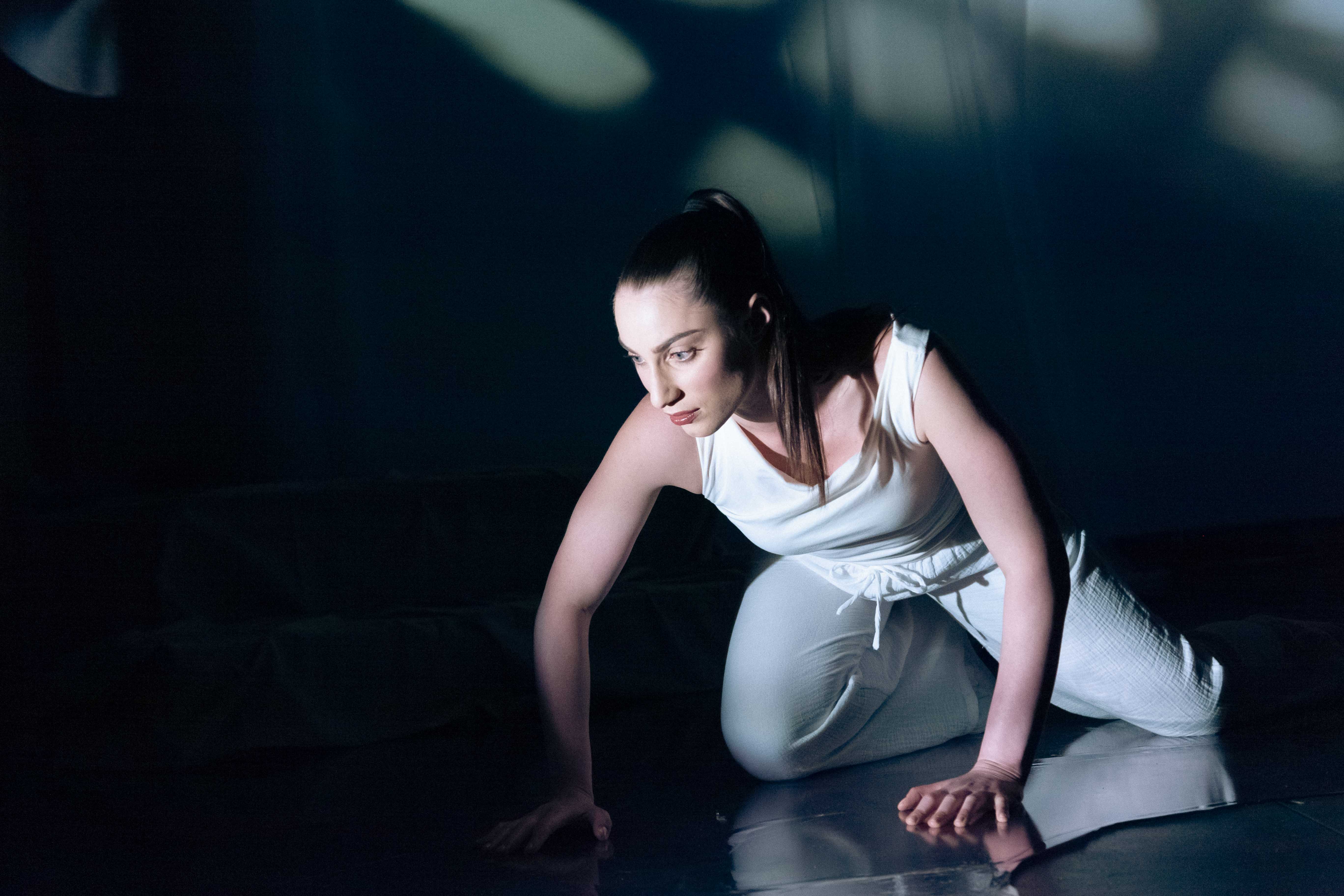
And the final creative decision making this a fascinating piece of theatre is the characterisation. It’s a one actor piece, and Emilia Kriketos is marvellous, showing enormous skill both vocally and physically. She also has the challenge of portraying three characters – Medusa, Athena, and a modern narrator – and presents these variations with aplomb.
In giving her version of Medusa’s tale, the modern narrator asserts there’s more than one side to every story. You might wonder if there’s a logical inconsistency here, or something oddly self-defeating. It’s certainly unusual for a character in drama – or, in this case, outside the drama – to make such an assertion. It’s like a used car salesman saying Trust me: at every repetition we feel a little less inclined to do so. Any commentary on the tale reminds us it’s just a tale (about a tale – which brings me back to my first question about storytellers and fishermen….)
As you can see – with its bold decisions and beating heart – this piece will spark much discussion.
Foam by Harry McDonald presents the encounters of skinhead Nicky with a range of men, from those who aim to lure him into far right ideology, to those who are aroused by his brutal persona. (There is at least one man, however, whose attitude is closer to the only good fascist is a dead one.)
Patrick Phillips as Nicky appears in every scene and, under the direction of Gavin Roach, delivers a magnetic performance. The supporting cast of Timothy Springs, Joshua Merten and Chad Traupmann create a range of characters to populate the world around Nicky. Traupmann as the older fascist seeking recruits is suitably calm, confident and deeply disturbing, and as Nicky’s lover movingly portrays both concern and vulnerability. Merten as a gay photographer under Nicky’s spell is both charming and funny. Springs effectively creates characters who are far less enthralled by the protagonist’s antics.
Set in Britain in the 70’s and 80’s, each scene of Foam is separated from the others by several years, and apart from Nicky, the characters don’t appear to have a continuous arc. This makes for a fascinating guessing game as we figure out what has happened to the protagonist in the time between.
Each scene is set in a toilet (though not the same toilet.) And as almost every scene involves Nicky and a lover (or a potential lover), the toilet is a symbol powerfully suggestive of the simultaneous ubiquity and marginalisation of gay experience. (It wasn’t until uni that I learnt that some men met in public toilets for sex – and I learnt it from a book. I read that book not long after I’d read another that claimed to be the work of a reincarnated medieval heretic and, to my painfully narrow experience, the premise of both books seemed equally likely.)
The play is inspired by a true story, and I’m guessing the stimulus was the question How could a queer man get mixed up in far right politics? This seems as provocative as the question Why do bad things happen to good people? and deserves the same answer: Why not? (Perhaps I’m less naïve than I was at uni.) After all, out of the crooked timber of humanity, no straight thing was ever made. (And like Kant when he wrote those lines, I’m not playing on any connotation that invites a reductionist vision of sexuality. Or, indeed, a reductionist vision of anything.)
The script doesn’t really explore why Nicky becomes a fascist. And (probably for the best) it uses the terms nazi and fascist rather vaguely and offers only a few examples of the type of violence that usually attracts those labels.
The piece is primarily about identity. Unsurprisingly, most communities develop a vision of themselves that is positive. I suspect few billionaires are of the belief that billionaires are myopically selfish. The queer community are likely to engage in the same strategy (and for much greater reason than the insanely rich.)
This play confronts us with human complexity, and that is a glorious invitation to growth. And who outgrows that?
There’s some thrilling creative decisions being made here.
Director and adaptor Lucy Boon abbreviates two Elizabethan texts, and then both juxtaposes and links them.
John Lyly’s Galatea tells of two maidens who escape into the forest dressed as men, hoping to avoid becoming sacrificial tributes to the god of the sea, Neptune. While disguised they meet, and the attraction is instant – and bewildering, and exhilarating. Meanwhile, in the same forest, is the god of chastity, Diana. When her entourage is surprised by Cupid, mayhem ensures. The adaptation is taut and terrific.
Shakespeare’s Measure for Measure tells of Isabella, tasked with saving her sibling from execution. The twist is that Lord Angelo has condemned the supposed criminal for fornication, the very act he now demands of Isabella if her sibling is to escape death. It’s a classic exploration of hypocrisy and, once again, the adaptation is excellent. The beautiful sting in the tale is that Boon cleverly alters Shakespeare’s overly neat and problematic denouement to express the pathos-inducing injustice of silenced voices, both female and lesbian.
The performance style is what I’ve previously termed the Theatre of Audacity. By this, I mean it appears that the audience is being invited to respond with a loud I can’t believe you’re actually doing that in front of me! Performances are fun and high energy. With the support of movement director Miriam Slater, the physical comedy is especially good, with highlights being Clay Crighton as Cupid, Jemima Hartley as the mischievous godling’s victim, and Cara Whitehouse as Venus and the Duke of Vienna. At times, the cast are challenged by Lyly’s language (though that probably helps explain why we still valorise Shakespeare but have pretty much forgotten the earlier playwright. Of course, Lyly’s interest in classical gods rather than real people might play a part in that, too.)
One aspect of the Theatre of Audacity that’s particularly fascinating is that it doesn’t demand perfection. (In fact, if you are flawless, your performance wouldn’t actually be audacious.) This aesthetic is reflected in the decision to have the cast both dance and lip-sync to recorded pop songs. (Drag in general shares this approach, declaring that Who I am is derived from already existing tropes, but I’m claiming it, and so, by sheer exuberance, it boldly stakes out an individual identity, but one still secure within a community.)
Theatre of Audacity’s seeming opposite is Theatre ofAuthenticity, but they’re not mutually exclusive. Isabella, played with both charisma and vulnerability by Aisling Delahunt, must navigate her conflicting loyalties – but she also radically seeks her own fulfillment. And, by ultimately connecting the two Elizabethan works, this piece offers a stunning resolution, one that’s a clear assertion of the authenticity of identities and of desires that transcend any stifling, small, supposed normalcy.
Paul Gilchrist
Love and Faith (and something unholy) adapted by Lucy Boon from Lyly and Shakespeare
First produced in 2019 in London, Shook by Samuel Bailey is set in an institution for youth offenders and focusses on the experience of three of the inmates.
The three have in common the fact they are fathers – or soon will be – and they share classes aimed at preparing them for this responsibility.
It’s an inspired choice by Bailey. It raises the disturbing and galvanising spectre that the underclass status of these youths is an inherited one and will be passed on to their children. It effectively conveys that their traumatised lives have ill prepared them for concerns beyond themselves. It highlights their vulnerability, stuck inside when there’s somewhere much more important to be. And, most of all, it reminds us that these young people, though rejected by society, are still one with the common human experience.
It’s a terrific script, brimming with humour and heart, and in this production, directed by Emma Whitehead, the performances are absolutely superb.
Malek Domköc as Riyad, one time gang member, beautifully balances the ominous with a blossoming maturity.
Isaac Harley as Jonjo, the troubled newcomer, delivers his character arc magnificently. The glimmers of transcendence of trauma that Jonjo achieves are presented with a gradualness that is gloriously truthful.
Edyll Ismail plays the social worker who must prepare these young people for the future. Ismail perfectly portrays the inner conflict so often experienced by those working in institutions charged with remedying institutional problems: genuine concern is twinned with a patience that is a close cousin to despair.
Louis Regan as Cain sets the stage alight with a brilliant high-energy performance, one of the most exciting I’ve seen for a while. His Cain suffers from ADHD, and bounces between intimidation, bravado, humour and a deeply affecting vulnerability.


 Theatre Red