In this adaptation of Jane Austen’s famous novel, the Bennet’s fourth daughter is utterly, inexplicably, and unjustly erased. I was mortified!!!
Of course, I’m parodying the pedantry of a certain species of Janeite, worshipers of Austen who are horrified whenever this sacred text doesn’t receive the fidelity and respect they feel it deserves.
(However, to be honest, I did feel the absence of the Gardiners. As models of a mature, successful romance, their very existence assures our heroine Elizabeth Bennet that her vision of true love is not just a naïve illusion.)
Austen’s Pride and Prejudice attracts pedantry because it’s a foundational text of modern romance. The extraordinary number of film and stage adaptations attests to that. But when I say foundational, I don’t mean merely in terms of the literary genre of romance – I mean of the experience itself. Lizzy Bennet is determined to marry only someone she loves. And with love defined as a heady mix of desire, admiration, respect and an unwavering belief in equality, Lizzy’s hopes encapsulate the romantic aspirations of virtually every young modern.
On one level, adaptations of the novel aren’t tricky: Austen is essentially a dramatic writer. (Though there is the issue of that famously ironic narrative voice; do you simply give it to Elizabeth? If so, how do you present the heroine’s emotional and moral growth?)
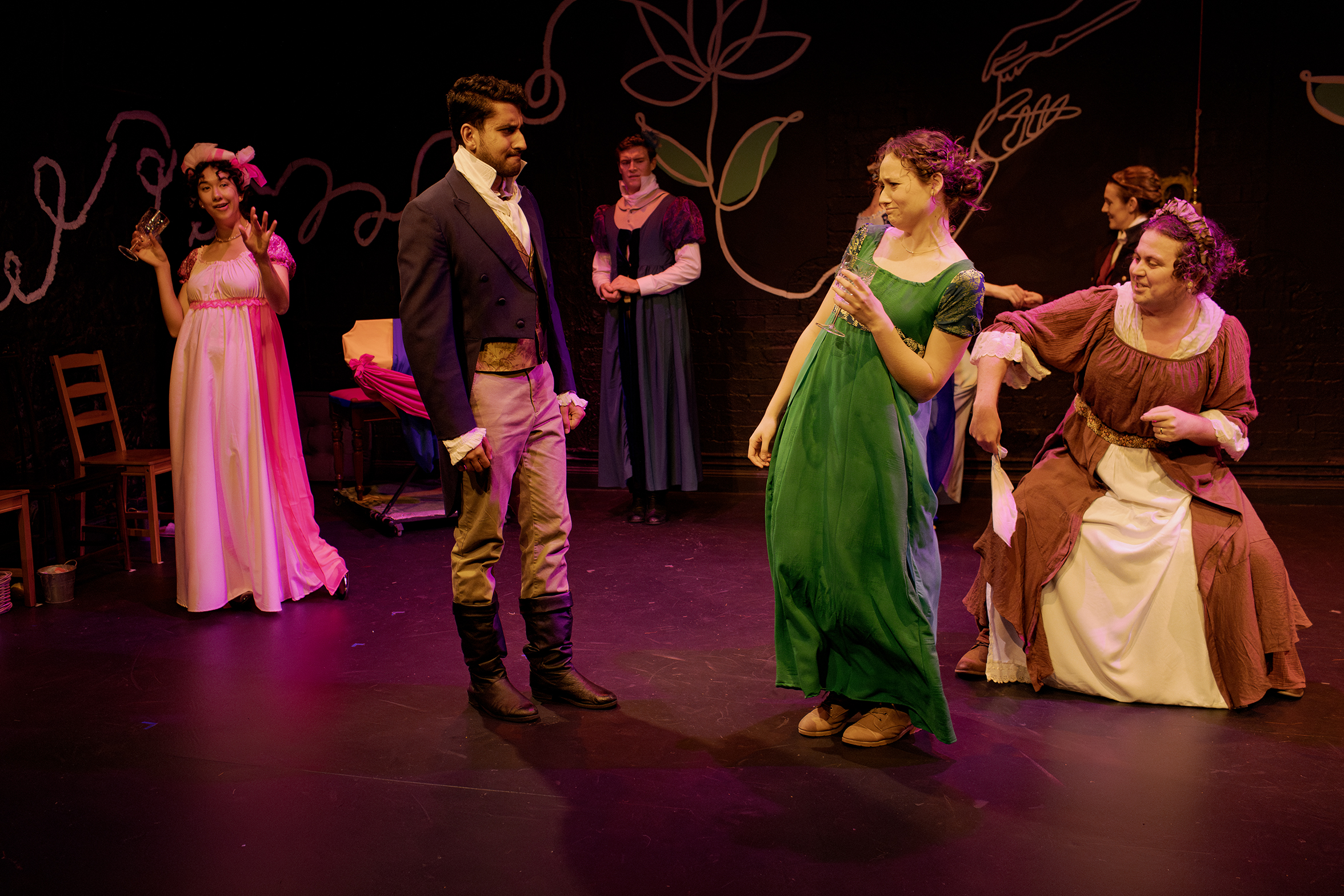
Directed by Emma Canalese, Kate Hamill’s adaptation captures all the key dramatic moments and, if an old, sentimental reviewer’s tears are worth anything, the heart of this piece beats strongly.
However, both in script and performance style, this production juxtaposes the drawing room dramedy of manners of the original text with a wacky theatricality. Sometimes, the deliberate double entendres and the unconventional casting make it feel as though the original is being parodied, or at least not being trusted to engage an audience. Several characters are cast against gender, which adds enormously to the playfulness but not much to the truthfulness. (This is theatre of audacity rather than of authenticity.) Some bold doublings ramp up the silliness, and won’t fail to get a laugh from most audiences. The major challenge is the relative homogeneity of the ages of the cast. Some of the representations of the older characters lack subtlety, and the snap is taken out of the original text’s social bite: Age often has an agenda it imposes on Youth, and the manipulation this entails is partly hidden if the generations are blurred.
Several of the characterisations might disappoint small-minded Janeites. Compared with more conventional adaptations: Darcy (Idam Sondhi) is more socially awkward, and Lizzy (Abbey Morgan) more attitude than sparkle (this Lizzy rejects not only marriage without love but marriage in general – which somewhat alters the impact of the final scenes); Jane (Lucy Lock) is less gentle; Mr Bennet (Steve Corner) is louder, and ultimately closer in characterisation to Mrs Bennet (AJ Evans) – who dominates the action more than she does in the novel; Mary also gets far more stage time and is presented as a mistreated neurotic; Bingley is reduced to a joke. (Bingley and Mary are doubled by Victoria Abbott, who displays extraordinary comic talent.)
But I’m not a pedantic Janeite; did these characterisations disappointment me? All roles are played with an exciting committed energy. (To make a hasty definitive judgement about a work whose main theme is the danger of hasty definitive judgements takes either less self-awareness or more courage than I currently command – which probably makes me fatally unsuited to theatre criticism.)
It is a truth universally acknowledged that no reviewer with literary pretensions can write about Pride and Prejudice without alluding to its famous first line. (So I can tick that off.) What is a little less commonly acknowledged is that all foundational myths must be reinvented, for that’s how they’ll find new audiences – and keep the old ones alive.
Paul Gilchrist
Pride and Prejudice adapted by Kate Hamill
Presented by The Artist Experiment & Dream Plane Productions
I have a confession to make: my title will probably be the most interesting thing about this article.
Deliberately titillating, that provocative word confessions is really no more than a sad attempt to disguise the fact that this will be just one more article written by me about me.
I usually write theatre reviews and, as everyone knows, reviews tell you more about the reviewer than the show. (After all, no matter what show I go to see, I’m always there. It’s this inevitability – rather than the quality of the work – that explains why so many reviewers become jaded.)
So, if this is just another article about me, why write it at all?
It recently occurred to me, that as of last year, I’ve written as many reviews about other people’s shows as I’ve had reviews written about my own shows. So, I guess, I’m in a weirdly privileged position.
Dear Theatre-maker, I know your love-hate relationship with reviewers, and I think I can offer some insight. (Or, if not, at least I’ve harnessed another opportunity to write about myself.)
Dear Theatre-maker, these are the things I must confess:
I’m excited every single time you send me an invitation to a show.
I don’t especially like to go to your opening night.
I like to bring a plus one.
I know what I write is not very important, certainly not as important as what you write.
I’m aware that everything I write is sloppy. I’d like to take more time and write for posterity, but I know that posterity doesn’t buy tickets. (What I write is mere fish wrap, hence the above image.)
I’m not trying to market your show, but I know you are. So, if I like your show, I’ll include a line or two you can use as a pull-out quote.
I dislike the idea of grading or comparing productions.
I’m not trying to make you famous. (I’m not trying to make me famous. It’s with great reluctance that my reviews have a byline. I’d prefer not to include my name at the conclusion of what I write, but I believe the obligation of accountability outweighs the pleasures of anonymity.) And, if fame is what you are trying to achieve, I think you should carefully consider why. I think you should also consider what that desire suggests about your attitude to other people. I’m not saying you shouldn’t seek financial gain from your art – but because I believe artists shouldn’t starve, I’d also rather they remain in good psychological health.
I want people to read what I write. So, if you like my review, share it on your socials.
Personally, I don’t read reviews. I think a fair percentage of reviewers write terribly. It’s sometimes said that we reviewers are failed artists, but that’s not the whole story: many of us are failed reviewers as well.
I read your program only so as not to misspell the names of your creative team (though sometimes I’ll still get them wrong anyway.) Apart from that, I studiously avoid everything you write about your show: marketing, advertising, director and writer’s notes … everything. In fact, reading your program notes afterwards can feel like a type of gaslighting; I saw the show, and now you’re telling me, in such authoritative tones, that my interpretation of the show is wrong? (But I understand why you write these notes. Many of the notes I’ve written as a playwright have simply been repeated back at me by reviewers and, as a result, the reviews have been a delight to read.)
I know you won’t like everything I write, and I’m OK with that.
I give your show much more thought than you probably imagine.
I find the spoiler-rule frustrating, but I’ll abide by it. I don’t like it when you act as though I’ve broken the rule when I’ve merely outlined the scenario. I have to be able to say what your show is about; I can’t just gush hyperbolic platitudes.
I don’t like it when you suggest I’ve misunderstood your play. You’ve shared it, and now it’s ours.
I know what I write is subjective. I know I have personal preferences and interests, and I know they’ll inform what I write. I don’t believe there’s an objective viewpoint, and I think those who assert there is are either naïve or lying.
I’m not interested in your politics. Or, more to the point, I’m interested in them in a way you might find surprising. To be honest, your piece of theatre is extremely unlikely to change my political outlook – but I do love to learn what political perspectives are being held by other people, artists included. When you behave as though your art will change hearts and minds, I think it’s a little odd. I’m not saying it won’t, or it can’t, but to have that as your driving purpose is to assume your audience is less sophisticated than you.
I like to be thanked for my review. Even a one-word message will suffice. Here’s one you can cut and paste for future use: Thanks.
And to end this article, I’ll take my own advice.
I’m absolutely thrilled about the upcoming year of theatre, and so, in advance, to all Theatre-makers, an enormous THANKS.
I’ve had the enormous good fortune to see 81 shows in 2024. Yes, a lot – but other reviewers see more.
This year, in response to productions, I’ve written 46,000 words. (To give some perspective, Hamlet is 30,000 words, The Great Gatsby is 47,000, and some random monkey banging away at his keyboard for 12 months is 46,000.)
I don’t get paid for my writing (though if someone wants, I can easily supply my banking details.) And I don’t do it for the tickets. I do it so I can write about theatre. (Would I have wanted to see so many plays without writing about them? No. I enjoyed seeing most of them, but I enjoyed writing about all of them.)
If you’re reading this article for my “Best of 2024 List”, you’ll be dissatisfied. I don’t see art as a competition, so I won’t be ranking productions. (I have become Disappointment, the Destroyer of Dreams.)
I’m writing this reflection simply to share some observations of Sydney’s theatrical world – because I believe sharing not competing is the essence of art. My observations will be, unavoidably, limited and subjective.
FIRSTLY, TRIVIALITIES: THE WORLD OF REVIEWING.
It appears there are more people writing about theatre than ever before. My current publicity list includes over 40 Sydney-based sites or publications. Despite this (or because of this) there’s still a tendency for many reviewers to write in marketing language. I’m not sure if this is a result of inexperience or cynicism. But there are some really interesting new voices, as well great material written by some old hands.
Despite the large number of reviewers, theatre companies are increasingly using “audience responses” in their marketing.
Despite the large number of reviewers, indie companies can still struggle to get critics to come along to their shows.
The trend to grade productions out of 5 has become almost universal. And it feels like an arms race. Not many shows are awarded 2 stars; if you want to garner attention for your site, you give a show 5 stars. I’m waiting for someone to award 6. (Give 1 star and you’ll also get noticed, but the invitations might soon dry up.) I’ve resisted the trend because I don’t feel productions are comparable in any sense that’s interesting. And, fortunately, I don’t have an editor demanding I follow the fashion.
I’ve noted theatre-makers expressing dissatisfaction with reviewers. (I’ve also noted the sun still rises in the east. Nothing gets past me.) Considering the nature of the relationship between artists and critics, some animosity is probably inevitable. I’ve heard complaints that too many reviewers are not experienced enough. I’ve heard complaints that reviews are not harsh enough. I’ve heard complaints that reviewers evaluate productions according to their politics rather than the artistry of the creatives. There also appears to be some moral discomfort when someone who produces art also writes about it (like myself). Obviously, I’m either trying to feather my own nest or piss on someone else’s. Sycophancy and vindictiveness, it seems, are more believable motivations than a genuine interest in the artform.
Reviews used to be referred to as fish-wrap, alluding to the fact that today’s newspaper becomes tomorrow’s rubbish liner. Now, with most reviews online, they’re less like fish-wrap and more like nuclear waste – a poisonous, unwanted byproduct that just never goes away. Personally, I’d like to see more reviews written in a manner that would make them interesting to read even if you were never going to see the show. I’d like reviews to invite readers to think more about the dramatic form and more about the ideas that the shows explore. I don’t expect all reviews to be like this, but I think there’s space for something more than glib, thought-free, idiosyncratic evaluations.
NOW THE IMPORTANT STUFF, THE PRODUCTIONS THEMSELVES.
It’s an absurd generalisation, but the overall standard in Sydney theatre seems higher than previously. Perhaps this is because the number of venues remains low and so access to them is more competitive. Or maybe it’s just a result of more discerning programming. Or maybe there’s something in the water. Whatever the case, I’ve been privileged to see many superb productions.
I’ve really enjoyed the sheer amount of new work presented this year; over 50% of what I’ve seen. I want to thank the season programmers for this, and all the indie producers who took a chance on the untested. (I will point out that there’s a tendency for some new work to be longer than needed. I think a good rule of thumb is that 90 minutes is as long as you should ask an audience to sit without an intermission. Yes, intermissions have gone out of fashion, so if it’s new work, and you’re in charge, please consider closely the show’s running time. Many pieces would gain from a tighter edit. In fact, few phrases in the theatre vernacular are repeated with more glee than A short show is a good show!)
As well as new work, there’s also been an enjoyable variety of old classics, the return of some Australian soon-to-be classics, and some thrilling contemporary work from overseas. A healthy theatre scene should be a mix, and at least for me, this year of theatre in Sydney got that mix just right.
To praise our directors in particular, the use of space has often been magnificent. In this regard, I’ve seen absolutely brilliant work at Belvoir, Ensemble, Sydney Opera House, Seymour, KXT, Old Fitz, New Theatre, Flight Path, Riverside, Qtopia, Carriageworks, Flow Studios and the Fringe. It’s been a joy to see directors embrace the potential of a space rather than merely attempt to minimise what they think are its limitations. To praise our designers, there’s been some terrific shows with a minimalist aesthetic. There are productions playing with technology, and doing so in an exciting way, but it feels as though our fascination with gadgets is waning.
I’ve never been a fan of theatre that’s little more than sitcom, and there appears to be less of it.
There’s a continuing interest in theatre that purportedly is Telling our Stories. I’ve written elsewhere how this phrase has morphed into the odd assumption that theatre is fundamentally a type of non-fiction. However, though the phrase Telling our Stories has been used this year, it hasn’t dominate the description of productions as much as previously. For example, in the last few years, it almost became the default position that any one-person show was a sharing of actual lived experience, but in 2024 I’ve seen some great one-actor shows that had no pretence of autobiography. We need diversity on our stages, but the fictional form doesn’t need to be sacrificed for this to be achieved.
I’m reluctant to make a judgement as to where we actually are in regard to diversity. The majority of companies claim to be committed to the concept, and the difference between now and, say, 15 years ago is substantial. But I’ve spoken to artists who are dissatisfied with what’s been achieved, and who feel that though the language of inclusion is spoken, it’s not always sincere. Diversity will remain a live issue, partly because theatre that doesn’t reflect the society in which it’s created is doomed to irrelevance, but also because the philosophical assumptions that drive our desire to achieve it are still muddy and require further discussion. Expect me to write more about this next year.
The standing ovation has become common. Does that mean audiences are more appreciative of what’s happening on our stages? I hope so. A cynical friend has suggested that the standing ovation is just a way of reclaiming the experience from the performers, or simply an automatic response from individuals frustrated by the requirement to sit still and relatively quietly for such a long time. Or, says my friend, it’s a way of shaking off the art, like frantically removing a spiderweb into which you’ve accidently stumbled. (I wonder if it’s perhaps more the shower you might take after a visit to the dentist; you’ve submitted to the necessary drill, and your smile might now be healthier, but only because blood and bone have been splattered everywhere.) I’m not one for standing ovations; I have enough trouble putting my socks on in the morning, let alone leaping instantaneously to my feet. But perhaps it’s also about what I value in the art. To respond so physically, so completely, to a piece of theatre means I haven’t had time to savour its subtlety or to be threatened by its thorniness.
But, most likely, most people are just quicker than me.
So I’ll give my standing ovation now, at the end of the year.
Thank you Sydney theatre-makers, you have shaped things of Beauty and shared dreams of Truth. We have asked for bread and you have not given us stones, and we are richer for it.


 Theatre Red