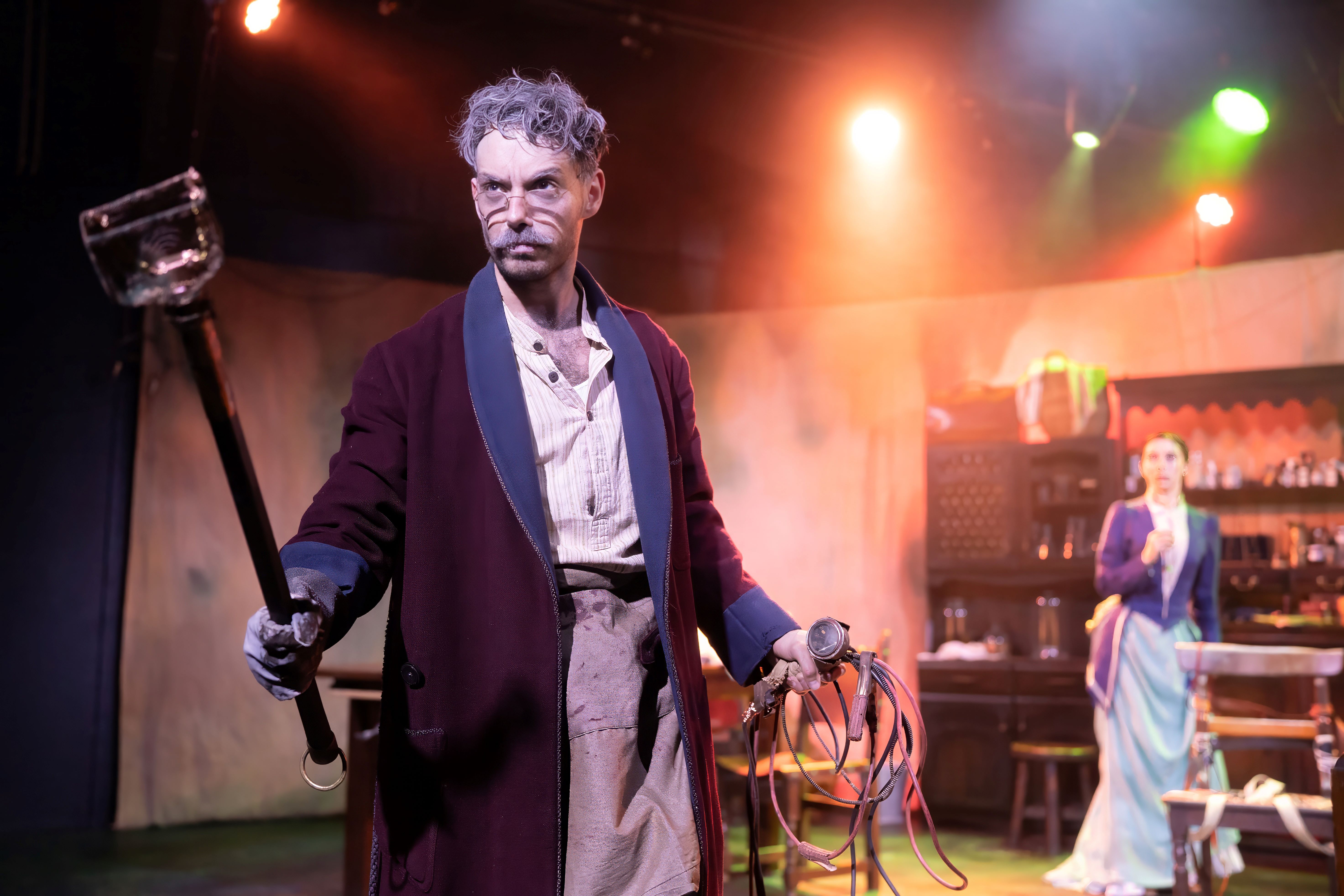
This is new Australian work and it’s a Victorian Gothic comedy. Such bold choices are always invigorating.
Set in the London of the late 1800’s, it tells of a desperate mother (Megan Elizabeth Kennedy) who begs a mad scientist (Tommy James Green) to enact a dreadful procedure.
In the broadest sense, the Gothic is a response to the Enlightenment and the Scientific Revolution – and to the extraordinary technological developments that followed. Often the Gothic is a plea: Not so fast! Be wary where all this is leading! Don’t so glibly dismiss the wild darkness within us!
It’s interesting how the Gothic changes through the nineteenth century. In Mary Shelley’s Frankenstein (1818), it’s a warning against intellectual hubris; be careful what you do with this newfound science. By Bram Stoker’s Dracula (1897) the warning has changed; now it’s an assertion that our rational scientific world view is limited, blinding us to the dangers that lie beyond its myopic vision. Shelley says be wary of the power, Stoker says don’t overestimate it.
Turpentine by Tommy James Green is closer to Shelley’s work thematically, but because it positions itself as comedy, the Gothic beast’s bite is softened. It’s tempting to see it simply as the unadulterated opportunity for larger than life characters and some entertaining mayhem.
Directed by Katherine Hopwood Poulsen, the cast energetically commit to the craziness. Vocal delivery (excluding that of the mute, played by Freddy Hellier) would benefit from more variety, both for the sake of emotional impact and comedic effect, but also for audience comprehension. Though the decision to set the play in London allows resonance with the grand tradition of the Gothic, I wonder whether an Australian setting might have freed the performers from the accent work that limits the production’s impact (though enhances its intended silliness.) As the piece stands, references to British colonialism effectively employ the Gothic’s ability to gaze into the darkest chambers of the human heart, but considering our nation’s troubled history, a change of setting wouldn’t diminish the potency of a similar, but more local, exploration.
Despite its playful intention, the piece takes its narrative structure seriously: it’s a genuine two act play, rather than a mere cavalcade of comic nonsense. Act One invites us into this wild Gothic world and cleverly sets up the events of Act Two. (Though I wonder if the dramatic question of the first act could be further clarified by establishing earlier the reasons for the doctor’s reluctance to perform the procedure. Let the question be whether the bereft mother can convince him despite what he fears. We know the procedure is impossible in the real world, but by introducing its nature and consequences earlier we know the rules of the game being played, and so can give our attention to the human truths that game serves to highlight. Note how Shelley’s Frankenstein spends little time on how the monster is created, directing our focus instead to the very real human experience of hubris and its terrible repercussions. My suggestion would also giving meaning to the doctor’s first act babbling, positioning it as a recognisable avoidance strategy, rather than merely colourful characterisation.)
Yes, I know, I’m indulging in that most annoying – and pointless – of dramatic criticisms: describing the play I wish had been written, rather than discussing the play that actually was. We critics think we’re specialists, though we’re only ever called in for the autopsy.
Design by Alex Baumann and James Shepherd is especially evocative, establishing a world of potions and poisonous pleasures. Sound design by Kyle Stephens deals ingeniously with the curse that occasionally strikes this theatre, and which its name in glorious honesty acknowledges. If external noises do intrude, an ominous rumbling thunder disguises them, while simultaneously suggesting the frightening secret tensions which are the Gothic’s speciality.
I mentioned an autopsy before, but I don’t want to suggest Turpentine lies cold on the slab. It’s deliciously audacious, with the potential to be truly electrifying.
Paul Gilchrist
Turpentine by Tommy James Green
Presented by Popular Playhouse
At Flight Path Theatre until March 1
Image by Jack Aliwood
 Theatre Red