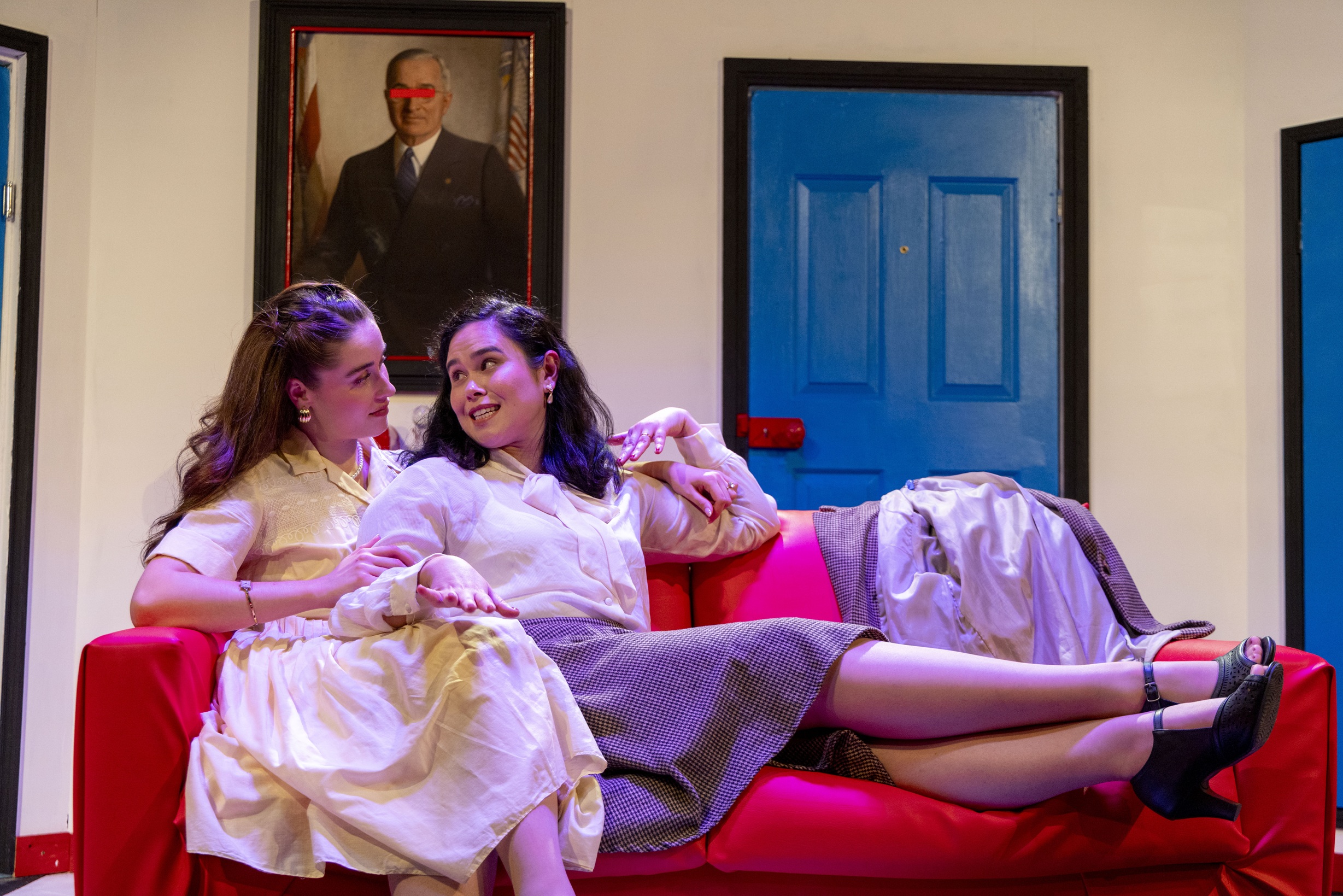
Millie loves Norma.
And Bob loves Jim.
But it’s 1950, so Millie is married to Bob, and Norma is married to Jim.
It’s a Perfect Arrangement.
The irony of the title is indicative of the humour of much of the piece; we’re invited to laugh at that pretence of contentment we’ve come to see as endemic to post-war America.
The humour is superbly playful. Both the script by Topher Payne and design by Patrick Kennedy and Tom Bannerman lean into a meta-theatricality that underlines the performative aspect of the characters’ lives. There’s the suggestion they’re being filmed on a TV set, complete with an offstage camera and an Applause sign. There’s allusions to the advertisements of the times in which chipper housewives give glowing endorsements of household products. There’s moments when the whole set deliberately lurches forward, highlighting this existence’s lack of a solid foundation. And perhaps most revealingly, there’s the mischievous conceit that when the characters exit this pretence of perfection, they retreat into a closet.
Clearly, what is being espoused is authenticity. And despite the wonderful comedy, the injustice of enforced secrecy is powerfully represented.
Director Patrick Kennedy creates a theatrical world that has a fun sit-com wrapping and soul-provoking centre. His cast beautifully bring to life both the humour and the tension.
Luke Visentin is excellent as the serious, authoritative Bob, whose playacted conservatism risks convincing even himself. Brock Cramond as Jim is lighter, a contrast to his lover that rings wonderfully true (in the disconcerting way that Truth both threatens danger and promises liberty.) Dominique Purdue as Norma bristles with defiance. Jordan Thompson as Millie gives a brilliant portrait of stifled potential, one that is intelligent and inspiringly pathos-free. Huxley Forras as a State Department official is appropriately stuffy. Brooke Ryan as his wife is delightfully silly. Lucinda Jurd shines as the brassy, unabashed Barbara.
The historical impetus for the play is the Lavender Scare of the early 50’s (or the period just prior to it) when homosexuals were hounded out of the US State Department. They were perceived as susceptible to blackmail and hence a security risk. (The logic is painful; why not accept homosexuality and watch the risk dissolve? It appears that option – sane and human – was inconceivable.)
Perfect Arrangement was first performed in 2013. Like most historical dramas, it has a whiff of anachronism about it. This is probably inevitable. Consciously or not, when we choose a story set in the past, we’ll focus on what most resonates with a contemporary audience.
Here that resonance is our current tendency to apportion blame to unlikely parties. It’s a tendency typified today in certain slogans you see at rallies or on social media, ones like If you’re not part of the Solution, you’re part of Problem or Silence is Violence. (I suspect this coercive attitude is one reason the Right has recently gained in support; accusation is a poor creator of fellow feeling, and guilt an imperfect motivator.) This play reflects the contemporary tendency to allocate blame to parties other than the obvious perpetrators – and it does so in an even more surprising manner than my above examples.
Perfect Arrangement could be read, not primarily as an indictment of the prejudice of the narrow-minded majority, but rather as a criticism of the victims of that prejudice who are too fearful to denounce it. Near the climax, Bob is told in no uncertain terms that he is the problem.
Digging further into this reading, Perfect Arrangement is not a protest play, but rather a play about protest.
But does it really blame those unwilling to object to the status quo?
Or rather, will those who suffer find in it the possibility of empowerment, an inspiring reminder that if one seeks authenticity, it can only begin with oneself? (Authenticity also ends with oneself; it’s the middle that’s the tricky bit, the bit where it helps if the majority come onboard.)
If it weren’t for the publicity requirements that push every reviewer of theatre to publish as soon as they reasonably can, I could write so much more about this piece – it’s rich, energising, and vastly entertaining.
Paul Gilchrist
Perfect Arrangement by Topher Payne
presented at New Theatre as part of Mardi Gras until March 7
Image by Bob Seary
 Theatre Red