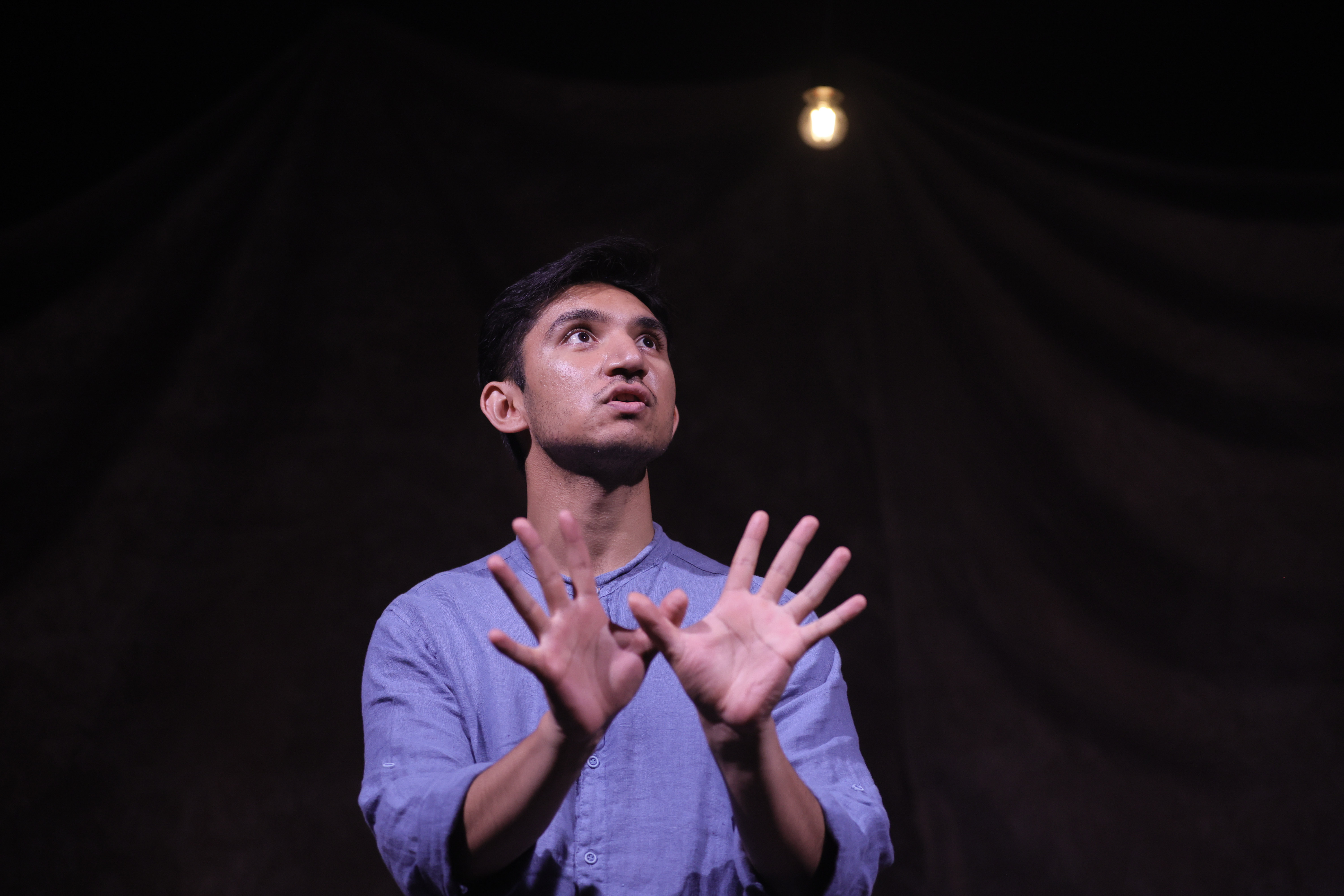
There’s something about this that reminds me of the experience of lying on your back and looking up into the night-time sky.
You know it’s beautiful, you know it’s deep … but you have to admit, after a while, that awe becomes tainted by alienation, and reverence begins its decay into indifference.
And then something shoots across the darkness, with a fiery life-changing radiance.
T.S. Eliot’s Four Quartets has plenty of lines that utterly light up the sky.
“Humankind cannot bear very much reality”
“In my end is my beginning”
“We shall not cease from exploration
And the end of all our exploring
Will be to arrive where we started
And know the place for the first time”
Four Quartets is about our relation to Time, and our seeking, in the Here and Now, of …. something… be it Meaning, or Salvation, or Love.
It crackles with religious allusion: Arjuna and Krishna in the Chariot of Life; medieval mystic Julian of Norwich’s extraordinarily provocative ecstatic assertion “All is good, and all manner of things are good”; and the Christian symbolism of the fire, the dove, the rose.
By the time Eliot wrote Four Quartets, he was making his peace with Christianity, and the tension inherent in that most unusual of religious outlooks – that a particular historical event, the Incarnation, is the key to eternity – is a tension that charges the entire piece.
Though concerned with the mystical, it’s not a guidebook, not a-here-is-how-I-achieved-enlightenment sort of crow, but rather an utterly intriguing sharing of moments in the journey of a troubled soul. It feels like a riff on the beginning of The Divine Comedy.
Dante suggests
“Midway upon the journey of our life/I found myself within a forest dark,/For the straightforward pathway had been lost.”
while Eliot says
“So here I am, in the middle way, having had twenty years-/Twenty years largely wasted”
But, regardless of these musings on the spiritual, many people might feel that the fundamental question raised by this piece is whether it’s actually meant for performance.
After all, not every brilliant creation is. The Periodic Table of the Elements is a stunning human achievement, but I’m not sure I could bear it being recited on stage.
Eliot’s language is beautiful, but often abstract. Somewhere in the early 20th century, poetry seemed to relinquish its claim to be a spoken form and demanded instead to be read. Many of us will openly acknowledge that the only modern poetry we understand on first hearing is the type found inside a Hallmark greeting card.
But Eliot himself considered his work theatrical. In fact, some of the lines from the first quartet, Burnt Norton, come from a draft of his play Murder in the Cathedral (though, as Eliot admitted, ones the producer didn’t feel he could make work on stage.)
Four Quartets also has the challenge that it doesn’t present as a dramatic monologue. We’re not getting a definite character, like Prufrock. In fact, it’s not really clear if it’s the same persona speaking through the four sections. In this production, there are four different actors.
Am I saying it shouldn’t be staged?
Not at all.
Directed by Patrick Klavins, this production is fascinating because it explores the frontiers of theatre.
The staging is appropriately simple, allowing the language the pre-eminence it deserves.
It’s thrilling to witness the gifted cast (Sandie Eldridge, Grace Stamnas, Charles Mayer & Kaivu Suvarna) face the challenge of presenting this script: finding those moments of natural dialogue, which pop up like mushrooms after rain; gently delivering those moments where the abundance of the language threatens to overwhelm, like the deluge itself; and powerfully portraying despondency, when the clouds gather, and joy, at the sun’s final glorious appearance.
Paul Gilchrist
Four Quartets by T.S. Eliot
Presented by The Wounded Surgeon
at the Old Fitz until 20 March, as a late show
Image by Matt Bartlett
 Theatre Red