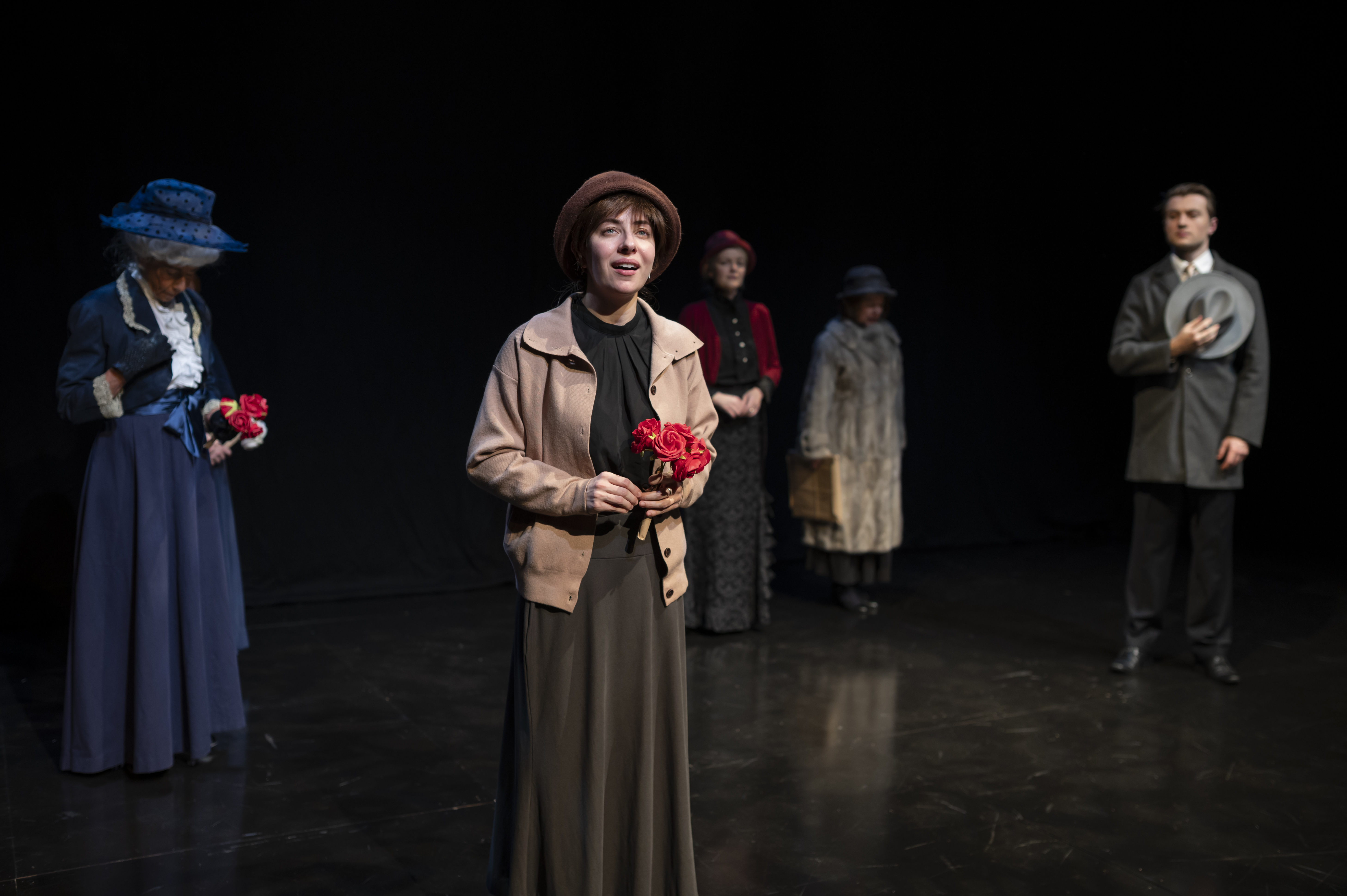
This is set in Ballarat during the First World War and its direct aftermath.
The Lucas Girls are the women who work in E. Lucas & Co, a clothing and corsetry factory.
They’re Amazing because of their response to the war. Losing husbands, lovers, brothers and fathers to the conflict, they work to give solace to those who grieve, and they fight against the introduction of conscription to ensure no other lives are unnecessarily sacrificed.
Writer and director Cate Whittaker tells this tale through a focus on two sisters, Tilly and Clara. The tensions and affections between the siblings are well presented by Joanne Booth and Amy Joyce. The sisters work in sales and management, and so are not the working class factory hands. In the main, these women are left off stage, represented only by Casey Martin, who portrays a wonderfully cheeky Mavis.
Martin also briefly plays Vida Goldstein, a character whose mere mention drew applause from the audience. This underlined one of the play’s unmistakable goals: to recognise the efforts of the women who have made our society more humane.
As an opportunity to present possibly forgotten historical facts, the play ticks the boxes, but Whittaker also works hard to give us an engaging character-driven story. Though both purposes are laudable, sometimes they seem at loggerheads. On some occasions, characters give slightly unnatural speeches of historical exposition. On all occasions, I was left uncertain whether these particular people once lived or whether they’re simply fictional creations. (The Lucas Girls are undeniably real, but I’m not so sure about these specific characters.)
Such are the perennial challenges of historical drama.
But I have to admit, I love the genre.
In contemporary theatre we often talk of sharing our stories and giving voice to particular communities, phraseology that creates the impression that theatre is merely a type of reportage.
But historical drama is clearly not reportage: when a play is set in a distant historical period the creating artists were simply not there. No matter how much research has been done, we know things are being made up, that we’re being thrown back onto fiction, and that’s a delightful thing. Rather than merely informing the audience, fiction is a glorious invitation to engage, to enjoy, to flourish.
It’s right to recognise and honour those who came before us. And from them we can take inspiration, whether they were made of flesh and blood, or of the stuff of dreams.
I saw the first night of this run, and production values will hopefully improve. The play has a large number of scenes, which means a large number of exits and entrances – and these could do with more pace and pizazz. Similarly, on this first night, operation of the lighting was patchy, including at least one occasion when the house lights were raised mid-action. (I’ve never felt more seen by a piece of theatre.)
But, seriously, who is seen by this piece of theatre? Everyone who works to make the world a better place.
Paul Gilchrist
The Amazing Lucas Girls by Cate Whittaker
presented as part of the HERStory Arts Festival
at Wharf 2 until 26 April
Image supplied

 Theatre Red