Archive | December, 2025

A Chinese Christmas

14 Dec

One of the many things that makes KXT an invaluable part of the Sydney theatre scene is their support of early career artists.

Directed by Monica Sayers, this is Trent Foo’s debut play. It tells the story of Heepa, who visits the underworld to enlist the aid of his ancestors to ensure his Paw Paw attends the family Christmas.

Despite this particularly Australian-Chinese setting, the piece deals with a universal theme: our relationship with those who came before us.

Heepa expresses a mix of feelings towards his grandmother: a rejection driven by his hunger for independence, a gratitude for all she’s done, and a regret that too often the first of these emotions has trumped the second. It’s a wild, heart-breaking, soul-making blend of feelings, a mix experienced by most of us, and it’s easy to imagine that the migrant experience only ramps up the intensity.

The whimsical conceit of the piece – that the protagonist speaks to his deceased ancestors – is the perfect vehicle for the exploration of what we owe family. (In contrast, the Christmas aspect of the piece is rather lightweight; the veneration of the dead taking precedence over the Christian myth. In fact, the Christian myth is given rather short shrift, reduced to the irrelevant Virgin birth and dismissed as ridiculous, no more worthy of attention than a laughable Chinese melodrama. For some audience members, however, the unspoken tension between the two spiritual traditions will be both provocative and thrilling. In contrast to the veneration of the dead, the Christian myth is about transcending our ancestors and shedding the common inheritance of selfish misery supposedly passed down from our forebears, Adam and Eve. Ultimately, it’s about new beginnings and looking forward. Add to that the conceit of the Divine choosing to enter the human world via a stable, the child of two nobodies, the birth witnessed by farm animals, and you have a tale that challenges all commonly accepted human values. Absurd simplification: you could place the two traditions, the veneration of the dead and the Christian myth, in stark contrast – one asserts the importance of connections, the other the importance of fresh starts. And a healthy spirituality requires both.)

Portraying Heepa, Foo has an easy stage presence, a charming, playful, natural manner that leans delightfully into the script’s use of the youthful vernacular. For the majority of the piece, the structure is amusingly loose, as Heepa shares anecdotes about his relationship with his Paw Paw. The finale is very moving (but the plot is dependent on the protagonist withholding information, and so the overall impact of the piece will be determined by whether you believe this reticence aligns psychologically with the way the earlier anecdotes are delivered.)

As Heepa’s Paw Paw, Tiang Lim beautifully combines comedy with dignity, playing with the grandma tropes of being overly demanding yet not openly affectionate, while at other times projecting a mature nobility, one that’s both inspiring and pathos-inducing.

Performing on traditional instruments, Jolin Jiang creates an accompaniment which is wonderfully evocative. As an actor, she creates a character of poignant mystery.

Paul Gilchrist

A Chinese Christmas by Trent Foo

Presented by FooFrame Productions in association with bAKEHOUSE Theatre Co,

At KXT on Broadway until Dec 20

kingsxtheatre.com

Image by Robert Miniter

The Forked Tongue

11 Dec

This a passionate cry against the injustice of sexual assault.

But it’s the way this cry is presented that makes The Forked Tongue such an intriguing piece of theatre.

I’d like to discuss three elements of this presentation.

The first of these relates to myth.

Written by Babette Shaw and directed by Kirsty Semaan, The Forked Tongue tells the story of Medusa, but – we’re told – not the one we know.  A reasonable number of people might find this an odd claim, because I suspect a reasonable number of people don’t know any story about Medusa. After all, she is a character from Ancient Greek mythology, a cultural creation of a faraway place and a long ago time.

But if you’ve wasted vast swathes of your life and have more than a passing familiarity with the culture of the classical world, you’ll be aware that Medusa, like most Ancient Greek mythical characters, is rather nebulous. A lot of classical authors mention her, but they’re short on detail, rarely agree on her story, and seem little interested in her psychology.    

But to distil: Medusa is a Gorgon, a monster, the one with snakes for hair, so hideous that she turns people into stone if they meet her eye.

It’s a myth ripe for feminist subversion – and subverted it has been. This is the second piece of theatre I’ve seen this year in Sydney that employs the Medusa motif. You might argue that observation alone counters my claim that Medusa is a relative unknown in our culture. Or you might not: you might read it as evidence that storytellers are want to emphasise stories, attributing to them far more importance than the average person does. Perhaps this is indicative of the deep insight of storytellers. Or perhaps it suggests their parochialism. All the world is a stage says the playwright; All the world smells of fish says the fisherman.

Leaving aside the value of interrogating old myths, I’ll move on to the second fascinating element of the piece: the clash that results from the modern appropriation of classical culture. When Modernity tangles with Antiquity, it really is the clash of the Titans and, in the case of The Forked Tongue, leads to some rather explosive theatre.

Let me start with a trivial example. Medusa is at work at the temple of Athena. She has rushed there this morning, fearful of being late again. It is though she works in retail and can’t afford to miss the train one more time. This is the mundane detail of the bourgeois novel – and that’s not a criticism: these modern artworks display an interest in interiority and equality which is at the very heart of the contemporary social justice project, a project unknown to a classical world in which women had virtually no power and one third of the population were slaves.

Another example (but with a different conclusion.) When Medusa is confronted by the predatory Poseidon, it’s at the end of her shift at the temple. She’s closing up. She’s alone. He asks her for a drink. She politely refuses. He violently takes what he wants. We’re asked How could the experience be consensual, considering the difference in position in pecking order of the two? Poseidon is presented as the creepy boss who abuses his power. It’s a very modern take, and one that effectively indicts such behaviour. However, if there had been any Ancient Greeks in the audience (I don’t think there were) they might have responded But Poseidon is a god! In the modern world, encounters with the Divine have become so rare we’ve forgotten that the value of such encounters is that they overturn …. pretty much everything. A terrible beauty is born. All encounters with the Divine were – and are – a type of assault. Does that justify any type of actual human assault? NO. But Poseidon’s dreadful violence reminds us of the existence of a sphere of Life beyond Project-Social-Progress, a sphere of Life where individuals are confronted with the utter capriciousness of the universe, and no well-meaning-committee-endorsed-protocols can protect them.

Modernity versus Antiquity. Time has determined the victor, but a play like this poses the question (at least for me) of what we’ve gained and what we’ve lost.

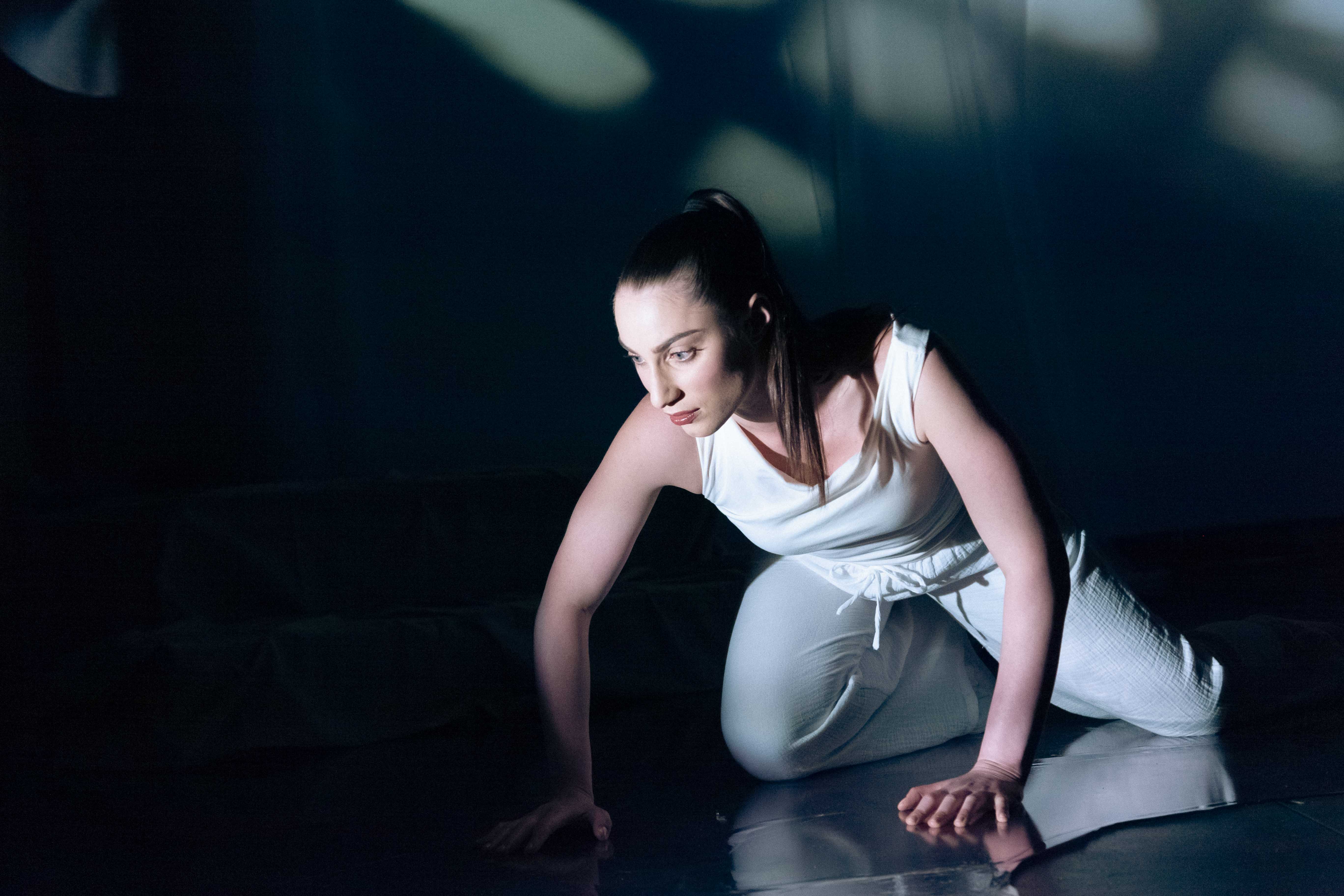
And the final creative decision making this a fascinating piece of theatre is the characterisation. It’s a one actor piece, and Emilia Kriketos is marvellous, showing enormous skill both vocally and physically. She also has the challenge of portraying three characters – Medusa, Athena, and a modern narrator – and presents these variations with aplomb.

In giving her version of Medusa’s tale, the modern narrator asserts there’s more than one side to every story. You might wonder if there’s a logical inconsistency here, or something oddly self-defeating. It’s certainly unusual for a character in drama – or, in this case, outside the drama – to make such an assertion. It’s like a used car salesman saying Trust me: at every repetition we feel a little less inclined to do so. Any commentary on the tale reminds us it’s just a tale (about a tale – which brings me back to my first question about storytellers and fishermen….)  

As you can see – with its bold decisions and beating heart – this piece will spark much discussion.

Paul Gilchrist

The Forked Tongue by Babette Shaw

presented by Left Leg Productions

at the Substation, Qtopia until Dec 13

qtopiasydney.com.au

Image by Signature Photography by Kirsty Semaan

Born on a Thursday

5 Dec

This is a homage, dusted with nostalgia.

Written by Jack Kearney, Born on a Thursday is set in the late 90’s in western Sydney, and tells the story of single mum Ingrid. Her son, Isaac, has been left mentally incapacitated by a rugby league injury. Her daughter, April, has unexpectedly returned home after a long period of silent absence.  

The pace is gentle, akin to a glacier, whose majestic, barely perceptible movement is only apparent through the occasional violent smashing of things.

It’s also a story built from the withholding of information. Why has April come home now? What actually happened to Isaac? Who was their father? Perhaps this builds suspense; perhaps it reflects the laconic, emotional reticence of the working class. Despite the piece’s length, a lot of these questions ultimately aren’t clearly answered, or when they are, these answers no longer really seem to matter. We’ve moved on, and are witnessing the power of resilience and the wondrous birth of hope. Despite the suggestion of sentimentality that warmly infuses the piece, it’s this sense of moving on that grants it verisimilitude. Not that the characters deliberately or consciously move on, not that we’re being glibly instructed we should leave the past behind – rather we’re being reminded that Life, whatever it is, is something that runs in only one direction.

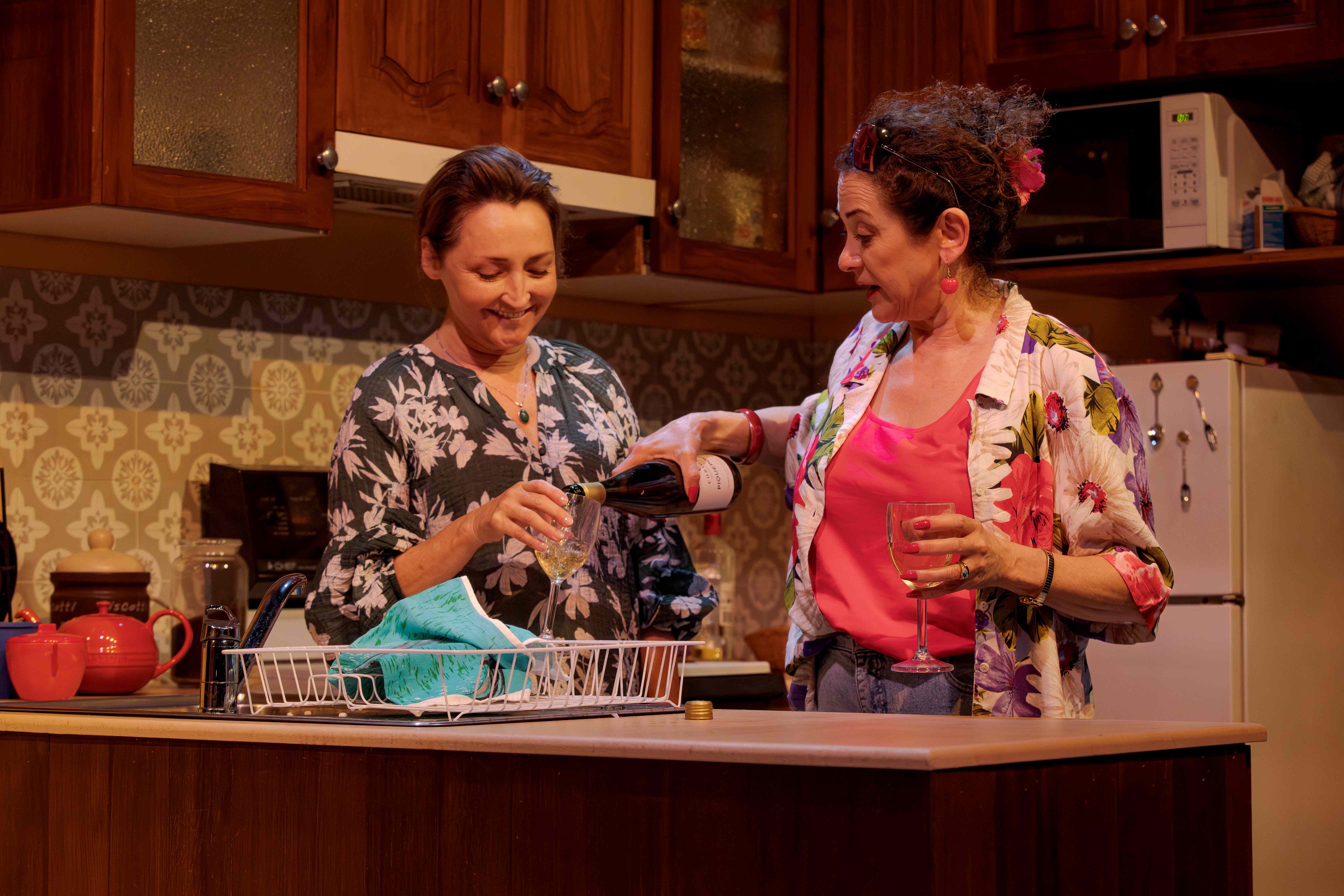
Director Lucy Clements elicits excellent performances from her cast. As April, Sofia Nolan portrays an eminently watchable tension between fragility and strength. As Isaac, Owen Hasluck captures frustrated bewilderment sparring with youthful energy. James Lugton, as the loyal neighbour Howard, gives us a wonderful portrait of gentle, patient persistence. Deborah Galanos, as the wine guzzling Estelle, is hilarious: brash, assertive, yet delightfully changeable. As Ingrid, Sharon Millerchip moves fascinatingly from a no-nonsense coldness to the surprise of joy, the reward for tenacity and its unexpected twin, hope.

Thursday’s child may have far to go, but distance isn’t everything.    

Paul Gilchrist

Born on a Thursday by Jack Kearney

presented by New Ghosts Theatre Company and Old Fitz Theatre,

at the Old Fitz until 14 Dec

oldfitztheatre.com.au

Image by Phil Erbacher

Dial M For Murder

4 Dec

This is a delightful mix of comedy and intrigue.

The film many people know – the one starring Grace Kelly and directed by Alfred Hitchcock – was adapted from a play by Frederick Knott. This version, directed by Mark Kilmurry, is an adaption by Jeffrey Hatcher of that original play.

It’s a classic thriller. I’ll avoid any plot details because it’s so easy to land in spoiler territory. I’ll simply suggest it’s the story of the supposed perfect murder.

Of course, thrillers are not everyone’s cup of tea. Though they’re tales of the most violent crimes, they too commonly function as little more than mind puzzles; like a type of dementia-delaying-sudoku, they exercise our brain but never our empathy.  

And thrillers often seem so very untruthful. This is partly because they’re peopled with characters who have the skill and intelligence to meticulously plan the perfect murder, but who seem entirely bereft of the irrational passion that might lead them to bother in the first place.

Thrillers also seem untruthful because their characters talk far too much about the truth. THIS is WHAT happened. THIS is WHO dunnit. THIS is HOW they did it. Truth assertions like these are much rarer in Life than thrillers would have us believe. Pass the salt is far more common an utterance than THIS is the salt. In Life, definitive statements of truth are rare, and the sane amongst us know that rarity doesn’t automatically equate with value.

But, as I suggested, this is a classic thriller – structured in such an amazingly intricate way that it’s a joy to watch unfold. (Everyone has seen those wizards of triviality who line up dominoes in the most elaborate, surprising patterns: the final flick doesn’t result in fine art, but it does make for pure fun.)   

And Kilmurry creates a fascinating world in which tight suspense is tempered by the tickle of humour. Anna Samson successfully combines a bewildered terror with a bewitching mischief. Garth Holcombe as her husband is gloriously coldblooded, divertingly duplicitous, and hilariously insincere. Kenneth Moraleda’s Inspector Hubbard is a wonderfully worthy inheritor of one of the grand tropes of the genre: the master professional who deliberately invites underestimation. Suave but goofy, seemingly innocuous but oh-so-persistent – it’s a terrific performance.

Paul Gilchrist

Dial M For Murder by Frederick Knott, adapted by Jeffrey Hatcher

at Ensemble until 11 Jan

ensemble.com.au